
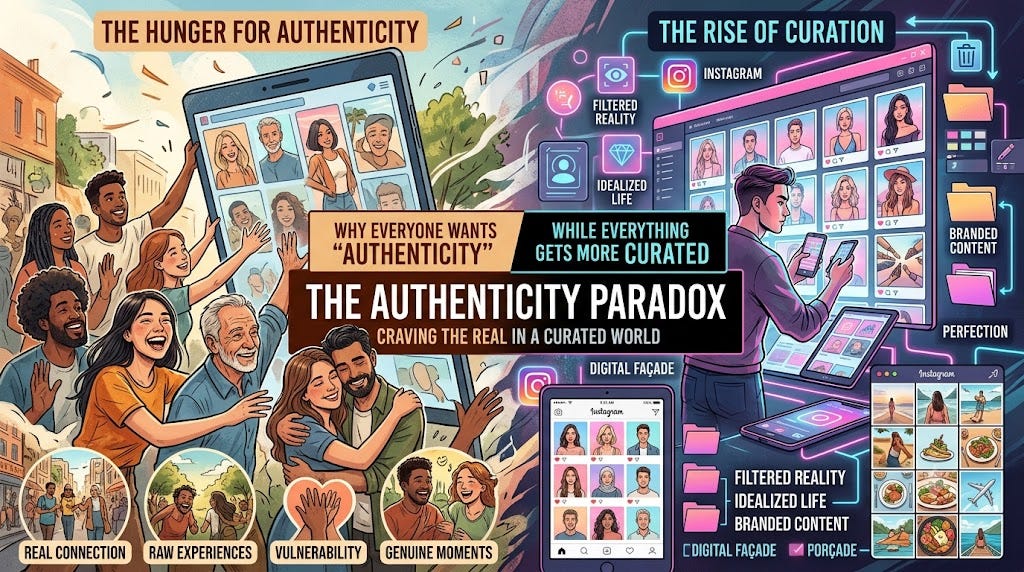
One of the more reliable ways to spot an AI-generated influencer account right now is that it has no live video history. No stories, no reels shot in one take, no unscripted replies to comments — just an endless feed of polished still images. That absence has become an actual structural signal, one platforms are now explicitly building into their ranking systems: creators with a consistent human voice, a real face cam, live streams, and active back-and-forth with followers are being pushed higher, while the algorithmically generated content sinks. We’ve arrived at the genuinely strange point where “has done a live stream” functions as a technical proof of humanity, the same way a CAPTCHA does.
That detail is the key to the whole paradox, I think, because it explains why authenticity is having such a specific, well-timed moment right now rather than just being an eternal marketing buzzword. An estimated 35% of influencer campaigns currently incorporate some form of AI-generated content — virtual personas, AI-enhanced visuals, synthetic voiceovers, scripts written by a model and delivered by a human face. As that flood rose, something scarce got created almost by accident: proof that a piece of content actually came from an unscripted human moment. Scarcity drives value in content the same way it does in everything else, and “unmistakably, verifiably real” quietly became one of the most valuable things a creator could offer, right as it became one of the hardest things to fake convincingly.
Gen Z’s own stated preferences track this shift precisely. Roughly 68% say authentic, unpolished content outperforms highly produced advertising for them, and about 53% say authenticity and transparency now matter more to them than price when evaluating a brand. But the more interesting shift is in what “authentic” has come to actually mean to that audience. It’s moved from what you could call authenticity-as-aesthetic — a slightly grainy photo, a casual caption, the visual grammar of realness — toward authenticity-as-structure: transparent pricing shown plainly, real and enforced return policies, an honest founder story that includes the parts that don’t flatter the brand, a creator willing to say “this one wasn’t for me” in the same breath as their recommendations. That’s a meaningfully higher bar than a filter choice. It’s asking a brand to actually behave more honestly, not just to look like it is.
And this is exactly where the paradox stops being cute and starts being genuinely uncomfortable, because brands have responded to that higher bar not by becoming more honest, but by getting extremely good at manufacturing the appearance of the higher bar. Reporting on the creator economy has found brands increasingly requesting creators’ imperfections as a deliberate deal term — asking for the shakier camera work, the less flattering lighting, the more casual delivery, on purpose, as a specified production value rather than an accident. “Messy” has become a look you can commission. The lo-fi aesthetic that once signaled a creator too busy or too genuine to bother with production values is now, in plenty of cases, a carefully art-directed choice made by a team that absolutely could afford better lighting and decided against it strategically.
The market itself is quietly rewarding a version of this that at least keeps some real stakes attached to it: nearly 45% of Gen Z say they trust smaller creators more than big celebrity influencers, and one 2026 industry analysis found micro-influencers with 5,000 to 50,000 followers driving 34% higher purchase intent than macro-influencers with far larger audiences. That’s not pure algorithm gaming — a creator with 12,000 followers genuinely has less institutional distance from their audience, genuinely can’t as easily hide behind a media-trained publicist, and genuinely has more to lose reputationally from an obvious fake. Smallness itself functions as a weaker but real authenticity signal, precisely because it’s harder to fully manufacture than a viral post can be.
Where I land on all of this is that “authenticity” hasn’t become meaningless so much as it’s become a genuine, scarce, valuable resource being actively contested between real behavior and manufactured signals of real behavior — and both sides are getting better at their part of that contest simultaneously. Platforms are getting better at detecting the structural fingerprints of fakery. Audiences are getting more sophisticated about decoding manufactured realness, per the same research showing Gen Z growing more skeptical of anything that merely looks honest rather than actually being it. And brands are getting better at producing the specific texture of unproduced content on demand. None of those three trends cancels the others out. They’re locked in exactly the kind of escalating arms race you’d expect once everyone involved has figured out that the appearance of realness and actual realness now trade at very different prices, and only one of them is genuinely difficult to fake at scale.
No posts
Comments
Nothing yet. Say the first thing.
Sign in to join the conversation.