
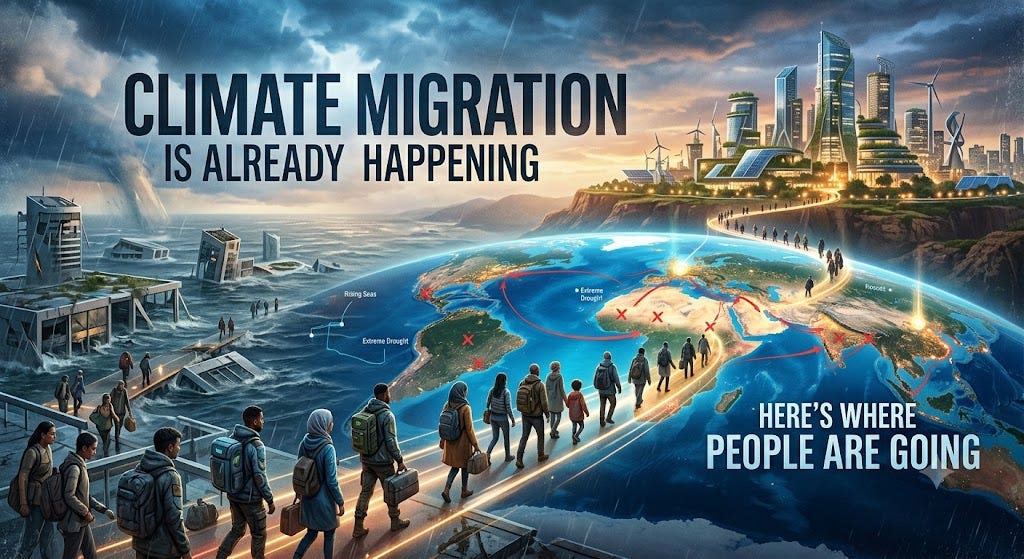
Roughly half of Tuvalu wants to leave, and there’s now an actual line to join. Australia’s Falepili Union treaty, in force since August 2024, offers up to 280 Tuvaluans a year permanent residency, full work and study rights, and - the detail I find almost unbearably specific - unlimited return travel to a country that may not exist in a swimmable, livable form by the time today’s Tuvaluan toddlers are elderly. The first ballot drew 5,157 applicants, which one analysis put at roughly half the country’s entire population, entering a lottery for a life somewhere else. This is, by design, the world’s first bilateral treaty built explicitly around climate displacement. It will not be the last, because the actual numbers behind it are so much larger than one Pacific nation that it’s almost misleading to lead with Tuvalu at all.
Here’s the real scale: 65.8 million internal displacements happened globally in 2024 alone, and 45.8 million of them were tied to disasters rather than conflict - storms alone accounted for 25.2 million, floods for another 19.1 million. Zoom out further and the number gets almost too large to hold onto: since 2008, storms, floods, droughts, and wildfires have triggered 401.6 million internal displacements worldwide. The World Bank’s Groundswell modeling projects up to 216 million people could be internally displaced by climate impacts by 2050, within the lifetime of most people reading this. Climate migration isn’t a future scenario being modeled for a report nobody will read. It’s the largest number in most of these reports, already, this year, and it’s happening mostly inside countries’ own borders rather than as the dramatic cross-border exodus the topic usually conjures.
Which brings me to the part of this story I actually think Americans are underrating, because it’s happening in their own zip codes and doesn’t get filed under “climate migration” in the news at all - it gets filed under “the housing market.” High-flood-risk US counties saw a net domestic outflow of just over 29,000 people in 2024, the first time that’s happened since 2019. Miami-Dade posted the worst outflow of any high-risk county in the country, at 67,418 people. Meanwhile Great Lakes cities that spent decades being punchlines for their winters - Buffalo, Rochester, Duluth - are turning up on relocation lists as “climate havens”: cooler summers, reliable freshwater, comparatively boring weather. Minneapolis and Indianapolis both flipped from losing residents to gaining them in the most recent data. Nobody moving to Duluth is telling their friends they’re a climate migrant. They’re telling them they got a better rate on a mortgage, or wanted a shorter commute, or found a good job. The climate math is sitting quietly underneath the decision, doing real work, without ever being named as the reason.
The mechanism doing a lot of that quiet work is insurance, and I think it’s the most honest broker of climate risk operating in America right now, precisely because insurers have no ideological stake in the answer - they just need the math to work. State Farm and Allstate have both stopped writing new homeowner policies across large parts of California and Florida entirely, not as a political statement but because the actuarial tables stopped closing. Florida alone claimed roughly two-thirds of all National Flood Insurance Program payouts in 2023, about $629 million. When a market that exists purely to price risk decides a place is too risky to price, that’s a signal worth taking more seriously than almost any political statement on the subject, from either direction. People don’t need a climate scientist to tell them their county is becoming uninhabitable. They need their insurer to stop returning their calls, and that’s already happening, right now, in specific counties you could look up by name.
I want to be careful about one number here, because it’s the kind of statistic that gets repeated past the point its precision can support. Different accounts of that first Falepili ballot cite different figures - one Australian government report describes roughly 2,474 primary registrations representing 8,750 people once spouses and children are counted, while other coverage describes over 5,000 total applicants closer to half the population. I don’t think either framing is dishonest, exactly; they’re likely counting different things - households versus individuals, primary applicants versus everyone covered under them - but the spread between “a quarter of the country” and “half the country” is large enough that I’d want the underlying methodology before citing either version as precise. The direction, though, isn’t in dispute under any accounting: an enormous share of a nation looked at a visa lottery for permanent departure and entered it.
What strikes me most, sitting with all of this, is how mismatched the emotional register of climate migration coverage is with where it’s actually concentrated. The coverage instinct is to reach for the sympathetic, distant case - a sinking Pacific atoll, a treaty with a name that sounds like poetry - because it’s clean and it’s someone else’s problem. The actual weight of the number is sitting in Ohio and Minnesota real estate listings, in Miami-Dade’s outflow column, in an insurance non-renewal letter that arrived with no mention of the word “climate” anywhere in it. Tuvalu’s exodus is real, and it’s a genuine first in international law worth taking seriously on its own terms. But the migration already reshaping where tens of millions of people live is mostly domestic, mostly quiet, and mostly being decided by actuaries rather than diplomats - which might be exactly why it hasn’t broken through as the story it actually is.
Comments
Nothing yet. Say the first thing.
Sign in to join the conversation.