
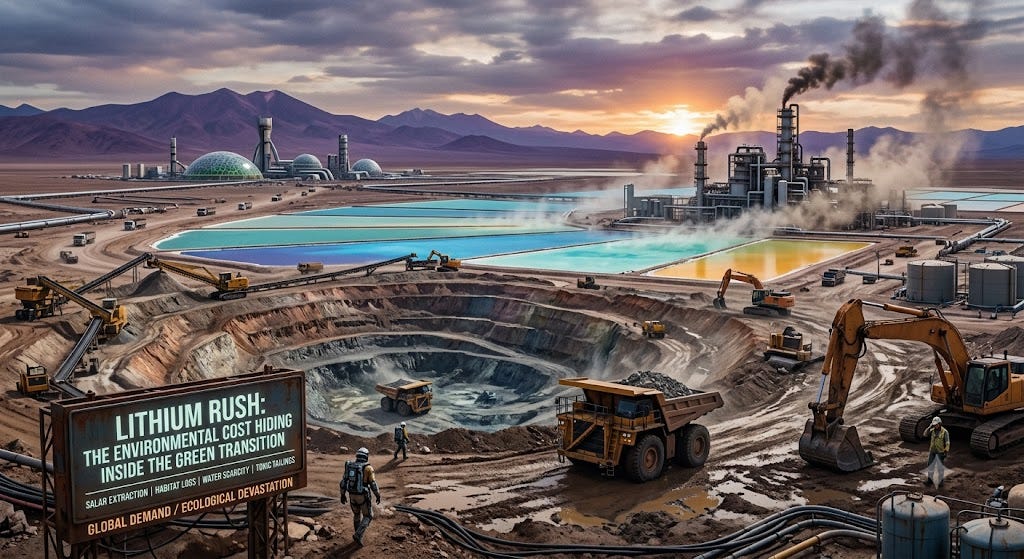
Extracting a single ton of lithium from the brine beneath Chile’s Atacama Desert takes roughly 500,000 liters of water, in a region so dry it’s used by NASA to test Mars rovers. Mining operations there already consume up to 65% of the available water in the Salar de Atacama basin, in direct competition with the farmers and Indigenous communities who were there first and the desert-adapted flora and fauna that have nowhere else to go. I think about that number every time I see an ad for an electric vehicle set against a clean, green backdrop, because the driest place on Earth is quietly paying part of the water bill for that image.
This is the part of the green transition story that gets left out of the press release, not because anyone’s lying exactly, but because “clean energy” is doing a lot of quiet work as a marketing term for a supply chain that is, in the specific places it touches, not clean at all. Lithium demand isn’t slowing down to give anyone time to fix this either - industry forecasts point to 30 to 40% demand growth in 2026 alone, and after a multi-year supply glut that crushed prices, the market flipped hard: battery-grade lithium carbonate roughly doubled in Q1 2026 to around $26,278 a ton. Morgan Stanley is forecasting an 80,000-metric-ton supply deficit this year; UBS puts it closer to 22,000 tons. I don’t think either bank has this precisely right - forecasting a global commodity deficit down to five figures a year out is more art than science - but both are pointing the same direction, and that direction is: more mines, faster, wherever the lithium actually is.
Nevada is where “wherever the lithium actually is” gets uncomfortable in a very specific, well-documented way. Thacker Pass, the largest known lithium deposit in the US, sits inside a collapsed supervolcano 25 miles from the Oregon border, and it’s also known as Peehee Mu’huh - sacred ground to at least 22 tribes, and the site of an 1865 massacre of Paiute people that survivors’ descendants say the mine’s environmental review barely acknowledged. The Reno-Sparks Indian Colony, Burns Paiute Tribe, and Summit Lake Paiute Tribe sued in 2021 over what they say was inadequate consultation; that case is still winding through court, a new tribal lawsuit was filed more recently, and in a detail I find genuinely remarkable, the mining company itself sued several of the protesters, several of whom faced civil charges and potentially life-altering fines for a 2021 demonstration. Once built out, the mine is projected to produce 60,000 tons of lithium a year - while consuming 1.7 billion gallons of water annually and emitting over 152,000 tons of CO2 doing it. A newer study out of Northwestern this year found that most proposed US lithium mines sit in already water-stressed regions, with the worst projected shortages concentrated around California’s Salton Sea and across Nevada - meaning Thacker Pass isn’t an isolated hard case. It’s close to the median.
Serbia gives you the same tension with a different flavor: instead of Indigenous land rights, it’s national politics and farmland. Rio Tinto’s Jadar project, projected to produce up to 58,000 tonnes of lithium carbonate a year - enough for roughly 1.1 million EVs - was suspended by Serbia’s own government in 2022 after mass protests over land and water pollution concerns, then revived in 2024. This July, the European Commission designated Jadar a “strategic project” under its Critical Raw Materials Act, and weeks later thousands of demonstrators were back in the streets of Valjevo protesting the same mine the EU had just formally blessed. I find that sequence almost too on the nose to need commentary: the same governing body writing the climate policy that depends on this lithium is the one stamping “strategic” on the mine that its own citizens are actively marching against.
None of this is an argument against electrifying transportation and the grid - I think that transition is genuinely necessary, and lithium-ion is, for now, the least-bad chemistry we have at the scale required. It’s an argument against the specific way the story gets told, which treats the transition as though it simply swaps a dirty input for a clean one, full stop, rather than swapping one set of externalities for a different set, concentrated in different places, borne by different people who mostly aren’t the ones buying the resulting cars. Fossil fuel extraction has a body count and an environmental ledger stretching back over a century, and I’m not remotely arguing lithium is worse. I’m arguing it isn’t nothing, and “isn’t nothing” is not the message on the ad.
What I’d actually want to see, and don’t, is the EV and battery industry being as loud about where their lithium came from as they are about the emissions their product avoids down the road. A car’s window sticker tells you its fuel economy. Nothing on it tells you whether the battery inside it drew down an aquifer under a desert already stressed by the century’s driest decade on record, or whether the mine that supplied it sits on land 22 tribes consider sacred, or whether the country hosting the mine had to overrule its own citizens twice to keep it open. That information exists. Companies and regulators mostly choose not to put it next to the thing they’re selling, because the actual, honest picture - necessary technology, real cost, unevenly distributed, worth it on balance but not free - is a much harder sentence to fit on a billboard than “zero emissions.”
No posts
Comments
Nothing yet. Say the first thing.
Sign in to join the conversation.