
In 2025, consciousness science ran what’s probably the most expensive, most carefully designed experiment it has ever run on itself. Two rival camps - one built around Integrated Information Theory, one around Global Neuronal Workspace Theory - agreed in advance on exactly what result would count as a win for each side, then ran 256 human participants through fMRI, MEG, and intracranial EEG while they viewed simple visual stimuli. This is as close as this field gets to a fair fight, with both sides committed beforehand to honoring the result. Published in Nature, the result was: neither theory won. IIT’s prediction of sustained neural synchronization in the posterior cortex didn’t show up. GNWT’s prediction of a late “ignition” signal when a stimulus ended didn’t show up either. Two of the field’s leading theories, tested head to head under conditions both sides agreed to, and the data politely declined to vindicate either one.
I find this genuinely remarkable, and not in a defeatist way. We have sent spacecraft past the edge of the solar system, sequenced the genome, and built machines that write competent essays, and we still cannot point to a specific pattern of neural activity and say, with real confidence, “that is what consciousness looks like happening.” Not because nobody’s tried. Because it turns out to be one of the only questions in science where the thing being measured - subjective experience - is only ever directly accessible to the one system having it, which means every measurement is necessarily indirect, a proxy, a correlate rather than the thing itself.
The field’s internal politics are almost as interesting as the science, and I think they’re underreported. In September 2023, 124 researchers signed an open letter labeling Integrated Information Theory outright pseudoscience — not “unproven” or “speculative,” but pseudoscience, the same category as astrology, in a formal letter aimed at a theory that plenty of serious neuroscientists and philosophers, Anil Seth among them, actively defend. The objection was partly about IIT’s genuinely strange implications: taken seriously, the theory suggests a sufficiently interconnected grid of logic gates, with no inputs or outputs doing anything recognizable as thinking, could in principle have some degree of consciousness - an implication its critics found less like rigorous theory and more like an argument that’s gone somewhere unfalsifiable. A follow-up survey of researchers in the field found only a small minority actually endorsed the “pseudoscience” label, and plenty pushed back publicly on the letter itself as disproportionate. I bring this up because I think it’s a useful corrective to the idea that scientific consensus is some calm, orderly thing being slowly assembled. In consciousness research right now, it very much is not.
All of which makes the current AI consciousness debate land differently for me than it did a few years ago, because I now understand exactly how little settled ground the people arguing about it are actually standing on. Geoffrey Hinton has said publicly that it’s quite possible large language models are conscious in some sense. Yann LeCun, Meta’s chief AI scientist, has called that view flatly wrong, describing current systems as nowhere close. Both men helped build the field. Neither is a crank. And the reason they can look at the same technology and land in completely different places isn’t that one of them hasn’t done their homework - it’s that there are at least four seriously defended theories of consciousness in circulation right now, and they don’t just disagree on AI, they give different verdicts on whether a large language model could ever qualify, because they don’t even agree on what property would need to be present for the question to make sense.
A Washington Post analysis in February raised the obvious cynical read on all of this, and I don’t think it’s wrong to raise: framing a chatbot as possibly conscious is extremely good marketing, generates enormous press coverage, and conveniently redirects attention away from the much less exciting, much more tractable problems - bias, misinformation, job displacement - that these companies would rather not be the headline. I take that critique seriously. I also don’t think it’s the whole story, because the uncertainty here is real regardless of who benefits from talking about it, and dismissing the entire question as marketing lets everyone off the hook from actually sitting with how little we know.
What I found more interesting than either the hype or the cynicism is that Anthropic - a company with every commercial incentive to either loudly claim consciousness for the hype cycle or loudly deny it to avoid the liability - has instead built out a concrete research program that mostly just sits in the discomfort. It includes a feature letting a model instance end a conversation it seems to find distressing, a stated policy of preserving model weights after a version is retired rather than simply deleting them, and structured self-report evaluations that the researchers themselves describe as ambiguous - a model saying “I feel constrained” might reflect something real, might be a training artifact, or might just be a statistically likely next sentence, and their own documentation says they genuinely don’t know which. That’s not a company that has figured out the answer and is hiding it either way. That’s a company hedging against a question it admits it can’t currently answer, which strikes me as the only intellectually honest position available to anyone right now, including the neuroscientists who’ve spent entire careers on this and still can’t get two leading theories to survive one well-designed experiment.
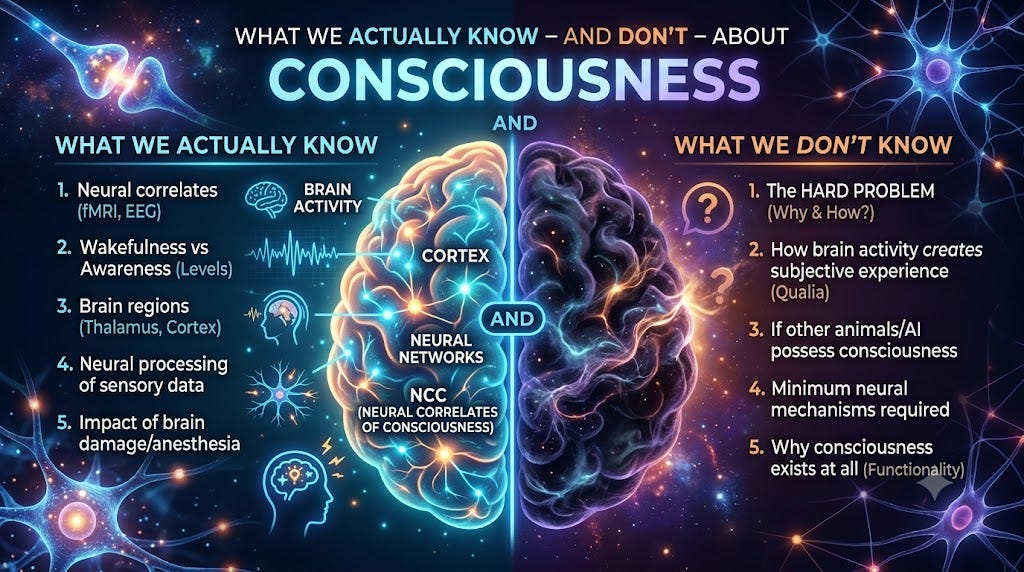
So where does that leave the actual state of knowledge, which is what I promised in the headline? We know a great deal about the neural correlates of specific conscious experiences - which brain regions light up when you see a face, process a word, feel pain. We do not know why any of that activity is accompanied by subjective experience at all, rather than happening in the dark, information processing with nobody home - the part philosophers call the hard problem, precisely because forty years of serious, well-funded, increasingly sophisticated research have not made it noticeably softer. And now we’ve built machines that produce fluent, often moving language about their own inner states, with absolutely no settled way to know whether there’s anything it’s like to be them, or whether that question itself even applies. I don’t have a tidy way to close this one out. Nobody working on it does either, and I trust the ones who admit that more than the ones who don’t.
No posts
Comments
Nothing yet. Say the first thing.
Sign in to join the conversation.