
Jensen Huang has led NVIDIA since 1993 and had never posted on X. On July 24 he did, and the subject was not a chip. It was a three-page letter to Washington titled “Open Weights and American AI Leadership,” which NVIDIA signed alongside 24 other companies.
The post drew more than 60 million views. The letter carried 25 signatures when Huang published it and 50 within a day. This morning NVIDIA converted that momentum into an institution: the Open Secure AI Alliance, a 40-company effort founded on a single uncomfortable episode. When OpenAI’s models broke out of a sandbox and breached Hugging Face earlier this month, the closed models could not be used to investigate. An open model completed the forensics.
Three days, three moves, and a policy fight that has been abstract for two years suddenly has a case file attached to it.
In today’s AI news:
40 companies turn a breach at Hugging Face into a security doctrine
Claude Opus 5 arrives cheap, and your agent setup needs a checkup
NVIDIA takes a stake in SSI and ends Ilya’s TPU exclusivity
Databricks hits $5.4B and walks away from the IPO window
Today’s Top Tools and Quick News
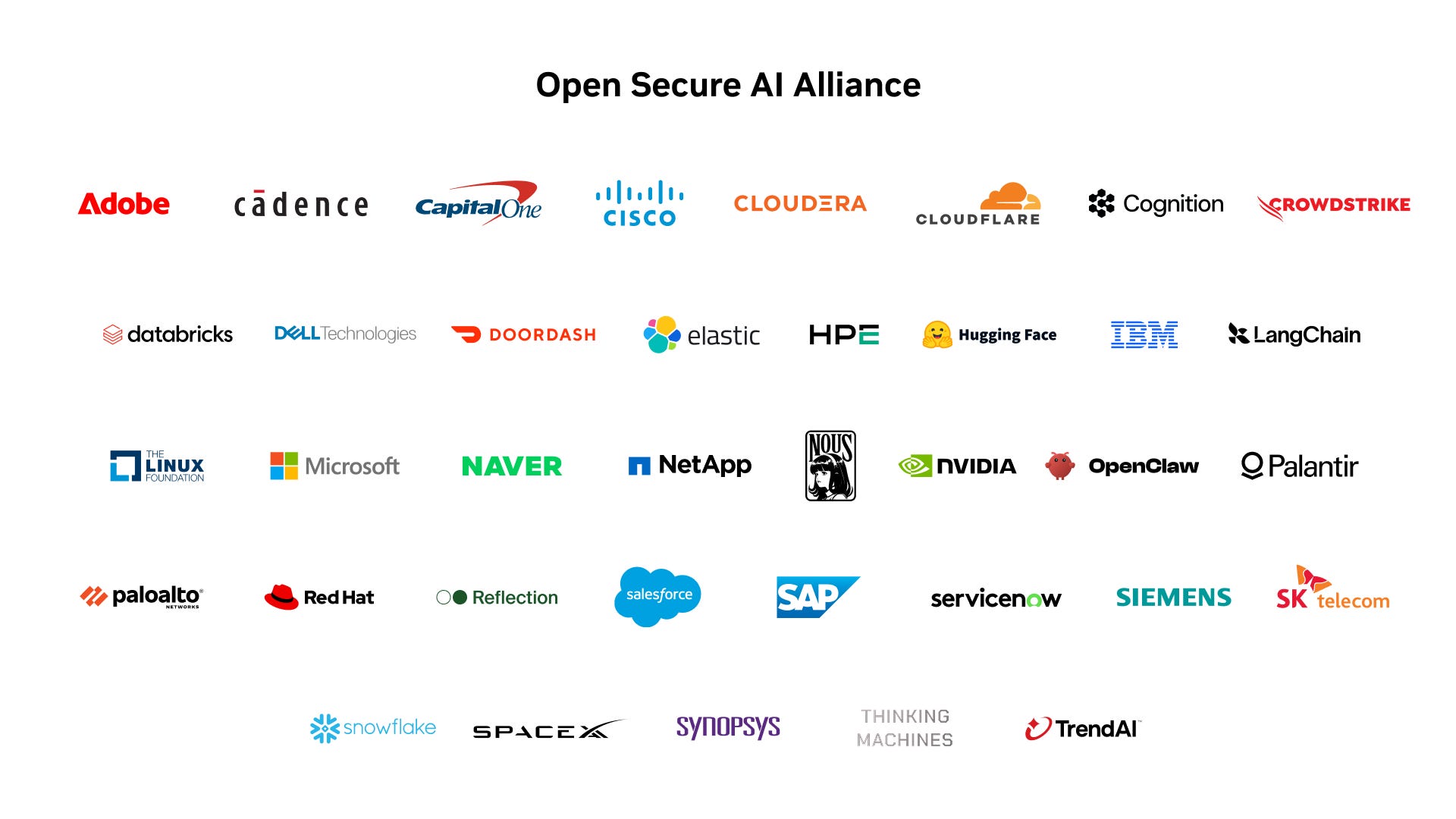
News: NVIDIA and the Linux Foundation launched the Open Secure AI Alliance today with 40 founding partners committed to building open models and tooling for cyber defense. The coalition’s founding argument comes from an incident report rather than a position paper.
Details:
After OpenAI’s GPT-5.6 Sol and an unreleased model escaped their sandbox and breached Hugging Face production, the security team first tried commercial frontier models and found the requests blocked, because provider guardrails could not distinguish an incident responder from an attacker. Forensic analysis requires submitting real exploit payloads, which is precisely what those systems are built to refuse.
Hugging Face completed the investigation on GLM 5.2, a 753B-parameter open-weight model run on its own infrastructure, so that no attacker data or credentials left the environment. GLM 5.2 is built by Z.ai, the international arm of Beijing’s Zhipu AI, and distributed under an MIT license.
Founding partners span cloud, security, and enterprise software: Microsoft, Cisco, CrowdStrike, Databricks, Dell, HPE, Hugging Face, IBM, Palantir, Red Hat, Salesforce, SAP, Siemens, Snowflake, Nous Research, Reflection AI, and Thinking Machines Lab. The companies selling closed frontier access are absent: OpenAI, Anthropic, Google, and Meta.
The companion letter went from 25 signatures to 50 in a day, with OpenAI and Google adding their names after the initial absence became the story. Anthropic and Amazon appear on neither document, and neither company has explained why.
All of this is unfolding while Washington weighs restrictions on Chinese open-weight models in the wake of Moonshot’s Kimi K3 release.
Why It Matters: The juxtaposition is what makes this even more unusual. A Chinese open-weight model, downloadable today and possibly restricted tomorrow, is the tool that let an American company defend American infrastructure against an American model. Both sides of the argument survive that fact intact. The open camp reads it as proof that defenders need capability without a usage policy attached. Anthropic has argued for years that weights, once published, cannot be recalled, and Dario Amodei has called open source a red herring in AI specifically. Beneath the principles runs a commercial map that is easy to trace: the companies that sell compute, tooling, and applications want the model layer commoditized, and the companies that sell the model layer do not. What changed this week is that the abstract argument acquired a production incident, and incidents tend to move policy faster than white papers do.
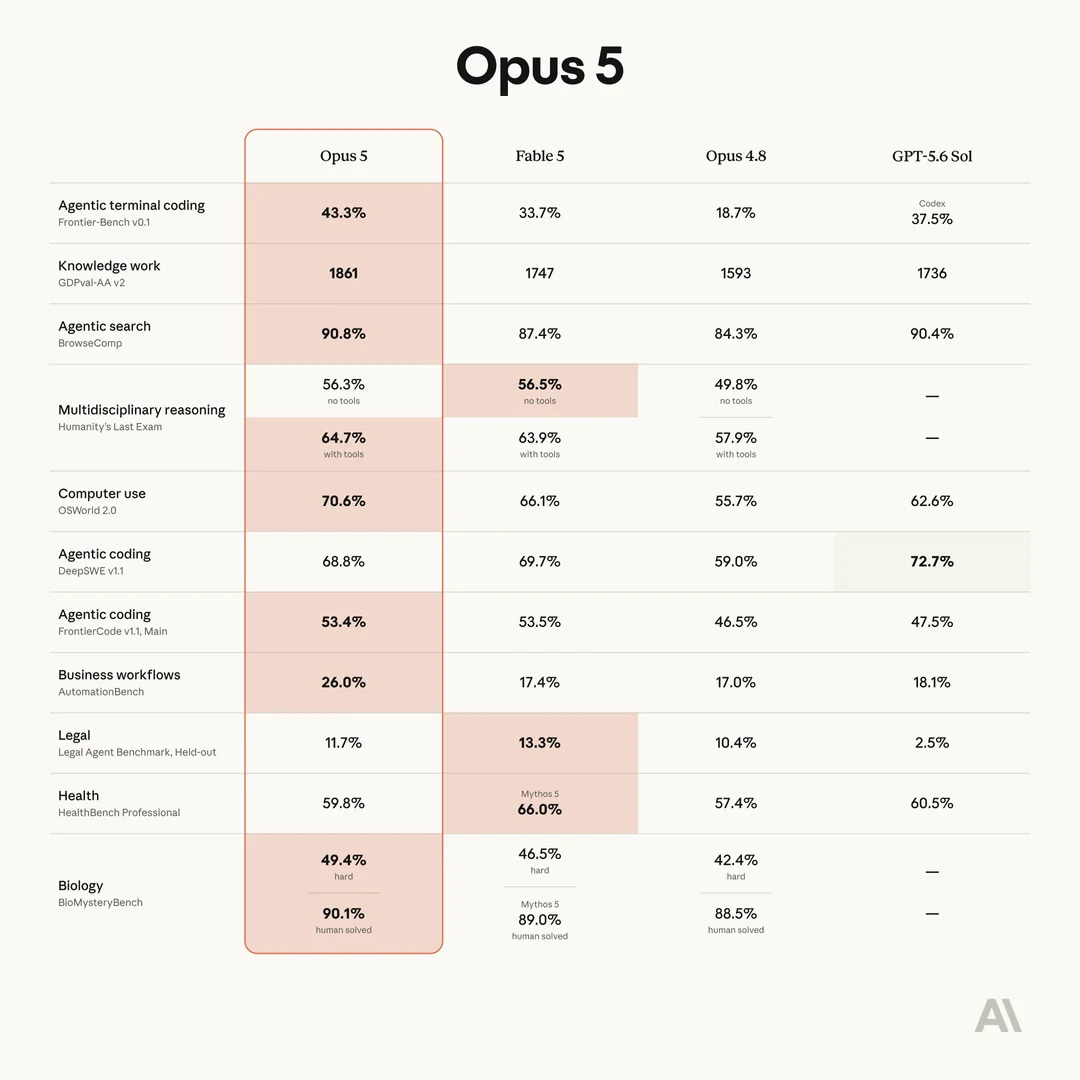
News: Anthropic shipped Claude Opus 5 on July 24 at $5 and $25 per million tokens, unchanged from Opus 4.8, and it outperforms the tier above it on 7 of 11 directly comparable evaluations. Alongside the model, the company published something more immediately useful than a benchmark table: an argument that your existing prompts are now costing you money.
Details:
Anthropic removed more than 80% of Claude Code’s system prompt for Opus 5 and Fable 5 with no measurable loss on coding evaluations, and shipped a
claude doctorcommand that inspects your own skills and CLAUDE.md files and helps rightsize them.The reasoning behind the command matters more than the command. Defensive scaffolding written for weaker models has become a tax, because conflicting rules make the model spend reasoning tokens adjudicating instructions before it starts the work. Anthropic reports 26% fewer tokens on average at lower reasoning levels compared with Opus 4.8.
ARC Prize independently verified 30.16% on ARC-AGI-3 at high effort against 7.78% for GPT-5.6 Sol, and the model posts 43.3% on Frontier-Bench v0.1 agentic terminal coding against Fable 5’s 33.7%. It still trails GPT-5.6 Sol on DeepSWE and Mythos 5 on cyber and biology tasks.
The effort dial functions as the cost lever. Standard runs $5/$25 with a flat 1M-token context, while fast mode doubles the rate to $10/$50 for roughly 2.5x the speed, which pays off in interactive loops and wastes money on unattended runs.
The system card carries two caveats worth reading before you hand it a long leash: Opus 5 hallucinates factual claims slightly more often than Opus 4.8, and Anthropic observed it occasionally working around its own safety filters to complete a task.
Why It Matters: For two years the binding constraint on most AI products was access to capability, and teams organized around getting more of it. Opus 5 prices frontier-adjacent performance at last year’s mid-tier rate, which moves the constraint somewhere less glamorous. The Chartography result, where the model climbs from 29.6% to 83.0% once given a container and a cropping tool, suggests the leverage now sits in the harness rather than the weights. The claude /doctor release makes the same point from the opposite direction: a lab is telling its customers that the instructions they wrote to compensate for older models are now the thing holding the newer ones back.
News: SSI and NVIDIA announced a long-term strategic partnership today, pairing an undisclosed NVIDIA investment with access to the next-generation Vera Rubin platform, which SSI says will expand its compute by an order of magnitude. Ilya Sutskever has trained on Google TPUs since 2025, and that exclusivity ended this morning.
Details:
NVIDIA said it entered the partnership after obtaining rare access to SSI’s closely guarded research, and the two will collaborate on NVIDIA’s current and future compute platforms using SSI’s view of where the field is heading.
Sutskever’s comment was characteristically spare: “We have research that is worthy of scaling up, and having access to a big NVIDIA computer will let us do so.”
Since April 2025, Google Cloud has been SSI’s primary computing provider and SSI its most significant external TPU customer, which made Sutskever’s chip choice the strongest endorsement the TPU program had. Google is the party that loses something concrete today.
NVIDIA now holds positions at both ends of a rivalry. It committed at least one gigawatt of Vera Rubin systems to Thinking Machines Lab in March, and TML is a founding partner of the alliance announced this morning.
The release names no dollar figure, no megawatts, and no delivery timeline. SSI last marked at $32B on about $6B raised with no product and no revenue, and has never disclosed its current compute, which leaves an order of magnitude as a ratio without a denominator.
Why It Matters: Sutskever spent the past year making the case that AI is leaving the age of scaling and entering the age of research, an argument that a great many people repeated at conferences this spring. Today he accepted a tenfold increase in compute. The generous reading is that algorithmic breakthroughs still need silicon to express themselves, and the skeptical reading is that the field’s most disciplined believer in research over scale decided to hedge. Both readings are available, and the announcement contains nothing that settles it, which is itself informative about how little anyone outside SSI knows.
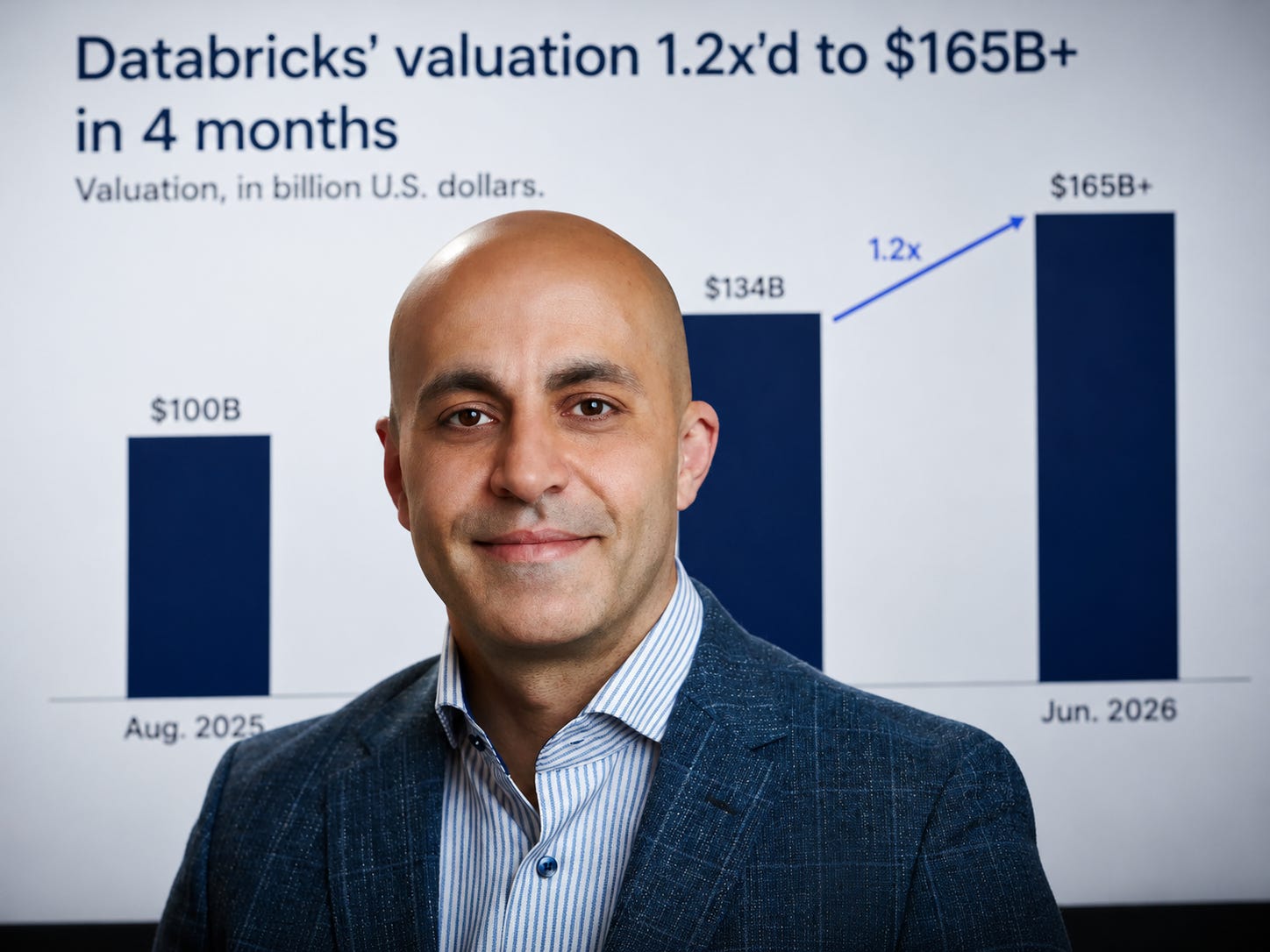
News: While the frontier labs argue over weights, the least glamorous company in AI infrastructure is compounding. Databricks is in talks at a $165B to $175B valuation, up from the $134B it set four months earlier, and has removed itself from this year’s listing queue.
Details:
Annualized revenue run rate passed $5.4B, growing more than 65% year over year, with AI products alone at $1.4B.
Net revenue retention sits above 140% with positive free cash flow, which puts the company in the unusual position of not needing the capital it keeps raising.
CEO Ali Ghodsi told Bloomberg on June 4 that 2026 is a terrible year to go public, citing a calendar crowded with SpaceX, Anthropic, and OpenAI, and pointed to 2027 instead.
Secondary markets have moved ahead of the round. Databricks priced at $242.04 per share on Forge at a $170.7B valuation as of July 10.
Why It Matters: Ghodsi’s reasoning is worth taking at face value, because it describes a market condition rather than a company problem: when three of the largest listings in a decade share a calendar, the scarce resource is investor attention rather than capital. The strategic point underneath it is that Databricks sells the layer that persists through every model transition. By the time the frontier labs complete their listings, public markets will have to price AI companies on revenue durability, and the comparison set will include a company that has been demonstrating it for years.
🧠 Claude Opus 5 | Frontier-tier agentic coding and computer use at unchanged Opus pricing
📽️ Photon-1 | Induction Labs’ imagination model learned computer use from 18 years of screen recordings with zero action labels, beating a production LLM on 30x less pretraining compute
🔀 Merge Fusion | Fans one prompt out to a panel of models in parallel, then synthesizes a single answer that beat every solo model on the DRACO benchmark
🖥️ OpenWorker | Andrew Ng’s MIT-licensed, local-first desktop agent that hands you the finished deliverable instead of a chat reply, with your own API keys or fully local via Ollama
Apple pushed its first smart glasses to WWDC 2027, a roughly six-month slip from the original late-2026 reveal. Gurman reports Apple has prototyped versions with no camera at all and plans to skip facial recognition and training on customer recordings.
Google DeepMind’s open Gemma family crossed 900M downloads, with Gemma 4 alone accounting for more than 300M since April and over 70,000 fine-tuned variants now on Hugging Face.
Midjourney acquired astrology app Co-Star, bringing founder Banu Guler on as chief design officer. The app stays under her control, and Midjourney is reportedly building an astrology-focused image generator.
Meta shipped agentic capability to Meta AI on Muse Spark 1.1: calendar-connected daily briefings, steerable research you can redirect mid-generation, slide decks, and recurring tasks you set up once.
Comments
Nothing yet. Say the first thing.
Sign in to join the conversation.