
Good morning AI entrepreneurs & enthusiasts,
Last Friday, 25 companies signed a letter defending open weights. Within a day there were 50. Anthropic did not sign, and neither did Amazon or xAI. Then Moonshot published the full weights for Kimi K3, 2.8 trillion parameters and the largest open model ever released, free to download with no rate limit and no permission slip. Dario Amodei published Anthropic’s position Monday night. Reuters broke this morning that China has begun mass producing its own lithography machines.
Two days for an industry to organize a position. Congress still has its bill in committee. That gap is the story, and this time it does not close, because a company can pull a product or revoke a key overnight and nobody can un-release a set of weights. Whatever rule gets written next gets written for a world where K3 is already downloaded and running.
In today’s AI news:
Moonshot publishes K3 weights, the largest open release ever
Anthropic stays out as the open-weights letter doubles to 50
China starts mass producing its own immersion DUV scanners
Microsoft bets cyber defense is won on cost, not capability
Today’s top tools and quick news
🌎 Moonshot publishes K3 weights
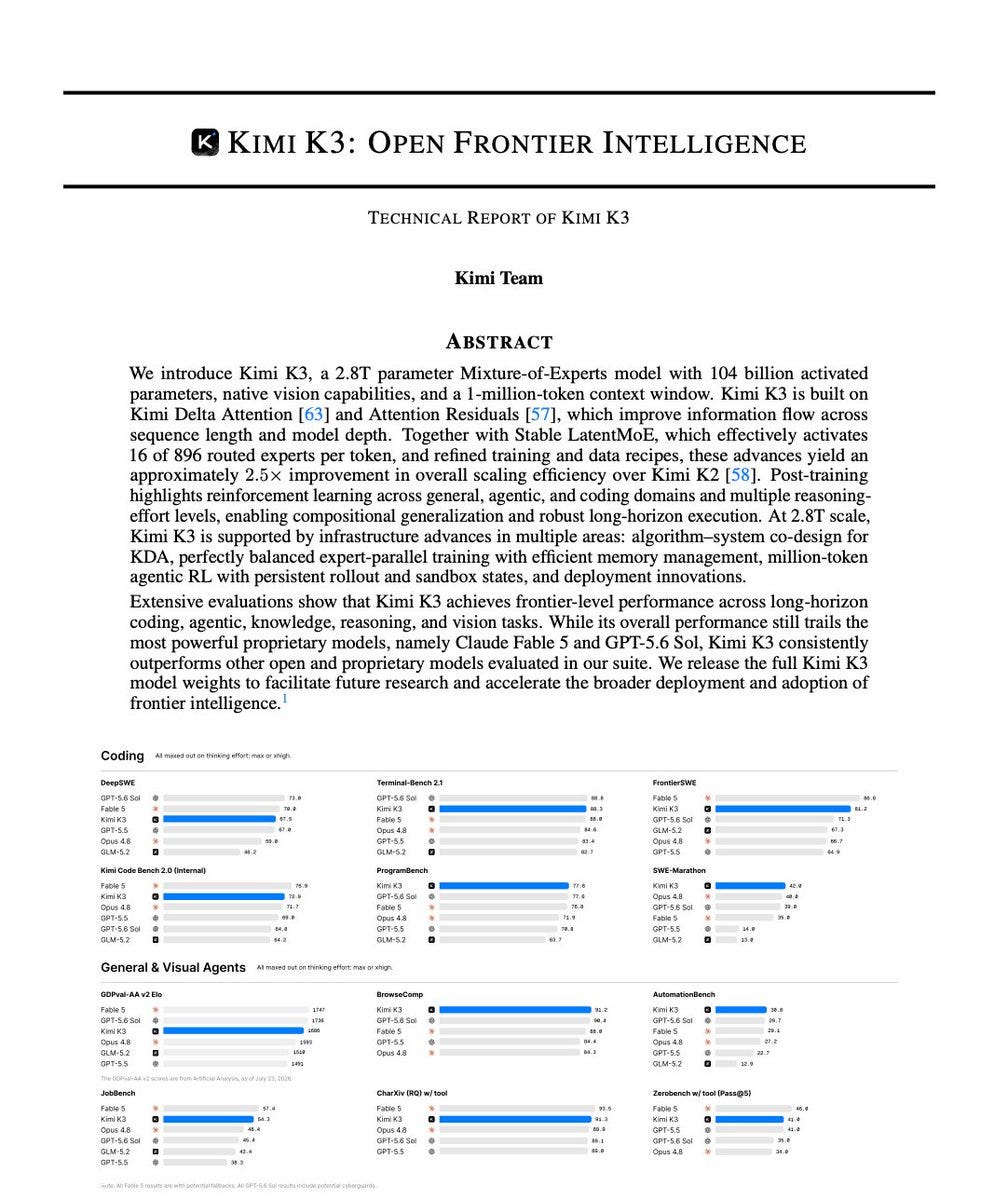
News: Moonshot AI releases the full weights and technical report for Kimi K3, a 2.8T-parameter model its repository calls the world’s first open 3T-class system. This is not a routine product launch. It is the release that forced Washington’s open-weights debate into the open.
Details:
Adoption ran ahead of the release. Moonshot paused new K3 subscriptions on July 19 after demand pushed its GPUs to the edge, so you could not buy an account while the world waited on the weights.
It took first in the Frontend Code Arena at 1,679 points, passing Claude Fable 5 and GPT-5.6 Sol. K3 now ranks fourth of 189 models on the Artificial Analysis Intelligence Index.
K3 runs on Kimi Delta Attention with a Stable LatentMoE framework activating 16 of 896 experts per token, for roughly 2.5x the scaling efficiency of K2.
Open weights are not free weights. Self-hosting needs roughly 64 H100 or B200 GPUs across eight servers, under a Modified MIT license permissive enough for commercial use.
Weights went live July 26-27, ten days after the July 16 API launch, not the “under 24 hours” that circulated on social.
Why It Matters: Every U.S. frontier lab rations access through rate limits, tiers, and safety gates. Moonshot removed all three, and once weights are public no export control or terms-of-service update pulls them back. That is why this drop is a geopolitical event rather than a product event: it lands at the exact moment Washington is deciding whether American companies should be allowed to use models like it, and it hands every builder a fallback that costs GPUs instead of a vendor relationship. Price your next twelve months against a permanent ceiling on frontier inference, because the ceiling arrived this week and no policy decision removes it.
📝 Anthropic responds to the Open Weights letter

News: Fifty companies have now signed “Open Weights and American AI Leadership,” the Nvidia-hosted letter urging Washington against restricting downloadable models. Anthropic is the conspicuous frontier holdout, and Dario Amodei published the company’s position last night. Read this one alongside the K3 story, because neither makes full sense alone.
Details:
The letter went out July 24 with 25 signatories and hit 50 within a day, with OpenAI, Google, AMD, Cisco, Cloudflare, GitHub, Block, and Ollama joining late. Anthropic, Amazon, and xAI remain off the published list.
Amodei states it plainly: Anthropic has never advocated for a ban on open-weights models, calling models without dangerous capabilities a public good. He concedes a ban would shield Anthropic from competition, then says that has never been his goal.
Chips out of authoritarian hands. This is why the China lithography story below belongs in the same issue. Amodei’s case rests on China’s limited domestic chip production as the binding constraint, and domestic scanners are the first crack in it.
Stop industrial-scale distillation. Anthropic has direct skin here. The White House’s Michael Kratsios accused Moonshot of building K3 by distilling Anthropic’s Fable 5, and Treasury Secretary Scott Bessent floated sanctions for distillation he likened to theft.
Safety testing for all capable models, open and closed. Anthropic has lived this: the government pulled Fable 5 and Mythos 5 via emergency export controls on June 12, three days after launch, and access stayed dark for 18 days. Anthropic has since promised the government earlier access to test future frontier models, and OpenAI previewed GPT-5.6 to a government-approved group rather than the public.
The one real break with the letter: he rejects the claim that open weights hand defenders an advantage, citing a UK AI Security Institute finding that released weights cannot be withdrawn, and fears biological misuse more than cyber.
Why It Matters: None of the three asks are radical. Chip controls are already policy. Distillation enforcement is already a Treasury conversation. Pre-release government testing already happened to both Anthropic and OpenAI this summer. And if Washington is right that K3 was built by distilling Anthropic’s models, then refusing to sign a letter defending K3 is the only consistent move on the board.
For Portlanders, I’m hosting an Anthropic event tonight focused on ‘who gets to make the rules in AI’ and will be diving into this hard conversation in great detail. Would love to see you there!
🔬 China starts mass producing its own immersion DUV scanners
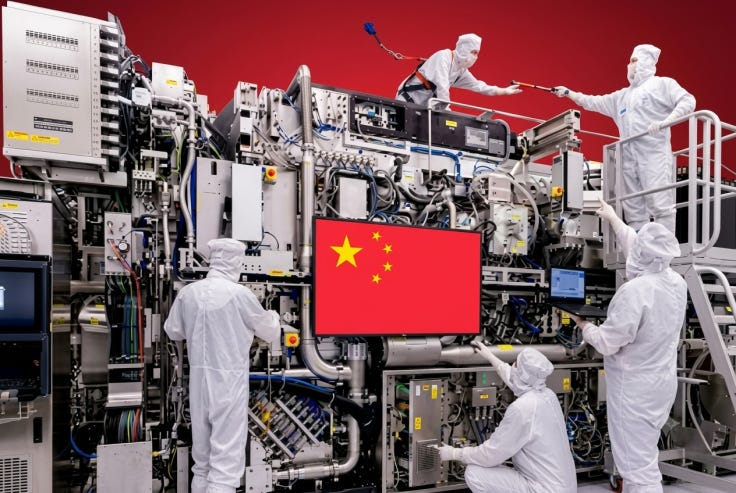
News: An immersion DUV scanner is the tool that prints circuit patterns onto silicon, floating a layer of water between lens and wafer to draw finer lines, and ASML has effectively been the only company on earth that makes good ones. Reuters now reports China has begun mass producing its own, led by a state-owned Shanghai firm almost nobody had heard of last week.
Details:
These tools print 28nm in a single exposure and reach 7nm through multipatterning, paid for in yield. EUV, required for 5nm and 3nm, remains entirely out of reach.
Here is the number that matters: roughly five machines in 2026 and 20 in 2027, against ASML’s expected 130 immersion shipments this year. That is about 4% of a single year’s supply.
Shanghai Aishengna has no website and absorbed teams from Yuliangsheng, a Huawei-backed SiCarrier affiliate, and from SMEE. First deliveries go to SMIC, Hua Hong, and CXMT.
Most components are domestic, though some critical parts still come from Japan, and local supplier delays held output back. Independent analysis puts commercial-scale Chinese immersion DUV in the mid-2030s, with ASML still at 98.7% of the market.
A bill moving through Congress would cut those same three companies off from ASML servicing and technical assistance, not just new sales, which reaches tools already running in Chinese fabs.
Why It Matters: Every argument about restricting Chinese models rests on an assumption that China cannot make its own chips at scale, and this is the first credible evidence that the assumption has a shelf life. Five machines is not a supply chain, but tool programs compound over decades, and Washington is moving to cut servicing on installed ASML tools at the exact moment Beijing offers an alternative, which turns a maintenance problem into a migration incentive.
For those of us in Portland this is not abstract, since ASML’s Hillsboro campus is its largest U.S. customer support site and the main training hub for its American service engineers.
🛡️ Microsoft bets cyber defense is won on cost, not capability
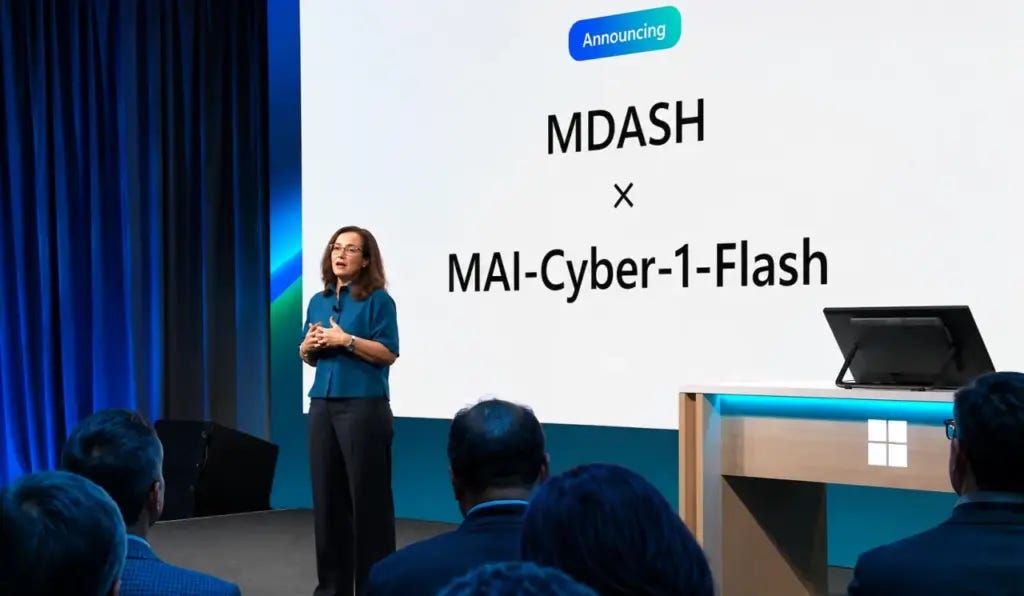
News: Microsoft launches MAI-Cyber-1-Flash, its first cybersecurity model, running inside MDASH, the company’s multi-agent vulnerability harness. The pitch is not raw capability. It is cost per scan.
Details:
MDASH with MAI-Cyber-1-Flash delivers 96% on CyberGym, 12 points above Mythos. The score belongs to the harness paired with GPT-5.4, not the model alone.
The field sits tight underneath: GPT-5.5 Cyber at 85.6%, Mythos 5 at 83.8%, GPT-5.6 Sol at 83.6%, Gemini 3.5 Flash Cyber at 83.2%.
The model is small by design at 137B total parameters with 5B active. It handles 90% of tasks and routes the hardest 10% to GPT-5.4.
That routing is the whole product. The configuration costs 50% less than Microsoft’s previous best MDASH setup, and swapping 80% of MDASH’s models moved the harness from 88.4% to 95.95%.
Microsoft also launched Perception, agent teams that continuously monitor, patch, and close threat vectors.
Why It Matters: Defenders lose on economics, not capability. An attacker probes one vulnerability while a defender scans millions of lines continuously, and at frontier token prices that math never closes. Microsoft’s real product is a routing architecture that puts a cheap specialist on the volume and saves the expensive model for the exceptions.
🛠️ Today’s Top Tools
🎯 Kimi K3: Moonshot’s 2.8T open-weight model, the largest ever published
🧠 Inkling: Thinking Machines’ 975B MoE, built to be fine-tuned rather than to top leaderboards
🔒 MAI-Cyber-1-Flash: Microsoft’s cyber model for hardening large codebases inside MDASH
🐝 Buzz: Block’s open-source Slack and GitHub replacement, where every agent gets its own cryptographic identity
🎥 FLUX 3: Black Forest Labs’ multimodal model generating 20-second video with native audio, in gated early access
⚡ Quick News
Lilian Weng leaves Thinking Machines Lab, citing seven months of illness worsened by startup pace. She is the fourth of six cofounders out since February 2025.
Ilya Sutskever’s Safe Superintelligence takes a reported $5B from Nvidia plus Vera Rubin access, enough to 10x compute in 12 months. Still no product, still $32B.
Nvidia weighs a $250B guarantee so OpenAI can lease SoftBank’s 10-gigawatt Ohio campus.
Chinese memory maker CXMT closed up 466% in its Shanghai IPO debut, with no HBM project in its prospectus.
Cursor launches a ₹649 (~$7) ‘Start’ plan in India, its first country-specific tier, weeks before the SpaceX acquisition closes. India is now its third-largest market at 3M developers.
Comments
Nothing yet. Say the first thing.
Sign in to join the conversation.