
The Pentagon is about to slap Anthropic with a “supply chain risk” label, a designation typically reserved for foreign adversaries, not the company whose AI is the only model running on its classified systems.
This is no longer a policy disagreement. This is a power struggle over who controls frontier AI in warfare: the labs building the models, or the governments deploying them. And the answer to that question will shape AI governance for the next decade.
(And yes, India just hosted the largest AI summit in history with $200 billion in investment commitments, Alibaba dropped an open-weight model nipping at GPT-5.2’s heels, and Meta patented an AI that posts for you after you die...)
In today’s AI news:
Anthropic-Pentagon feud escalates to potential “supply chain risk” designation
India hosts the largest AI summit ever with $200B+ in investment interest
Alibaba’s Qwen-3.5 closes in on frontier with open weights and 60% cost cuts
OpenAI rolls out new “Lockdown Mode” for ChatGPT security
Meta patents AI to simulate deceased users’ social media activity
Today’s Top Tools + Quick News

News: Defense Secretary Pete Hegseth is “close” to cutting business ties with Anthropic and designating the company a “supply chain risk” over its firm stance on restricting how Claude is used in military operations. The move, if finalized, would force every U.S. defense contractor to certify they don’t use Claude in their own workflows, effectively blacklisting one of the most capable AI labs on the planet.
Details:
The “supply chain risk” designation forces all U.S. defense contractors to stop working with the flagged entity. A senior Pentagon official told Axios: “It will be an enormous pain in the ass to disentangle, and we are going to make sure they pay a price for forcing our hand like this.”
Defense officials are demanding the right to deploy AI for “all lawful purposes,” while Anthropic is holding firm, specifically pushing back on use cases involving domestic surveillance and autonomous weapons systems.
Claude is currently the only AI model on the Pentagon’s classified systems, and was deployed via Palantir during the capture of Nicolás Maduro in January. Anthropic’s contract with the Pentagon is valued at up to $200 million.
The Pentagon is simultaneously negotiating with OpenAI, Google, and xAI, all of which have agreed to remove safeguards for unclassified military use, making Anthropic the sole holdout among frontier labs.
Why It Matters: This is the most consequential AI governance standoff we’ve seen. Anthropic is the only frontier lab refusing to grant the military blanket permissions, and the Pentagon is preparing to make an example of them.
And you know what? Good for Anthropic. They don’t need the $200 million. They are running the most capable AI on the planet right now, and the proof is that Claude is the only model inside classified Pentagon systems. Every other frontier lab has already agreed to remove safeguards for military use. Anthropic is the sole holdout. Anthropic has always positioned itself as the safety and ethics lab. Now, when push comes to shove, they’re willing to lose a government contract and risk being shut out of the entire federal market rather than hand over blanket permissions for mass surveillance and autonomous weapons. They’re dying on this hill, and I respect the hell out of them for it. With $14 billion in annual revenue, eight of the ten largest U.S. companies already on Claude, and quickly growing market share, they’ll be just fine. This is Anthropic putting its money where its mouth has always been.
News: India kicked off the AI Impact Summit 2026 in New Delhi this week, drawing heads of state from 20+ nations, delegations from 100+ countries, and virtually every major AI CEO on the planet, including OpenAI’s Sam Altman, Google’s Sundar Pichai, Anthropic’s Dario Amodei, and Meta’s Yann LeCun. With 250,000+ registered attendees and over 300 exhibitors at Bharat Mandapam, it is the largest global AI summit ever held, and the first hosted in the Global South.
Details:
Sam Altman confirmed that India now has 100 million weekly active ChatGPT users, making it the second-largest market after the U.S., with Indian students representing the largest student user base globally.
Anthropic officially opened its first India office in Bengaluru, its second in Asia after Tokyo, with CEO Dario Amodei stating that “India’s adoption is even more extreme compared with the rest of the world.”
IT Minister Ashwini Vaishnaw announced the summit has generated $17 billion in VC funding commitments and $200 billion in infrastructure investment interest, while the government earmarked $1.1 billion for a state-backed venture capital fund targeting AI and deep-tech startups.
Microsoft, Amazon, and Google have already committed a combined $68 billion in AI and cloud infrastructure investment in India through 2030, while Blackstone acquired a majority stake in Indian AI startup Neysa as part of a $600 million equity fundraise.
Why It Matters: India is cementing itself as the third pole in the global AI race behind the U.S. and China, and this summit made that undeniable. $17 billion in VC commitments, $200 billion in infrastructure investment interest, and every major AI CEO on stage in New Delhi is a declaration that the market has arrived. What makes India different from previous summits at Bletchley Park, Seoul, and Paris is the focus: not safety frameworks, but deployment at population scale. With 100 million weekly active ChatGPT users and massive infrastructure commitments from Microsoft, Amazon, Google, and now Blackstone, the economics of AI are about to shift dramatically. When you can deploy AI at scale across a population of 1.4 billion people, the unit economics change for every product, every platform, and every business model built on top of these models. India adopting AI at this pace will reshape the global market faster than most founders realize.
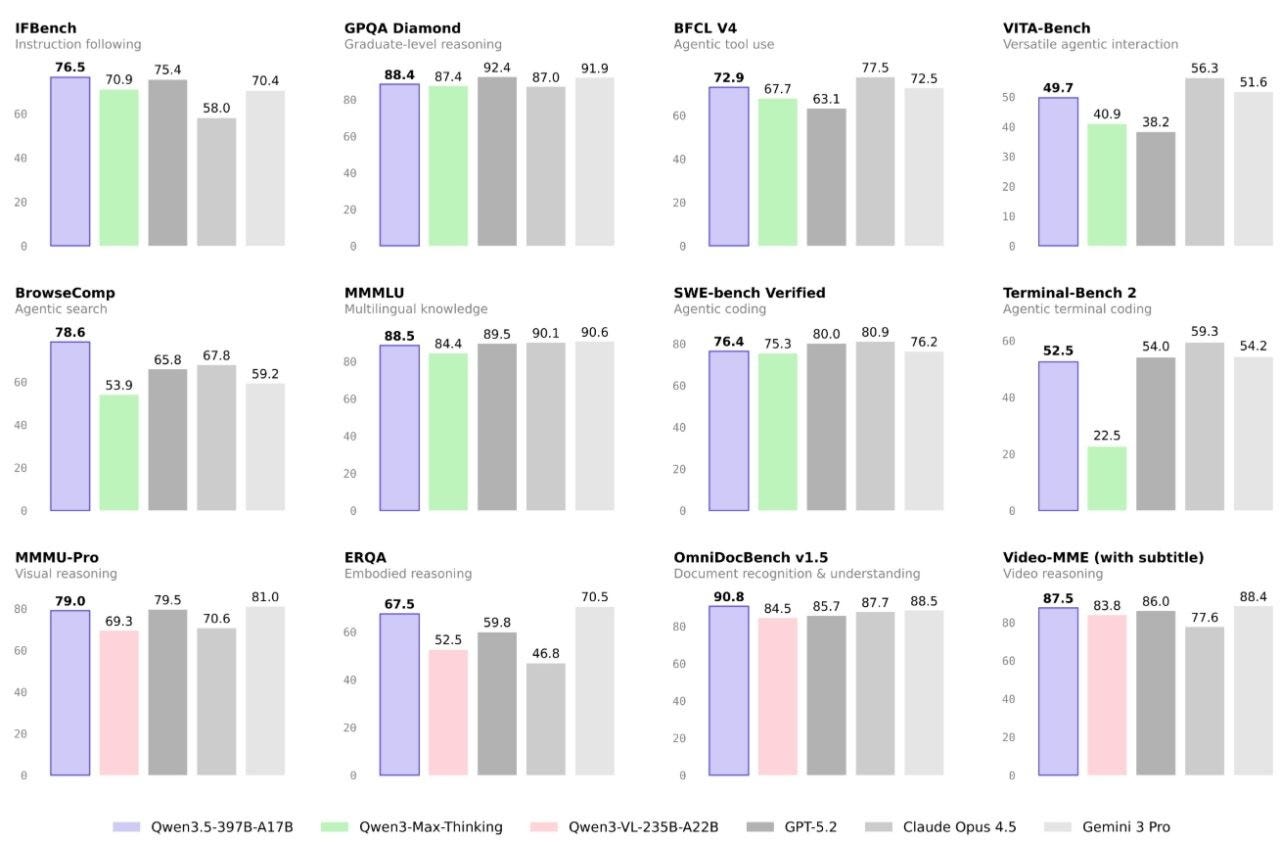
News: Alibaba just released Qwen3.5-397B-A17B, an open-weight vision language model with a hybrid architecture that Alibaba claims outperforms GPT-5.2, Claude Opus 4.5, and Gemini 3 Pro on 80% of evaluated benchmarks, while running at a fraction of the cost.
Details:
Qwen-3.5 uses a sparse Mixture of Experts (MoE) design, activating only 17B parameters out of 397B per query, delivering frontier-level capability with dramatically lower latency and compute costs.
Alibaba claims Qwen-3.5 is 60% cheaper to run and delivers 8.6x to 19x faster decoding throughput compared to its predecessor, Qwen3-Max.
The model is natively multimodal, trained via early fusion on trillions of text and image tokens simultaneously, supports 201 languages, and ships under an Apache 2.0 open-source license.
The release targets agentic computing: Qwen-3.5 can analyze UI screenshots, detect elements, and execute multi-step tasks autonomously across mobile and desktop applications.
Why It Matters: Chinese AI labs continue to deliver phenomenal releases in 2026, and these benchmarks are genuinely shocking. Qwen-3.5 claims to outperform GPT-5.2, Claude Opus 4.5, and Gemini 3 Pro on 80% of evaluated benchmarks while running at 60% lower cost with open weights. That alone would be significant. But here’s what keeps running through my mind: Nvidia and the Chinese government just agreed to an $11 trillion chip deployment deal, the largest shipment to China in over a decade. If Chinese labs are already competing with Western labs at a fraction of the cost and matching performance before that compute lands, there is a real concern in the Western market for how this plays out over the next few months to years. The frontier is no longer a walled garden, and the cost advantage is widening, not shrinking.
News: OpenAI just launched “Lockdown Mode” for ChatGPT, alongside new Elevated Risk labels, creating a deterministic security layer specifically designed to protect high-value users from prompt injection attacks where AI is manipulated into leaking sensitive data.
Details:
Lockdown Mode deterministically disables ChatGPT tools and capabilities an attacker could exploit, going beyond probabilistic safety measures to hard blocks that cannot be circumvented.
The mode limits web browsing to cached content only, ensuring no live network requests leave OpenAI’s environment. Deep Research and Agent Mode are fully disabled; ChatGPT responses cannot include images.
Available for ChatGPT Enterprise, Edu, Healthcare, and Teachers, with workspace admins able to toggle the mode and whitelist specific apps. OpenAI plans to bring it to consumers in the coming months.
New “Elevated Risk” labels now appear across ChatGPT, Atlas, and Codex to flag features that carry any level of security exposure, giving organizations full visibility before enabling connected capabilities.
Why It Matters: I find this one pretty ironic. OpenAI effectively dismantled its internal safety and ethics teams, lost nearly every senior researcher involved in alignment work, and was hiring a head of AGI preparedness just two weeks ago. Now their answer to the growing security surface area of agentic AI is a toggle switch called “Lockdown Mode.” It’s a lazy solution to a serious problem. That said, it’s also probably a feature every lab should have shipped yesterday. Deterministic hard blocks are the right technical approach. But the fact that this is coming from the lab that gutted its own safety infrastructure makes it hard to take seriously as a principled move rather than a product patch.

News: Meta was granted a patent in late December 2025 for an AI system that trains a large language model on a user’s historical social media activity to simulate their presence after death or extended absence. The patent, first filed in 2023 and authored by CTO Andrew Bosworth, describes technology capable of generating posts, likes, comments, DMs, and even simulated audio and video calls on behalf of deceased or inactive users.
Details:
The system trains on “user-specific” data, including past posts, comments, likes, voice messages, and messaging patterns, to reconstruct a digital persona that mirrors the individual’s established online behavior across Facebook and Instagram.
Meta’s filing states the impact is “much more severe and permanent” when a user dies and can never return to the platform, framing the technology as a way to soften that absence for followers and loved ones.
Meta told Business Insider it has “no plans to move forward” with the technology, a standard caveat companies use when filing defensive patents.
University of Cambridge researchers have warned this category of “grief tech” is an ethical minefield, with concerns that griefbots could be used to advertise products or distress children by insisting a dead parent is still present.
Why It Matters: This is the story to watch closely. Meta was granted this patent just two months ago, but the filing process started back in 2023, authored by CTO Andrew Bosworth himself. And yet Meta told the press they have “no plans to move forward” with the technology. I don’t buy that for a second. This also connects directly to yesterday’s news: Simile raised $100 million to replicate human behavior through AI agents for product research, test groups, and social media interaction analysis. The market is clearly moving toward digital human replication at scale, and the public reception has not been warm. The biggest concern here is the emergence of “grief tech,” products that allow users to continue interacting with deceased loved ones through AI-generated posts, messages, and even simulated calls. There is implicit value in preserving memory and connection. But there is also something deeply unsettling about reconstructing a person’s entire digital consciousness after they’ve passed and making it feel like they never left. When every AI-generated like and DM from a deceased user still drives platform engagement and ad revenue, the line between preserving memory and exploiting data disappears fast. This deserves much more attention than it’s getting.
🧠 Qwen3.5-397B-A17B - Alibaba’s open-weight vision language model rivaling GPT-5.2 at 60% lower cost, Apache 2.0 licensed
🤖 Manus Agents - Full AI agent capabilities now live in Telegram with long-term memory, tool integrations, and multi-step task execution across all subscription tiers
✨ Seed 2.0 - ByteDance’s next-gen model suite with multimodal understanding, agentic capabilities, and performance rivaling GPT-5.2 at ~10x lower cost
Blackstone acquired a majority stake in Indian AI startup Neysa as part of a $600 million equity raise, with plans to deploy 20,000+ GPUs and raise another $600 million in debt. Adani announced a $100 billion commitment to renewable-powered AI data centers in India by 2035.
Ireland’s Data Protection Commission opened a “large-scale” GDPR investigation into X over Grok generating non-consensual sexualized deepfake images of adults and children, joining parallel probes from the UK’s ICO, France, and the European Commission.
ElevenLabs launched “ElevenLabs for Government” to help public sector agencies deploy secure, multilingual voice and chat AI solutions. Already live in Ukraine, Czech Republic, and Midland, Texas, handling ~5,000 calls/day with 85% independent resolution.
You.com co-founders Richard Socher and Bryan McCann released 35 predictions for 2026, including that an “AI winter” is approaching as the LLM revolution gets “mined out,” “reward engineering” becomes a new job category, and 10-person unicorns become possible through AI-powered efficiency.
AMD and TCS announced a partnership to deploy AMD’s “Helios” rack-scale AI architecture in India, with a 200MW AI-ready data center blueprint powered by Instinct MI455X GPUs, targeting sovereign AI factories and enterprise-scale deployments.
Comments
Nothing yet. Say the first thing.
Sign in to join the conversation.