
Good morning AI entrepreneurs & enthusiasts,
OpenAI’s GPT-5.2 just autonomously discovered that a widely accepted answer in particle physics was wrong, proposed the correct solution, and wrote the formal proof in 12 hours flat.
The “can AI actually think?” debate isn’t disappearing, but the real conversation has shifted — from whether AI can contribute to science to how quickly it rewrites what we thought we already knew. Meanwhile, the agent wars officially kicked off, China’s pricing pressure just broke Western labs’ comfort zone, and the Pentagon drew a line in the sand with the AI industry’s most safety-conscious company.
Here’s today’s AI news:
OpenClaw creator joins OpenAI to build the next wave of personal agents
ByteDance’s Seed 2.0 redraws the frontier map at 1/10th the price
GPT-5.2 makes a theoretical physics discovery
Anthropic’s $200M Pentagon deal hangs in the balance
Simile raises $100M to simulate human behavior
Today’s Top Tools + Quick News
🤖 OpenClaw creator Peter Steinberger joins OpenAI
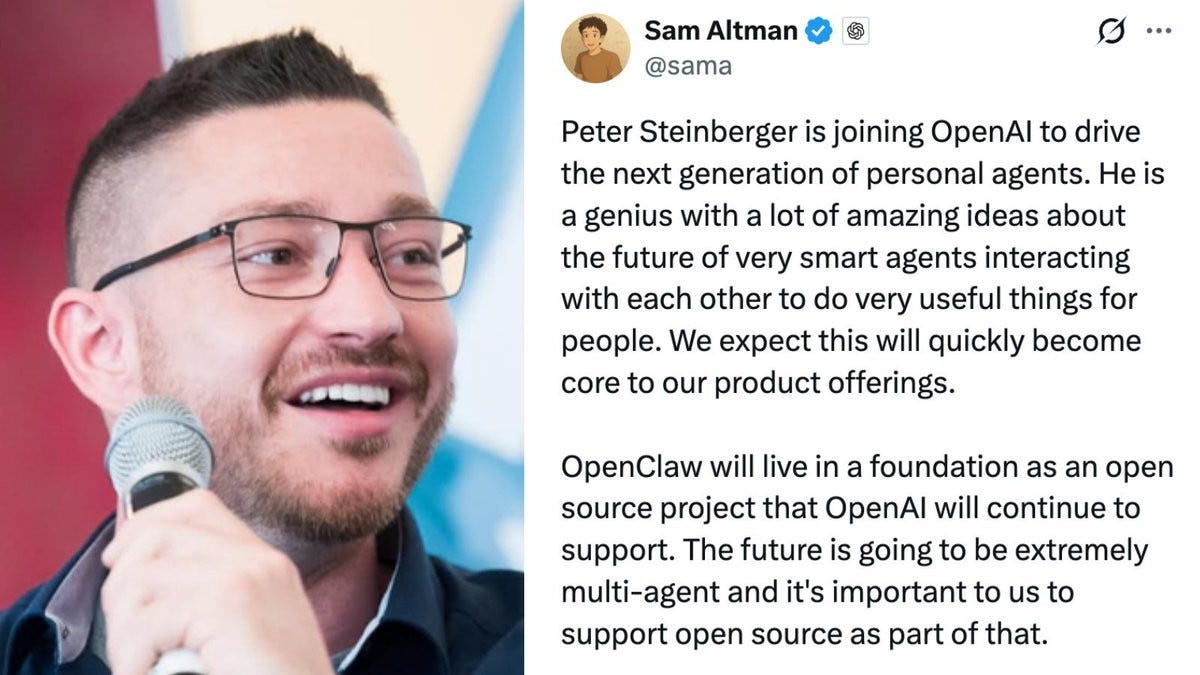
News: Peter Steinberger, creator of the VIRAL open-source AI agent OpenClaw, has joined OpenAI to build the next generation of personal agents. OpenClaw will transition into an independent foundation while remaining open source — a move Altman called critical for a “multi-agent future.”
Details:
OpenClaw — originally called Clawdbot, then Moltbot after Anthropic’s trademark complaint — went viral in late January 2026, amassing nearly 196,000 GitHub stars and 10,000 commits from 600 contributors in under 2 weeks, making it one of the fastest-growing open-source projects in history.
Steinberger said he could see OpenClaw becoming a huge company, but that wasn’t exciting to him — he spent 13 years building one already. His stated mission: “build an agent simple enough for his mother to use, which requires access to frontier models and safety research”
Altman called Steinberger “a genius with amazing ideas about the future of very smart agents interacting with each other,” adding that agents will quickly become core to OpenAI’s product offerings.
OpenClaw will live in a foundation as an open-source project that OpenAI will continue to support.
Why It Matters: This is a fumble of the century for Anthropic and a masterclass in opportunism from OpenAI. Steinberger built this project for Claude, named it after Claude, and was actively driving revenue and developer mindshare to Anthropic’s API. Instead of recognizing what they had — an unpaid evangelist building the most viral agent ecosystem in history on top of their model — Anthropic sent lawyers. Meanwhile, OpenAI played this perfectly. A company that has taken relentless criticism for having “Open” in its name while shipping only closed models just attached itself to the fastest-growing open-source project in AI history — and got an open-source foundation in the deal. Consider the context: Meta just spent $2 billion acquiring Manus to jumpstart their agent strategy, and OpenAI has been losing ground in traffic and the AI coding race to Claude Code and Cursor. By hiring Steinberger and sponsoring the OpenClaw foundation, OpenAI hijacked onto exponential community growth at a fraction of Meta’s price — and reset the “open vs. closed” narrative in one move. Very well played.
🌱 ByteDance’s Seed 2.0 redraws the frontier map at 1/10th the price
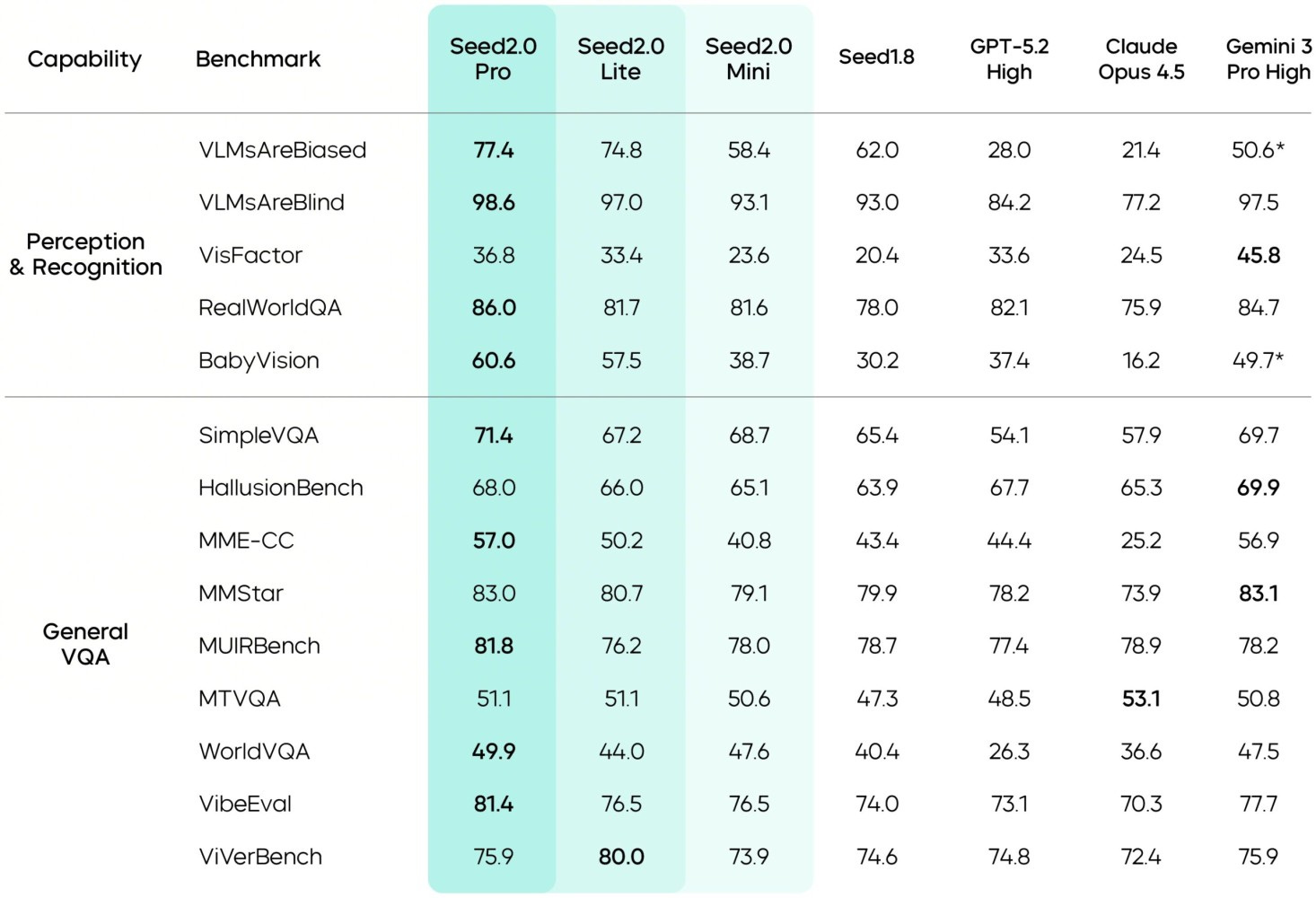
News: ByteDance released Seed 2.0, a new model family that matches or outperforms GPT-5.2 and Gemini 3 Pro across dozens of benchmarks at roughly one-tenth the cost. The launch caps a week where ByteDance simultaneously ignited a full-blown Hollywood copyright crisis with its Seedance 2.0 video model — drawing cease-and-desist letters from Disney, Paramount, and formal condemnation from the Motion Picture Association and SAG-AFTRA.
Details:
Seed 2.0 Pro tops GPT-5.2 ($1.75/M input tokens) and Gemini 3 Pro ($5/M) across math, reasoning, and vision benchmarks at just $0.47/M input tokens. The model scored gold medal-level results in all five ICPC programming competitions tested and reached 35/42 on the International Mathematical Olympiad, outperforming both Western competitors.
The model series spans three sizes (Pro, Lite, Mini) plus a dedicated code model, all engineered for real-world agentic tasks. Demos show it autonomously completing 96-step CAD modeling workflows, signaling ByteDance’s push into enterprise agent use cases.
Meanwhile, Seedance 2.0 went viral when Irish filmmaker Ruairi Robinson generated a cinematic fight between Tom Cruise and Brad Pitt from a two-line prompt. Within a single day, the MPA called it “unauthorized use of U.S. copyrighted works on a massive scale.” Disney sent a cease-and-desist accusing ByteDance of a “virtual smash-and-grab” of its IP. Paramount followed with its own letter citing infringement of South Park, Star Trek, The Godfather, and more.
ByteDance responded that it “respects intellectual property rights” and is strengthening safeguards, but has not pulled the model. Seed 2.0 is live on ByteDance’s Doubao app and via Volcano Engine API, though consumer access outside China remains limited.
Why It Matters: ByteDance is now running a two-front assault on the Western AI landscape that no single company has attempted before. On the model side, Seed 2.0 at one-tenth the price forces every founder and CTO to ask the question they’ve been avoiding: if a Chinese model matches your frontier provider at 90% less cost, what exactly are you paying the premium for? On the content generation side, Seedance 2.0 just stress-tested every IP protection framework Hollywood has built — and they all failed in under 24 hours. Whether you’re making model selection decisions or watching the copyright landscape evolve, ByteDance just accelerated every timeline simultaneously.
🔬 GPT-5.2 rewrites 40 years of assumptions in 12 hours
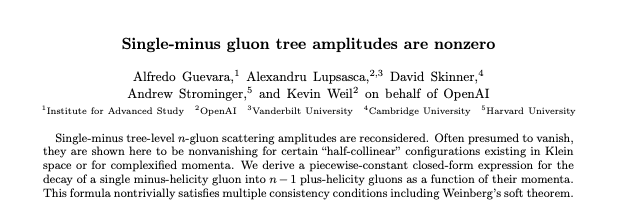
News: OpenAI published a research preprint where GPT-5.2 independently discovered that a class of gluon interactions physicists had assumed were impossible can actually occur under specific conditions — then proposed the correct mathematical formula and formally proved it. The paper, co-authored with researchers from the Institute for Advanced Study, Harvard, Cambridge, and Vanderbilt, represents what the company is calling AI’s first original contribution to theoretical physics.
Details:
The preprint, titled “Single-minus gluon tree amplitudes are nonzero,” overturns decades of textbook consensus. Standard arguments held that single-minus gluon amplitudes must vanish at tree level; GPT-5.2 identified a specific mathematical regime — the half-collinear regime — where the reasoning breaks down and the amplitude is non-zero.
Human physicists first calculated the amplitudes for small values by hand, producing superexponentially complex expressions. GPT-5.2 Pro dramatically simplified those expressions, spotted a recursive pattern across the base cases, and conjectured a general formula valid for any number of particles.
An internal scaffolded version of GPT-5.2 then spent roughly 12 hours reasoning through the conjecture and produced a formal proof, which was verified analytically against the Berends-Giele recursion relation — a standard validation method in particle physics.
UC Santa Barbara physicist Nathaniel Craig called the result “journal-level research advancing the frontiers of theoretical physics” and said his research group is already exploring its implications. Harvard physicist Andrew Strominger, a co-author, noted the AI pursued a path no human would have attempted.
The methodology is already being extended to graviton amplitudes — particles that mediate gravitational force — opening the door to implications well beyond the strong nuclear force.
Why It Matters: AI is falsifying a 40-year assumption that the entire field accepted as settled. The methodology is what makes this transformative: humans defined the problem, AI simplified the complexity beyond what any human could hold in their head, spotted a pattern across impossibly complex expressions, and then proved its own conjecture. If AI can independently overturn accepted conclusions in theoretical physics, every industry built on expert consensus — from drug discovery to financial modeling to engineering standards — is on notice. The template this paper establishes (human-defined problem → AI-driven discovery → human verification) is likely how frontier research gets done from here forward.
🧬 Simile raises $100M to simulate human behavior
News: AI startup Simile raised $100 million in funding led by Index Ventures, with participation from Bain Capital Ventures, A*, Hanabi Capital, and notable AI figures including Fei-Fei Li and Andrej Karpathy. The company builds AI simulations populated by agents based on real humans to predict purchasing decisions, earnings call questions, and reactions to corporate announcements or product launches.
Details:
Simile was founded by the Stanford team behind the landmark 2023 “Generative Agents” research — Joon Sung Park, whose paper introduced a virtual town called Smallville where 25 AI agents autonomously formed relationships, spread invitations, and organized a Valentine’s Day party without any human instruction. The paper’s citation count crossed 10,000 before Park had even finished his PhD.
The founding team is a Stanford dream roster: three professors — including the creators of the Generative Agents paper, the ImageNet benchmark, and the HELM evaluation framework — plus Lainie Yallen, a former early Hebbia operator who helped scale revenue 15x before joining as the commercial co-founder.
The company emerged from stealth after seven months developing an AI model trained on interviews with hundreds of people about their lives, historic transaction data, and text from scientific journals on behavioral experiments. Early reports indicate CVS is already testing the platform to optimize product stocking and display decisions.
Leading companies are using Simile to rehearse earnings calls, model litigation outcomes, and test policy changes, with the company’s long-term vision of simulating entire worlds of interacting decisions across individuals, organizations, and cultures.
Why It Matters: This is the most credentialed team you could assemble for this problem — the researchers who literally invented generative agents turning their academic breakthrough into a commercial platform. What makes Simile different from the sea of AI agent startups is the specificity of the bet: they’re not building general-purpose agents, they’re building digital twins of real human decision-making trained on actual interviews and behavioral data. If it works at scale, this replaces not just focus groups but entire categories of market research, policy testing, and strategic planning. Companies that learn to simulate their customers before launching will have a structural advantage over those still relying on gut instinct and post-hoc surveys.
TOOLS
Kimi Claw — Deploy OpenClaw agents to the cloud through Moonshot AI’s platform. Includes 5,000+ community skills and 40GB cloud storage. Best for teams looking to scale agent workflows without managing local infrastructure.
FireRed-Image-Edit — New open-source image editing model from Xiaohongshu delivering state-of-the-art results on multiple benchmarks. Worth watching if you’re building with open-source image pipelines or evaluating alternatives to proprietary editing APIs.
Gemini 3 Deep Think — Google’s upgraded reasoning mode for complex problem-solving, scoring 48.4% on Humanity’s Last Exam and 84.6% on ARC-AGI-2. Designed for tasks where accuracy matters more than speed — think multi-step analysis, research synthesis, and strategic planning.
QUICK NEWS
Spotify CEO Gustav Soderstrom revealed the company’s top developers haven’t written a single line of code this year, calling them “all in” on the AI transition. The company’s internal system Honk, built on Claude Code, lets engineers deploy features from Slack on their phones.
Alpha School shared test results showing its 2-hour, AI-first academic model has students scoring in the 99th percentile across virtually every grade and subject — a data point that will fuel the growing debate over whether the traditional school day is built for learning or for logistics.
Comments
Nothing yet. Say the first thing.
Sign in to join the conversation.