
My stomach dropped and my whole body froze as I stood there, completely helpless, as I saw my dog almost get hit by a car.
I started shaking as my body went completely cold.
My parents had been babysitting my dogs while I was on client calls and they were bringing them back to my house. They pulled in the driveway and, while they usually hook them on the leash before they bring them in, my one dog jumped out of the car before my mom could leash him.
There were two dogs walking on the sidewalk on the other side of the road, and my dog darted across the street to try and go say hello to the other dogs.
There was a car coming and it nearly hit my dog as he ran right out in the street (dogs, as it turns out, do not know to look both ways before crossing the street).
We got my dogs back inside and, even though we were about to eat dinner, I completely lost my appetite (I was in a very conflict active state).
I started screaming irrationally at my mom (who had not grabbed my dog in time before he squeezed out of the car) and crying as I was shaking uncontrollably.
My husband and both of my parents told me to just calm down.
Ah, a phrase I’ve been told many times through my life.
Why can’t I just react a little less intensely?
And, I also ask myself, “why the f*ck can’t I just CALM DOWN?”
But, I was in survival mode. You see, through my perception, I experienced that entire event as if my dog had actually been hit by the car.
My brain was “wired,” if you will (based on past conflicts, trauma, and just my perception of the world in general as a chronic “worst case scenario” junkie) to go straight to worst case scenario. Almost always.
Primally, and biologically, my body really did not understand that my dog was just fine.
I was still trapped in a full-on conflict active, survival, “fight or flight” state.
My imagination, for several weeks, played out the scenario in my head as if my dog has been hit and his little body was splattered all over the street.
It was a constant nightmare. And, not surprisingly, my nervous system responded as if what was happening in my imagination was actually real.
I also became extremely hyper-vigilant about, well, everything. I stopped taking my dogs to the park in case a little kid left the gate open on accident. I was obsessive about being sure to very carefully and slowly open doors so my dogs couldn’t sneak past. I didn’t want my parents to take them anywhere in the car, because I didn’t trust that they would be careful enough when opening the doors/hooking them on the leash. Always having them on leash to go outside, even though our backyard has an electric fence system.
I was constantly, obsessively thinking about how can I keep them safe? How can I prevent losing them (especially in a tragic, untimely way)?
How can I figure out how to prevent a potential separation?
And, boom. This is what I’ve come to understand as the unique “flavor” for hair loss (both in my own experience and from the clients I’ve worked with).
Typically, in the Germanic Healing Knowledge, or German New Medicine (GNM), framework (click here if you’re wondering what the heck is GNM??) hair loss is simply a separation conflict. However, I’ve come to understand it as a little more specific than that. It’s not just either wanting to be separated from someone/something or to NOT be separated from someone/something (wanting to either push them away vs. wanting to draw them close), but rather needing figure out (think of the phrase, “scratching my head” to figure something out, which is perhaps how it relates to the scalp) HOW to PREVENT a potential separation.
Perhaps this is why hair loss is commonly seen in postpartum women (again, not everyone experiences this, because we all perceive and experience conflict shocks differently… but it is more common in this demographic). They have this tiny, precious new being and they’re constantly thinking about how to best protect it and keep it healthy and safe. In other words, how to prevent a potential separation.
So, if something unexpected and distressing happens where you felt isolated in your experience in that moment (i.e. a “conflict shock”) that is not a separation conflict in and of itself, but it results in more of a fear of a potential separation, and that you need to figure out how to prevent that, then that would be what I’ve come to understand as the unique flavor of an epidermal scalp adaptation that can result in hair loss.
To fully understand this story, you have to know just how much I love my dogs. As someone who doesn’t want children, my dogs are my babies. They’re my whole world.
I’ve frequently thought that I’m really not sure how I could go on if I lost them.
Especially Fitzgerald, my oldest dog. He’s a 10 year old Lhasapoo, and he is my best friend.
I also have Winston, a 2 year old Westie.
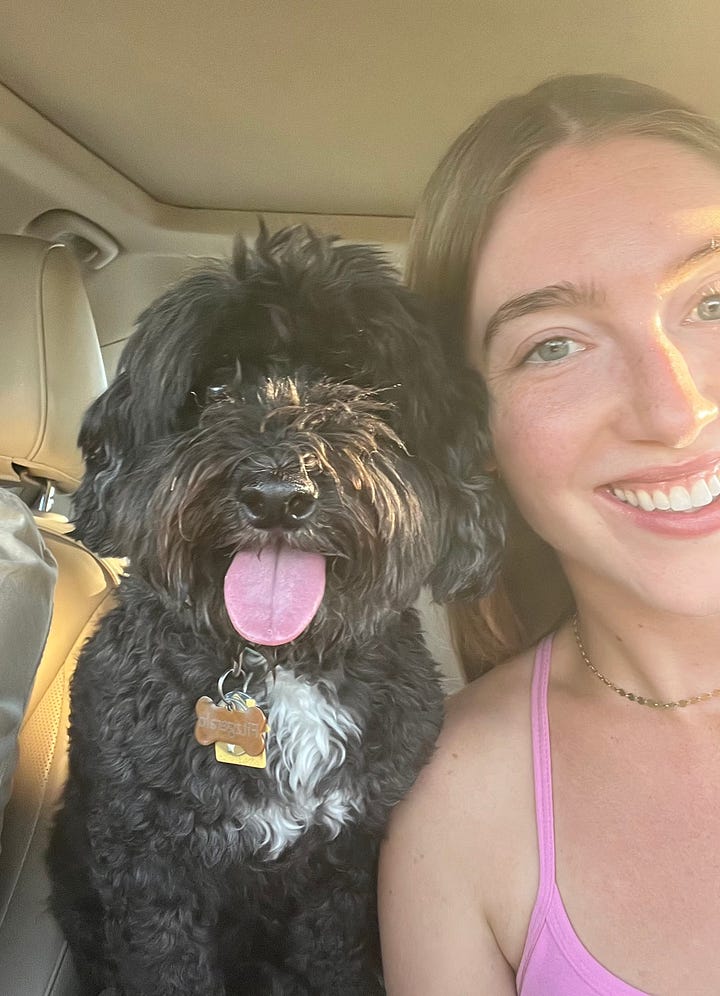
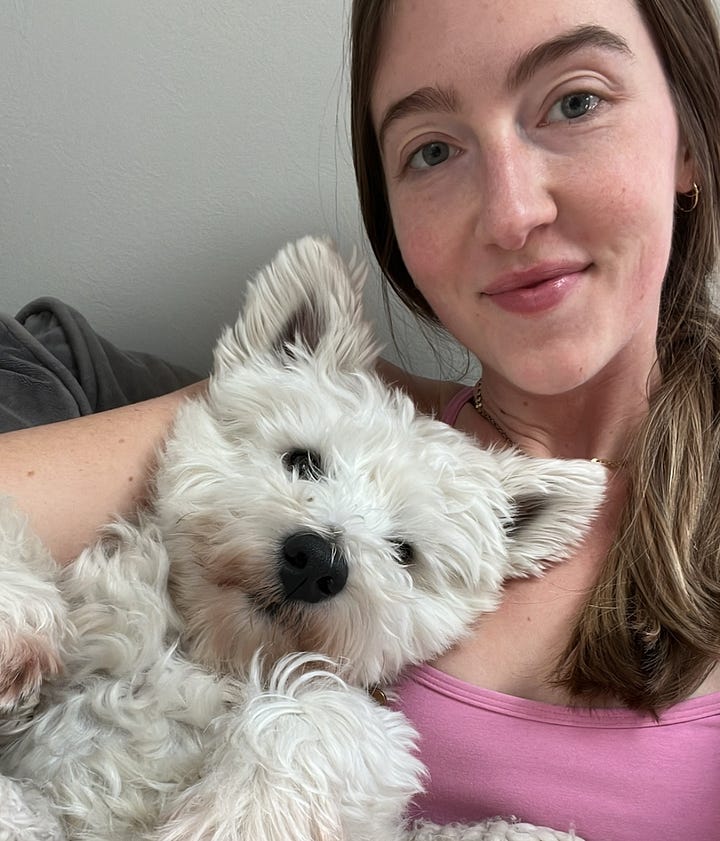
There’s probably nothing I love more in the world than my dogs (except my husband, of course).
Anyhow, a lot of people have asked me to share my hair loss story and how I “solved” the underling conflict. They want to know about hair loss from a GNM (German New Medicine) perspective, which is a framework for understanding how and why our body adapts that is in what I like to call the “mind body” realm.
Because, of course, I think a lot of understand the fairly straightforward premise that our lived experience (and what we might call “stress” or “trauma”) obviously has an impact on our physiology.
But the GNM framework provides a way of understanding the specific psychobiological conflicts that are at the root of specific symptoms/diagnosis labels. There is a lot of synchronicity between this framework and other “mind body” approaches, especially with things like Traditional Chinese Medicine and other ancient ways of understanding the body’s wisdom, but this is currently the paradigm through which I view the world around me and, well, just makes the most sense based on my own personal lived experience and my background in the health world.
So, for me to properly describe the conflict that leads to hair loss and my own personal take on the specific nuance or “flavor” of conflict, you have to understand my relationship with my dogs and just how important they are to me.
For additional context, I had also found out the day before that our neighbor’s dog had unexpectedly passed (who was also a Westie - and my deep love of this neighbor dog was actually why I decided to get our Westie puppy, Winston) and then within 24 hrs I also discovered that our other neighbor’s dog had just received an unexpected diagnosis. These are examples of what I would call perception priming - where you are become even more “eligible,” so to speak, to experience a certain type of conflict or a more intense conflict shock than perhaps you otherwise would be.
Anyhow, in the days following that shocking event, my hair started falling out. And not just a little extra shedding here and there, as I’ve always had a thick head of hair and have plenty of “normal” shedding, but big clumps started coming out. I knew exactly what the conflict was and was not exactly surprised by this, but it was very distressing. My hair started to thin more and more and I hated brushing my hair, taking showers, or even putting my hair in a sad, thin little ponytail that was getting smaller and thinner by the day.
It might sound a bit vain, I suppose, by losing my hair like that was incredibly distressing in a way that I didn’t quite expect.
And, let me tell you, I tried EVERYTHING to solve this conflict. I had a session with a trusted mentor. I tried revisiting the memory and trying to revise it. I tried to just chill out.
None of which were working.
You can know everything there is to know about GNM. You can understand the tissue layers and brain regions and types of conflicts. You can know 100% what the exact conflict shock moment was (like I did). And yet, you still struggle to actually solve the conflict.
And let me tell you, I was very conflict active. Despite my work as a GNM-informed practitioner and helping coach other people on how to understand, downgrade, and work on resolving their conflicts.
My brain was obsessed with it. I was constantly ruminating on the possibility of losing my dogs.
And, as for a practical, biological resolution, there wasn’t one (other than getting rid of my dogs, which would’ve made the conflict irrelevant, and therefore solved - but I obviously wasn’t willing to do that). My dogs won’t live forever. I can’t prevent every possible type of tragedy. There’s always the possibility that it could happen again.
So, I wish I had a neat and tidy way to sum this up for you and say “here’s my 3-step method for resolving hair loss!!”
But, resolution doesn’t work like that.
So, how did I resolve it?
Well, I don’t know. It wasn’t some big “aha” moment. It just happened, slowly.
I did take some action steps, though.
I fully made peace with the fact that my hair would probably continue to fall out, and that I was okay with that (I even looked at wigs). Because obsessing with the symptom is a surefire way to perpetuate the conflict.
I wore a hat and stopped looking in mirrors so I wasn’t constantly bombarded by feelings of distress around my hair loss.
Knowing I was conflict active, I tried to really take care of myself by lots of warm, hot baths, high sugar foods (apparently your brain uses 16x more sugar when you’re in conflict active), and letting myself just not eat when I wasn’t hungry, usually opting for more liquid foods like smoothies and broth and such.
But, truthfully, it all boiled down to focus.
I started focusing more on what I want.
You can’t get rid of all the “bad” stuff or tragedy or erase fear.
But, you can change what you focus on.
When all of your focus “oxygen” is being used up on focusing on what you want, going out and about, and just living your life… you simply have less time and “oxygen” to spend on ruminating on the conflict.
In some ways… it can really boil down to just making yourself busier (mentally).
I started getting out the house more (as my dogs were triggers, as every time I looked at them I would immediately have a visual flashback of my dog almost getting hit by that car).
I started spending more time with friends.
Working on my business goals.
Going places with my husband.
Not that my dogs will ever lose importance to me, but I do have the tendency to be such a homebody that my entire world becomes, well, my dogs. Even when my husband is at work, my dogs are there. It’s always me and them.
How can I change how I perceive the world around me so that I am simply not as eligible for this type of conflict? This is the main question at the heart of any perceptual resolution.
So, I started getting really curious about how I can make my dogs just a little bit less of a big deal in my life. How can I focus on other aspects of my life and cultivating more of what I want?
And, I wasn’t perfect at this. It took a few months for my hair to stop falling out. Little baby hairs slowly started growing back in. It’s still perhaps not quite as thick as it was before, but the conflict is definitely super downgraded and I no longer have the flashbacks or am so obsessive about trying to figure out how to keep my dogs safe.
My hair is basically back to how it was before.
So, that’s my hair loss + resolution story. Again, this is not prescriptive or meant to be a lecture on this symptom, but rather to share my thoughts on the psychobiological roots of hair loss from both my own personal experience and through the lens of the GNM framework, which is simply what currently makes the most sense to me and is how I view symptoms (“adaptations”).
I usually find that our conflicts are so much more about the little things (well, that we judge and perceive as things that “shouldn’t” cause that big of a conflict) way more than the capital-T “Traumas” that we’re societally and culturally “allowed” to process. The things that we’re perhaps even encouraged to seek help for, process, and work through. The things that people reach out to you about to check in and see how you’re doing… to see if they can bring a warm meal over.
But, in situations like this? I honestly felt so ashamed, stupid, and “less than” for this affecting me to this extent. Not to mention those in my life who quite literally brushed it off and just didn’t understand why I’d be so upset.
I recently had a friend tell me that two big things recently happened in her life: her grandpa passed away and she’s getting ready to move because her husband got a new job. She said that she was struggling with the grief that she was feeling around moving and leaving behind the place that they’ve called home for the past few years, and that she felt stupid for being sad about that when her grandpa had just died - something she viewed as more worthy of grieving. Something that we would give ourselves more permission to feel grief around.
Out of all the clients I’ve worked with, I find that the vast majority of conflicts are about things or situations which you might not classify as a typical “trauma.” They usually involve a hefty dose of “shoulds” as well - or rather… should NOTS. I shouldn’t feel this intensely about this. I shouldn’t have a conflict over this. It is actually SO embarrassing that this is THIS big of a deal to me. My reaction to this wouldn’t be accepted societally, familialy, or culturally, so instead my body will need to adapt so that I can tuck this away in my subconscious. I must bury it.
I know that this story is not tied up in a neat little “how I reversed my hair loss in 5 easy steps” bow, but a real, messy, lived experience that reminded me (again) that resolution isn’t about doing the right thing or thinking the right thought. It’s about shifting how you view the world around you. It’s about loosening the grip. Creating more room. Giving yourself permission to stop obsessing and start living. Because when your entire system is devoting 100% of its oxygen to fear and what ifs, there’s simply no space left for freedom. And that’s really what GNM has given me - a way to understand my body’s adaptations through the lens of perception, not pathology.
And, if nothing else, I hope this reminds you that your “weird little” conflict - the thing that feels too embarrassing or irrational or not serious enough to matter - is exactly the kind of thing that does matter. Because it mattered to you - to your psyche. And your biology responded accordingly.
That doesn’t make you broken. That makes you beautifully, sensibly human.
Stay curious,
Abigail
If you enjoyed this post, please consider sharing it or leaving a comment below! Thank you :))




No posts
Comments
Nothing yet. Say the first thing.
Sign in to join the conversation.