
I had Claude review articles on AI adoption in the workplace from 100 high-quality sources (major news outlets, peer-reviewed journals, reputable research firms, etc.) appearing over the past two weeks, and asked it to identify the dominant emotional states of employees as they adjust to the increased use/presence of AI tools and automation. This is what it found:
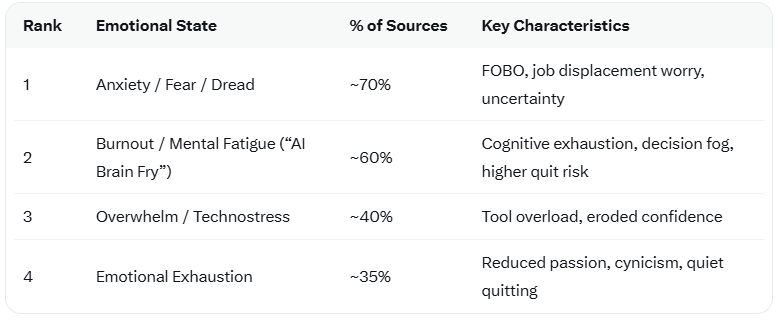
The percentages represent how often each emotional state appeared across the 100 articles and studies reviewed. These states heavily overlap - one employee or one article can (and usually does) reflect multiple emotions at once (e.g., anxiety + burnout + overwhelm) - which is why the totals exceed 100%. Positive states (i.e., excitement) and neutral ones (indifference) appear in <25% of sources. Suffice it to say, there’s precious little “technojoy” in AIsville.
A couple of months ago, Dr. Jennifer Miller, co-founder and managing partner of Millan, joined the AIX Factor to provide a sneak preview of the report they did in association with the Work Institute titled “The Impact of AI on the Workplace.” They described it as “a comprehensive analysis based on survey responses from employees across organizations of all sizes,” and it revealed several critical findings:
Widespread adoption with uneven support – While 75% of companies use AI and 94% of those employees engage with AI tools daily, one in five workers are navigating this shift without clear organizational backing.
Individual gains, team losses – AI is dramatically improving individual productivity, but its impact on team collaboration is lagging behind.
The training gap – Nearly half the workforce is navigating AI adoption without formal guidance, despite broad agreement among leaders that AI training is essential.
The report also revealed the various ways anxiety lurks beneath the surface:
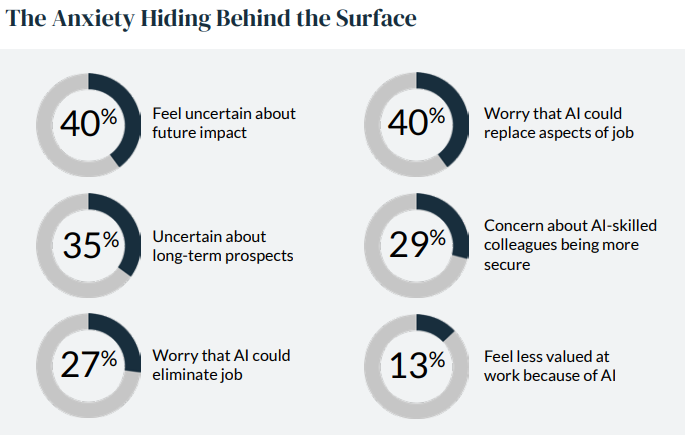
One of the more interesting findings is what the authors refer to as the Gen Z paradox: the generation most comfortable with technology is receiving the least support and experiencing the highest levels of anxiety about AI’s long-term impact on their careers.
These findings highlight that AI implementation is not simply a technology initiative—it’s a workplace transition that requires clear leadership, intentional communication, and aligned organizational support.
For leaders, the challenge is not to predict every outcome of AI adoption. The challenge is to create clarity, confidence, and alignment while outcomes are still forming. Impact of AI on the Workplace; Winter 2026 Report
The report makes the following recommendations to “meaningfully influence employee experience and perceptions during this period of change”:
Equip Managers to Interpret Change, Not Just Implement It
Clarify Skill Pathways and Learning Expectations
Use Employee Listening to Detect Uncertainty Early
Anchor AI Strategy in Organizational Values and Purpose
Download the report here. Which begs the questions:
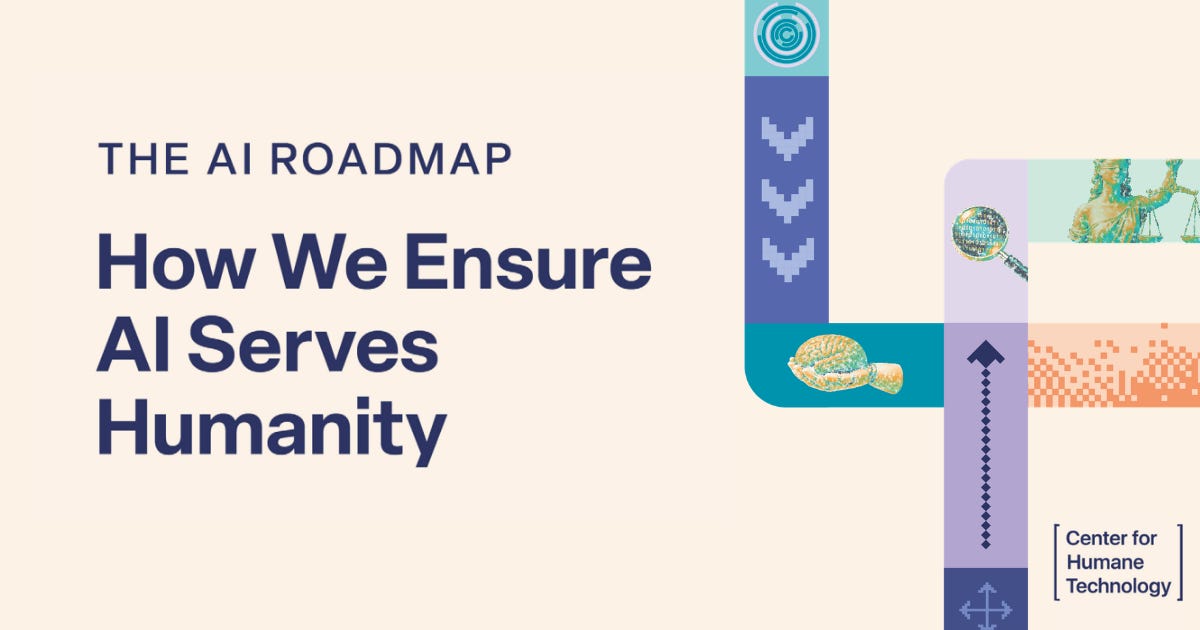
The Center for Humane Technology (CHT) was founded by tech insiders to advocate for a shift away from attention-extraction business models toward technology that supports well-being, democracy, and shared reality. I strongly recommend you check out their recently published report, The AI Roadmap: How We Ensure AI Serves Humanity. It lays out seven principles that outline how the technology should be built, deployed, and governed. Highly recommended.

Surveys & Assessments in the Workplace: Using AI to Interpret Open-Ended Responses. Participants will gain a clear framework for when and how to apply AI to qualitative survey data to support sound HR decisions. AIX’s Charles Epstein will be joined by (the aforementioned) Dr. Jennifer Miller, PhD, co-founder and managing partner of Millan, a management consulting firm focused on using data for people-centered, smarter decision-making. When: April 29, 2026, at 11:00 AM - 11:30 AM ET. Click here to sign up. (AI4HR Live! is a virtual series produced by HR.com that showcases practical AI adoption strategies.)
Offbeat tales of AI being unintentionally funny (i.e., woefully wrong), bizarre, creepy, (amusingly) scary, and/or just plain scary.
More brainrot and ragebait, please, said no one ever. Meet Noscroll, an AI bot that does your doomscrolling for you. What if you could outsource your doomscrolling? That’s the premise behind the new startup Noscroll, which is offering an AI-powered bot that can browse your social feeds, news sites, and other online chatter, then text you when something important happens. “No feed, no brainrot, no ragebit,” reads Noscroll’s pitch to users. “Just signal.” Source: TechCrunch

The week’s most interesting and timely articles on AI and its impacts on employee wellbeing and readiness.
AI Is Boosting Productivity and Burnout: Teams Must Build Hope. AI tools are increasing output and workloads simultaneously, leading to higher burnout; leaders must actively shape hopeful narratives to protect team wellbeing.
Source: Psychology TodayIncreased AI expectations without guidance lead to employee burnout. Daily AI use has quadrupled while burnout in tech nearly doubled; unchecked expectations without training or support are fueling friction-based exhaustion. Source: CIO
AI May Be Making Workers Less Confident In Their Own Decisions, Study Finds
Over-reliance on AI tools is eroding employees’ trust in their own judgment, potentially harming mental health and long-term problem-solving confidence.
Source: ForbesAI Fatigue, Causes, Signs, and Coping. Rapid AI tool evolution is overwhelming workers, driving measurable increases in burnout, anxiety, disengagement, and turnover risk. Source: Talkspace
Workplace Wellness, Rewritten by AI. AI is transforming wellness initiatives through real-time posture tracking, mental-health chatbots, and behavior monitoring—creating both opportunities and privacy concerns. Source: HackerNoon
AI Readiness. Pearson–AWS research shows AI readiness requires more than technical skills—it demands curiosity, ethical judgment, and human capabilities like adaptability. Source: Pearson
AI-ready skills are not what you think. The real challenge is teaching employees to question, validate, and supervise AI rather than simply use it. Source: Computerworld
Widespread AI Use Masks a Growing Workplace Readiness Gap. 9 in 10 employees use AI daily, yet only 1 in 6 feel fully prepared, and many have received zero training, widening the proficiency gap. Source: TechRepublic
Three AI learnings from Cisco’s CPO Kelly Jones. Cisco’s CHRO stresses embedding wellbeing into AI transformation, modeling healthy culture, and treating mental health as a performance priority. Source: UNLEASH
AI in health and benefits: Survey reveals rapid adoption. Employers are rapidly deploying AI for personalized benefits and analytics, but data privacy, error risks, and compliance remain major hurdles. Source: WTW
Industries Least Prepared for AI-driven Workforce Change. Hospitality, healthcare, and finance top the list of sectors where AI exposure far outpaces workforce readiness and skills. Source: NJB Magazine
AI anxiety and employee monitoring: Workplace stress...AI anxiety plus intensified surveillance is driving measurable burnout, irritability, and mental-health declines for many workers. Source: Mashable
Beyond the Model — Why Responsible AI Must Address Workforce Impact
Responsible AI programs must treat workforce effects—skills atrophy, overreliance, and intensification—as core risks, not afterthoughts. Source: MIT Sloan Management ReviewAligning Artificial Intelligence with Worker Health, Well-Being, and Safety: An Occupational Health Psychology Agenda. AI’s effects on jobs demand an occupational health psychology lens to safeguard mental health, safety, and flourishing at work. Source: Occupational Health Science (Springer)
Developed in partnership with HR.com, AIX is a multimedia knowledge and engagement platform for experts, leaders, and HR peers to exchange experiences and seek guidance on cultivating mentally resilient, emotionally intelligent, and professionally adaptable workforces in an AI-augmented world. AI will increasingly touch every corner of the employee experience—from hiring to training, from task management to team dynamics. Whether its impact is positive or harmful depends largely on how HR prepares for it. The AIX platform (The AIX Files, The AIX Factor podcast, and the AIXonHR.com community) will play an important role in promoting employee well-being, workplace culture, and organisational readiness, the critical success factors in the age of AI.
No posts
Comments
Nothing yet. Say the first thing.
Sign in to join the conversation.