
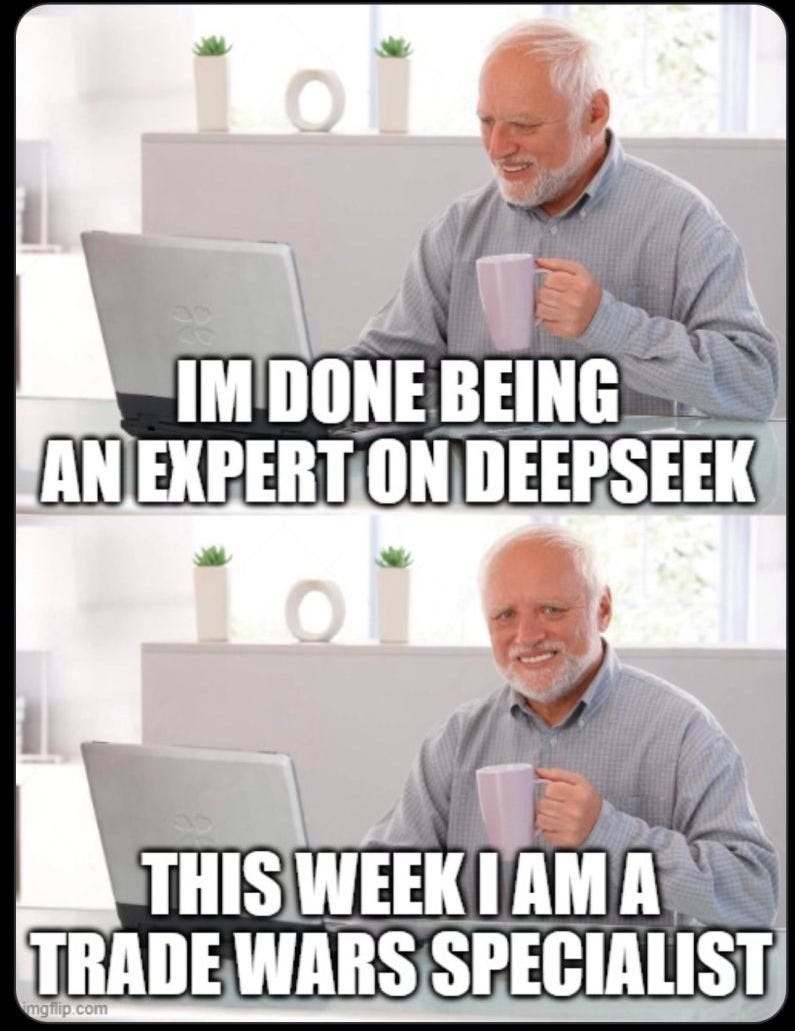
Legendary screenwriter William Goldman is known for writing some of the greatest movies ever made (Butch Cassidy and the Sundance Kid, All the President’s Men, Marathon Man, etc.), but is probably best known for his immortal line about Hollywood: “nobody knows anything.” The application of AI to just about every domain of knowledge and expertise provides its corollary: everyone knows everything (and everyone can do everything). But, on further inspection, the two lines wind up saying much the same thing.
In The Death of Expertise, published in 2017, Tom Nichols argues that the digital age has paradoxically made the public less informed despite unprecedented access to information. He describes a shift toward a “misguided intellectual egalitarianism,” where the average citizen believes a quick internet search makes their opinion as valid as a professional’s specialized knowledge. The book identifies several systemic factors contributing to this trend:
The Internet: The openness of the web allows for the rapid spread of misinformation, leading people to believe they have mastered complex subjects via platforms like Wikipedia or WebMD.
Higher Education: A shift toward a “customer satisfaction” model has softened academic rigor, often prioritizing student feelings over intellectual challenge.
Modern Journalism: The news industry’s evolution into a 24-hour entertainment cycle prioritizes engagement and “balanced” debates between experts and fringe voices, regardless of factual merit.
Nichols warns that when intellectual achievement is treated with hostility and dismissed as “elitism,” it creates an angry, ill-informed citizenry. This collapse of respect for established knowledge threatens democratic institutions by leaving them vulnerable to populism and a total breakdown in productive public debate.
It turns out that eulogies bemoaning the death of expertise have been premature. What the “digital age” and its accomplices did to bring about its death, AI has done to resuscitate it – more precisely, a version of it… one that addresses another very different set of problems: the democratization of expertise.
With AI, everyone can do everything. Marketing directors with no formal finance training are generating sophisticated revenue forecasts with AI. Accountants are producing polished brand visuals and pitch decks. Operations managers are drafting legal language, and junior analysts are leading strategy sessions armed with outputs from tools like ChatGPT, Claude, or Gemini.
What once required years of specialized training now takes a few well-crafted prompts. The barriers to cross-functional work have collapsed. Employees at all levels are using generative AI to tackle tasks far outside their core competencies, often with management’s encouragement to “experiment” and boost productivity. A non-expert can now produce work that looks professional, blurring traditional lines of expertise.
This sounds great, until you bring the true experts in for a closer look. To a trained eye, AI outputs in unfamiliar domains will often lack nuance, context, or accuracy—resulting in flawed financial models, generic creative assets, or subtly incorrect strategic recommendations. But it’s not just these unfiltered, unqualified outputs that are flawed – and potentially disastrous if they reach clients or prospects – it’s a process that will inevitably cause friction and resentment when experts feel marginalized or out of the loop, threatening productivity, culture, and long-term organizational capability…creating a paradox where an organization of so-called experts puts you at risk of losing genuine experts.
AI is like Batman’s toolbelt, turning mere mortals into superheroes. It worked for Batman, but for most, an overliance on AI, particularly for tasks outside your actual skill set, creates an illusion of competence - Dunning-Kruger on stilts. Surrendering your judgment, problem-solving, and creativity to an AI chatbot will atrophy those important skills. It will also diminish your ability to spot errors in machine-generated work.
There’s even a correlation between heavy AI reliance and spikes in imposter syndrome - where polished machine outputs make users question their own contributions. Many feel like frauds because their impressive deliverables were heavily AI-assisted. Those known for heavy AI use also risk getting reps as lazier or less competent, even when outputs improve…or feel resentment when their colleagues assume their work is AI-generated, even when they’ve made genuine contributions unassisted by AI.
Others—true domain experts—watch their specialized knowledge being “good enough-ed” by non-specialists using AI, leading to resentment and a sense that hard-earned expertise is being devalued.
While the unchecked “everyone can do everything” mindset carries clear risks, the opposite extreme—rigidly forcing employees to “stay in their lane”—creates its own set of problems. Siloed mindsets stifle innovation, slow decision-making, and limit organizations’ ability to respond to complex, interconnected challenges. Employees confined strictly to narrow roles often experience boredom, reduced motivation, and stunted career growth. They miss the bigger picture, leading to suboptimal solutions that fail to account for cross-functional realities.
In today’s environment, pure specialization can become a liability. The most effective teams blend deep expertise with broader, multi-disciplinary knowledge. Developing fluency in adjacent domains enables richer collaboration, better questioning of AI outputs, and more holistic problem-solving. For instance, an art director who understands basic financial concepts can provide more strategic creative direction, while a finance professional with design literacy can communicate ideas more persuasively.
Disclaimer: this is NOT about democratizing access to new skills, which is a net positive. AI-powered learning platforms are providing people from all walks of life with greater access to personalized education and training tools that can accelerate skills development, enhance learning outcomes, and help individuals pursue new opportunities or professional growth.
There are attractive elements to the “democratization of expertise” — the idea that powerful knowledge and capabilities are finally becoming accessible to everyone. Tools like ChatGPT, Claude, and Gemini allow non-specialists to generate outputs that resemble the work of trained professionals in seconds. Expertise no longer appears scarce – it’s there for the taking. But there are clear downsides: As expertise becomes easier to imitate, genuine expertise becomes harder to recognize, harder to develop, and in some ways more valuable than ever.
People able to interact more intelligently across disciplines can be enormously beneficial. The problem is that AI creates the illusion that surface-level competence is equivalent to deep understanding. The easier it becomes to simulate mastery, the more difficult it becomes to distinguish between fluency and understanding, confidence and competence, output and insight. And in organizations flooded with AI-generated work, that distinction is rapidly becoming one of the defining management and cultural challenges of the modern economy.
The solution lies in thoughtful balance rather than extremes. Organizations should encourage the acquisition of multi-disciplinary knowledge; rather than replace domain experts, enable more intelligent collaboration. Employees need to know when to defer to true experts and when their expanded skill set allows them to contribute meaningfully or catch critical flaws in AI-generated work. It’s a good thing to have more jacks-of-all-trades, so long as there are acknowledged masters who are valued, deferred to, and relied on when it counts.

Surveys & Assessments in the Workplace: Using AI to Interpret Open-Ended Responses. This session introduces how AI can support HR teams in efficiently and consistently interpreting open-ended survey data while maintaining analytical rigor and transparency.
Recognize when open-ended items are most useful in employee surveys and assessments
Distinguish between common analytical approaches and understand when each is appropriate
Recognize the essential components of a structured codebook that support consistent interpretation
Understand common pitfalls, limitations, and best practices when using AI for qualitative text analysis in HR contexts
Featured Presenter: Dr. Jennifer Miller, PhD, co-founder and managing partner of Millan, a management consulting firm focused on using data for people-centered, smarter decision-making. Dr. Miller has a PhD in psychology and an MS in applied statistics.
Sign up for our next AI4AIX session, scheduled for May 27 at 11:00 – 11:30 AM ET. This is for HRCI/SHRM credit validation.
Offbeat tales of AI being unintentionally funny (i.e., woefully wrong), bizarre, creepy, (amusingly) scary, and/or just plain scary.
Reinforcement learning has taught machines how to master incredibly complex strategy games, including Dota 2 and Starcraft II. But there’s one area of gaming remaining—at least for now—where computers still can’t hold a candle to flesh and bone humans. They are still not great at learning different kinds of more open-ended games quickly. When it comes to picking up a random title from a game store that they haven’t seen before and getting the gist, human gamers still learn the ropes much quicker than even the most advanced AI models. Source: Popular Science

The week’s most interesting and timely articles on AI and its impacts on employee wellbeing and readiness.
Rising AI Adoption Spurs Workforce Changes. Gallup’s latest survey shows half of U.S. employees now use AI at work, with AI-adopting organizations reporting more disruption, staffing changes, and productivity gains. Source: Gallup
How AI Is Changing How We Learn at Work. Harvard Business Review explores how AI is fundamentally reshaping workplace learning, expertise development, and professional identity. Source: Harvard Business Review
What Workers Really Want from Artificial Intelligence. Stanford HAI study reveals a significant gap between what employees desire from AI and its current capabilities and implementation. Source: Stanford HAI
AI AND THE WORKFORCE 2025 White Paper. TechNet report explores how AI is advancing careers, democratizing skills, and enhancing workplace safety. Source: TechNet
U.S. Workers Are More Worried Than Hopeful About Future AI Use in the Workplace. Pew Research finds U.S. workers are more worried than hopeful about AI’s future impact on jobs and opportunities. Source: Pew Research Center
The AI-Ready Workforce. JFF’s new framework analyzes how AI impacts tasks and skills, offering readiness profiles for different industries and occupations.
Source: Jobs for the Future (JFF)Exploring how AI adoption in the workplace affects employees. Bibliometric review and analysis of AI’s effects on employee well-being, highlighting both positive and negative outcomes. Source: PMC (PubMed Central)
The effects of AI on firms and workers. Brookings synthesis shows AI adoption is associated with firm growth and increased employment, but also rising industry concentration. Source: Brookings Institution
AI powers into the workplace. ADP Research finds frequent AI users are more engaged and less stressed, but overall adoption patterns vary widely by industry.
Source:: ADP ResearchThe impact of AI on the workforce: Tasks versus jobs? U.S. Census Bureau survey finds AI is replacing tasks more than jobs, with 27% of firms reporting task substitution but only 5% seeing employment changes.
Source: Economics Letters
Developed in partnership with HR.com, AIX is a multimedia knowledge and engagement platform for experts, leaders, and HR peers to exchange experiences and seek guidance on cultivating mentally resilient, emotionally intelligent, and professionally adaptable workforces in an AI-augmented world. AI will increasingly touch every corner of the employee experience—from hiring to training, from task management to team dynamics. Whether its impact is positive or harmful depends largely on how HR prepares for it. The AIX platform (The AIX Files, The AIX Factor podcast, and the AIXonHR.com community) will play an important role in promoting employee well-being, workplace culture, and organisational readiness, the critical success factors in the age of AI.
No posts
Comments
Nothing yet. Say the first thing.
Sign in to join the conversation.