
Welcome to this week's AI round-up! In this edition, we cover what Cloudflare's crawl-to-referral data reveals about AI's relationship with the open web, new research on AI and climate communication and three policy briefs on health AI readiness, European grid capacity for AI demand, and AI in urban traffic management.
This week at a glance:
Thanks for reading Substack of AI World! Subscribe for free to receive new posts and support my work.
Internet crawlers should give and take, by now they mostly take: Cloudflare data shows Anthropic’s Claude generating around 71,000 page requests for every referral sent back to a source, against Google’s near-parity ratio, with publishers already returning more than one billion HTTP 402 responses per day to AI crawlers.
AI can make climate data legible, but synthetic fidelity erodes the trust it depends on: three studies find that AI improves climate risk prediction and public reach, but that realistic AI-generated disaster images reduce willingness to act when their artificial origin is detected or suspected.
Startup spotlights: Compri, Timefold, and JUPUS each closed rounds this week across industrial procurement automation, enterprise scheduling infrastructure, and AI-powered legal operations.
1. Internet crawlers should give and take, by now they mostly take
Automated systems now account for 57.5% of global HTTP requests, more than a year ahead of Cloudflare's own forecast. A new Cloudflare metric comparing AI crawler activity against referral traffic finds that Anthropic's Claude generated around 71,000 page requests for every referral sent back to a source in the week of 19 to 26 June 2025, reflecting its heavy use in agentic and API-driven workflows where users never encounter the underlying links.
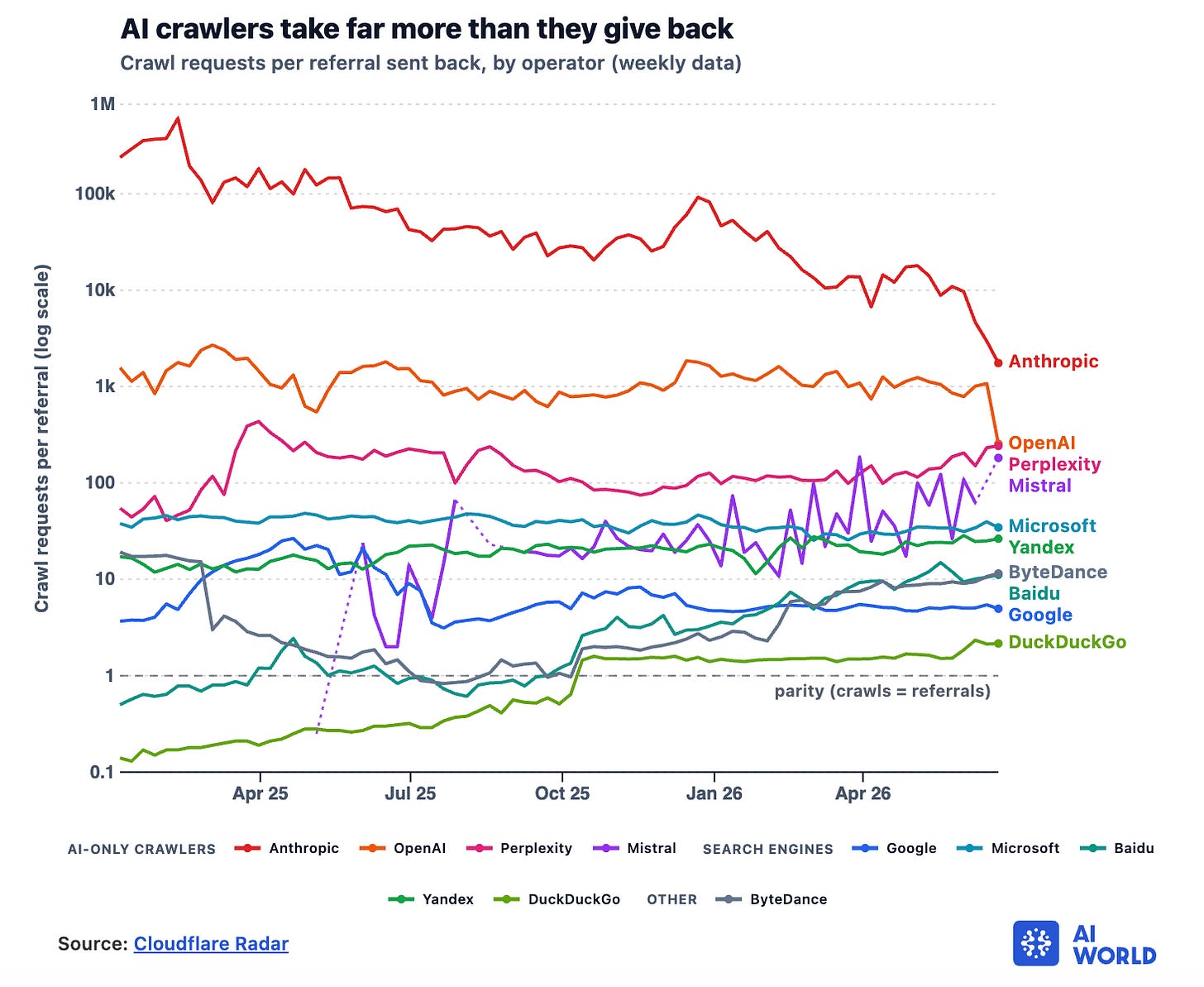
The contrast with traditional search is structural: Google's ratio sits closer to parity, because users still navigate to sources to read content in full. Publishers are already responding, with Cloudflare customers returning more than one billion HTTP 402 responses per day to AI crawlers, and the Wikimedia Foundation attributing a 50% rise in multimedia bandwidth since January 2024 to automated scrapers. The interface through which users choose to interact with AI determines not just how they experience it, but what the open web receives in return.
→ Read the full story at AI World
2. AI can make climate data legible, but synthetic fidelity erodes the trust it depends on
AI improves climate risk prediction and public reach, but the trust dynamics run in the opposite direction.

Three studies trace the same asymmetry. AI now predicts floods, droughts, and heatwaves more accurately and reaches more people than any prior medium, but Atkins et al. (2024) found its climate accuracy uneven across the regions that need it most, and Eppler (2026) found across 2,580 participants that realistic AI-generated disaster images erode trust and reduce willingness to act when their synthetic origin is suspected. Buck et al. (2026) argue the IPCC's core function is sustaining a shared basis of reality, and that AI backlash could erode exactly that.
→ Read the full paper summaries on AI World
3. Two policy briefs on energy and mobility
Deployment is outrunning readiness across two sectors. A UCL model puts the grid cost of European AI data centres at up to 323 GW of new capacity and 25 million additional tonnes of CO2 by 2050. An OECD and ITF paper concludes AI governs urban traffic most effectively as a guidance layer, adjusting flow without direct infrastructure control.
→ Read the full analysis on AI World Linkedin page
4. Startup spotlights of the week
This week’s selection showcases the application of AI to structural gaps in industrial procurement coordination, enterprise scheduling optimisation, and legal administrative operations.
🇮🇹 Compri: Milan-based, founded 2024 by Edoardo Arbizzi and Edoardo Gava. Compri deploys specialised AI agent teams across procurement and supply chain workflows, handling supplier chasing, compliance auditing, order tracking, and paperwork collection from a centralised hub integrating ERP systems, emails, and regulatory databases, with full SAP and Oracle integration and EU-hosted GDPR-compliant infrastructure. Raised €3.2 million in a seed round led by Picus Capital, bringing total funding to over €5 million.
🇧🇪 Timefold: Belgium-based, co-founded by Maarten Vandenbroucke and Geoffrey De Smet. Timefold provides scheduling optimisation infrastructure for software teams embedding routing and workforce scheduling into enterprise applications, combining AI with deterministic constraint optimisation across field service routing, shift scheduling, pick-up and delivery, and task scheduling. Raised $13 million in a Series A led by Alstin Capital, bringing total funding to approximately $19 million.
🇩🇪 JUPUS: Germany-based, founded by René Fergen, Jannis Gebauer, and Oskar Handrick. JUPUS automates the administrative core of law firm operations through three modules covering AI voice reception, client onboarding and case file creation, and document analysis drawing on a database of over one million German court rulings, built to comply with DSGVO, BRAO, and §203 StGB. Raised €13 million in a Series A led by Semapa Next.
What’s next
For more updates, research and insights across the AI ecosystem, visit aiworld.eu. Subscribe to receive next week’s round-up directly in your inbox and stay ahead of key developments.
Have a great weekend!
Gaia Cavaglioni
On behalf of the AI World Team.
Thanks for reading Substack of AI World! Subscribe for free to receive new posts and support my work.
Comments
Nothing yet. Say the first thing.
Sign in to join the conversation.