
Welcome to this week’s AI round-up! In this edition, we cover the first government-forced takedown of a commercially deployed frontier AI model, Europe’s AI compute trajectory to 2031 and what it reveals about continental dependence, new research on the technical and governance challenges of training a European frontier model, and three startups raising rounds across SAP migration automation, AI-assisted patent filing, and precision agriculture.
This week at a glance:
Thanks for reading Substack of AI World! Subscribe for free to receive new posts and support my work.
The first frontier model to get banned: three days after launch, Claude Fable 5 was pulled worldwide after a US government directive targeted foreign national access, establishing for the first time that proprietary AI models can be treated as export-controlled assets and leaving every non-American working at a US AI company with a newly clarified understanding of how precarious that access is.
Where European AI compute is heading: Europe is projected to hold around 5% of global AI compute capacity by 2031, with France set to account for 35% of the continental total if current plans are executed, while the US is forecast to hold roughly 70% globally.
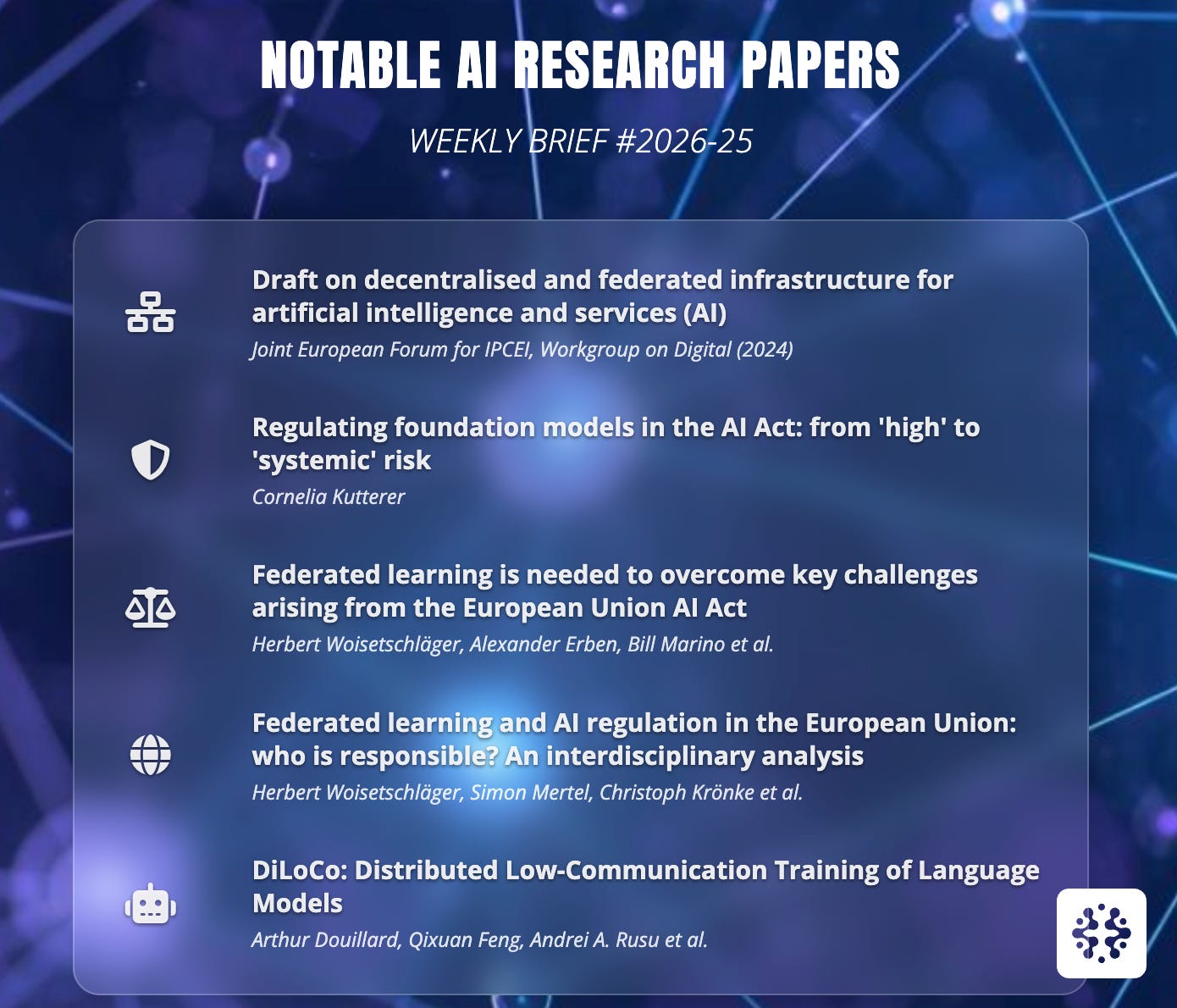
Training a European frontier model: five papers map the technical path from distributed compute to a model at scale, and find the hardware increasingly tractable and the governance questions still largely unresolved.
Startup spotlights: Qorelo, Lightbringer, and OneSoil each closed rounds this week across SAP migration automation, AI-assisted patent filing, and precision agriculture.
1. The first frontier model to get banned
Three days after launch, Claude Fable 5 was suspended worldwide after Anthropic received a government directive ordering immediate compliance and citing national security authorities. The trigger was reportedly a claim that Mythos 5 had been jailbroken in one specific cybersecurity scenario; Anthropic described the jailbreak as narrow and non-universal and called the situation a misunderstanding, but complied within hours, having no practical mechanism to filter by nationality in real time.
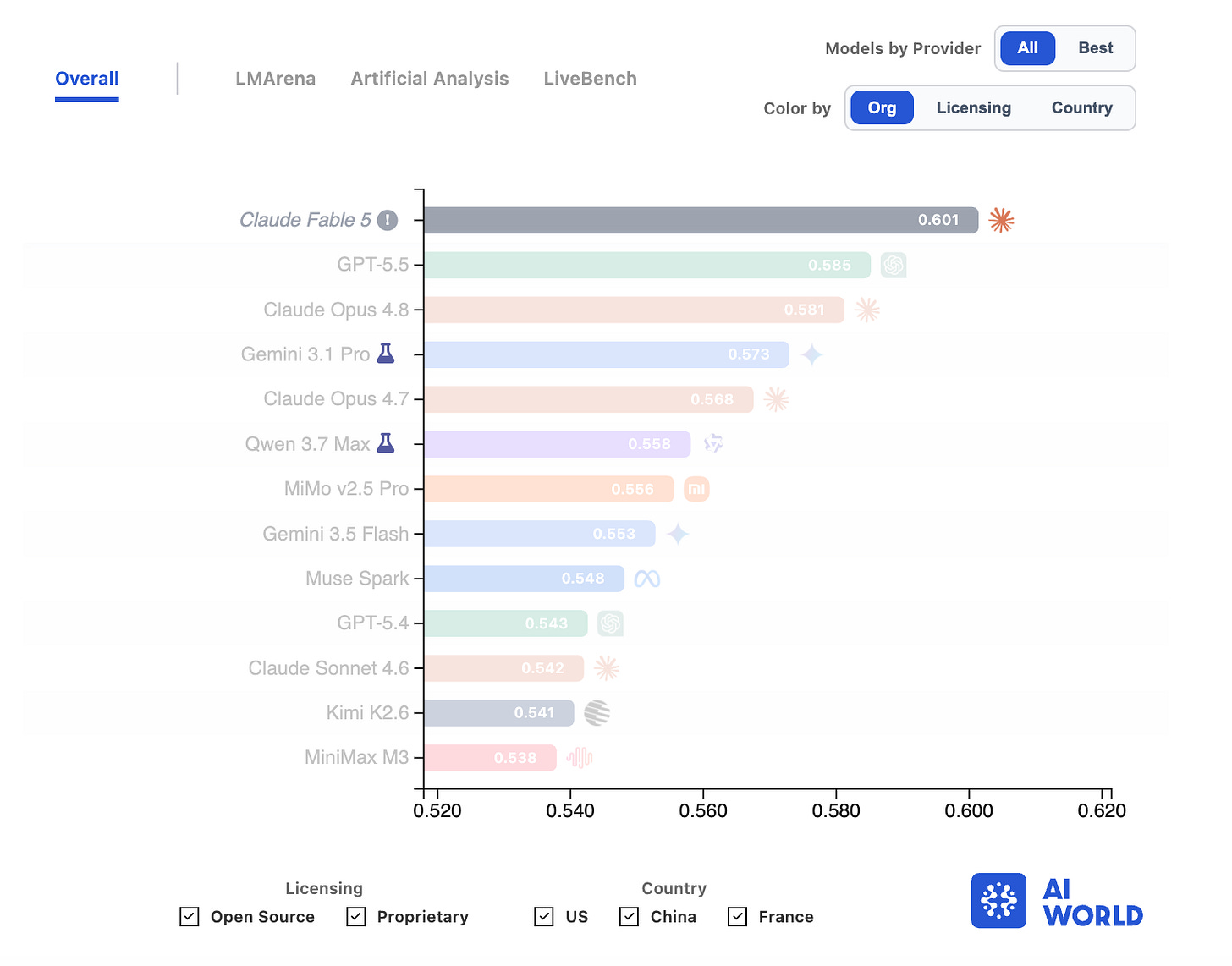
The directive established, for the first time, that a commercially deployed frontier AI model can be treated as an export-controlled asset in the same regulatory category as advanced semiconductors, with access revocable overnight by executive action for any foreign national regardless of contract or employer. There is also a structural irony in Anthropic’s position: the company built its public identity around the argument that it was developing something genuinely dangerous, and the government used exactly that framing as the justification for the shutdown.
→ Read the full article at AI World
2. Where is European AI compute heading?
A five-year scenario published as Europe 2031 projects the continent holding around 5% of global AI compute capacity by 2031, with a temporary rise to 8% in 2028, against a US share of roughly 70%. Within Europe the distribution is uneven: France, if it executes on current plans including the Softbank data centre and Mistral Campus, would account for around 2.4 GW and 35% of continental capacity, as much as Norway, Germany, Portugal, and Sweden combined.
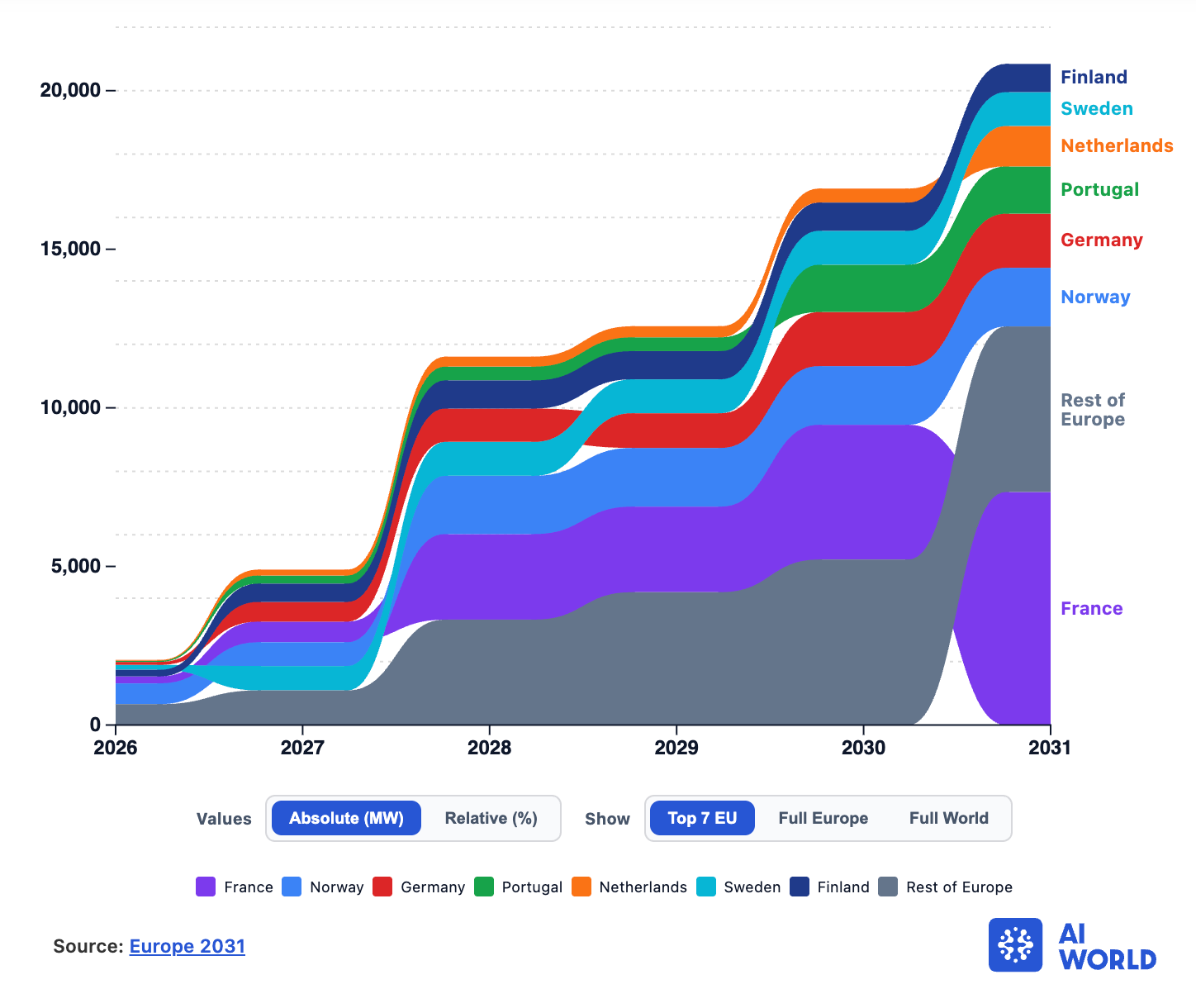
The 101 publicly known compute projects across the continent are heavily concentrated at the top, with the ten largest responsible for more than half of total planned capacity. The Fable 5 ban, which in the Europe 2031 scenario only arrives in 2029, arrived instead this week, making the dependence the report describes less a projection than a present condition.
→ Read the full analysis on AI World
3. This week's most notable AI research papers
This week’s selection maps the path to a European frontier model across four dimensions: the federated infrastructure required to pool distributed compute, the AI Act’s systemic-risk obligations for models trained above 10^25 FLOP, the liability architecture that federated training creates, and DiLoCo’s demonstration that distributed training across poorly connected machines can reach standard training quality while reducing inter-machine communication by a factor of 500. The hardware turns out to be the tractable part. Who governs the model and who is accountable when something goes wrong remains the open problem.
→ Read the full paper summaries on AI World
4. Three policy briefs on code shipping gaps, open source strategy, and AI safety evaluation
Three reports map the gap between what AI produces and what we can verify. An NBER paper finds coding activity up 180% at the commit level but shipped software up only 30%, because the human work of reviewing and merging does not compress.
An OECD paper for the G7 finds open-weight models at 90% of closed-model performance for a fifth of the price, with measurable GDP returns. The second International AI Safety Report finds that pre-deployment tests no longer predict real-world model behaviour, and that developers shipped 2025 models with extra safeguards because testing could not rule out bioweapon uplift risk.
→ Read the full analysis on AI World Linkedin page
5. Startup spotlights of the week
This week’s selection showcases the application of AI to structural gaps in enterprise SAP migration delivery, intellectual property protection for SMEs, and field-level precision agriculture.
🇩🇪 Qorelo: Berlin-based, founded 2025 by Nicholas Torabi, Louis Schmidlin, and Marino Kurtović. Qorelo automates the functional delivery layer of SAP ECC to S/4HANA migrations, handling custom ABAP code reading, fit-gap analysis, business requirement conversion, and documentation, integrating directly with SAP S/4HANA and maintaining a continuously updated transformation record. Raised $3.5 million in a seed round co-led by HPI Ventures and Caesar Ventures, five months after launch.
🇸🇪 Lightbringer: Sweden-based, founded 2023 by Dominic Davies, Markus Andreasson, and Ola Wassvik. Lightbringer combines agentic AI with licensed attorney oversight in a single workflow for patent filing, covering invention capture, claim drafting, prosecution tracking, and portfolio management across multiple jurisdictions, reducing filing timelines from around two months to a few days. Raised $10 million in a Series A co-led by 6 Degrees Capital and Newion, June 2026.
🇨🇭 OneSoil: Zurich-based, founded 2017 by Sasha Yakovlev, Slava Mazai, and Usevalad Henin. OneSoil’s precision agriculture platform now includes AI Agronomist, a natural-language assistant that draws on accumulated satellite data and the company’s own analytical models to provide farmers with daily field-level insights on conditions, productivity changes, and emerging stress signals. Secured €1 million from existing investors.
What’s next
For more updates, research and insights across the AI ecosystem, visit aiworld.eu. Subscribe to receive next week’s round-up directly in your inbox and stay ahead of key developments.
Have a great weekend!
Gaia Cavaglioni
On behalf of the AI World Team
Thanks for reading Substack of AI World! Subscribe for free to receive new posts and support my work.
Comments
Nothing yet. Say the first thing.
Sign in to join the conversation.