
Welcome to this week's AI round-up! In this edition, we cover Anthropic's compute deal with SpaceX, ICLR 2026's organisational footprint, the geography of AI job postings across the EU, this week's papers on military AI, three policy briefs on AI's economic and labour footprint, and three startups raising rounds across open inference, threat intelligence, and SME automation.
This week at a glance:
Anthropic rents Colossus 1 outright: Anthropic has signed for the full capacity of SpaceX’s Tennessee data centre, over 200,000 Nvidia GPUs and more than 300 MW of compute, with rate caps lifted for paying users from this month.
ICLR 2026 mirrors NeurIPS: Chinese institutions account for around 40% of poster-paper affiliations and 30% of orals; US institutions hold the inverse split, with European, Singaporean, and South Korean contributions sitting close behind.
EU AI job postings, decentralised but uneven: Germany leads in absolute volume with around 75,000 postings in 2025, but Portugal, Poland, and Luxembourg lead on share, and California alone matches Germany, France, and Italy combined.
Military AI’s tempo problem: this week’s selection charts how AI-enabled drone strike rates in Ukraine have moved from 10–20% to 70–80%, alongside the governance lag the figure exposes.
Three policy briefs on AI’s economic footprint: the ECB, OECD-WEF, and Cedefop each map a different layer of adoption, with distribution rather than diffusion emerging as the binding question.
Startup spotlights: Featherless.ai, QuoIntelligence, and CodeWords each closed rounds this week across serverless open-model inference, sovereign threat intelligence, and SME automation.
Anthropic has signed an agreement with SpaceX to use the full capacity of its Colossus 1 data centre in Tennessee: over 200,000 Nvidia GPUs and more than 300 MW of compute, taking effect within the month. For paying users the consequences land immediately, with five-hour rate caps lifted, peak-hour restrictions removed, and Claude Code rate limits doubled on paid plans.

The deal sits on top of a multi-gigawatt agreement with Amazon, a 5 GW deal with Google and Broadcom, and a $30 billion Azure partnership with Microsoft and Nvidia, which together answer Dario Amodei’s earlier acknowledgment of strain on infrastructure during peak hours. The contract carries an unusual clause giving SpaceX the right to reclaim compute if Claude engages in actions that harm humanity, a framing that sits awkwardly alongside Musk’s earlier public criticism of the company but is consistent with the safety thesis Anthropic’s research agenda actually requires.
→ Read the full article at AI World
ICLR 2026 reproduces the geographic pattern visible at NeurIPS 2025. Chinese institutions account for roughly 40% of author affiliations on poster papers and 30% on orals, the latter a status only 4% of papers receive; US institutions sit at the inverse split, with two of three Outstanding Paper Awards this year going to American institutions and the third to a European collaboration between RPTU Kaiserslautern-Landau, ETH Zürich, and the Max Planck Institute.
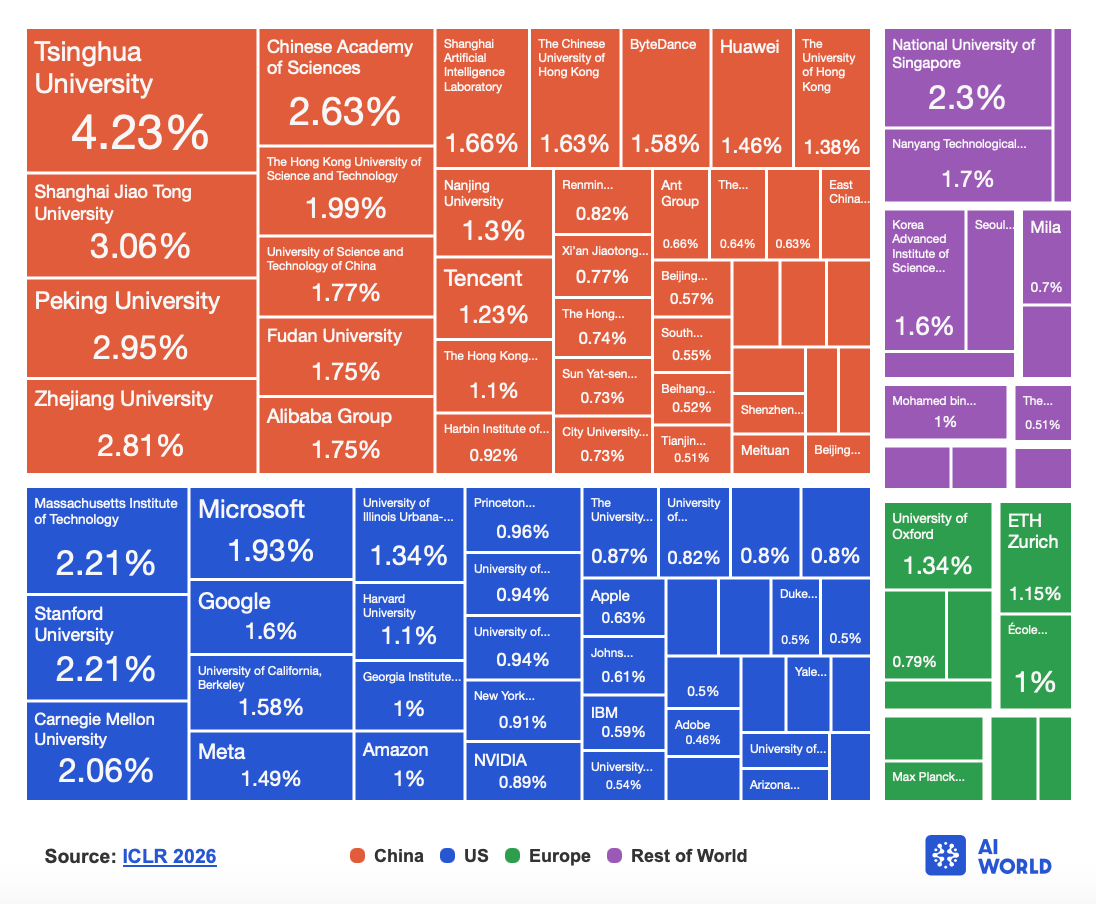
Outside the US-China axis, contributions from Singapore and South Korea are competitive with the EU-27 taken as a whole, and the underweighting of Chinese research in Western coverage continues to track the underrepresentation of Chinese model releases such as Kimi K2.6 and DeepSeek V4 against GPT-5.5 and Claude Opus 4.7. The ICLR 2026 analysis uses direct affiliations cited in the papers themselves rather than OpenReview registrations, a tighter methodology than that used for the NeurIPS dataset.
→ Explore the interactive chart on AI World
Drawing on Lightcast's categorised online job postings, the data shows Germany leading the EU in absolute AI job postings every year from 2018 to 2025, with France and Poland second and third by 2025. France moved from around 9,000 postings in 2018 to over 60,000 in 2025; Poland went from around 550 to roughly 56,000 over the same period.
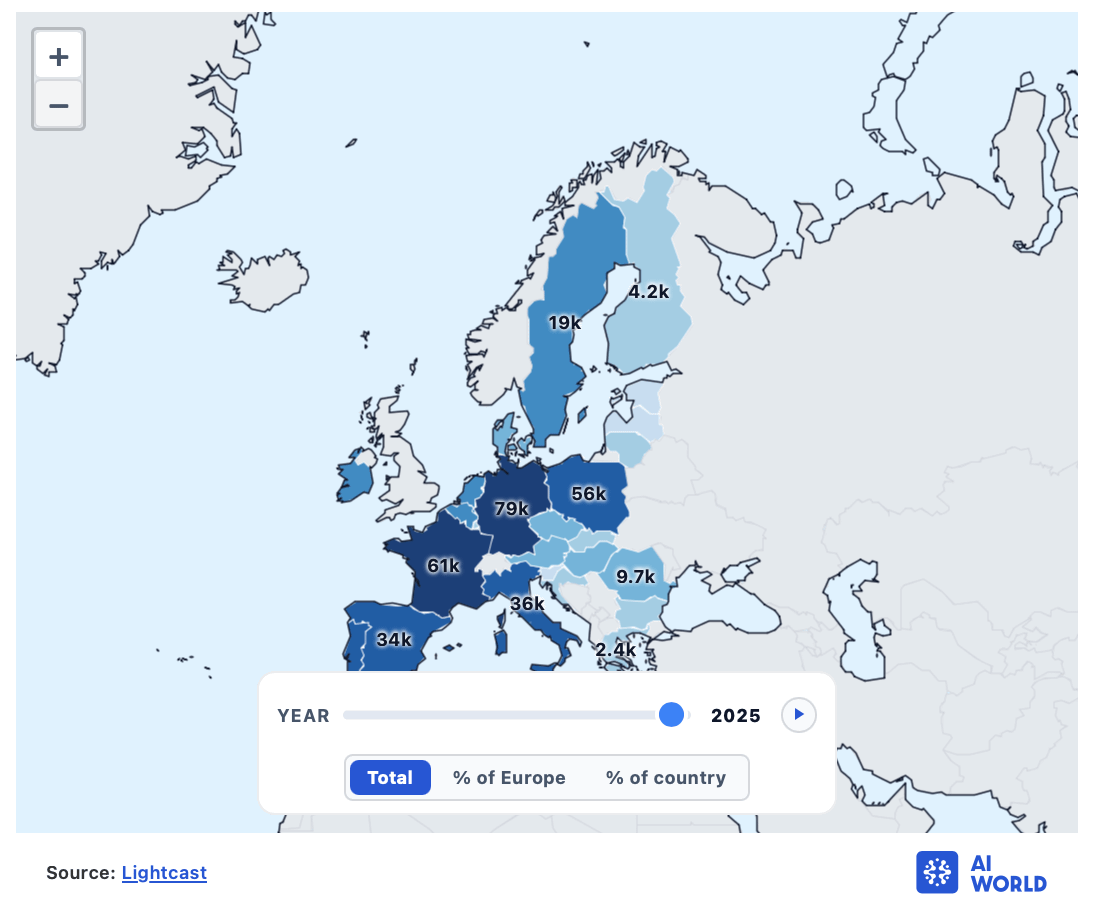
On AI postings as a share of total postings, the ranking inverts: Portugal, Poland, and Luxembourg lead, while Germany sits behind despite its volume. The aggregate gap with the US remains structural - California alone posted as many AI roles in 2025 as Germany, France, and Italy combined, and the US share of AI postings overall sits at 2.5% against roughly 1% in many EU countries.
→ Read the full analysis on AI World

This week’s research examines the speed at which AI is reshaping warfare, from a 70–80% drone strike rate in Ukraine to a doubling of global military AI spending, and the institutional and ethical frameworks struggling to keep pace.
→ Read the full paper summaries on AI World
The ECB has found that the use of AI by euro area workers has risen from 26% to 40% in a year, with firm productivity increasing by 4% and no adverse effect on employment. However, euro area payments for US-based IP have increased fivefold in a decade, and almost 30% of European unicorns founded between 2008 and 2021 have relocated abroad. An OECD-WEF white paper surveying 167 foresight practitioners across 55 countries finds AI used by two-thirds, but only 53% of public-sector respondents feel skilled in it against 93% in the private sector.

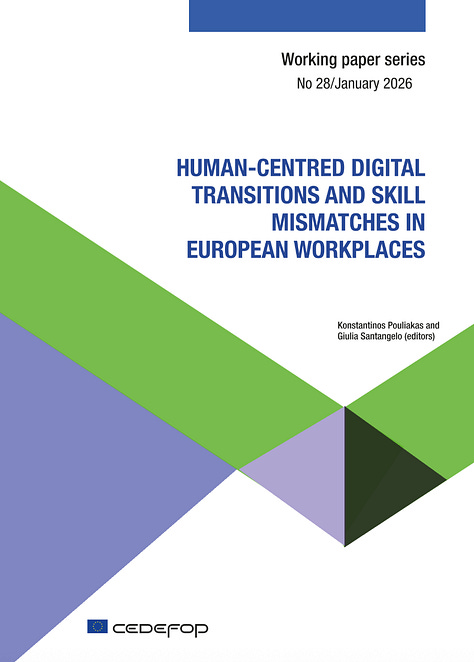

A Cedefop analysis of 46,213 workers across 29 countries found that digitalisation does increase training demand, but the benefits mainly accrue to male, urban, highly educated workers in non-routine roles, complicating the EU’s “human-centred digital transition” framing.
→ Read the full analysis on AI World Linkedin page
This week’s selection showcases the application of AI to structural gaps in open-model inference economics, EU cyber threat intelligence, and SME automation.
🇺🇸 Featherless.ai: founded in 2023 by the team behind RWKV, the attention-free architecture that became the first foundation-model project hosted by the Linux Foundation. Featherless is a serverless inference layer giving developers access to over 30,000 open language, vision, and audio models through one API, with subscription-tier pricing rather than per-token billing. Raised $20 million in a Series A co-led by AMD Ventures and Airbus Ventures, with BMW i Ventures, Kickstart Ventures, Panache Ventures, and Wavemaker Ventures participating, on top of a $5 million seed in 2025.
🇩🇪 QuoIntelligence: Frankfurt-based, founded 2020 as a spin-off from QuoScient’s intelligence team. QuoIntelligence pairs an AI platform, Mercury, with European analysts producing localised threat-intelligence briefs for the roughly 160,000 EU entities newly in scope under NIS2 and the 22,000 financial firms covered by DORA, with a conversational analyst, KARLA, making the briefs queryable from board to SOC. All intelligence data is held inside the EU. Raised €7.3 million in a Series A led by Elevator Ventures and co-led by BMH, with eCAPITAL and Mercurius Private Equity participating, bringing total capital to roughly €12.3 million.
🇬🇧 CodeWords: London-based, founded 2023. CodeWords’ agent, Cody, studies a business’s operations and autonomously builds and executes automations across more than 1,000 integrations including Notion, HubSpot, Slack, WhatsApp, and Gmail, writing the underlying Python and maintaining the workflows on schedules and triggers without manual intervention. The product targets the 38-point AI adoption gap between large EU enterprises (55%) and small ones (17%) flagged in Eurostat 2025 data. Raised $9 million in a seed round led by Visionaries, with Firstminute Capital, Sequoia, Illusian, and angels participating.
For more updates, research and insights across the AI ecosystem, visit aiworld.eu. Subscribe to receive next week’s round-up directly in your inbox and stay ahead of key developments.
Have a great weekend!
Gaia Cavaglioni
On behalf of the AI World Team
Comments
Nothing yet. Say the first thing.
Sign in to join the conversation.