
Welcome to this week’s AI round-up! In this edition, we look at Anthropic’s Opus 4.7 release and what it signals about frontier access, three policy briefs reframing how we talk about AI and work, democracy, and EU regulation, China’s week-defining embodied AI rounds, five papers on AI in architecture, and four startups applying AI to construction compliance, building renovation, AEC workflows, and renewable site selection.
This week at a glance:
Opus 4.7, second best by design: Anthropic’s new flagship is an incremental step on public benchmarks, and the company is open about why, its cybersecurity capabilities have been deliberately reduced to test safeguards before a Mythos-class release.
Three briefs, one frame: ILO, Carnegie California, and the JRC each draw a cleaner line between what AI changes, what democracies inherit, and what regulation has historically scaled rather than slowed.
China’s embodied AI stack: three rounds in week 17 mapped the brain, the factory, and the home of embodied AI, with $455 million to Tars marking the largest embodied AI round in Chinese history.
AI in architecture: five papers this week show the gap between idea and workflow has collapsed from 62 years to 2.5, while the gap between prototype and practice has not.
Startup spotlights: four companies applying AI to construction compliance, building renovation, AEC workflows, and renewable site selection across Japan, Germany, and France.
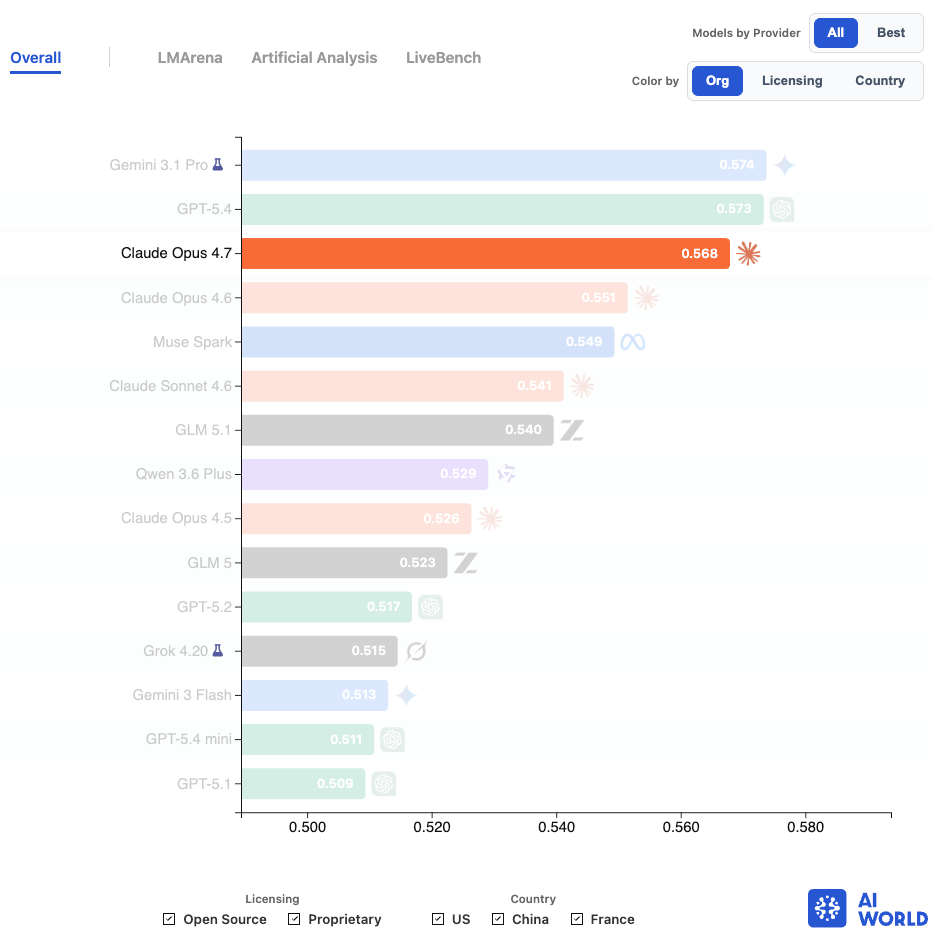
Anthropic has launched Claude Opus 4.7 with modest gains over 4.6, a six-thousandths lead on the AI World aggregated Leaderboard, two points on LMArena’s text category, and 0.6 on LiveBench. The company is unusually explicit about the reason. Opus 4.7 is a testbed for the automated safeguards Anthropic hopes to apply to Mythos, a more capable model whose autonomous zero-day discovery capabilities have kept it restricted to roughly 50 vendors under Project Glasswing. Cybersecurity capabilities were deliberately reduced during training. The result is a generally available flagship that openly admits it is not the frontier, and a dual-track strategy that separates the commercial product from the actual state of the art.
→ Read the full analysis on AI World
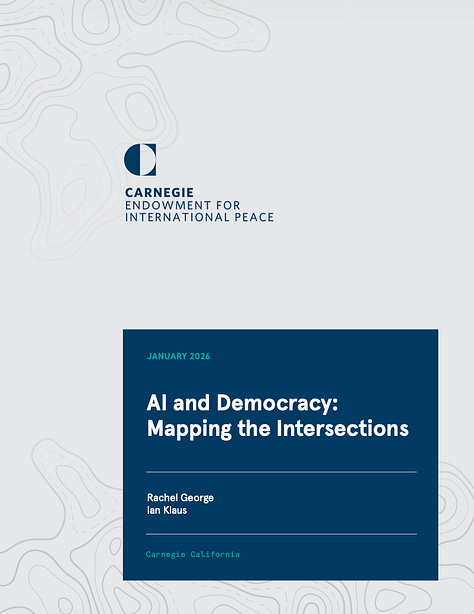

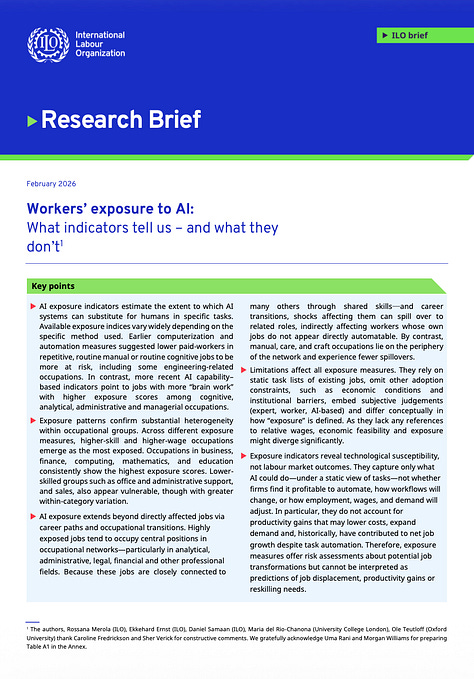
The ILO clarifies that AI exposure measures what technology could technically do to tasks today, not whether firms will adopt it, whether adoption will be profitable, or whether jobs will survive the workflow redesign that follows. Carnegie California maps four intersection points between AI and democracy, elections, citizen deliberation, government services, and social cohesion, against a backdrop where autocracies outnumber democracies for the first time in twenty years. The JRC’s Science for Policy Brief traces the EU’s decade of AI policy through three phases, exploration, transition, and maturation, and argues that regulation historically scaled aviation, pharma, and finance rather than slowing them. Together, the three briefs draw a cleaner line between what AI changes and what it inherits.
→ Read the full analysis on AI World Linkedin page
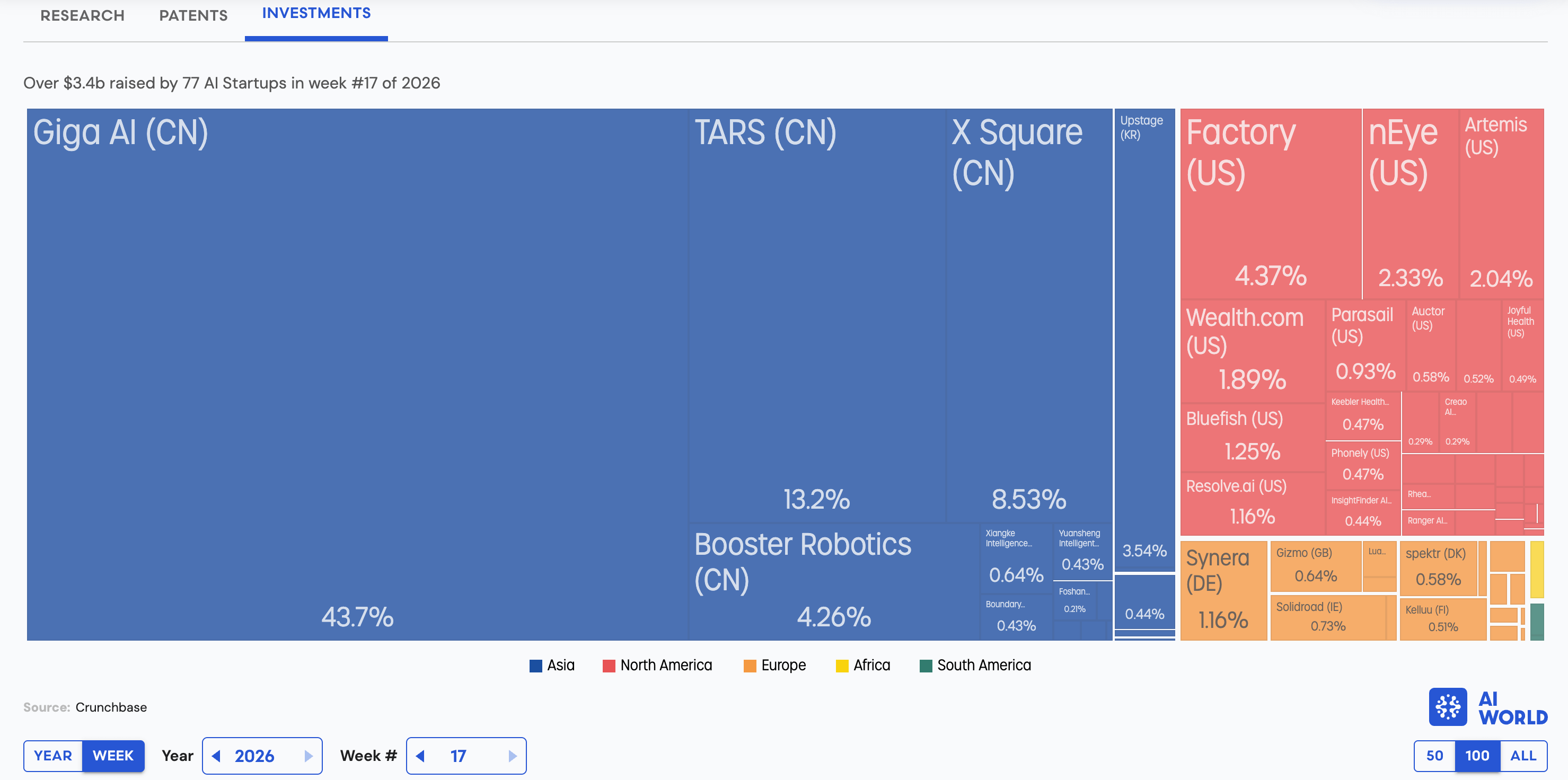
Three Chinese rounds defined last week’s embodied AI activity, together mapping the full stack from reasoning to deployment. 🇨🇳 Tars closed a $455 million Pre-A, the largest embodied AI round in Chinese history, built around the first large-scale Vision-Language-Tactile-Action dataset. 🇨🇳 X Square Robot raised $276 million in a Series B led by Xiaomi Technology with ByteDance, Meituan, and Alibaba, targeting humanoid robots for household use. 🇨🇳 GigaAI raised for its 4D world models spanning autonomous driving and embodied robotics. With China’s workforce in decline since 2011, robotics is increasingly a labour policy, not a technology bet.
→ Explore the interactive chart on AI World
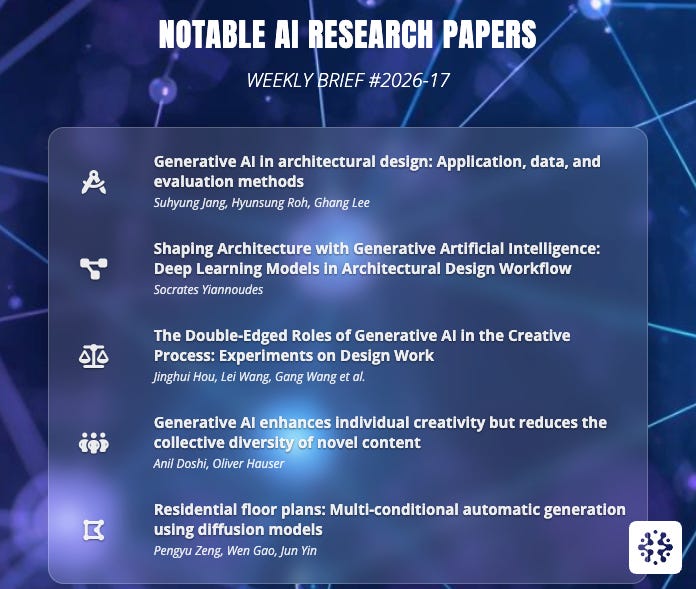
Five papers trace AI’s uneven penetration of architecture and design: the gap between a technique appearing in the literature and its first architectural application has collapsed from 62 years to 2.5, but workflow integration, expert productivity, and stylistic diversity are all moving in less encouraging directions.
→ Read the full paper summaries on AI World
This week’s selection highlights the application of AI to structural gaps in construction compliance, building decarbonisation, AEC workflow automation, and renewable energy permitting.
🇯🇵 Mign: Japan-based, founded 2022. A vertical agentic AI platform for real estate and construction, covering compliance review, legal compilation, and architectural visualisation. Raised ¥230 million (approximately $1.5 million) in a pre-Series A in April 2026, led by Angel Bridge.
🇩🇪 Meinhaus.digital: Germany-based. An AI platform combining software with architect and energy consultant advice, helping property owners plan renovations under the updated EPBD’s national renovation plan requirements. Raised €1 million in a pre-seed round in April 2026 from L-Bank Baden-Württemberg.
🇩🇪 Conxai: Germany-based, founded 2020. A no-code agentic AI platform for the AEC sector, pulling together site photographs, sensor feeds, and project documents for tender analysis and site monitoring. Raised €5 million in a Series A in April 2026, led by BayBG Venture Capital and Capricorn Partners, bringing total funding to approximately €7.7 million.
🇫🇷 Plume: Franco-American, co-founded 2024. Aggregates 150+ geospatial datasets and deploys AI agents on regulatory documents, letting renewable developers query territorial constraints through a natural language interface, addressing RED III permitting delays. Raised €3.9 million in April 2026, led by AENU.
What’s next
For more updates, research and insights across the AI ecosystem, visit aiworld.eu. Subscribe to receive next week’s round-up directly in your inbox and stay ahead of key developments.
Have a great week ahead!
Gabriel Rossi
On behalf of the AI World Team
Comments
Nothing yet. Say the first thing.
Sign in to join the conversation.