
Welcome to this week’s AI round-up! In this edition, we cover Moonshot AI’s Kimi K3, the largest open model released to date and now within one release cycle of the proprietary frontier, new research on AI’s energy footprint and the structural limits of renewable expansion as a fix, and three startups raising rounds across robotic concrete manufacturing, construction site data infrastructure, and patient-derived drug discovery.
This week at a glance:
Open source is one release cycle behind the frontier: Kimi K3, a 2.8 trillion parameter open model from Moonshot AI, places around Opus 4.8 tier on independent benchmarks, at $15 per million output tokens against Fable 5’s $50, compressing the lag between open and proprietary to a single release cycle.
AI’s energy footprint, five studies: renewable expansion relaxes the AI scaling constraint without displacing fossil generation, and the external cost of US data centre emissions already runs to roughly $25 billion a year, borne by surrounding communities rather than the sector itself.
Three policy briefs on efficiency, capital, and grid: the IEA finds data centre demand growing 50% in 2025 despite falling energy per query; Big Tech capital spending in 2026 is projected to exceed global oil and gas investment; and Europe’s plan to triple data centre capacity by the early 2030s depends on grid connection, not permits or money.
Startup spotlights: Hyperion Robotics, Sodex Innovations, and Sightera Biosciences each closed rounds this week across robotic concrete manufacturing, construction site real-time data, and patient-derived oncology drug discovery.
Moonshot AI has released Kimi K3, a 2.8 trillion parameter mixture-of-experts model with native vision, a 1M token context window, and two new attention mechanisms the company claims yield roughly 2.5 times better scaling efficiency than its predecessor.
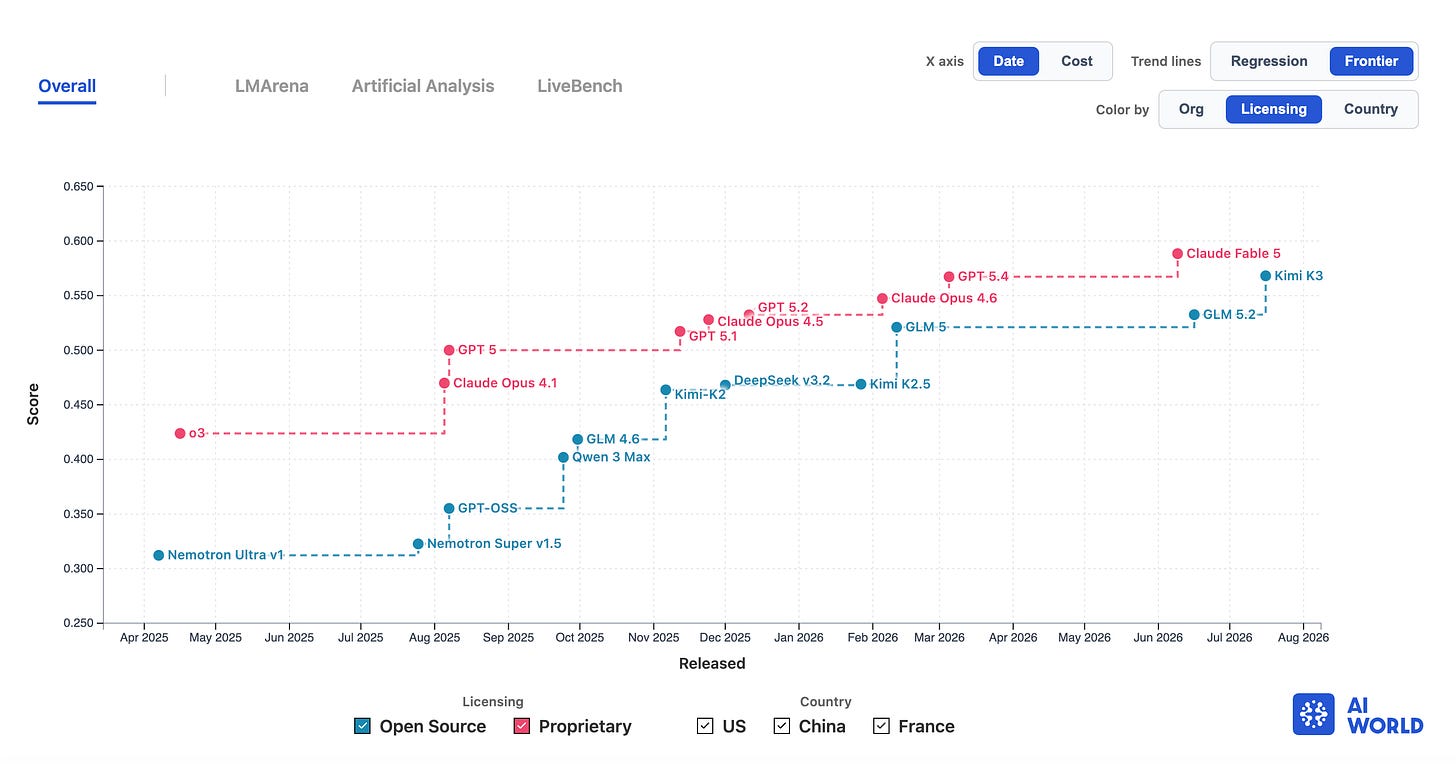
On independent benchmarks from Artificial Analysis, K3 places around Opus 4.8 tier, winning or placing second on most coding and agentic evaluations against Claude Opus 4.8, GPT 5.5, and GLM-5.2. Moonshot’s own blog acknowledges K3 still trails Claude Fable 5 and GPT 5.6 Sol, but an open model outperforming last generation’s Western flagships weeks after their successors shipped compresses the lag between open and proprietary to something like a single release cycle, a gap that used to be measured in more than a year.
→ Read the full article at AI World
US AI server deployment could add 24 to 44 million tonnes of CO2 equivalent a year by 2030, and best industry practice covers only 73% of residual emissions. Gui and Dai (2026) show why renewable expansion does not close the gap: markets rewarding capability scaling push developers towards larger models regardless of carbon intensity, so new clean capacity relaxes the scaling constraint without reducing fossil generation. Muller (2026) prices the external damage from US data centre emissions at roughly $25 billion a year, currently unpriced by the sector.
→ Read the full paper summaries on AI World
The IEA finds energy per AI task has fallen by roughly an order of magnitude per year, yet global data centre electricity grew 17% in 2025 and AI-focused data centre consumption grew 50%, with demand projected to roughly double to 950 TWh by 2030; heavier tasks including reasoning, agents, and video use hundreds to thousands of times more energy per query, and cheaper tasks invite more tasks. The IEA's World Energy Investment 2026 report projects Big Tech capital spending, most of it on data centres, reaching $715 billion in 2026, more than global oil and gas investment at $546 billion and more than these companies earn, with spending now absorbing almost all their cash and the pace of new electricity demand becoming a function of market sentiment. The same IEA report finds Europe's data centre pipeline implies 2.3 times current installed capacity under the AI Continent Action Plan's target of tripling by the early 2030s, with the Commission's own European Grids Package tabled in 2025 to address connection queues, and the report's conclusion unambiguous: overcoming energy constraints is the critical variable.
→ Read the full analysis on AI World Linkedin page
This week’s selection showcases the application of AI and robotics to structural gaps in infrastructure manufacturing, construction site data collection, and patient-derived drug discovery.
🇫🇮 Hyperion Robotics: Finland-based, co-founded by Fernando De los Ríos, Ashish Mohite, and Henry Unterreiner. Hyperion’s robotic microfactory platform uses 3D printing and AI to manufacture low-carbon concrete components locally, with its Forge software calculating lightweight geometries that use up to 75% less material and production processes that reduce carbon emissions by up to 70% compared to conventional methods. Raised $7.4 million in a growth round co-led by Course Corrected and the European Innovation Council Fund.
🇦🇹 Sodex Innovations: Austria-based, co-founded by Ralf Pfefferkorn, Bernhard Gantner, and Raphael Ott. Sodex mounts laser scanning hardware on existing construction and mining machinery, turning excavators into continuous data collectors that feed real-time terrain models, stockpile volume calculations, and quantity documentation into its SDX-Cloud platform without interrupting operations. Raised €4 million in a round led by Capmont Technology.
🇧🇪 Sightera Biosciences: Belgium-based, spun out from the University of Antwerp and Antwerp University Hospital. Sightera trains its generative AI on proprietary datasets generated from patient-derived samples of therapy-resistant cancers and fibrosis, producing drug candidates designed against actual diseased tissue biology rather than generic chemical databases, with lead programme SIGHT001 advancing towards preclinical candidate selection. Raised €3 million in a pre-seed round co-led by Entourage, Anacura, and QBIC.
For more updates, research and insights across the AI ecosystem, visit aiworld.eu. Subscribe to receive next week’s round-up directly in your inbox and stay ahead of key developments.
Have a great weekend!
Gaia Cavaglioni
On behalf of the AI World Team.
Comments
Nothing yet. Say the first thing.
Sign in to join the conversation.