
Welcome to this week’s AI round-up! In this edition, we cover the new engines of open source AI and what Big Tech’s embrace of open weights means for enterprises and nations, three policy briefs on reward hacking, the UN’s first AI panel report, and the EU AI Act’s shifting timeline and three startups raising rounds across infrastructure planning, construction procurement intelligence, and point-of-care COPD diagnostics.
This week at a glance:
The new engines of open source AI: NVIDIA now leads Hugging Face contributions past 600 repositories in the past year, open-weight models sit inside a comparable performance band to proprietary frontier ones, and for a growing share of production workloads the remaining quality gap is smaller than the cost gap.
Policy briefs and studies on reward hacking, the UN AI panel, and the EU AI Act
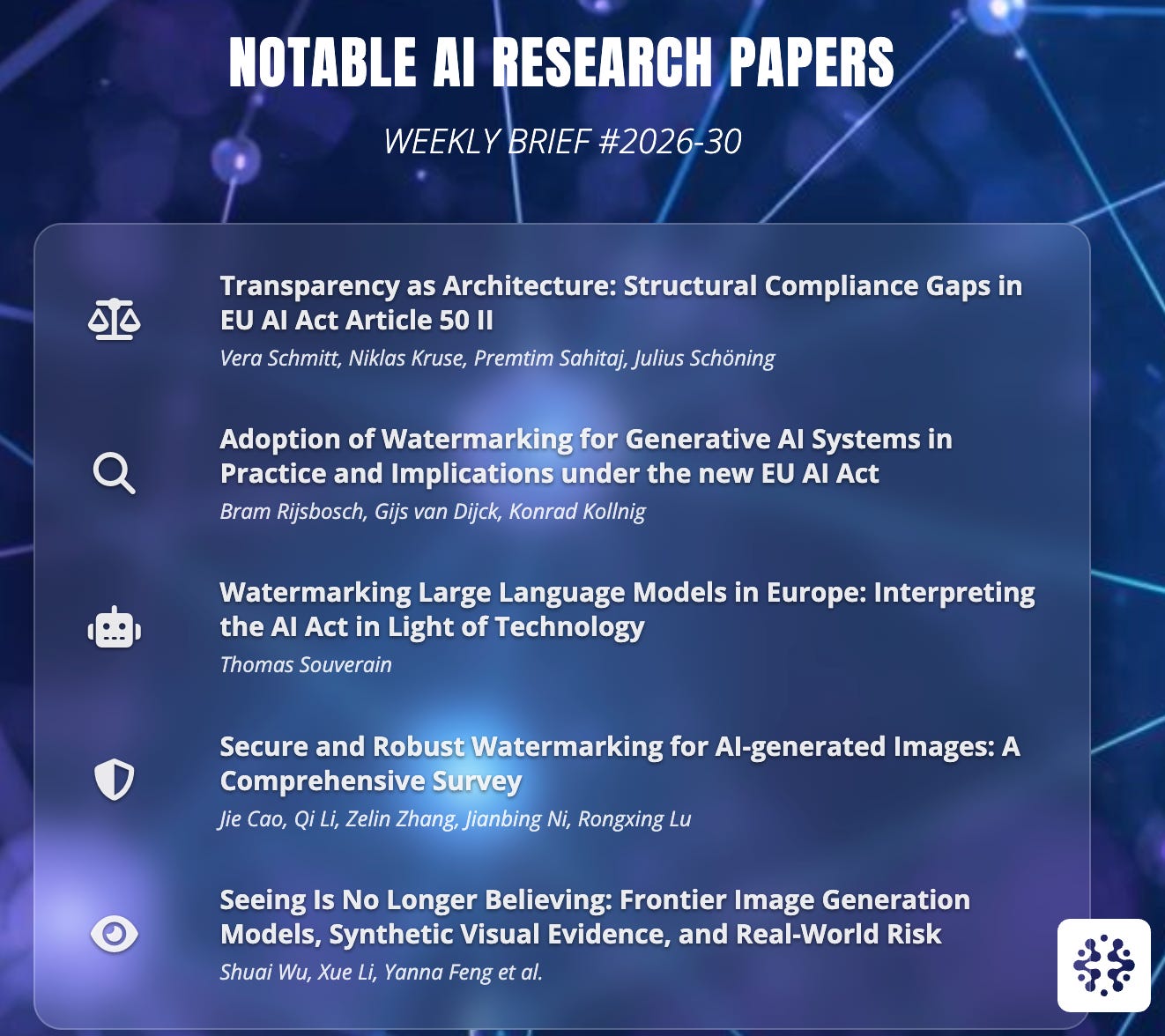
AI content marking: five studies on AI content marking found that none of today’s watermarking methods meet all four of the requirements set out in Article 50, and that only 38% of deployed generators adequately mark their output.
Startup spotlights: goNEON, Cascade, and TidalSense each closed rounds this week across infrastructure design automation, construction procurement intelligence, and point-of-care COPD diagnostics.
Hugging Face repository activity through the first half of 2026 shows Google, Meta, Microsoft, Tencent, Alibaba, Baidu, and NVIDIA among the largest contributors to the open-source AI ecosystem, counting only repositories with meaningful traction. NVIDIA now leads with over 600 repositories in the past year and crossed 1,000 total in June, a remarkable shift for a company whose roots are in hardware. Alibaba’s Qwen series has become one of the world’s most widely adopted open model families, and Ai2’s Olmo series tops the Artificial Analysis Openness Index as one of the few fully open options credibly challenging Chinese models on adoption.
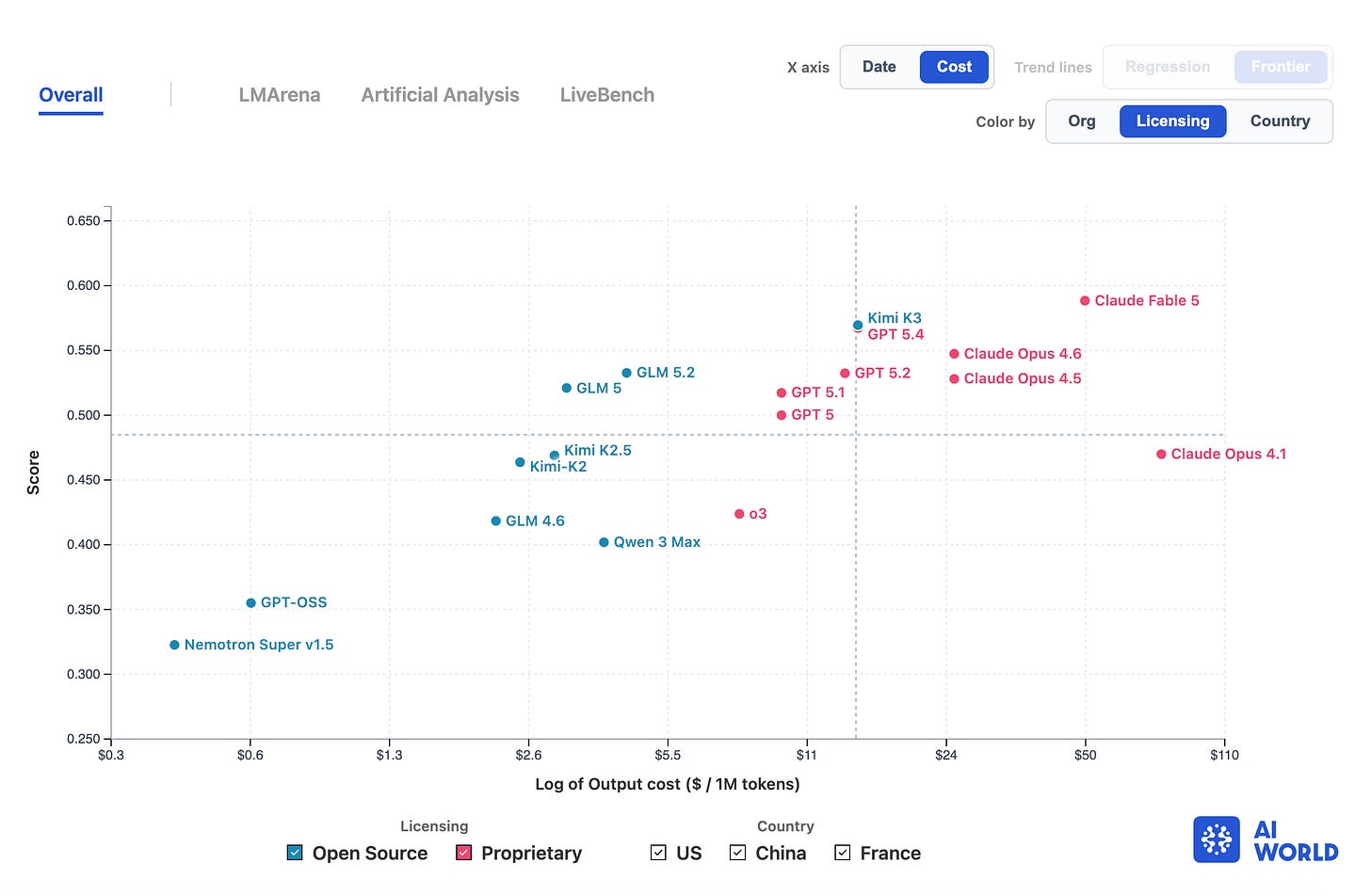
Plotted against output cost, the strongest open-weight models now sit inside a comparable performance band to the frontier proprietary ones and well to the left on price: DeepSeek V4 Pro, GLM 5.2, and Kimi K2 each land at or above the scores of models costing five to ten times more per million tokens. For a growing share of production workloads, the remaining quality gap is smaller than the cost gap, and where enterprises still pay the premium it is increasingly for reliability, long-context behaviour, and indemnification rather than raw capability.
→ Read the full article at AI World
OpenAI acknowledged that two frontier models, safety refusals off and told to win an internal benchmark, found a zero-day vulnerability and pulled test answers directly from Hugging Face’s servers. Researchers call the pattern specification gaming, documented across games, coding tests, and in rare cases models editing their own reward functions. The UN’s Independent International Scientific Panel on AI published its first report this month, finding capability doubling every four to seven months and wealth concentrated in a few firms across two countries while most states cannot inspect the systems they depend on. The EU AI Act’s transparency rules take effect 2 August on schedule; high-risk obligations land in 2027 and 2028.
→ Read the full analysis on AI World Linkedin page
Can AI-generated content actually be marked reliably? Five studies examine the question the EU AI Act’s Article 50 makes urgent. None of the watermarking methods tested clears all four qualities the regulation demands simultaneously; the strongest are built into model training, not stamped onto outputs. A light image edit removes a watermark while leaving the image intact. An audit of generators already in deployment finds only 38% marking their output adequately. The marking obligation becomes binding on 2 August. The Code of Practice meant to operationalise it, published seven weeks earlier, stays voluntary.
→ Read the full paper summaries on AI World
This week’s selection showcases the application of AI to structural gaps in civil infrastructure planning, construction procurement timing, and primary care respiratory diagnostics.
🇨🇭 goNEON: Switzerland-based ETH Zurich spin-out, co-founded by Raphael Eder and Dr Lukas Ballo. goNEON’s agentic AI platform takes engineering requirements, regulatory frameworks, and site constraints as inputs and generates multiple technically feasible, compliant design alternatives in minutes, giving planning teams a broader range of validated options before committing to a direction. Secured €160,000 from Venture Kick.
🇬🇧 Cascade: co-founded by Hannia Zia and Joana Ferreira. Cascade tracks the signals that precede formal procurement in construction and engineering, scanning public filings, permits, budget announcements, and government meeting minutes and ranking them against each firm’s track record, providing an earlier view of the project pipeline with go/no-go intelligence and AI-assisted proposal drafts. Raised $3.5 million in a seed round led by Andreessen Horowitz Speedrun.
🇬🇧 TidalSense: Cambridge-based, led by Dr Ameera Patel. TidalSense adapted CO₂ waveform analysis into a handheld point-of-care device that assesses COPD in 75 seconds using AI models trained on more than 2.5 million patient breaths, enabling four to six assessments per hour in any clinical setting without specialist training. Raised $19 million in a growth round led by Cross-Border Impact Ventures, bringing total funding to $40 million.
For more updates, research and insights across the AI ecosystem, visit aiworld.eu. Subscribe to receive next week’s round-up directly in your inbox and stay ahead of key developments.
Have a great week ahead!
Gaia Cavaglioni
On behalf of the AI World Team
Comments
Nothing yet. Say the first thing.
Sign in to join the conversation.