
Something is changing in how we access information, and most users haven't noticed yet. This edition draws on the Stanford HAI 2026 AI Index to map the gap between public and expert optimism on AI, looks at what generative search is doing to the sources we rely on, and highlights four startups working on the infrastructure problems that rarely make headlines.
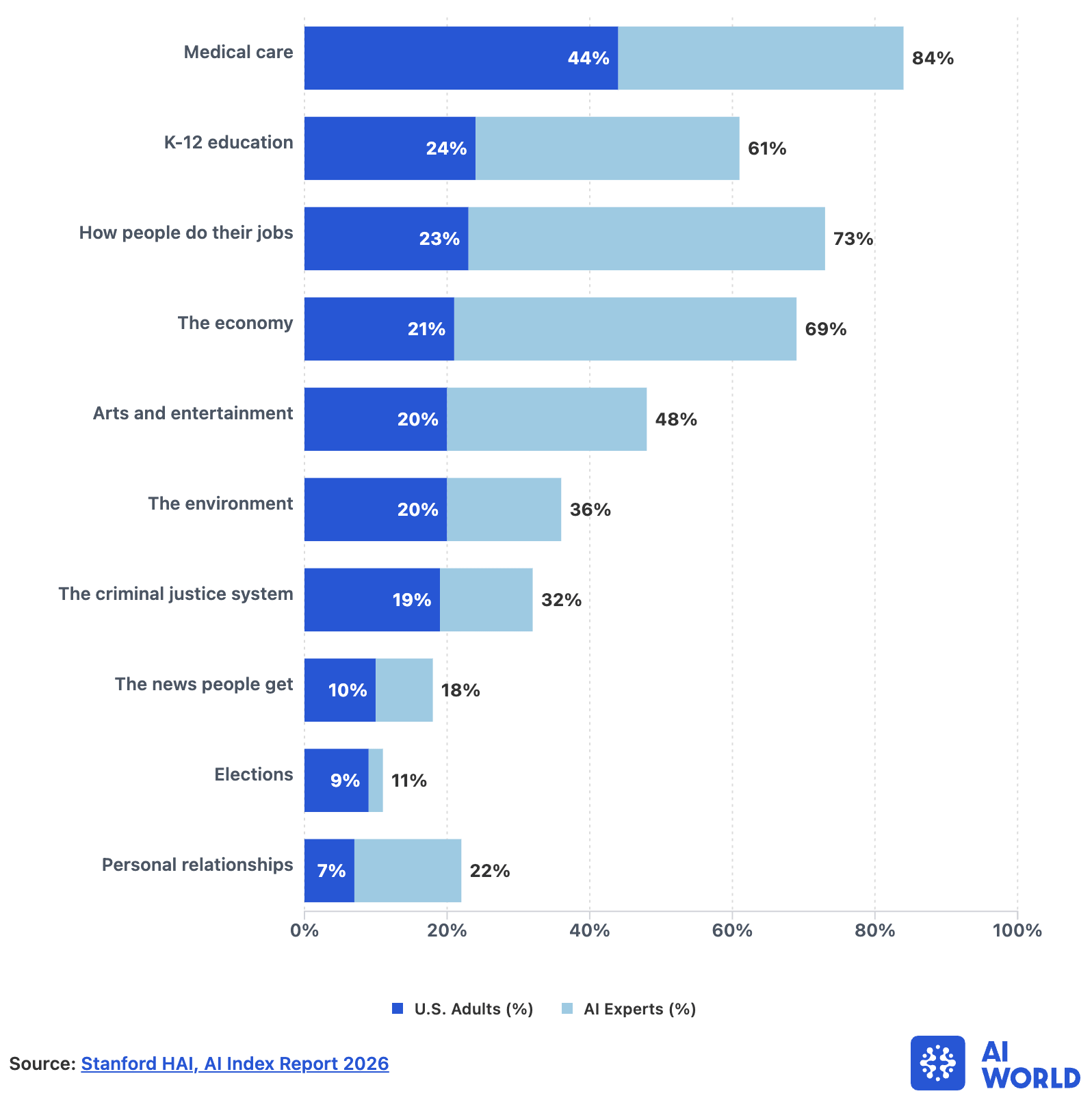
A 2024 Pew Research Centre survey of 5,410 US adults and 1,013 AI experts, cited in the Stanford HAI 2026 AI Index, finds a consistent gap between public and expert optimism about AI’s societal impact. Expert optimism exceeds public optimism by roughly 30 percentage points in medical care, K–12 education, jobs, and the economy, and by approximately 28 points in arts and entertainment. In areas tied to trust and social cohesion, elections and the news media, both groups converge around low expectations, suggesting that shared scepticism, not disagreement alone, defines the current baseline. The data point to a structural communication gap, one that without structured dialogue will continue to develop in parallel, driven by separate reference points.
Source: Stanford HAI, AI Index Report 2026, Figure 9.2.1. Survey data: Pew Research Centre (2025).
The way information is retrieved is changing structurally. Where traditional engines return ranked lists that invite comparison, generative AI produces a single synthesised answer with no visible editorial trail.
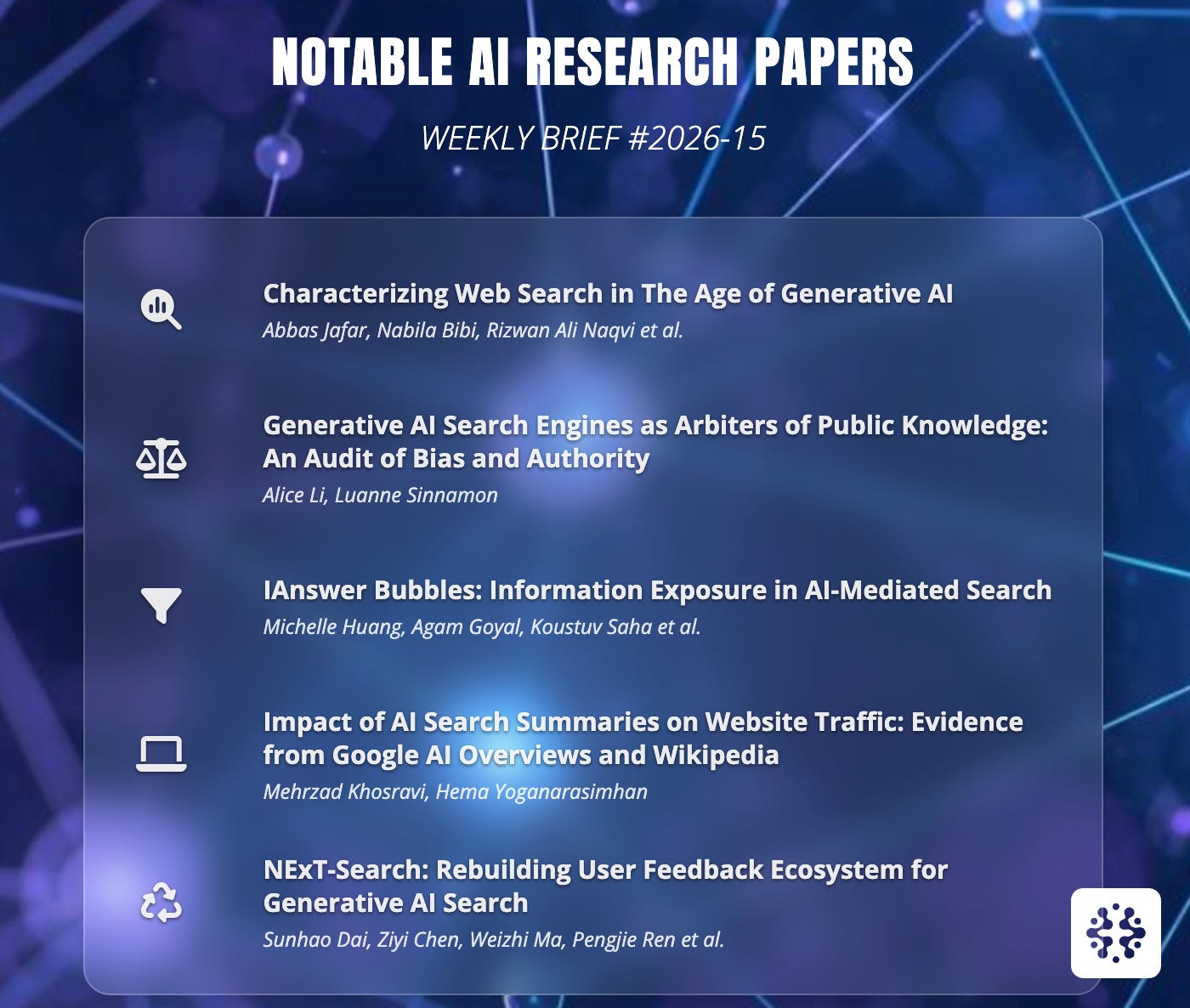
Research finds these systems diverge substantially in which sources they surface and how they define authority (Kirsten et al., 2025), with audits showing consistent bias towards US commercial media over academic and non-Western outlets (Li & Sinnamon, 2024). AI summaries also tend to strip uncertainty language from their sources, presenting secure answers where research remain cautious (Huang et al., 2025). The downstream effects are measurable. Khosravi & Yoganarasimhan (2026) find AI Overviews reduce daily traffic to source pages by roughly 15%, creating a new story dictated by inherent bias and a new SEO framework.
🇸🇪 Validio (Sweden, founded 2019) monitors enterprise data pipelines in real time, using automated anomaly detection to catch quality failures before they reach production AI systems and generating auditable data lineage records relevant to regulatory reporting. In March 2026, the company raised a $30 million Series A led by Plural, bringing total funding to $47 million, to support expansion into the US, UK, and Northern Europe. EU AI Act Article 10, enforceable from August 2026, requires that training and testing datasets be representative, error-free, and covered by documented governance practices.
🇩🇪 Penemue (Germany, founded 2023) integrates with an organisation’s social media channels and internal systems via API, scanning content in real time across 89 languages to detect hate speech, threats, and harmful material, including coded language and emojis, using NLP and behavioural analytics. The platform allows users to remove content or escalate it for legal proceedings, and collaborates with police authorities and public prosecutors across Germany and Europe. In April 2026, the company raised over €1.7 million from investors including TION Health, Beyond Tomorrow, and Berlin Angel Fund.
🇫🇷 Omniscient (France, founded 2024) deploys a network of specialist AI agents, each assigned to a defined domain such as regulation, supply chain, or media narratives, to scan press, social media, the web, and internal corporate data, synthesising the results into a real-time executive briefing accessible in multiple languages. The platform is designed to give boards and C-suite teams a unified view of regulatory and reputational risk without relying on manual reporting cycles. In April 2026, the company raised €3.5 million in pre-seed funding led by Seedcamp, with participation from Plug and Play, Bpifrance, and others.
🇪🇸 EchoWi (Spain, founded 2025) addresses the measurement gap opened by generative AI search, running natural-language queries on repeatable schedules across eight AI engines to track how each model selects and ranks sources over time. The platform monitors visibility, share of voice, sentiment, and cited domains, comparing results against competitors in parallel. The company raised a €750,000 seed round in March 2026, led by Successful Fund I FCRE, to scale its infrastructure.
Thanks for reading Substack of AI World! This post is public so feel free to share it.
Comments
Nothing yet. Say the first thing.
Sign in to join the conversation.