
AI search isn’t just about typing a question into Google anymore. The competition is heating up, and two major players - Perplexity AI and Google Deep Research - are taking completely different approaches. One prioritizes speed, the other depth. Which one actually works best?
Meanwhile, DeepSeek just dropped Janus Pro, an open-source multimodal model that’s turning heads. It processes images, answers questions, and generates new visuals, all while running on consumer hardware.
And let’s not forget Riffusion, the AI music generator that’s back and making waves.
Big updates, big shifts. Let’s get into it.
Perplexity AI is all about speed and citation-backed answers, making it great for quick fact-checking and real-time research. It’s also free to use, with an optional paid plan.
Google Deep Research focuses on structured, in-depth reports, breaking queries into subtopics and compiling multi-page research summaries. But it’s locked behind a $20/month paywall.
Speed vs. Depth – If you need fast, transparent answers, go with Perplexity. If you need a detailed research assistant with memory retention, Google’s your pick.
Best strategy? Use both. Perplexity for quick insights, Google Deep Research for full reports.
DeepSeek just dropped Janus Pro, an open-source multimodal AI that processes images, understands them, and generates new ones.
Why does this matter? It’s free, lightweight (7B parameters), and runs on consumer hardware. A major leap for open-source AI.
Competing with the big players – Benchmarks suggest Janus Pro holds its ground against Stability AI’s models and OpenAI’s DALL·E.
The OG AI music generator is back, and it’s free (for now).
Full-length song generation, vocal + instrumental options, genre blending, and even remixing of uploaded audio.
No paywalls, no credits, unlimited generations during open beta. Get in before the inevitable monetization wave hits.
Two big names, Perplexity AI and Google Deep Research, are taking completely different paths.
Perplexity wants to be your go-to for fast, citation-backed answers.
Google? It’s aiming to be your all-in-one research assistant.
So, which one works best for you? Let’s break it down.
Before diving into the features, let’s establish what each tool actually does.
Think of Perplexity AI as a search engine on steroids. Instead of just linking you to articles, it reads, analyzes, and summarizes information from multiple sources instantly. It blends real-time web indexing with a variety of AI models (GPT-4, Claude 3, and proprietary models) to generate concise, citation-backed answers.
Best for: Fact-checking, trending topics, quick research
Key Edge: Speed, answers in seconds
This is Google’s serious attempt at revolutionizing deep research. Housed within Gemini Advanced, Deep Research doesn’t just answer your question, it builds a structured research plan, iterates through sources, and delivers a multi-phase analysis.
Best for: Business research, academic reports, in-depth analysis
Key Edge: Thoroughness, breaks queries into subtopics and compiles multi-page reports
Google Deep Search locks you into a $20/month Gemini Advanced plan, no free trial, no way to test it out first. Perplexity, on the other hand costs also $20 a month but offers a free tier with unlimited basic searches and a few Pro searches daily. For casual users, that’s a clear win.
But if you’re after enterprise-grade features, Google delivers. You get 2TB of storage and seamless integration with Google Docs.
For businesses, both offer enterprise plans, but Perplexity stands out with custom API credits and Sonar models, great for teams that want AI research tools without being tied to Google. That said, some Perplexity users report random account downgrades, which could be a red flag if reliability matters to you.
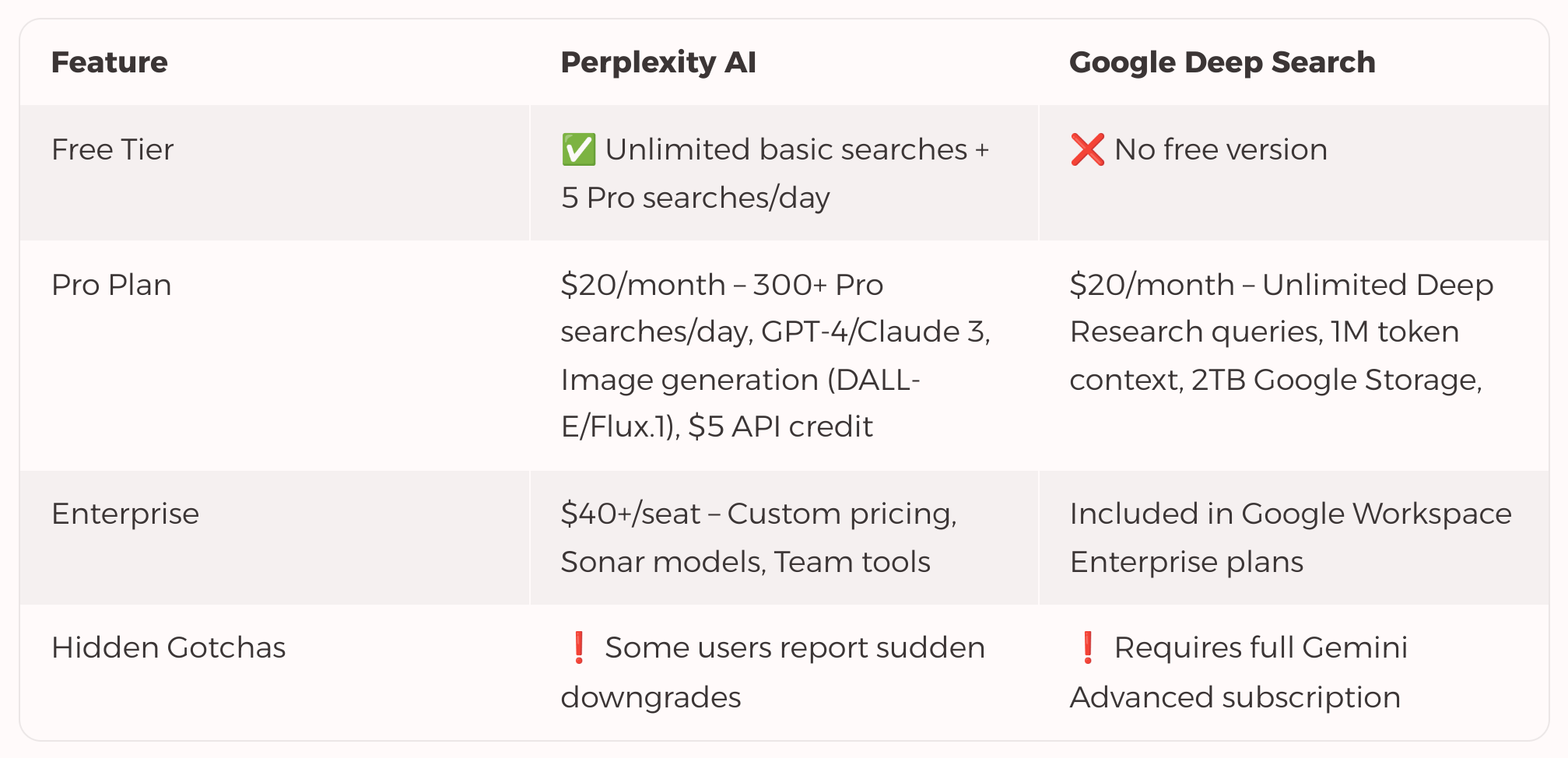
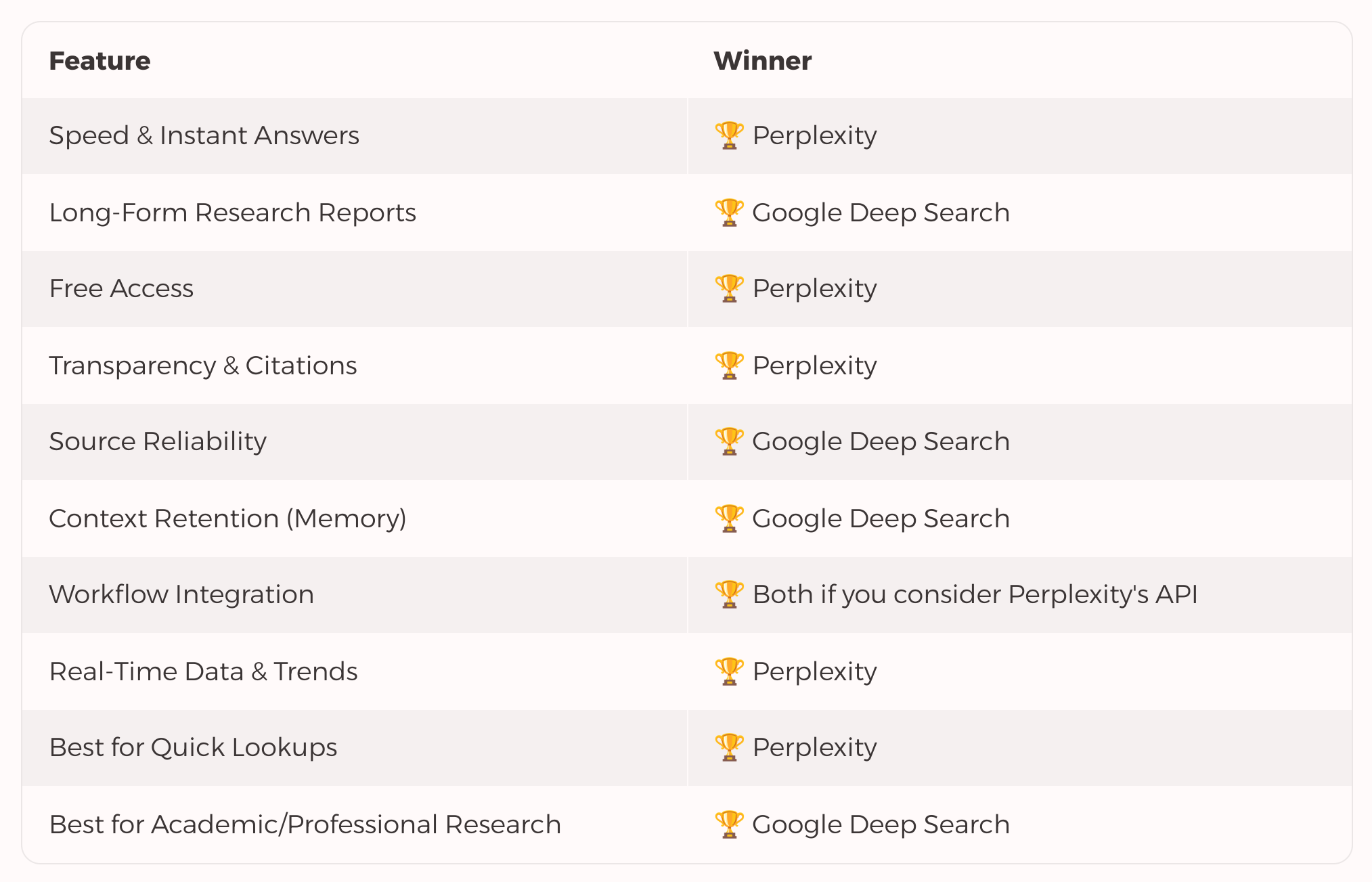
If you want free access, Perplexity is the clear winner. But if you’re after structured workflows for enterprise or academic use, Google Deep Search is worth the price. It offers better integration and a bigger context memory to get the job done..
Perplexity works like a Formula 1 pit crew, fast, efficient, and gets straight to the point. Most queries are answered in seconds, with a max wait of 90 seconds. Perfect for quick fact-checks or research summaries. Its speed comes from optimized language models that cut out wasted processing time without losing accuracy.
Google Deep Search, on the other hand, takes its time, about 5 to 8 minutes per query. Why? Because it doesn’t just find facts; it builds detailed research reports. You get a 2,500+ word summary that reads like an academic paper, pulling from multiple sources. Great for deep dives or big projects, but way too slow if you just need a fast answer.
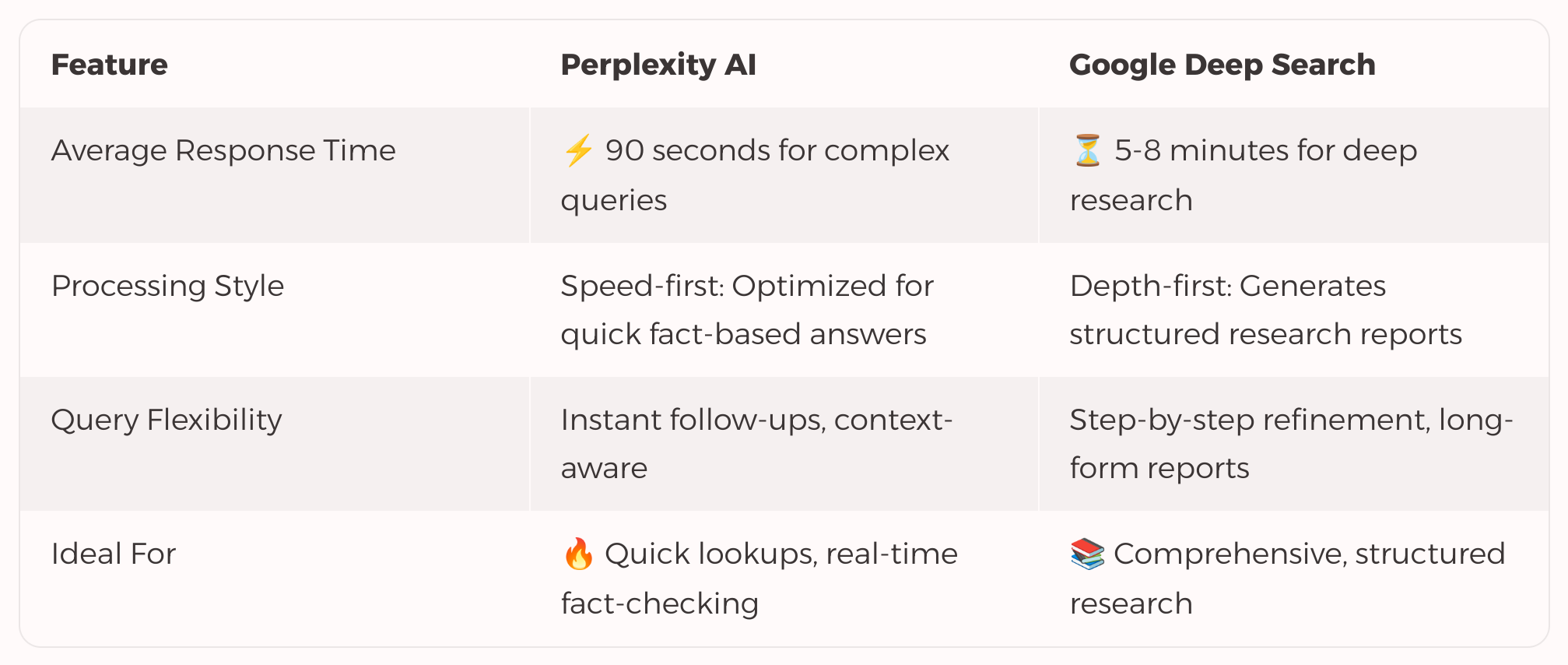
If you want speed, Perplexity dominates. If you need depth and detailed research briefs, Google is the better choice.
Perplexity is all about speed and transparency. Every answer comes with clickable citations, so you can verify sources and fact-check easily. It also pulls in data from live sources, making it great for real-time trends, something Google Deep Search struggles with. That said, Perplexity doesn’t do full research reports, so answers are short and less detailed.
Google Deep Search works more like an academic assistant. It creates full research briefs with headings, citations, and summaries, and you can export them straight to Google Docs. Perfect for academic or professional work. The downside? It sometimes relies too much on one source, and its citations aren’t as clear as Perplexity’s
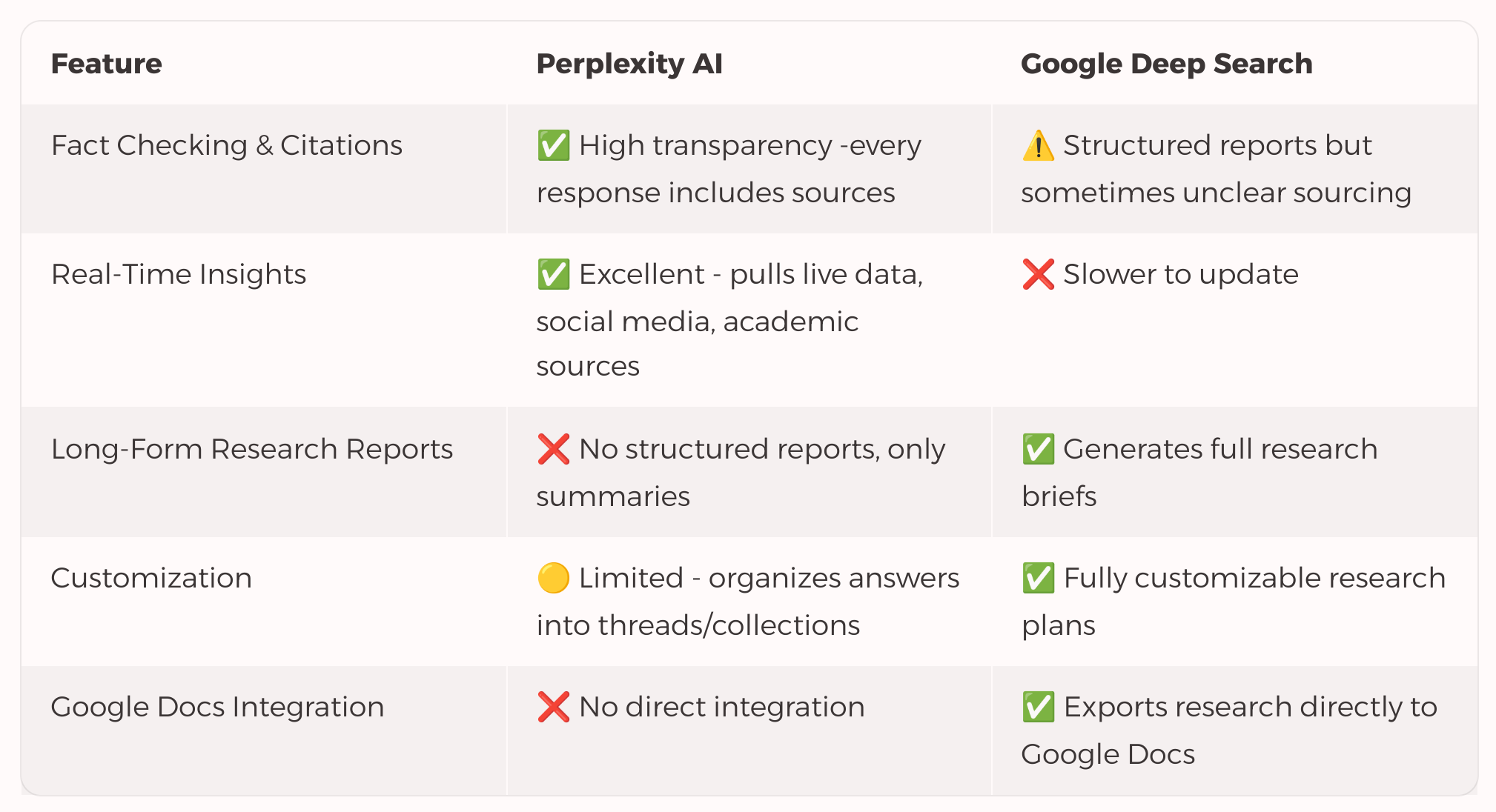
For quick, fact-checked responses, Perplexity is the better choice. For in-depth research reports, Google Deep Search is unmatched.
Perplexity is great for quick answers, but it has a short memory. Once you start a new search or refresh, everything disappears. It’s fine for simple questions, but not so great for longer research where you need to build on what you’ve already found.
Google Deep Search works differently. It’s like a research assistant with a sharp memory. It keeps track of your searches, so you can refine your results without starting over. Perfect for academic or professional projects that need multiple rounds of digging.
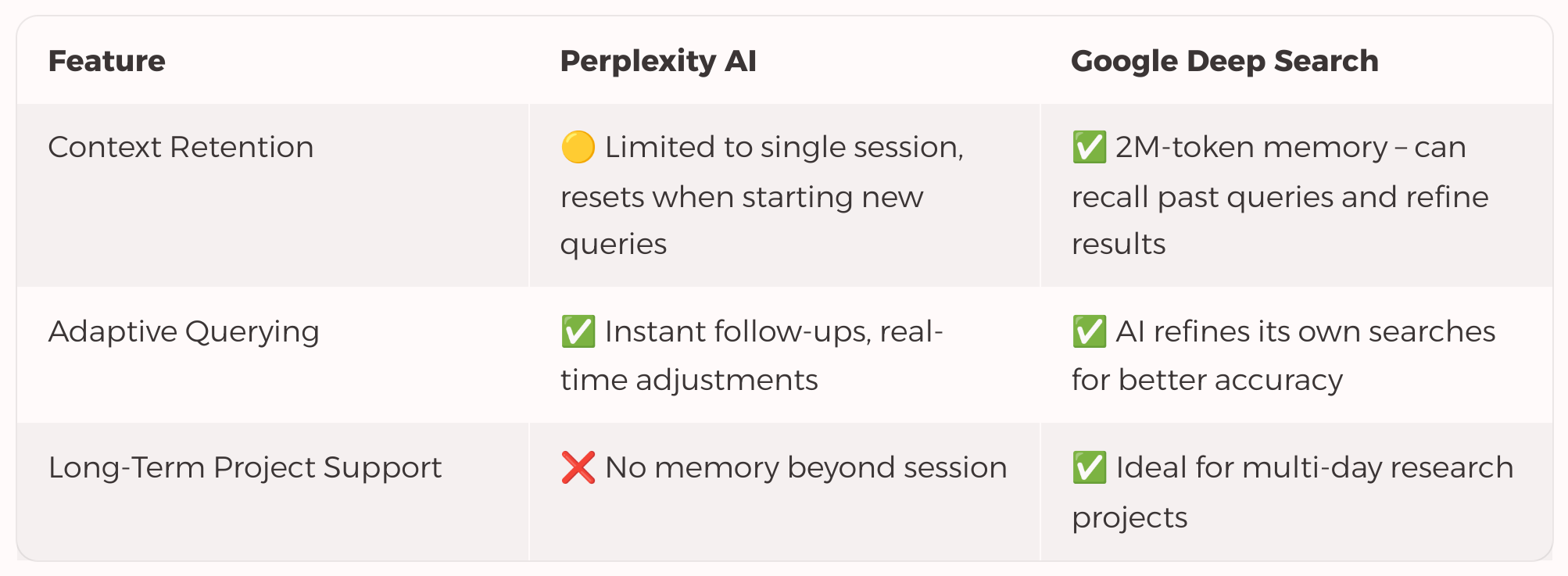
If you need short bursts of information, Perplexity is fine. But if you're working on a long-term project, Google’s context retention is miles ahead.
Perplexity pulls info from everywhere, academic papers, Reddit, social media, YouTube, you name it. This gives it a wider view, but you’ll need to double-check some sources for accuracy.
Google Deep Search plays it safe. It sticks to trusted sources like academic journals and government websites. Great for formal research, but it might miss real-time trends and fresh discussions.
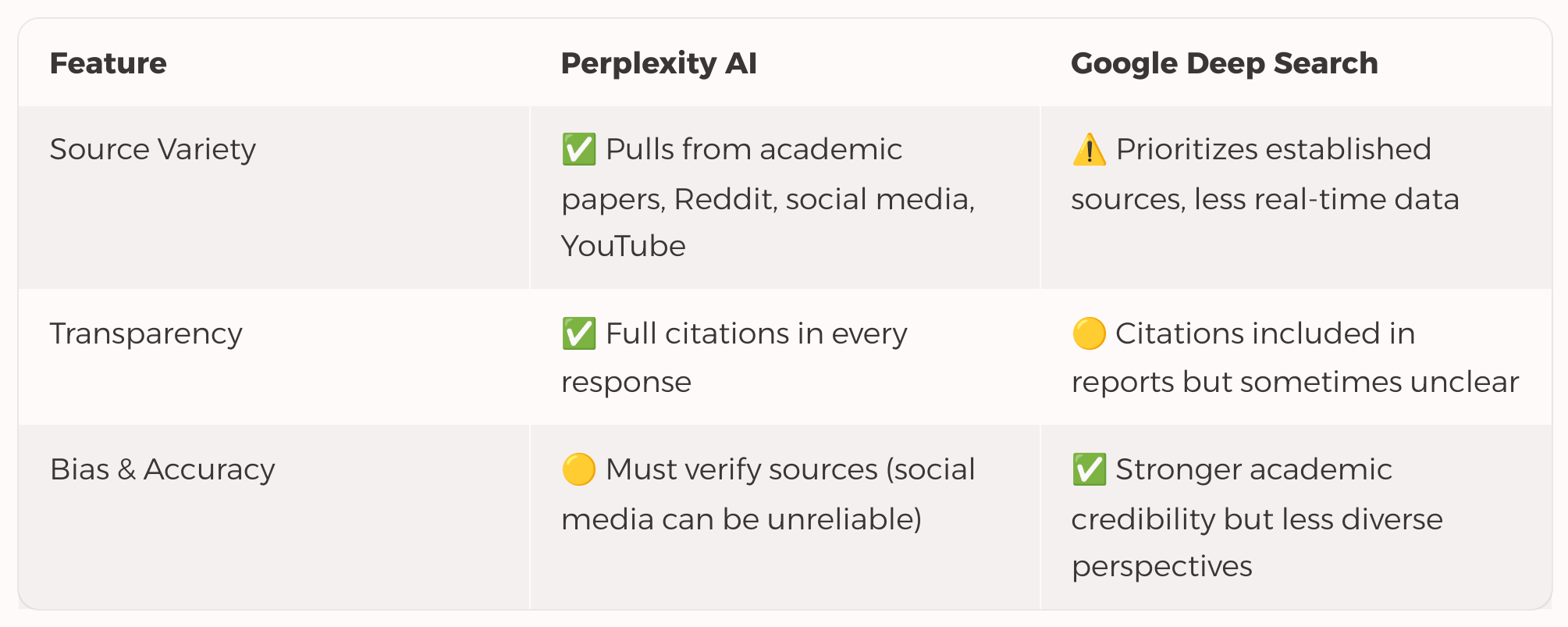
If you need broad perspectives (news, Reddit, niche forums, real-time updates), Perplexity wins. If you prefer trusted, academic sources, Google takes the crown.
Perplexity puts your privacy first. With its incognito mode, your searches stay private. Simple as that.
Google, on the other hand, doesn’t offer the same level of privacy, but it wins on accessibility. It’s built for everyone, with full support for screen readers, braille displays, and voice commands. If you’re visually impaired, Google’s the better pick.
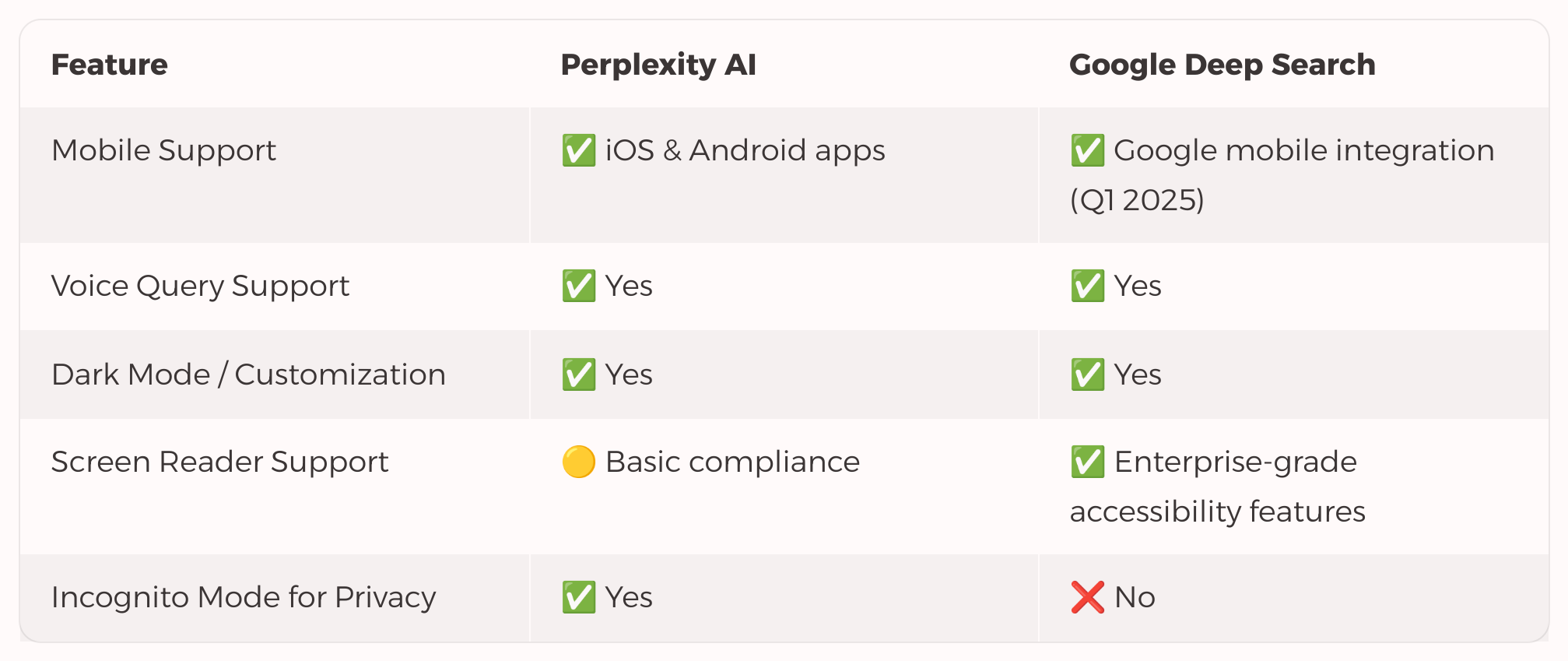
Google has better accessibility for visually impaired users, but Perplexity’s privacy-first approach makes it better for anonymous research.
Great for:
Fast, no-nonsense fact-checking
Casual users who want free AI research
People who need real-time insights from social media, forums, and diverse sources
Researchers who prioritize citation transparency
Not ideal for:
Complex, multi-step research projects
Academic or enterprise research requiring structured reports
Users who need memory/context retention across multiple sessions
Great for:
Academics, professionals, and researchers who need structured, detailed reports
Users who want full research briefs instead of just short answers
Long-term projects requiring context retention
People deeply integrated into the Google ecosystem (Docs, Drive, etc.)
Not ideal for:
Users who want quick, real-time information
People unwilling to pay $20/month without a free tier
Those who prefer transparent, citation-heavy responses
Use Perplexity for quick answers and fact-checking.
Use Google Deep Search for detailed reports and long-term research.
This way, you get speed and depth, no compromises (just double the cost).
Just when you thought open-source AI couldn’t get any better, DeepSeek pulled another wild card. One week after its last release, it dropped Janus Pro, a brand-new multimodal model that’s turning heads.
This isn’t just another AI model. It sees. It understands. It creates.
For the first time, we have an open-source model that can process images, answer questions about them, and generate new images. All in a single package. And it’s not some behemoth requiring a supercomputer. This thing runs on just 7 billion parameters, making it shockingly lightweight and accessible.
Completely open-source. Free. Open weights. This is the AI revolution we’ve been waiting for.
DeepSeek is making a bold claim: Janus Pro outperforms Stability AI’s models and OpenAI’s DALL·E.
And they have the numbers to back it up.
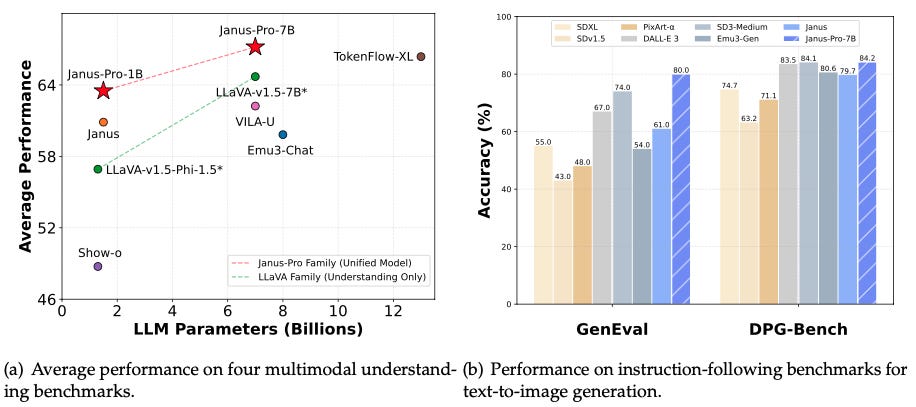
Take a look at the benchmark comparison. Janus Pro is sitting right at the top. Even when stacked against SD3 Medium, SDXL, and Emu3 Gen, Janus Pro holds its ground and even surpasses them in key areas.
Absolutely.
Here’s why:
Janus Pro is compact. At just 7 billion parameters, it’s smaller than most top-tier models but still delivers serious power.
It’s free. No paywalls, no API restrictions, run it however you want.
It’s multimodal. Unlike most AI models that specialize in either text, vision, or image generation, this one does it all in a single system.
It runs on consumer hardware. You don’t need a data center. Fire it up on your own machine or rent some power from the main cloud providers.
DeepSeek isn’t just keeping up, it’s dominating.
Janus Pro proves that open-source AI is catching up to (and in some cases surpassing) proprietary models. This is the kind of technology that levels the playing field, putting powerful AI tools in the hands of anyone willing to experiment.
AI music just got a big update.
For a while, Udio and Suno have led the AI music scene. But now, there’s a new player in the mix. Meet Riffusion.
The OG AI music generator is back. It’s free (for now) and packed with powerful features.
Full-length song generation – No more 30-second clips. Riffusion pumps out entire tracks right from the start.
Vocal + instrumental options – Generate lyrics and vocals or go full instrumental mode.
Genre-blending madness – Use advanced controls to mix and match styles - surf rock meets Middle Eastern music with a funk twist? Sure, why not.
Upload & remix – Take any existing audio (even your own recordings) and transform it into something entirely new.
AI personalization – It learns your style over time and tailors better results.
And yes, it’s free. Unlimited generations. No paywall. No credits. For now.
Riffusion is in open beta - which means it’s free for now. Unlimited generations. No hidden fees. You know how these things go - get in while the buffet is open.
AI search, AI creativity, and open-source dominance. Perplexity AI and Google Deep Research are redefining search. DeepSeek is making open-source AI more powerful than ever. And Riffusion is letting anyone create AI-generated music without restrictions.
Thanks for reading! Got thoughts, questions, or ideas for future issues? Leave a comment or send me a message. I’d love to hear what’s on your mind. See you in the next one.
No posts
Comments
Nothing yet. Say the first thing.
Sign in to join the conversation.