
In this issue, you’re gonna get a crash course in AI communication - a simple step-by-step blueprint that will take you from “meh” to “hmm… I can use this”.
If you work in marketing, content strategy, or growth hacking, knowing how to talk to AI isn't optional anymore. It's the difference between struggling with mediocre results and making AI work for you.
While the examples focus on digital marketing, the same principles apply to any field. Whether you're in finance, education, product development, or something completely different, mastering AI communication will give you an edge.
Think of AI like an intern with unlimited potential - but no common sense. Give it vague instructions, and you’ll get vague results. Guide it with precision, and it becomes a powerhouse for content, marketing, and strategy.
Mastering prompt engineering lets you:
Churn Out Content Faster - Blog posts, social media updates, ad copy, etc.
Supercharge SEO - Spot the best keywords, write ranking-friendly content, and optimize meta descriptions effortlessly.
Turn Visitors into Leads - Create landing pages, email sequences, and ads that convert.
Keep Audiences Hooked - Build interactive content, personalized campaigns, and posts people actually engage with.
Outthink the Competition - Use AI for brainstorming, market analysis, and strategy development.
This guide isn't just theory. It’s a project-based crash course where each module builds on the last. You'll get:
No-BS Explanations - Clear, simple breakdowns of key concepts.
Practical Examples - Real-world digital marketing scenarios in action.
Hands-On Exercises - Step-by-step tasks to sharpen your skills.
Before-and-After Comparisons - Watch weak prompts turn into gold.
Again, while we’ll focus on digital marketing, these skills translate to any field.
Let’s get started.
Before getting into the fancy stuff, let's get one thing straight: AI isn't a mind reader. If your prompts are sloppy, expect mediocre results.
Think of it like giving instructions to a toddler - be clear, be specific, and set boundaries, or you’ll get chaos.
Clarity - No fluff, no jargon, no guessing games. The AI needs clear, direct instructions.
❌ "Tell me about remote work." (This will get you a Wikipedia summary.)✅ "Write a 100-word LinkedIn post about the benefits of remote work in a friendly, engaging tone."Specificity - The more details you provide, the better the AI performs.
❌ "Describe an AI tool." (This could be anything from a chatbot to a self-driving car.)✅ "Write a product description for a new AI-powered content tool aimed at marketing professionals, highlighting ease of use and time-saving benefits."Constraints - Give the AI a box to work in, or it’ll aimlessly wander. Define length, tone, style, and target audience.
❌ "Write an Instagram caption." (It might spit out a paragraph-long essay.)✅ "Generate a 3-sentence Instagram caption using a humorous tone to promote a digital marketing course."Format - Tell AI exactly how you want the output structured.
❌ "Give me SEO tips." (Prepare for an unstructured info dump.)✅ "Create a bullet-point list of five SEO strategies for 2025."Context - AI lacks intuition and it doesn’t have any information about your specific need, so feed it the necessary background.
❌ "Summarize this." (Summarize what? And for whom?)✅ "Summarize this article for a beginner in digital marketing, keeping it under 150 words."
Let’s say you need a social media post for a coffee shop. A weak prompt would be:
"Write a social media post for a coffee shop."Why This Prompt Falls Flat
Clarity: Somewhat clear, but still vague. What’s the goal of the post? A promotion? A brand story? A customer testimonial?
Specificity: Very low. Should it be funny? Inspirational? A call-to-action?
Constraints: None. AI has free rein, which means you might get something generic.
Format: Implied, but not defined. A tweet? A long-form Facebook post? An Instagram caption?
Context: Nonexistent. Is this a high-end café? A budget-friendly spot? A trendy, Gen Z hangout?
Analyze the following prompts and break down their flaws using the core ingredients (clarity, specificity, constraints, format, context) :
"Write a blog post about SEO."
What aspect of SEO? Basics? Advanced tactics? Local SEO?
Who is the audience? Beginners? Experts? Business owners?
What length? A quick summary? A detailed guide?
"Generate marketing ideas."
For what? A product launch? A holiday campaign? A struggling brand?
What industry? Tech? Fashion? Fitness?
What format? A list? A detailed strategy breakdown?
"Create an ad."
What product or service? What’s the unique selling point?
What platform? Facebook, Google, Instagram, YouTube?
What style? Emotional? Humorous? Urgent?
"Summarize customer feedback."
What kind of feedback? Positive? Negative? Mixed?
What’s the purpose? To address complaints? Highlight strengths?
How detailed should the summary be? Bullet points? A one-sentence overview?
Now, take a moment to rethink these prompts. What details would you add to make them sharper, more targeted, and more effective? Get this part right, and AI stops being a guessing game.
Now that we’ve seen how basic prompts fall short, it’s time to sharpen them into high-performing instructions.
This module is all about iterative prompting - a process where we refine prompts step by step until they generate exactly what we need.
Start with a Basic Prompt: Begin with a simple prompt that captures the core request.
Analyze and Identify Weaknesses: Evaluate the basic prompt against the core ingredients (clarity, specificity, etc.) and identify areas for improvement, as you did in Exercise 1.1.
Refine for Clarity and Specificity: Make the prompt more precise and unambiguous. Clearly state your objective and the desired output.
Add Constraints: Incorporate limitations and boundaries to guide the AI's response. This could include length, tone, style, target audience, keywords, or specific elements to include.
Specify Format: Explicitly state the desired format of the output (paragraph, list, blog post, etc.).
Provide Context: Add relevant background information, scenarios, or perspectives that the AI should consider.
Test and Iterate: Run the refined prompt and evaluate the AI's output. If the output is not satisfactory, go back to step 2 and further refine the prompt based on the output and your goals.
Let's revisit our basic prompt from Module 1:
"Write a social media post for a coffee shop."Step 1: Basic Prompt: "Write a social media post for a coffee shop."
Step 2: Analyze Weaknesses: Lacks specificity, constraints, and context. Too generic.
Step 3: Refine for Clarity and Specificity: Let's be more specific about the post's goal. We want to promote a new seasonal drink.
Improved Prompt (Version 1):
"Write a social media post announcing a new seasonal drink at a coffee shop."Step 4: Add Constraints: Let's add constraints for platform (Instagram), length (short, engaging), and tone (enthusiastic, inviting).
Refined Prompt (Version 2):
"Write a short, engaging Instagram post announcing a new seasonal drink at a coffee shop. Use an enthusiastic and inviting tone."Step 5: Specify Format: We want a post with emojis and hashtags.
Refined Prompt (Version 3):
"Write a short, engaging Instagram post to announce a new seasonal drink at a coffee shop. Use an enthusiastic and inviting tone. Include relevant emojis and hashtags."Step 6: Provide Context: Let's give the drink a name ("Pumpkin Spice Latte"), specify the target audience (young adults, students), and mention a limited-time offer.
Advanced Prompt (Version 4 - Getting Closer to Expert Level):
"Create an Instagram post to excitedly announce the 'Pumpkin Spice Latte,' our new limited-time seasonal drink at 'The Daily Grind' coffee shop.
Target young adults and students. Use an enthusiastic, inviting tone, and keep it short and engaging.
Include relevant emojis (coffee, pumpkin, fall leaves) and popular hashtags like #PumpkinSpiceLatte, #FallDrinks, #CoffeeShop, #LimitedTimeOffer. Focus on creating a sense of excitement and urgency to try the new drink."
Basic Prompt:
"Write a social media post for a coffee shop."Generic, likely bland output.
Advanced Prompt:
"Create an Instagram post to excitedly announce the 'Pumpkin Spice Latte,' our new limited-time seasonal drink at 'The Daily Grind' coffee shop. Target young adults and students. Use an enthusiastic, inviting tone, and keep it short and engaging. Include relevant emojis (coffee, pumpkin, fall leaves) and popular hashtags like #PumpkinSpiceLatte, #FallDrinks, #CoffeeShop, #LimitedTimeOffer. Focus on creating a sense of excitement and urgency to try the new drink."Specific, targeted, engaging output ready for use.
Take the basic prompts from Exercise 1.1 and apply the iterative refinement process to transform them into more effective prompts. For each prompt:
Basic Prompt (from Exercise 1.1): (Copy the basic prompt)
Analyze Weaknesses: (Identify weaknesses as you did in Module 1)
Refined Prompt (Version 1): (Improve clarity and specificity)
Refined Prompt (Version 2): (Add constraints)
Refined Prompt (Version 3): (Specify format if needed)
Advanced Prompt (Version 4 - or more iterations if needed): (Provide context and any further refinements for maximum effectiveness)
Prompts to Refine (from Exercise 1.1):
"Write a blog post about SEO."
"Generate marketing ideas."
"Create an ad."
"Summarize customer feedback."
Remember to think about:
What is the specific goal of each prompt?
What kind of output do you want to achieve?
What are the key elements that will make the output effective for digital marketing purposes?
Who is the target audience?
What platform or channel is it for?
(Stop here and complete Exercise 2.1. This step locks in your understanding of prompt refinement. Compare your improved prompts with the basic ones - the difference in quality will be obvious.)
Next up: advanced prompt engineering techniques.
Now that you've nailed the basics of prompt refinement, it's time to step up your game with advanced prompt engineering.
These strategies will help you tackle complex tasks, generate more nuanced outputs, and push AI to its full potential.
Role-Based Prompts
Tell the AI who to be. Giving it a specific role sharpens its responses, making them more relevant and on-brand.Need SEO insights? Have it act as an "SEO Specialist." Crafting social content? Make it a "Social Media Manager."
You can even have it embody a customer persona for more tailored messaging.
"You're an experienced SEO Specialist. Give me five long-tail keywords for a blog post on 'best coffee beans for French Press.'”Iterative Prompting (Beyond Basic Tweaks)
This isn’t just about refining a single prompt - it’s an ongoing conversation.Start broad, then fine-tune based on the AI’s responses. This approach is key for brainstorming, deep dives, and refining complex ideas.
Prompt 1:"Give me five headline ideas for a blog on 'Benefits of Social Media Marketing.'"(AI Responds)
Prompt 2:"Headline #3 is interesting. Can you make it more specific to small businesses?"(AI Responds with a more targeted headline)
Chain-of-Thought Reasoning
Force the AI to explain its thought process before delivering an answer. This works wonders for strategy, problem-solving, and anything requiring logic or justification."Break down the step-by-step process for re-engaging inactive email subscribers. Start with defining the goal and finish with measuring results."Few-Shot Learning
Rather than just telling AI what you want, show it. Providing a few examples guides it toward the style, structure, or tone you're aiming for. This is gold for creative tasks, brand voice consistency, and structured outputs."Write three social media posts announcing a flash sale for our online clothing store. Match the tone and style of these examples: [Example Post 1] [Example Post 2] [Example Post 3]"
These techniques don’t just improve AI’s output - they turn it into a real asset.
Let's say you need to find relevant keywords for a new blog post about "digital marketing trends."
Basic Prompt (Starting Point): "Find keywords for digital marketing trends blog post." (Too basic, likely generic keywords)
Refined Prompt (Role-Based):
"Act as an expert SEO Keyword Research Specialist. Provide a list of 10 high-potential keywords for a blog post about 'digital marketing trends in 2025.' Focus on keywords with medium search volume and low keyword difficulty. Include both short-tail and long-tail keywords."Refined Prompt (Chain-of-Thought + Role-Based):
"Act as an expert SEO Keyword Research Specialist.
First, outline your step-by-step thought process for identifying relevant keywords for a blog post about 'digital marketing trends in 2025.'
Then, based on your process, provide a list of 10 high-potential keywords with medium search volume and low keyword difficulty, including both short-tail and long-tail options.
Explain why each keyword is relevant and potentially valuable."
Refined Prompt (Few-Shot + Chain-of-Thought + Role-Based):
"Act as an expert SEO Keyword Research Specialist. First, outline your step-by-step thought process for identifying relevant keywords for a blog post about 'digital marketing trends in 2024.' Then, based on your process, provide a list of 10 high-potential keywords with medium search volume and low keyword difficulty, including both short-tail and long-tail options. Explain why each keyword is relevant and potentially valuable. Format your keyword list as follows:
Keyword: [Keyword Example]
Search Volume (Estimated): [Estimate]
Keyword Difficulty (Estimated): [Estimate]
Relevance & Potential: [Brief Explanation]"
Before-and-After Transformation (Keyword Research Prompt):
Basic Prompt:
"Find keywords for digital marketing trends blog post."Generic, likely unhelpful keywords.
Advanced Prompt:
"Act as an expert SEO Keyword Research Specialist. First, outline your step-by-step thought process for identifying relevant keywords for a blog post about 'digital marketing trends in 2024.' Then, based on your process, provide a list of 10 high-potential keywords with medium search volume and low keyword difficulty, including both short-tail and long-tail options. Explain why each keyword is relevant and potentially valuable. Format your keyword list as follows:
Keyword: [Keyword Example]
Search Volume (Estimated): [Estimate]
Keyword Difficulty (Estimated): [Estimate]
Relevance & Potential: [Brief Explanation]"
Highly structured, expert-level keyword list with reasoning.
For each digital marketing task below, write three prompts:
Basic Prompt: A straightforward, beginner-level request.
Intermediate Prompt: A refined version that adds clarity, specificity, constraints, format, or context.
Advanced Prompt: An optimized version using at least two advanced techniques (role-based prompts, iterative prompting, chain-of-thought reasoning, few-shot learning).
Generate Content Ideas for a YouTube channel on "Healthy Eating."
Create a Facebook Ad Campaign for a new fitness app.
Develop an Email Marketing Sequence to nurture leads for a SaaS product.
Brainstorm Strategies to boost engagement on an Instagram business profile.
For each Advanced Prompt, specify which techniques you're using and why. Experiment with different combinations and see how they impact the AI’s responses.
(Stop here and complete Exercise 3.1. This hands-on practice will sharpen your ability to craft powerful AI prompts.)
Now let’s take on a task where prompt engineering really proves its worth: writing landing page copy that converts.
A basic prompt leads to forgettable fluff, but a well-structured prompt turns AI into a reliable assistant.
Task: Create headline & copy for the hero section of a Landing Page Promoting a Digital Marketing Course
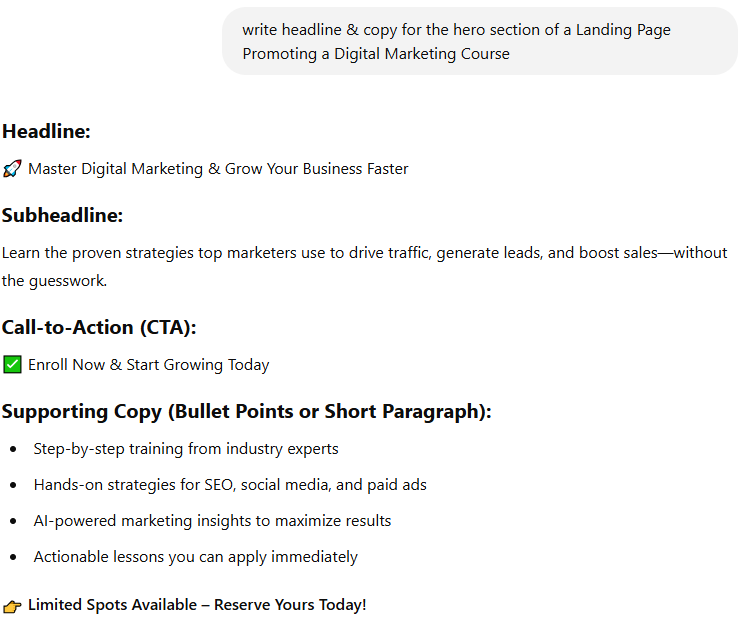
Why This Fails:
No persuasive elements
No audience targeting
No benefits or emotional appeal
Weak call to action
Extra stuff I didn’t asked for (CTA, Supporting copy)
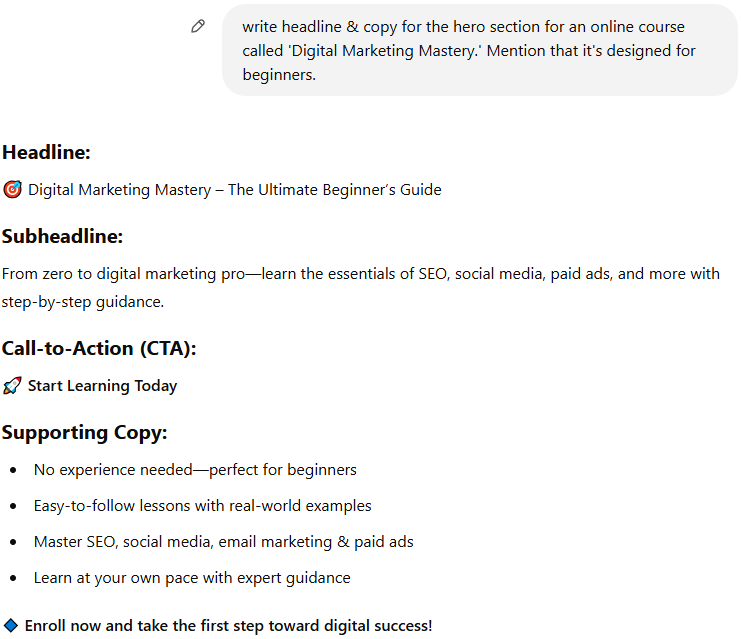
What’s Improved?
Course name is included
Audience is specified
What’s Still Wrong?
Boring, generic headline
No emotional hook or urgency
Lacks a clear value proposition
I still get extra stuff I don’t need
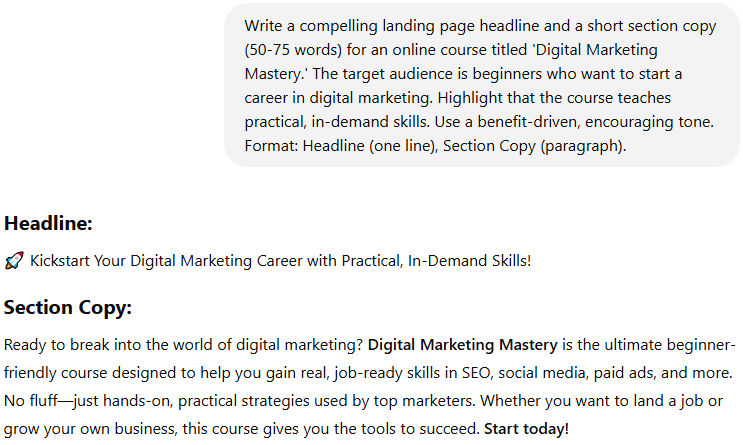
Why It’s Better:
✅ No more extra Stuff
✅ Clearly defines the audience
✅ Highlights career benefits & skills gained
✅ Uses an encouraging tone
But we’re still missing the wow factor.
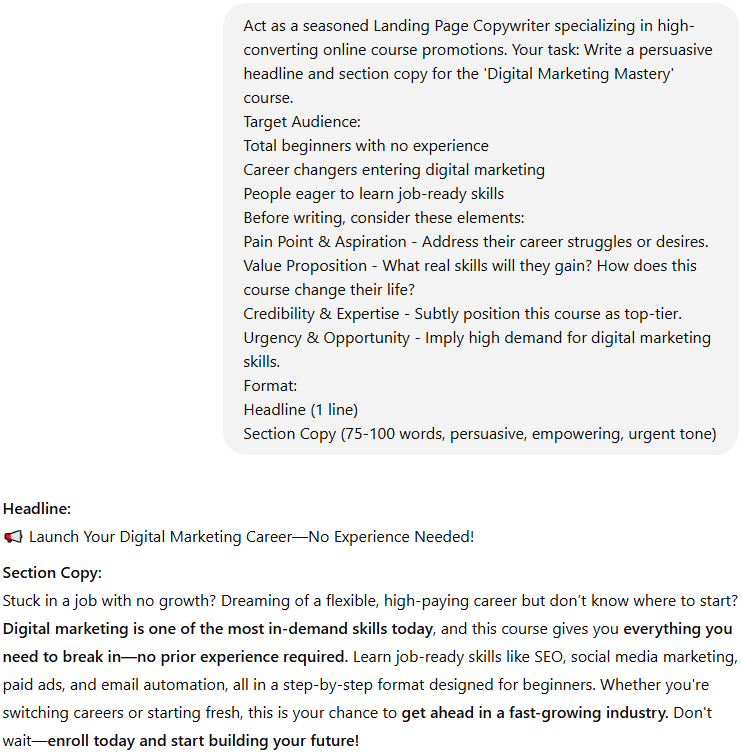
The difference? Night and day.
This version is far better than where we started - it’s more persuasive, targeted, and emotionally compelling. But would I publish it as-is? No. I'd refine the tone, adjust for brand voice, and test variations for conversion.
AI can get you close, but human editing makes it truly great.
The takeaway? A weak prompt gets you weak copy. A strategic prompt gets you something usable - with a little fine-tuning.
We've come a long way.
You've seen firsthand how the right prompt can take AI from giving you generic fluff to producing highly targeted, persuasive, and strategic content.
Precision Matters – Vague prompts lead to vague results. Be clear, specific, and intentional.
Constraints Improve Output – Structure and limitations guide AI to deliver exactly what you need.
Advanced Techniques Make the Difference – Role-based prompting, iteration, and structured thinking take AI responses to the next level.
AI is a Tool, Not a Replacement – You now know how to get AI to work for you. The final touch always comes from human creativity.
Iteration is Everything – The best results don’t come from the first prompt. Refinement is the real secret.
Marketing Applications are Limitless – Whether it’s SEO, ads, emails, or engagement, a well-crafted prompt makes AI a game-changer.
Practice Constantly – The more you experiment, the sharper your prompts become.
Apply It to Real Projects – Start using AI in your campaigns, content, and business growth efforts.
Stay Curious – AI is evolving, and so should your prompt strategies. Keep learning.
Teach & Share – Help others understand the power of well-crafted AI instructions.
This course gave you the how. Now, it's time to apply it, refine it, and make AI work for you.
Happy prompting – See you all in the next one.
No posts
Comments
Nothing yet. Say the first thing.
Sign in to join the conversation.