
Today I am on “holiday” in Thailand for half term and it’s great to be in a country where fried meat and rice for breakfast is a staple and what a bargain for only 8AED (£1.80) in an area called Ban Chang in Rayong. Fresh and delicious.

I am a developer at heart. I write code (well I did until about 6 months ago). I think in systems, APIs, and pipelines. What I do not do or like doing - or did not do - is sales, marketing, content strategy, or social media management. Those were always someone else’s job. Entire departments exist for those functions. I never had the skills, the time, or frankly the inclination.
Then AI changed the equation. In the same way that AI has enabled every non-developer to write software, developers can now enter other areas of the business. A marketer can spin up a landing page. A salesperson can build their own dashboards. A designer can write working prototypes. And a developer like me can run a content and distribution operation. AI is not replacing anyone’s role - it is expanding everyone’s reach into adjacent ones.
I used AI to build a full content-to-sales pipeline for a podcast for less than $60 a month. But the podcast is just the example. The real point is that AI lets anyone stretch into the roles next door to their own - and your existing skills become the foundation for how you do it.
For most of my career, roles were neatly separated. Developers built the product. Marketing told people about it. Sales closed the deals. Content teams kept the social feeds alive. Everyone stayed in their lane - not because they wanted to, but because crossing into someone else’s territory meant acquiring a whole new skill set from scratch.
If you were a developer with a side project, you had two options for distribution: post it on Hacker News and hope for the best, or pay someone to handle the marketing. If you were a marketer with a product idea, you had to find a developer or learn to code. Every role had a hard boundary where your expertise ran out and someone else’s began.
The gap was not just knowledge. It was volume. Modern content marketing, for example, is a numbers game. You need dozens of pieces of content per week across multiple platforms. You need platform-specific formatting. You need consistent scheduling. You need captions, thumbnails, descriptions, hashtags. Doing it properly is a full-time job - and a job I had zero training for.
AI did not teach me marketing. It handled the parts of marketing that are mechanical and let me focus on the parts that are strategic. The interesting thing is that my existing skills - breaking problems into components, designing systems, optimising for outcomes - turned out to be directly transferable. Not because developer skills are better than marketing skills, but because every role has transferable instincts that become powerful when you can suddenly apply them in new territory.
A friend and I started a podcast. A weekly chat about where AI is heading for those in the technical sphere.
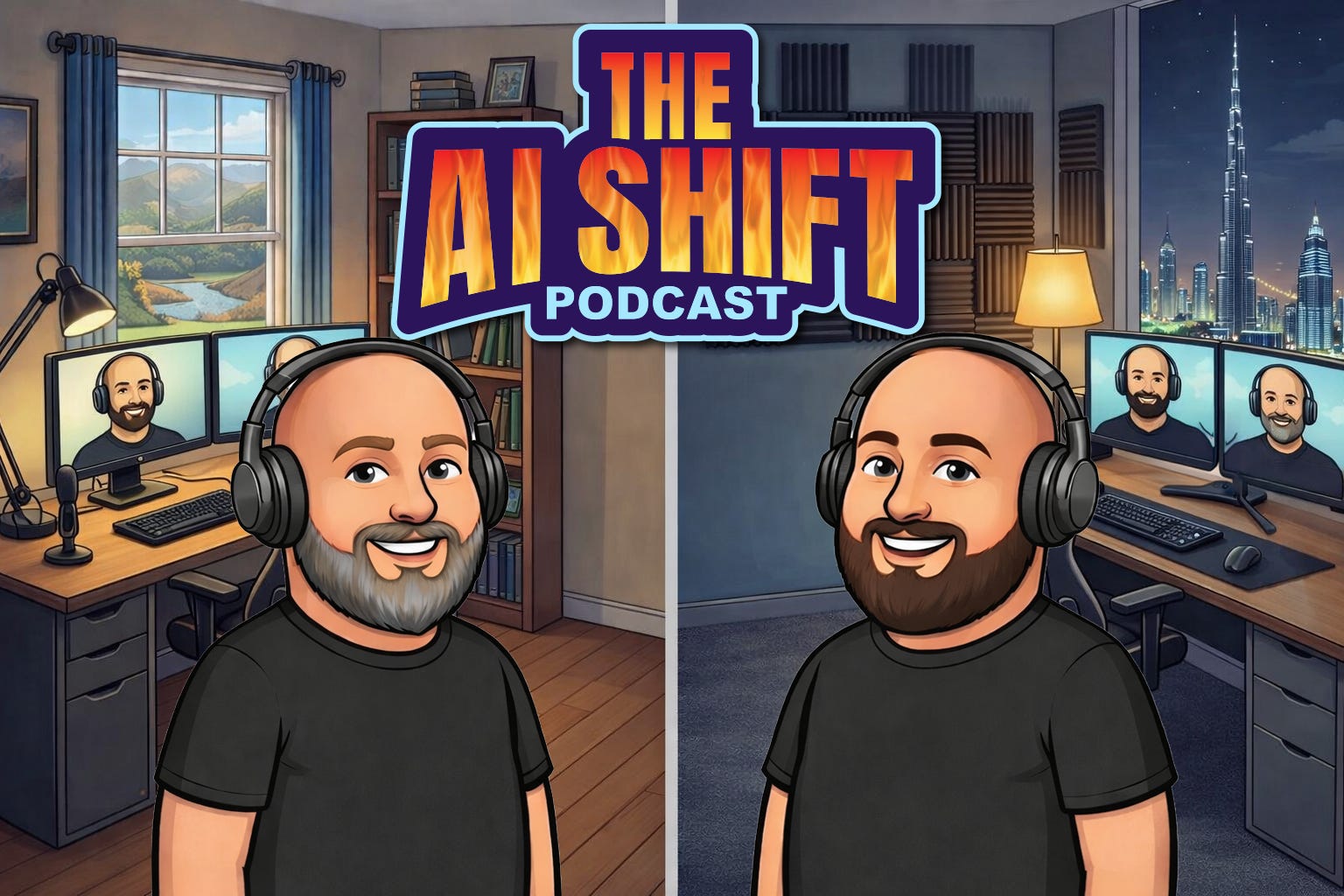
We record on Riverside, from that single recording, I needed to produce a week of content across every platform. Full episodes for Apple Podcasts, Spotify, and YouTube. Thirty to forty short vertical clips for TikTok, Instagram Reels, and YouTube Shorts. A Substack article. A LinkedIn post. Platform-specific captions and post description for every single piece.
A media team to do this would cost thousands per month. I built the pipeline in a morning. Not because I am a content expert, but because I am a developer who knows how to chain tools together.
You can check out all the podcast channels at www.theaishift.ai
Here is the actual workflow. I naturally thought of it as a pipeline - that is just how my brain works after years of building software. Someone from a different background would probably frame it differently, but the result would be the same.
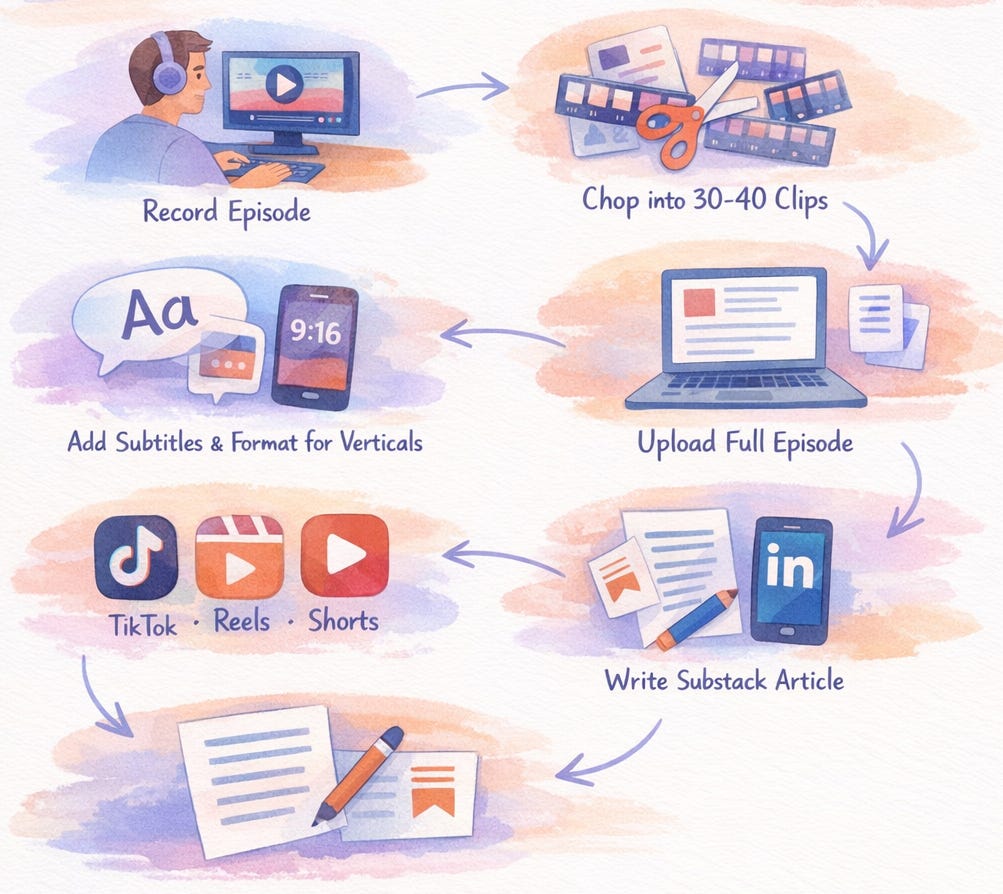
Record on Riverside. Riverside handles the recording infrastructure so I do not have to think about codecs, sync issues, or upload reliability. It just works, and the output quality is high enough that everything downstream looks professional.
Quick edit. Play the episode back at double speed. Fastest way to catch anything that needs cutting. You now have a clean master file.
Transcribe and chapter. AI transcription generates a full transcript. From that, chapter markers are auto-generated based on topic shifts. These become structured metadata for podcast platforms and YouTube - the kind of thing that helps discoverability and that I would never have written manually.
Clip with Opus Clips. This is the multiplier. Opus Clips takes the full episode and uses AI to identify the most engaging 30 to 60-second moments. It produces them as vertical 9:16 videos with baked-in subtitles. From a single 40-minute conversation, I get 30 to 40 standalone clips. Each one is a piece of content I did not have to edit, subtitle, or format by hand.
Post-processing. Each clip gets a branded outro appended, then gets re-encoded to meet platform specs. Different platforms want different aspect ratios, codecs, and file sizes. I wrote scripts to handle this - automating repetitive work is second nature to me, and this is where my background really helped.
Platform-specific captions. TikTok, Instagram Reels, and YouTube Shorts all have different character limits and conventions. A caption that works on one gets truncated on another. So each clip gets its own set of captions, generated and formatted per platform. This is the kind of detail a social media manager would know instinctively. I had to learn it by getting it wrong, then I automated it so I would never get it wrong again.
Schedule with Buffer. All the clips, with their platform-specific captions, get loaded into Buffer for scheduling. Seven clips per day, five days a week, across all three platforms, starting the day before the full episode drops. Buffer handles the actual posting - I just need to fill the queue.
What I like about Buffer is that it turns scheduling from a daily task into a batch operation via their API. I load a week of content in one session and then I am done. Set it and move on.
Full episode upload. The complete episode with intro, outro, and structured description goes to Apple Podcasts, Spotify, and YouTube.
Substack article. One hour after the YouTube upload, a Substack article publishes with the video embedded. Newsletter audience gets a reason to engage. YouTube video gets an early traffic boost. Two birds.
LinkedIn highlight. From all the clip transcriptions, I pick the most business-relevant one, write a concise summary, and post it. Different audience, different format, same source material.
Here is what I have realised. Every role has instincts that transfer into adjacent work when AI removes the barriers.
My background gave me systems thinking - the reflex to chain tools together, automate repetitive steps, and think about data flow. That is what made this pipeline possible. But a marketer building the same workflow would bring something I completely lacked: an intuition for what resonates with an audience, which hooks work, how to write a caption that stops a thumb mid-scroll. A salesperson would instinctively build the funnel mechanics I had to stumble into by accident.
We all arrive at the same territory from different directions, and we each bring skills the others do not have. That is what makes this moment interesting. AI is not flattening everyone into the same generic role. It is letting people bring their specific strengths into places those strengths have never been applied before.
For me, the transferable skills looked like this:
Editorial judgment - what to say, what is interesting, what resonates. I do not have great instincts here, but AI helps. It identifies compelling moments in a conversation, suggests captions, drafts articles. It bridges the gap in my weakest area.
Production skills - video editing, subtitling, formatting. AI handles most of this now. Opus Clips does the clipping and subtitling. Post-processing scripts handle the rest.
Distribution knowledge - where to post, when, in what format. Tools like Buffer abstract this. The platform-specific details are learnable and automatable.
Volume and consistency - the sheer grind of producing enough content, often enough, across enough platforms. This is where my background helped most. Automation is what I do.
The only piece that still needs a human is the original conversation - the actual ideas, opinions, and expertise. Everything between “we said something interesting” and “it is now on every platform” can be systematised.
I never studied sales funnels. But once I built this pipeline, I accidentally built one.
The short clips on TikTok, Instagram, and YouTube Shorts are top-of-funnel. They are the shop window on a busy street. People scrolling past see a 30-second clip. Most keep scrolling. Some stop (19,100 views on instagram reels in the first week). Some of those click through to the full episode. Some of those subscribe. Some of those start following on other platforms. That is a funnel. A marketer would have designed it intentionally from day one. I backed into it by thinking about data flow and conversion rates. Different starting point, same destination.
The numbers are simple. Instagram Reels are getting over a hundred views per post, with around 100 posts out there. TikTok started slow but now the videos are getting zero views so there is something I need to investigate on my account (maybe I posted too aggressively and got restricted). Small details that a social media professional would have caught immediately. I had to learn them the hard way, but once I understood the problem, I could automate the fix.
The point is not the specific numbers. The point is that I have a measurable pipeline with inputs and outputs, and I can iterate on it. My version of iteration happens to involve scripts and data. Someone else might iterate by feel and experience. Both work.
The pipeline handles production and distribution. Now I want to close the loop.
Automated engagement. Engagement drives reach on every platform. But responding to comments manually across three platforms is its own time sink. The next step is a system that pulls comments, generates draft replies in our conversational tone, and queues them for human review. Not fully automated - I want the responses to feel human. Just faster.
Analytics-driven scheduling. Right now I post everything and see what sticks. But the data is there. Pull analytics from each platform, feed them into a model, predict which segments will perform best, and weight the scheduling accordingly.
Smarter thumbnails. Some of my current thumbnails are blurry frames or shots with closed eyes. A thumbnail selection system that scores frames by visual quality, face detection, and motion - then ranks by predicted click-through rate - would solve this.
Self-hosted pipeline. Currently this runs across Riverside, Opus Clips, Buffer, and a few other services. The long-term goal is to containerise what I can - transcription, captioning, post-processing, scheduling - into a single pipeline triggered by one command. Own the infrastructure, reduce the dependencies, cut the cost.
A dedicated media team to do what this workflow does would cost thousands per month. My total spend is under 60 dollars. Riverside for recording, Opus Clips for clipping, Buffer for scheduling, plus some transcription API calls.
But the real story is not the money saved. It is the capability gained. Without this workflow, I simply would not have a content distribution strategy. I would not have hired a team. I would not have done it manually. It just would not exist. The opportunity cost of not building this was invisible until I built it.
The walls between roles are coming down. Not because AI makes everyone equally good at everything - it does not. But because it lowers the barrier to entry enough that your existing skills can carry you into adjacent territory.
A marketer who uses AI to build a simple app is not suddenly a software engineer. But they can ship something that works and solves a real problem. A developer who uses AI to run a content operation is not suddenly a media strategist. But they can build a pipeline that gets their work in front of people.
This is happening in every direction. Designers are shipping code. Salespeople are building internal tools. Product managers are creating prototypes. The common thread is not any one role having an advantage. It is that AI lets everyone extend their reach - and the people who lean into that will operate at a different level than those who stay strictly in their lane.
For me, the specific opportunity was content and distribution. I had a podcast, I had development skills, and AI bridged the gap between what I knew and what I needed to know. Someone else will read this and see a completely different opportunity based on their own skills and their own adjacent roles.
You do not need to learn a new profession. You need to point the skills you already have in a new direction.
No posts
Comments
Nothing yet. Say the first thing.
Sign in to join the conversation.