
I am writing this on the balcony of my hotel in Thailand, overlooking the coast.

The last three mornings, on the way down to breakfast, I have walked past the same group of kids - somewhere between eight and eleven years old - huddled over iPads and little handheld devices, completely absorbed in their digital pets. Feeding them. Cleaning them. Playing with them.
Who would have thought digital pets would be a thing again?
It took me straight back to the 90s. The original Tamagotchi. That tiny plastic egg clipped to your schoolbag, beeping at you during double maths because your pet was hungry. So you sat there, feeling genuinely guilty about neglecting something that did not exist.
The kids in this hotel lobby are doing exactly the same thing, thirty years later, on better screens. The technology changed. The attachment did not.
So this morning, instead of breakfast, I built the whole thing again - in a browser, from scratch. Check it out https://tamagochi.leemallon.com
The original Tamagotchi sold 82 million units. Not because the technology was impressive. A monochrome LCD, three buttons, and a watch battery. It sold because it made people care about a cluster of pixels. It created emotional stakes out of nothing.
That is an extraordinarily hard design problem. Most apps struggle to get people to open them twice. The Tamagotchi had children crying at the dinner table because their digital pet died while they were at school. It had teachers banning them. It had adults - grown, professional adults - sneaking into the bathroom to feed a blob.
I have been thinking a lot about what makes software feel alive. Not alive in the AI sense. Alive in the sense that it changes when you are not looking. That it has needs. That it rewards attention and punishes neglect. There are some interesting parallels with how we are building AI models and neural networks today. Most of the software we build is inert. It sits there waiting for input. The Tamagotchi is the opposite. It does not wait for you. It needs you. And that tiny shift - from passive tool to active relationship - changes everything about how people engage with it. With agents, that is starting to change - we are building our own productive Tamagotchis.
The whole thing runs in the browser. No app store. No download. No framework. You open a URL and there it is - a pixel pet bobbing around inside a rendered Tamagotchi shell, complete with chunky coloured buttons, screw details, and a keychain hole. It looks like holding the real thing.
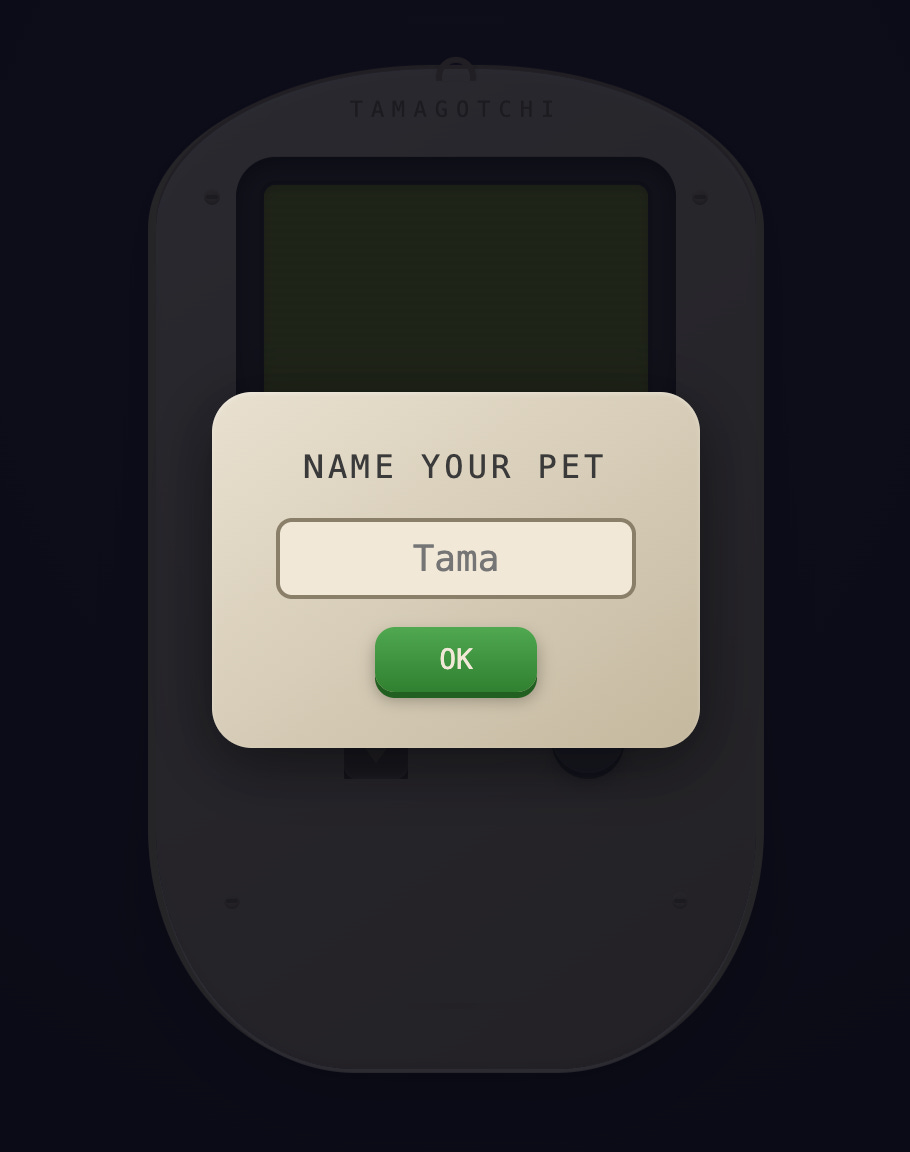
The first thing it asks you to do is name your pet - you cannot skip it, you cannot use it without naming it. This is the moment everything changes. Once you type a name, it is yours. You are responsible. That three-second interaction is where engagement spikes, and it is the oldest trick in the book - but it works every single time.
Once named, your pet has five stats to manage: Hunger, Happiness, Health, Energy, and Cleanliness. Feed it and it gets messy. Play with it and it gets tired and dirty. Give it medicine and it gets healthier but its happiness drops. Every action has a trade-off. There is no button that just makes everything better. You have to think about what your pet actually needs right now.
There is a bath button. You will use it more than you expect.
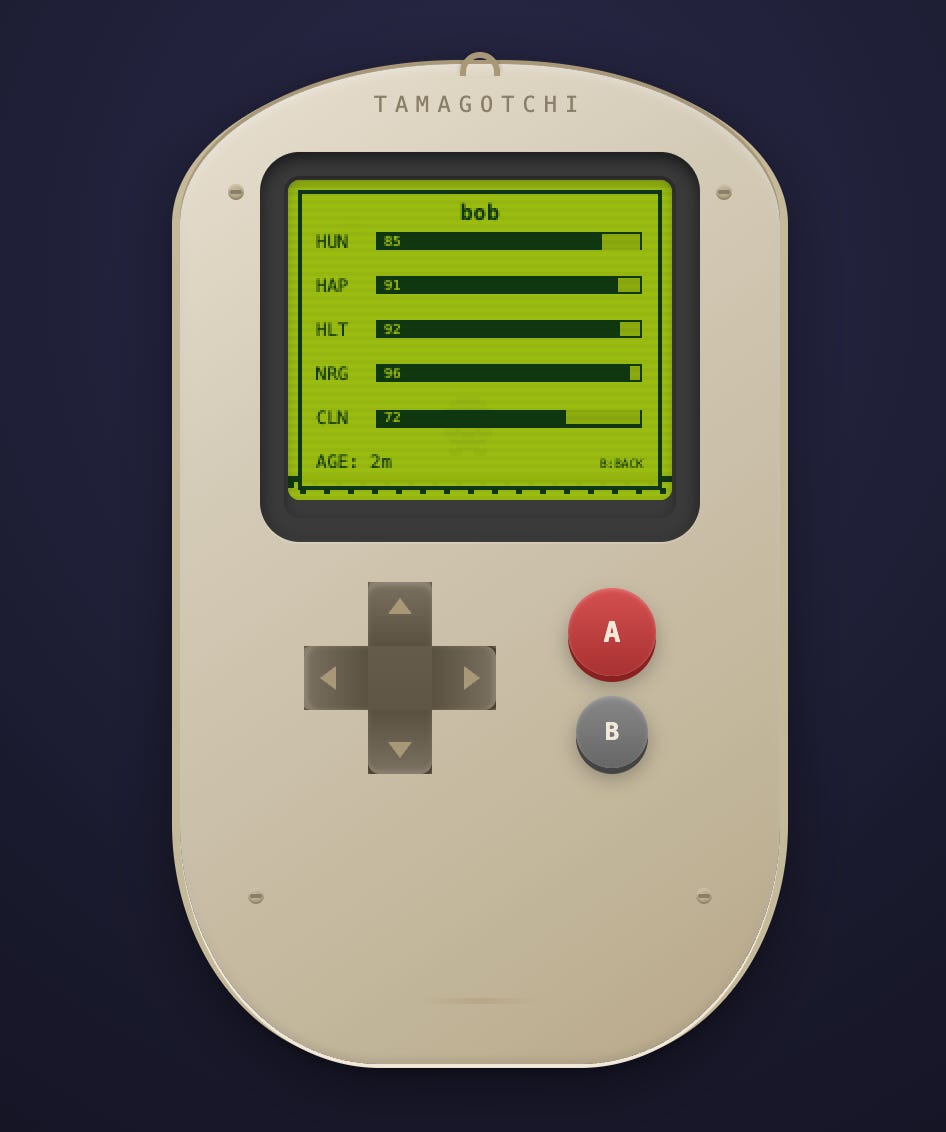
This is where things get interesting. The game runs on real time. Stats decay whether you are watching or not. Close the tab at lunchtime, come back at six, and the game calculates what happened while you were away. Your pet got hungry. It got dirty. Maybe it fainted.
If you close the tab at night, your pet sleeps through the night - energy stops draining, hunger slows down. During the day, you can toggle the lights off manually to tuck it in for a nap. It costs nothing. It requires nothing except that you noticed it was tired and decided to do something about it.
This creates something rare in browser experiences: genuine emotional stakes. Not points. Not leaderboards. The feeling of coming back to a tab at 11pm on a Tuesday and seeing “Your pet got hungry while you were away!” and actually caring.
When your pet is in trouble - starving, sick, filthy - a little exclamation mark flashes on screen with an urgent beep. It tells you exactly what it needs. “FEED ME!” “BATH!” “MEDS!” Without this, new players just stare at the idle pet. With it, you feel like a parent.
The whole game uses four shades of green. The exact colours from the original Game Boy LCD. When you only have four colours to work with, every pixel matters. The pet’s expression changes with just a few dots moved around - happy eyes, sad eyes, sick eyes, sleeping eyes. It is remarkable how much emotion you can communicate with so little.
Every sound in the game - the chewing when your pet eats, the sad descending tone when it is unhappy, the urgent beep when it needs you, the snoring when it sleeps - is generated mathematically in the browser. No audio files. No assets to load. Pure synthesised sound from the Web Audio API.
Most people will not consciously notice these details. But they would notice if they were missing. The crunch of food. The splash of a bath. These tiny audio cues are what make the difference between clicking a button and feeding a pet. Same action, completely different experience.
There is a game within the game. “Catch the Stars” - tap falling stars on the screen for ten seconds. It turns the whole experience from “click button, watch number go up” into something with actual rhythm and skill. Your pet gets happier based on how many you catch. Suddenly you care about your high score. Not for the score itself, but because your pet’s happiness depends on it.
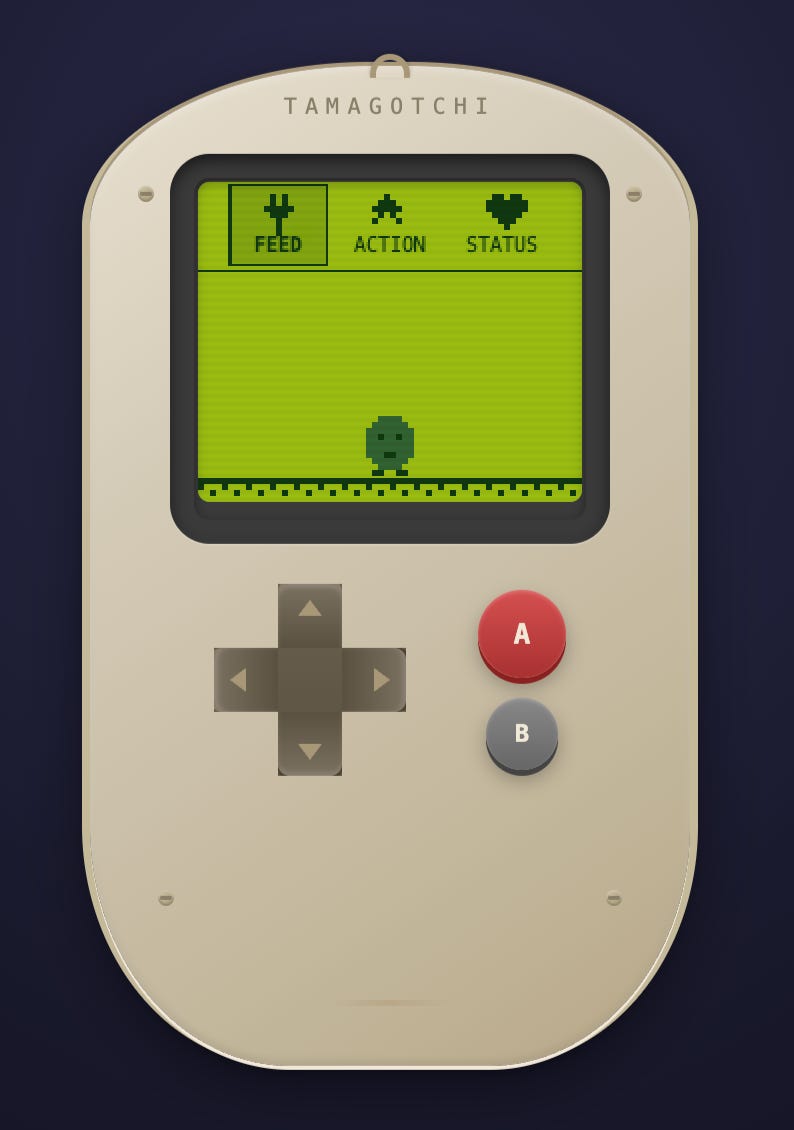
This is the Tamagotchi’s design genius, and it translates perfectly to the browser. The reward is not abstract. It is not a badge or a notification. It is a little pixel face looking slightly happier because you did something for it.
Adults get more attached than you would expect. The phrase “oh no, my pet!” has been said out loud by multiple grown professionals who should know better. People immediately try to break it - “What happens if I never feed it?” It faints. “Can I revive it?” Yes, press Feed. The fact that people ask these questions means they are already invested.
The light switch - the simplest feature in the entire build - gets the most “oh that is clever” reactions. It does almost nothing mechanically. But the act of tucking your pet in, of turning the lights off so it can rest, is the kind of small caring gesture that makes people feel something. It turns a game mechanic into a human one.
And the naming screen. Three seconds of typing. But it is the moment people commit. Everything before it is curiosity. Everything after it is responsibility.
So why write about a Tamagotchi? Because it reveals something important about what makes software engaging.
We spend enormous amounts of time building things that are efficient, optimised, conversion-focused. Dashboards. Funnels. Onboarding flows. We measure engagement in session duration and click-through rates and retention curves. And most of it feels like exactly what it is - software trying to keep your attention.
The Tamagotchi does not try to keep your attention. It earns it. By needing you. By changing while you are away. By being something you check on not because a notification told you to, but because you genuinely want to know if your pet is okay.
A 30-pixel blob with four shades of green and a mathematically generated beep is more engaging than most dashboards I have ever built. That should tell us something about what engagement actually means. It is not about features or polish or performance metrics. It is about whether the thing on the other side of the screen feels alive.
The web can do so much more than forms and tables and content feeds. Sometimes it just needs permission to be playful. Sometimes the most memorable thing you can build before breakfast is something small, silly, and emotional.
Sometimes it is a tiny pixel blob that needs you.
Check it out https://tamagochi.leemallon.com
So - what are you building before breakfast?
No posts
Comments
Nothing yet. Say the first thing.
Sign in to join the conversation.