
You are standing at a checkout in Thailand. There is a queue behind you. The cashier has just said “450 baht” and you are holding two cards - one linked to your UK account, one to your UAE account. You know the exchange rates are different. You know one card will cost you less than the other. But which one?
You could open your banking app. Check the GBP rate. Then switch apps. Check the AED rate. Do some mental maths. Compare. Decide. All while the person behind you sighs audibly and the cashier stares at you like you are trying to solve a differential equation at the till.
Or you could just know the answer instantly.
Check it out at multicurrency.leemallon.com
The Multi-Currency Problem
A growing number of people hold bank accounts in more than one currency. Expats. Remote workers. Frequent travellers. People who moved countries but kept their old accounts open. It is increasingly common, and it creates a very specific kind of daily friction.
The problem is not that exchange rates are hard to find. You can Google “450 THB to GBP” in seconds. The problem is that you are not converting to one currency. You are converting to several, simultaneously, and comparing them - in the two seconds before you need to make a decision.
Thanks for reading AI with breakfast! Subscribe for free to receive new posts and support my work.
No calculator app does this well. Currency converter apps are designed for single conversions. Banking apps show you your balance, not a side-by-side comparison. And none of them answer the actual question you are asking: which of my accounts gives me the best deal right now?
Now, you could take the smarter approach and use something like Wise - transfer money into their multi-currency account based on whichever rate works out best, and pay from there. But honestly, I did not think that far ahead. I was on holiday with the family, standing in a queue, and I just wanted to know which card to tap.
You might think the difference between currencies is negligible on everyday purchases. Normally, you would be right. But with everything going on in the world right now - tariffs, geopolitical uncertainty, markets reacting to every headline - a five percent swing is not unusual. And when you are paying for a hotel stay or a family dinner, five percent adds up fast.
This is where things get interesting. The problem is not technical complexity. It is a gap in how existing tools frame the question. They answer “how much is this worth in pounds?” when the real question is “which of my three cards should I use for this purchase?”
The Two-Minute Spec
I have written before about how the quality of what you get from AI is proportional to the clarity of what you put in. This one did not need a long spec. The problem was tight and well-defined.
I described the scenario to Claude Code. You are abroad. You see a price in the local currency. You want to instantly see what that price is in each of your home currencies, and you want it to highlight which one is cheapest. It needs to work on a phone. It needs to work offline. And it needs to be fast - the kind of thing you can open, type a number, and get your answer before the cashier finishes bagging your items.
That was the spec. Not a technical document. Just a clear description of the moment I was trying to solve.
What Got Built
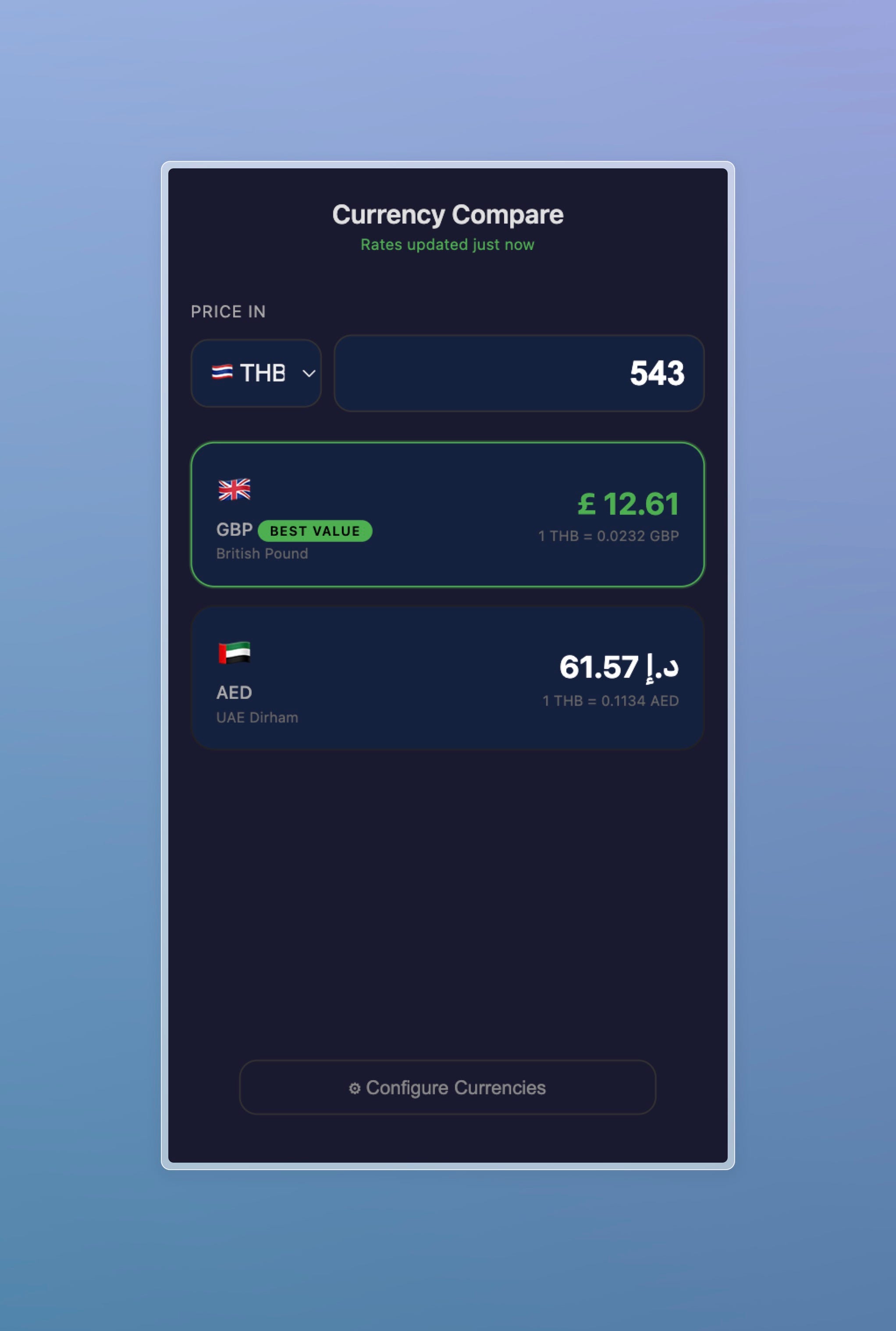
Currency Compare is a single HTML file. No framework. No build tools. No dependencies. You open it in a browser and it works.
You type a price in the local currency - say 450 Thai Baht - and it instantly shows what that costs in British Pounds and UAE Dirhams. Side by side. With a clear indicator showing which one is the better deal.
It fetches live exchange rates from a free public API every thirty minutes. But here is the detail that matters: it caches those rates locally. So when you are standing in a basement restaurant with no signal, it still works. It just tells you how old the rates are, so you can decide if you trust them.
It remembers the last price you typed in. So if you are comparison shopping - walking between two stalls, checking the same item at different prices - you can reopen the app and your last number is still there.
The currencies are configurable. It defaults to Thai Baht converting to Pounds and Dirhams because that is my life right now. But you can add or remove any of twenty supported currencies. Going to Japan next month? Add Yen as the source. Got a Euro account? Add it as a target. The tool adapts to however your financial life is arranged.
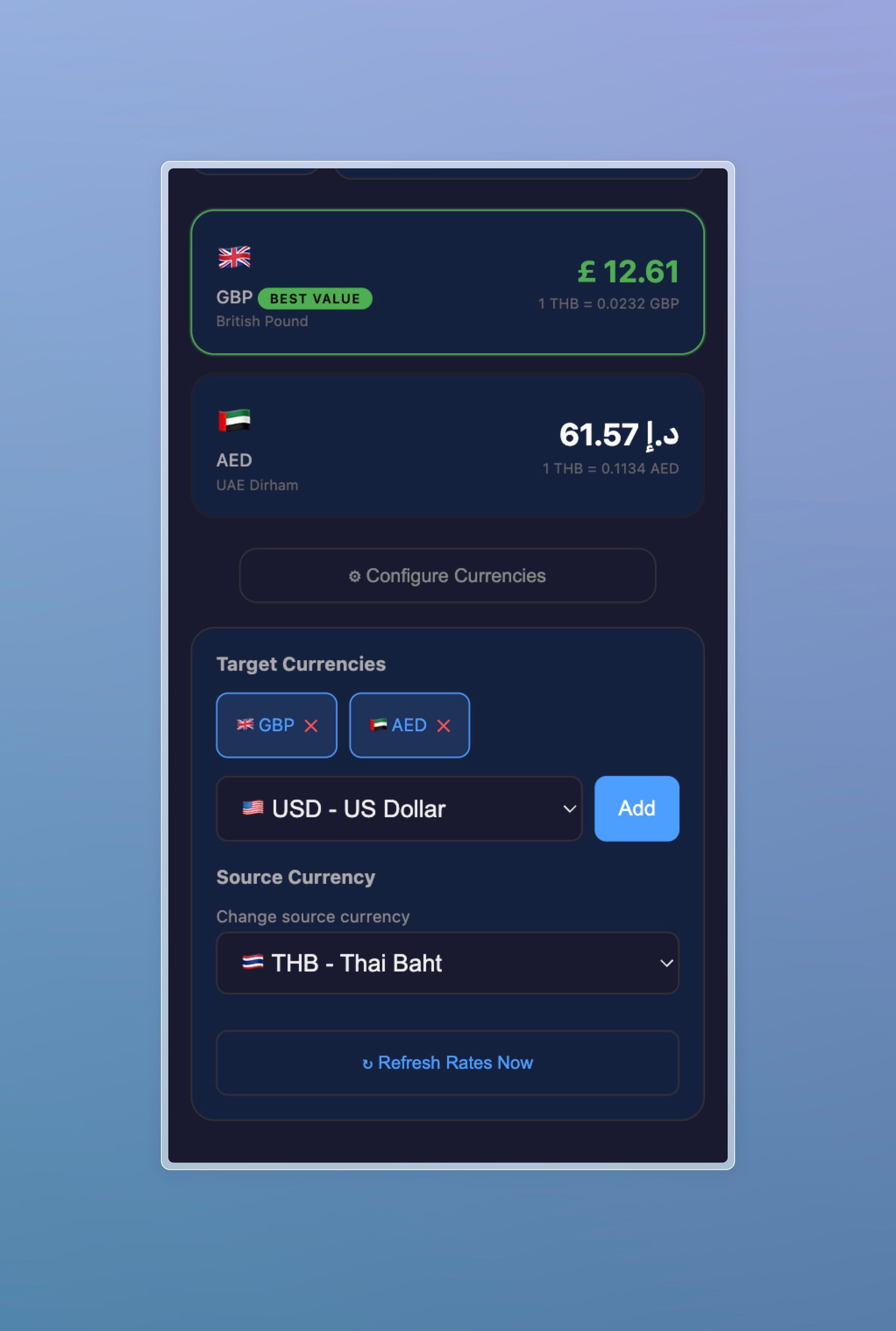
And the whole thing is designed for one-handed use while standing up. Dark theme so it does not blind you in a dim market. Large buttons. Decimal keyboard on mobile. No scrolling required to see your answer.
The Pattern Behind the Tool
So why write about a simple currency converter? Because the pattern behind it is more interesting than the tool itself.
Think about what happened here. I am on holiday with my family for half term. I had a specific, recurring moment of friction - a decision I had to make several times a day while travelling, with inadequate tools to support it. It was never urgent. It was never a crisis. It was just... annoying. The kind of micro-friction that you adapt to without realising you have adapted.
This is where most problems stay. In the gap between “annoying enough to notice” and “painful enough to solve.” They live there forever because the cost of building a solution used to be wildly disproportionate to the size of the problem. You would never hire a developer to build a personal currency comparison tool. Even I - someone who has been building software for over twenty years and knows exactly how to make something like this - would never have bothered spending a few hours on it. The effort just was not worth the payoff.
But that calculation has changed completely. I did not build this instead of breakfast. I built it in the elevator on the way down to breakfast. Ten minutes. From idea to deployed, working tool. On my phone, ready to use by the time I sat down and ordered coffee.
This tool exists as a single HTML file because that is all it needed to be. No backend. No database. No deployment pipeline. Just a file you open in a browser.
The shift is not that we can build bigger things faster. It is that we can now build small things at all. The tools that were never worth building - because the effort outweighed the benefit - are suddenly viable. And it turns out, those small tools that solve one specific moment of friction? They are often the most useful things you own.
The Offline Question
One design decision is worth expanding on because it reveals something broader about how we build tools now.
I could have made this app require an internet connection. It fetches exchange rates from an API, so it would be natural to assume it needs to be online. But the moment I was designing for - standing at a checkout, in a foreign country, possibly underground or in a concrete building with no signal - is exactly the moment when connectivity is least reliable.
So the app caches everything. The last-known rates. The last price you entered. Your currency configuration. All stored locally in the browser. If you have no internet, it still works. It just shows you when the rates were last updated so you can judge for yourself.
This is an analogy for something bigger. We have spent fifteen years building tools that assume connectivity. Cloud-first. Always-online. Real-time sync. And for many applications, that makes sense. But for tools that need to work in the real world - at a checkout, on a building site, in an aircraft, in a country with unreliable infrastructure - offline capability is not a nice-to-have. It is the whole point.
The best tool is the one that works when you need it. Not the one that works when conditions are perfect.
What This Is Really About
I keep coming back to the same observation. We are moving from a world where you waited for someone to build the tool you needed, to a world where you build it yourself, shaped exactly to the contours of your own life.
Currency Compare is not a product. It is not a startup. It will never have users in the traditional sense. It is a personal utility - built for one recurring moment, used by one person, solving one specific problem that no existing app quite addressed.
And that is precisely why it matters. Because the most transformative thing about AI-assisted building is not the big projects. It is the small ones. The ones that live in the gap between “someone should make an app for this” and “it is not worth anyone’s time to build.” That gap is closing. Fast.
Every person has a dozen of these micro-problems. Tiny frictions they have learned to live with. Things that take ten seconds longer than they should, repeated hundreds of times a year. The compound cost is invisible but real.
The question is no longer whether the technology exists to solve them. It does. The question is whether you have noticed the friction - and whether you are willing to spend a morning making it disappear.
So - what are you building before breakfast?
Comments
Nothing yet. Say the first thing.
Sign in to join the conversation.