
Today on AI before breakfast I am tackling one of the biggest issues of the world, not world hunger, not cancer, not unlimited free energy but budgeting.
Every month, the same conversation. My wife and I sit down, open the bank app, scroll through the transactions, and try to piece together where exactly everything went. We recognise some of the charges. Others are mysteries - merchant names that look like someone fell asleep on a keyboard. And the total? Always more than we expected, and lets not forget all the amazon orders that are missed.
The Budgeting Problem Nobody Has Fully Solved
Here is what I find fascinating about personal finance tools. Pretty much everyone on the planet has to budget in some form. It is one of the most universal human activities. and yet the tools aviaible are meh.
In some countries, you can connect a slick aggregator app to your bank and get a beautiful dashboard that categorises every transaction automatically. In others, your bank does not even have an app. There is no way to pull your data out programmatically. No integrations. No exports.
Then layer on the complexity of a family. Multiple cards. Multiple accounts. Maybe different banks. Now you need a unified view across all of that - securely, reliably, and in a way that everyone in the household can actually use.
Thanks for reading AI with breakfast! Subscribe for free to receive new posts and support my work.
The Manual System
Our solution, like many families, was a shared expense tracking app. The idea was simple: every time you buy something, you open the app and log it. Amount, category, done.
In theory, this works perfectly.
In practice, it is a disaster.
Because the system relies on the one thing humans are reliably bad at: remembering to do a small boring task consistently, forever. You buy a coffee and think, “I will log that later.” You grab groceries and your hands are full. You pay for parking and you are already late for wherever you are going.
Later never comes. The entries pile up. And by the end of the month you are staring at your bank balance wondering what happened between then and now.
This is where things get interesting. The problem was never about budgeting. It was about data capture. We had the intention. We had the system. What we did not have was a frictionless way to get the data in.
Friction kills consistency. And without consistency, the best budgeting tool in the world is just an incomplete spreadsheet.
The SMS Goldmine
Living in the UAE gives you one particular advantage when it comes to financial tracking, even if most people do not think of it this way.
Every time you make a purchase - any purchase, on any card - your bank sends you an SMS. Not a vague notification. A detailed message containing the date, time, merchant name, transaction amount, currency, and remaining account balance.
I had been receiving these messages for years without really thinking about them. They were just noise. A buzz in my pocket that I would glance at and dismiss.
But one day I looked at one of those messages differently. I stopped seeing it as a notification and started seeing it as structured data. Every piece of information I had been trying to manually enter into our expense app was already arriving on my phone, automatically, seconds after every purchase.
The data was there. I just was not capturing it.
I first tried to see if I could get these SMS alerts forwarded to my email, thinking I could process them from there. No luck. The banks do not offer that. So I needed another approach.
The Apple Shortcuts Stepping Stone
My first attempt at automation was with Apple Shortcuts on the iPhone. The idea was straightforward: when a purchase SMS arrives, trigger a shortcut that opens our expense app and pre-fills the details.
It worked - sort of. The shortcut would fire when the SMS came in, which was better than relying on my memory. But I still had to manually enter the amount because I could not easily get the shortcut to extract it from the SMS text. Looking back now, I probably could have solved that with some regex or text parsing. But even if I had, the expense app itself was the bottleneck. It did what it did, and what it did was not what I actually wanted.
I wanted budgets I could define myself. I wanted family visibility. I wanted tagging and categorisation on my terms. I wanted something that worked the way my family actually spends, not the way some app designer in California imagined a generic user might spend.
So the question became: what if I removed the expense app from the equation entirely?
The “What If” Moment
What if the Apple Shortcut did not open an app at all? What if it simply called a URL and sent the raw SMS text to a service I controlled?
That service could use AI to parse the message - extract the amount, currency, merchant, date, time. It could log the transaction automatically. No manual entry. No remembering. No friction.
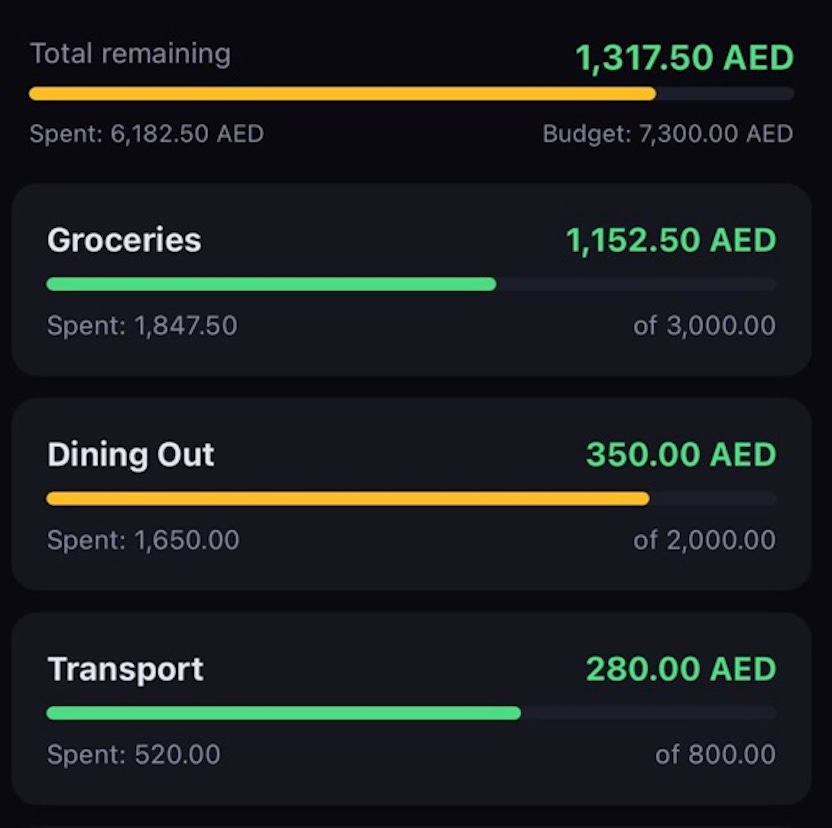
And because I would own the backend, I could build whatever features I wanted on top of it. Custom budgets. Family access. Categories that actually make sense for how we live. The SMS becomes the input. AI becomes the parser. And the output is a fully automated, real-time family budget tracker.
Speccing It Out
One thing I have learned from building with AI is that the quality of what you get out is directly proportional to the clarity of what you put in. You do not need to write a technical specification down to the function level. But you do need to clearly articulate the logic and features of what you want.
I sat down and wrote a semi-detailed spec for Claude Code. It covered:
The core flow: receive SMS text via API, parse it with AI, store the transaction
The data model: transactions, budgets, categories, users
The features: budget creation, transaction listing, spending summaries, family access
The deployment approach: how I wanted it hosted and secured
The security requirements: API key authentication, no exposed endpoints, encrypted storage
The key was that I described what the system should do, not how it should do it. I outlined the behaviour and let Claude Code figure out the implementation. This is the shift that makes AI-assisted building so powerful - you move from writing code to describing intent.
The Two-Hour Build
With the spec in hand, I kicked off Claude Code and let it run.
It was not a perfectly linear process. There were tweaks along the way - adjustments to how the SMS parsing handled different bank message formats, changes to how budgets were calculated, small UI decisions that I wanted to steer. But the core system came together remarkably fast.
Once the application was functional, I did something I think is critical and that too many people skip: I ran a security review. This is financial data. It is my family’s spending. Even though it is my own system, running on my own infrastructure, I treated it with the same seriousness I would treat any system handling sensitive information.
I used a security review agent to scan for gaps - exposed endpoints, missing authentication, injection vulnerabilities, anything that could leak data. it came back with nothing major but about 15 things that would be wise to enhacne the security especially if I gave others access to the system, but the exercise itself is the point.
With the security review done, I deployed, configured the Apple Shortcut to call my API with its key, and ran a few test messages. Fake SMS content, formatted like the real thing. Every one parsed correctly. Transactions appeared in the app exactly as expected.
From idea to solution: two hours and twenty minutes.
Later that day, my wife ordered something from Amazon.
I saw the SMS arrive on my phone - the familiar bank notification. The automation fired. The shortcut triggered. The SMS text hit my API. The AI parsed it. And within seconds, the transaction appeared in our budget tracker.
I did not have to do anything. I did not have to remember. I did not have to open an app and type in numbers. The system just worked.
What I Have Added Since
The core system solved the immediate problem, but once you have a platform that captures every transaction automatically, you start seeing possibilities everywhere.
Default budget allocation. When a new transaction comes in, the system can automatically assign it to a budget.
Zero-target budgets as IOUs. This one came from real family life. My kid wants to buy something but forgot their card. I pay for it. Now I create a budget with a zero target in their name and allocate the transaction to it. It tracks what they owe and makes repayment visible.
Tagging. I can tag transactions as takeaway, education, utilities, entertainment - whatever categories make sense for us. The next step is to add a simple learning model so the system starts recognising patterns and auto-tagging based on merchant names and amounts. Teach it once, and it remembers.
Transaction renaming and notes. Bank merchant names are often unhelpful. “POS TRANSACTION 847291 DUBAI” tells you nothing. Being able to rename a transaction or add a note - “Birthday present for Sarah” - turns raw data into actual information.
Why This Matters
I built this to solve a personal problem. But the pattern behind it is universal.
Think about what actually happened here. I had structured data arriving on my phone that I was ignoring. I had an automation tool (Apple Shortcuts) that could intercept it. And I had AI that could write code to parse unstructured text into clean, usable information. The only thing missing was a system to tie it all together - and that system took two hours to build.
No bank API required. No third-party aggregator with access to my accounts. No subscription to a fintech platform that might shut down next year. Just SMS, a shortcut, an AI parser, and a simple backend.
This is the shift I keep coming back to. We are moving from a world where you had to wait for someone to build the tool you needed, to a world where you can build the tool yourself, before breakfast, tailored exactly to your life.
The technology to do this is not coming. It is here. The question is not whether it is possible. The question is what problem are you going to solve with it.
So - what are you building before breakfast?
Comments
Nothing yet. Say the first thing.
Sign in to join the conversation.