
This week, AI for Breakfast is coming to you from my kitchen. Due to ongoing missile attacks on Abu Dhabi - and a shelter-in-place alert going off about twenty minutes ago so instead, I am having a lovely bowl of granola with yogurt and honey at home. I am not even going to share a photo because I forgot to take one before I eat it all and started writing.
But if the foodies that I know read, here is a lovely french toast I had yesterday.

I was sitting in a meeting this week, listening to a hiring manager rattle off a job description. Five years of experience with this platform. A degree in that discipline. Certifications in three different tools.
And somewhere near the bottom, almost as an afterthought:
“Must be curious and adaptable.”
Why is passion and the ability to integrate always last, ranked below perceived skills?
We have built entire hiring systems around a simple question: What does this person already know? CVs are designed to answer it. Interviews are structured to test it. Decades of recruitment practice have refined the art of filtering humans by the assumed knowledge they have accumulated so far.
But here is the thing. The economics of knowledge acquisition are changing - fast. What once took months or years to learn can now be accessed, understood, and applied in minutes. The role of humans in work is shifting from doing the work to orchestrating, guiding, and validating the work being done by systems.
So why are we still hiring as if knowledge is scarce?
In The Matrix, Neo sits in a chair, gets a cable plugged into his head, and seconds later opens his eyes and says: “I know kung fu.”

We are not quite there yet. But we are closer than most people realise.
Think about what AI-assisted learning actually looks like today. Someone with no experience in a particular tool can sit down, describe what they need to do, and receive not just an explanation - but a guided walkthrough, tailored to their specific task. They can learn a new system, generate a workflow, adapt a process, and validate the output - all without formal training.
This is where things get interesting.
Hiring someone because they know Tool X becomes less meaningful when AI can teach Tool X in minutes - or just do the task itself. Not just teach it in the abstract, but teach you how to use that specific tool to complete that specific task in your specific context.
The skill is no longer the differentiator. The ability to learn, adapt, and apply - that is the differentiator.
There is an idea that has been floating around management thinking for years: the “T-shaped” person. Deep expertise in one area - the vertical bar of the T - combined with a broad understanding across other disciplines - the horizontal bar. It became shorthand for the ideal modern employee. Someone who could go deep but also collaborate widely.
It was a useful model. But AI is reshaping it.
Here is why. The horizontal bar - that breadth of general knowledge across domains - used to take years to build. You had to work across teams, sit in on projects that were not yours, read widely, attend conferences. Breadth was expensive. It took time and exposure.
AI collapses that cost almost entirely. Need to understand the basics of supply chain logistics for a project? Ask. Need to grasp the fundamentals of contract law for a negotiation? Ask. Need a working knowledge of data architecture to have an informed conversation with an engineering team? Ask. The breadth that used to take a decade of cross-functional experience can now be assembled in an afternoon.
So what happens to the T-shape?
The vertical bar - deep domain expertise - becomes more valuable, not less. Because while AI can give you breadth instantly, depth still requires time, context, and lived experience. The person who has spent years understanding the subtleties of their craft brings something AI cannot replicate: the intuition that comes from having been wrong, having recovered, having seen the edge cases that do not appear in any documentation. Yes, AI can learn from what is documented - but it cannot validate it the way a human can. It cannot put its reputation or its job on the line for that decision.
But the shape itself changes. Think of it as X-shaped: expertise at the centre, with connections radiating outward into multiple domains. The intersection point represents the professional, and the arms represent the cross-boundary reach that AI now makes possible - on demand, in real time, tailored to the specific problem they are solving.
The “AI-shaped” professional is not broader or deeper. They are more connected. Their expertise sits at the intersection, becoming a launching point for exploring and orchestrating across boundaries that used to require entire teams to cross.
This is not a small shift in how we think about professional development. It is a fundamental change in what it means to be capable.
Companies love to say they value curiosity, passion, adaptability, and creative problem-solving. These words appear in mission statements, careers pages, and leadership talks.
But then you look at the actual job descriptions.
Multiple degrees. Long lists of platforms and tools. Perfect career trajectories with no gaps. A decade of experience in a field that has only existed for seven years.
There is a disconnect here, and it is not subtle. Curiosity and passion only seem to matter after someone has already passed an unrealistic checklist of pre-existing knowledge. The very qualities companies claim to want are being filtered out by the systems designed to find them.
How many brilliant, curious, adaptable people never make it past that filter? How many potential orchestrators of the future are being rejected because they do not have the right certification from 2019?
I know this because I tested it.
About two years ago, I ran an experiment. I applied for 150 roles online - across the UAE, London, Europe, and remote positions. I have been in tech for over twenty years. I have lived and breathed it since I was twelve. I have worked for large companies, small companies, and startups. I ran my own business for a decade. I have freelanced. I have worked for government, in regulated industries, in media, in events. I even have a computer science degree, for whatever use that is from twenty years ago.
Out of 150 applications, I got three replies. One interview.
I was shocked. If I cannot get through the filter - even as an experiment - then how does anyone who is genuinely curious and passionate but does not have FAANG on their CV? The system is not just flawed. It is actively broken.
So what should we actually be hiring for? I think it comes down to three capabilities.
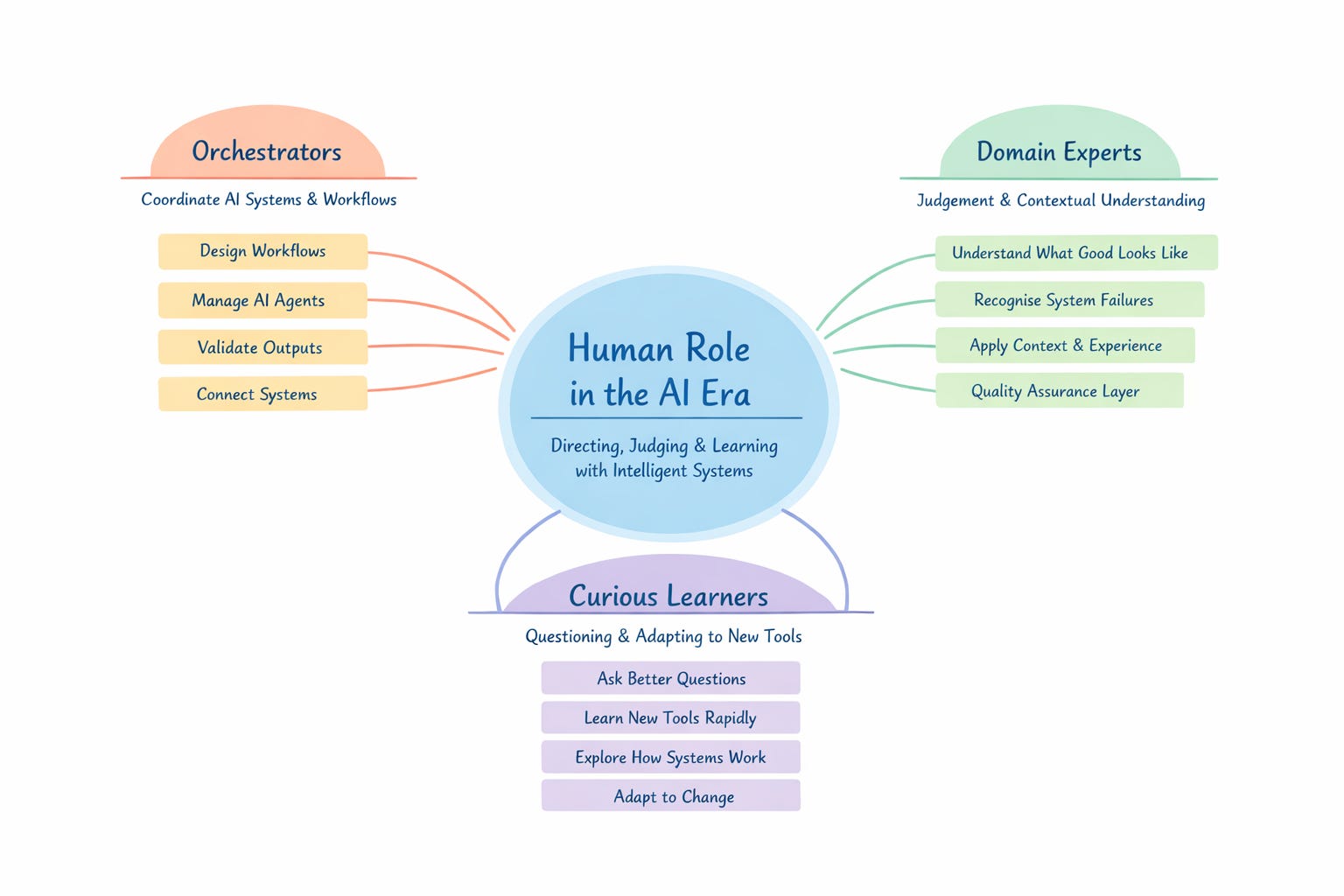
The first is orchestration. As AI agents, automation systems, and intelligent tools become more capable, the human role shifts towards coordination. Designing workflows. Managing AI agents. Validating outputs. Connecting systems together in ways that create compounding value.
Think of it like conducting an orchestra. The conductor does not play every instrument - but they understand each one deeply enough to know when something is off. The value is not in doing the task, but in directing the systems that perform it.
The second is domain expertise - but not in the way we have traditionally defined it.
Experience still matters. Enormously. The person who has actually done the job understands something that no amount of AI training can replicate: what good looks like. Where systems break. The nuance behind decisions that appear simple on the surface but carry decades of context beneath them.
Their value is shifting from manual execution to judgement, validation, and contextual understanding. They become the quality layer. The human filter that ensures AI outputs are not just technically correct, but practically right.
The third - and perhaps most important - is curiosity.
In a world where answers are seconds away, the limiting factor is no longer access to knowledge. It is the quality of the questions being asked.
Curious people ask better questions. They learn new tools rapidly not because they are smarter, but because they are genuinely interested in understanding how things work. They adapt to changing systems because change does not threaten them - it energises them.
Or as Ted Lasso put it:
“Be curious, not judgmental.”
That line is not just good television. It should be the hiring mantra of every company in this AI era.
Here is something I find genuinely fascinating. The oldest model of learning we have - apprenticeship - might be about to become the most relevant one again.
Think about how apprenticeship worked for centuries. A young person would sit alongside a master craftsperson. They would not start with theory. They would not sit in a classroom memorising principles. They would watch, then try, then fail, then try again - all within the context of real work, with immediate feedback from someone who had already mastered the craft.
It was learning by doing, guided by expertise, embedded in context.
Then we industrialised education. We pulled learning out of the workshop and put it into classrooms. We standardised it, credentialed it, and scaled it. And for a long time, this made sense. You could not have a master craftsperson for every learner. The economics did not work.
But now? The economics have changed completely.
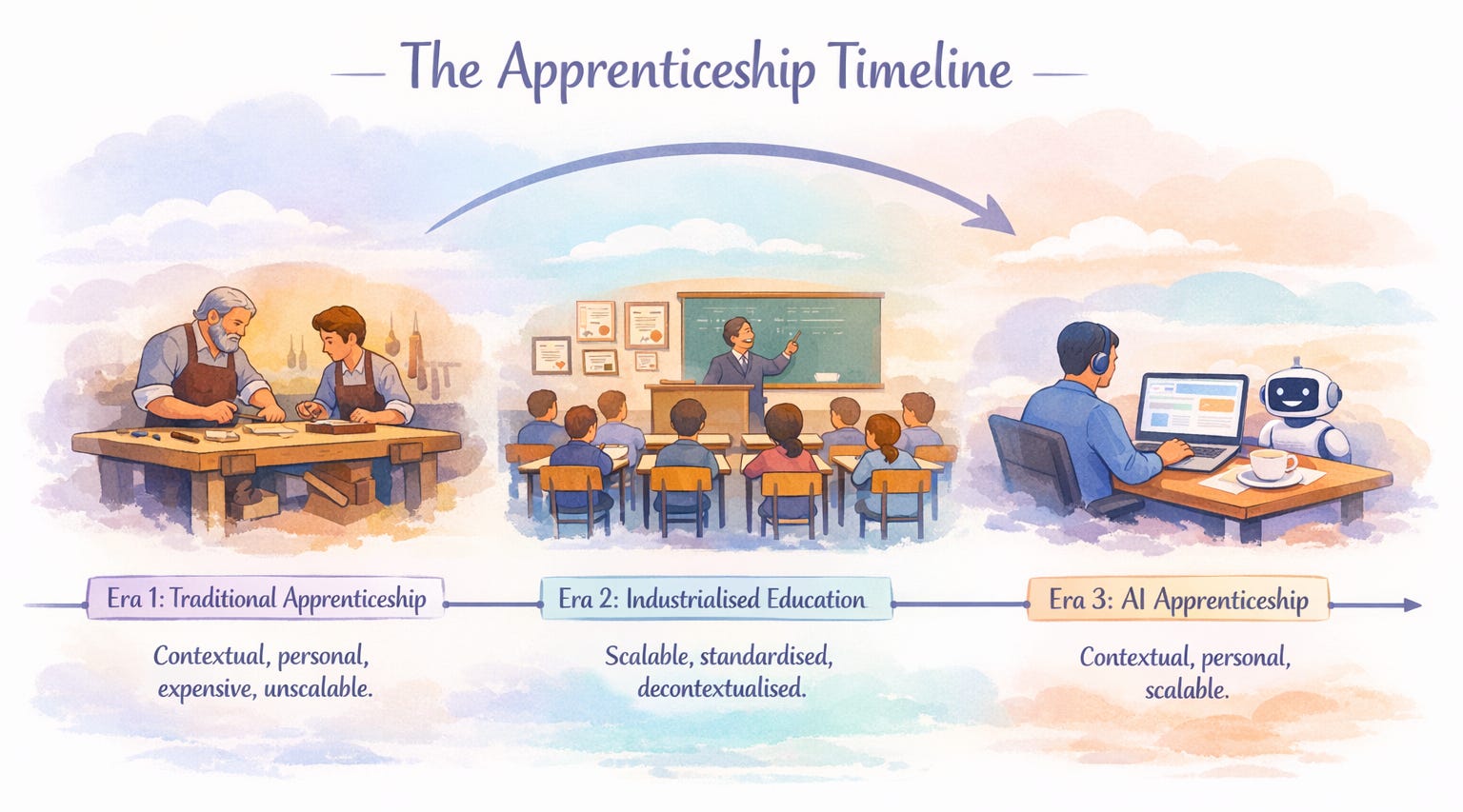
AI is becoming something remarkably close to a personal master craftsperson - available to everyone, at any time, for any skill. It does not just explain concepts in the abstract. It watches what you are doing, understands your specific context, and guides you through the work itself. It corrects you in real time. It adapts to your pace. It answers the exact question you have at the exact moment you have it.
This is not classroom learning. This is not even e-learning. This is contextual apprenticeship at scale.
And the implications are significant. If learning becomes something that happens inside the work rather than before it, then the entire idea of “training someone up” before they can contribute starts to dissolve. People can contribute and learn simultaneously. The barrier between “preparing for the job” and “doing the job” blurs - and eventually disappears.
We have to accept that we are forever learners. The old model - get hired, get trained, do the same job for ten years, repeat - is dead. You are not a static resource to be deployed. You are a human being who learns, adapts, and evolves continuously. That is not a weakness in the system. That is the system.
This does not mean formal education becomes worthless. But it does mean that the way we think about readiness, onboarding, and professional development is due for a fundamental rethink. The apprenticeship model is not a step backwards. It is the future, delivered through a completely different mechanism.
Now here is where things get uncomfortable.
There is a structural challenge in many organisations that nobody talks about openly. Many managers have never actually performed the tasks they manage. Their skill - and it is a genuine skill - has been managing people. Coordinating resources. Running teams. Navigating politics.
Historically, this worked. And the reason it worked is because people were the primary resource currency of organisations. Managers coordinated people, and that coordination was where the value sat.
But the ground is already moving beneath this model.
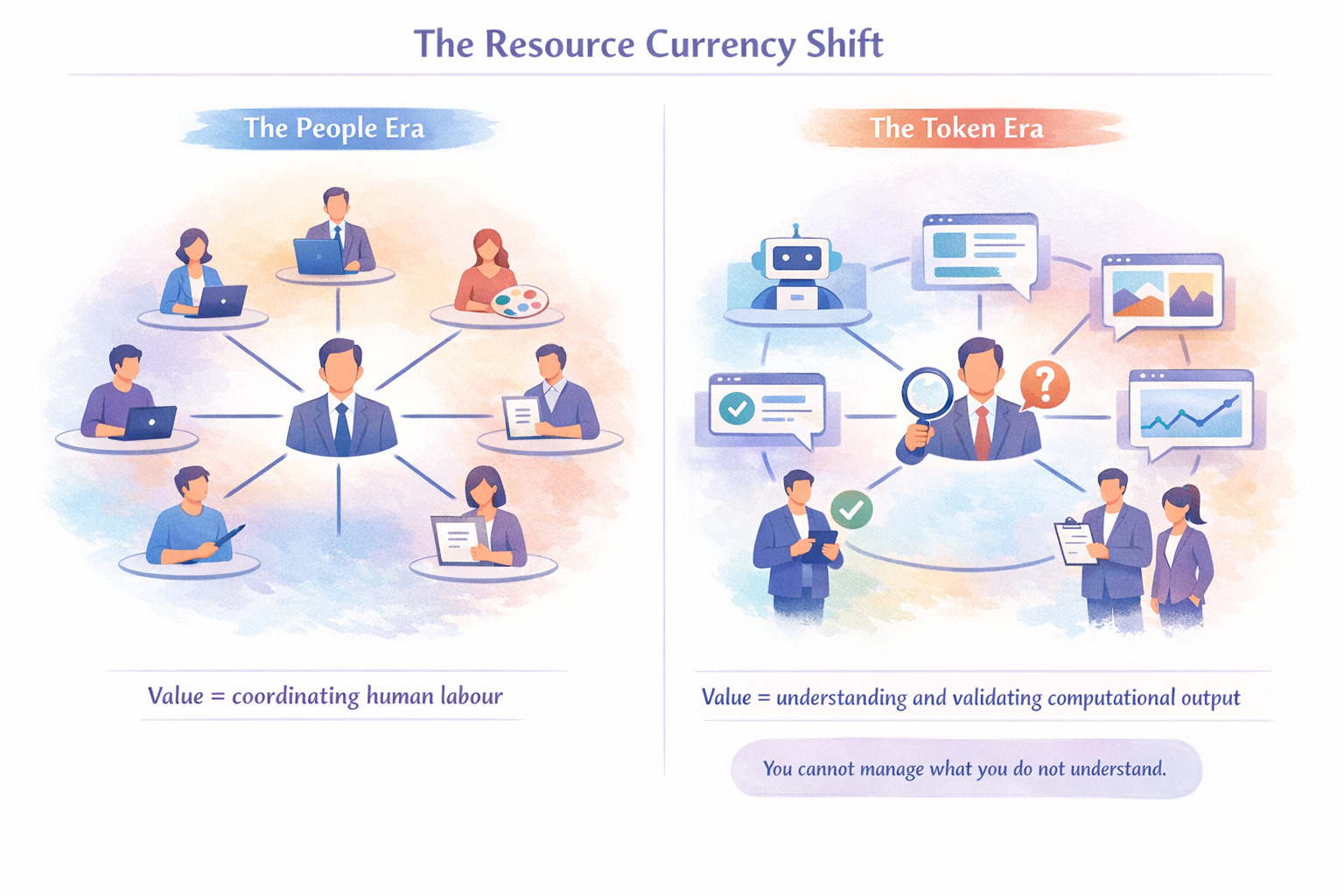
Tokens are becoming the new resource currency. Systems, agents, and models now perform much of the execution that people once did. The resource being coordinated is changing - from human labour to computational capability.
This creates a problem. If you are coordinating AI systems and validating their outputs, you need to understand the work deeply enough to know when something is wrong. You cannot manage what you do not understand. And “managing people who understand it” becomes a weaker position when the people themselves are being augmented or replaced by systems.
The leaders who will thrive are the ones who combine management capability with genuine domain understanding. The ones who can look at an AI output and say, with confidence: “That is not right, and here is why.”
The world of work is shifting from doing to directing. You might assume this means current managers - the ones already in directing roles - will benefit the most from this transition. They are already skilled at directing, after all.
But I think the opposite may be true.
The real advantage may lie with the doers. The people who understand the work deeply. The people who have spent years in the trenches, building the intuition and judgement that comes from actually doing the thing. These are the people who can merge their domain expertise with emerging technologies and guide AI systems because they know - viscerally, practically - what good output looks like.
They will not just adapt to this shift. They will drive it. They will become the orchestrators, the validators, the quality layer between raw AI capability and real-world impact. This is not a small change. It is a fundamental inversion of how we think about organisational value. The managers who cannot do the work will find themselves managed out by the people who can.
For decades, the working world has rewarded specialists. The deeper your expertise in a single domain, the more valuable you were considered. Generalists - the people who moved between fields, who knew a bit about a lot - were often seen as unfocused. Jack of all trades, master of none. It was not a compliment.
AI is flipping that entirely - but not in the way you might expect. This is not about being vaguely good at everything. It is about being a generalist within a subject space. Someone who understands their domain deeply but can reach across its boundaries into adjacent areas with confidence.
When AI can provide specialist-level knowledge on demand, the scarcity shifts. Deep technical execution in a single domain becomes something that systems can increasingly handle or augment. What remains scarce - and becomes dramatically more valuable - is the ability to see across domains within your area of expertise.
Think about what generalists actually do well. They connect dots that specialists miss. They spot patterns across industries. They translate ideas from one context into another. They ask the question that nobody in the room thought to ask because everyone in the room has the same background.
I have seen this in practice. Some of the most effective people I have worked with were not the deepest experts in any single area. They were the ones who could sit in a room with engineers, marketers, designers, and operations people - and be the connective tissue between all of them. They understood enough about each domain to ask the right questions, challenge assumptions, and see where one team’s problem was actually another team’s solution.
In the AI era, this capability becomes supercharged. A generalist who can orchestrate AI tools across multiple domains - pulling in specialist knowledge as needed, synthesising it, and directing it towards a coherent outcome - becomes enormously powerful. They are not replacing the specialists. They are amplifying the value of specialisation by connecting it to everything else.
The jack of all trades is no longer master of none. They are becoming the master of integration. And in a world of increasingly capable but narrow AI systems, integration might be the most valuable skill of all.
So what does this mean in practice? Future hiring might start prioritising questions like:
How quickly can this person learn something new?
How well do they collaborate with intelligent systems?
Can they validate AI outputs with genuine understanding?
Do they ask strong, insightful questions?
Are they curious enough to explore the unknown?
The immediate objection is always the same: “But we cannot talk to everyone. There are thousands of applicants. That is years of conversations.” And maybe it was. But now you can use AI to have those conversations. Not to screen people out. Not to cancel them before they have had a chance. But to evaluate - transparently - how they think, how they work, and how they solve problems. Use those questions to train the model to do it at scale.
When people say that will feel robotic, it is because they are imagining a poor system. If you have used AI chatbots for customer service, you know the bad ones are obvious. But the good ones? You do not even realise you were talking to an AI. The same principle applies here.
These qualities were always important. We always said they mattered. But they were secondary signals - nice to have after the checklist was satisfied.
Now they are becoming the primary signals of capability. The checklist is the thing that is becoming secondary.
For years, older workers have faced a particular kind of bias in hiring. Not always spoken aloud, but present in the filtering. They do not know the latest tools. Their tech stack is outdated. They are not “digital natives.” The assumption - sometimes conscious, often not - is that someone who learned their craft twenty years ago is less capable than someone who learned it two years ago on the latest platform.
But think about what we have just established. If tools become learnable in minutes - if AI can teach anyone to use any platform in the context of their specific task - then the “they do not know the latest tools” argument collapses entirely. It simply stops being relevant.
And what is left when you remove that filter?
Experience. Judgement. Pattern recognition built over decades. The ability to see a situation and know, intuitively, that something is off - because you have seen it go wrong before, perhaps more than once, in ways that a textbook or an AI training dataset never captured.
These are exactly the qualities we have been talking about. The domain expertise that validates AI outputs. The contextual understanding that separates technically correct from practically right. The wisdom - and it is wisdom - that comes from having navigated uncertainty, failure, and ambiguity over a long career.
So this could be a genuine turning point for age diversity in hiring. If companies truly embrace the idea that skills are learnable and judgement is scarce, then experienced workers become more valuable, not less.
I recently re-read Lee Groombridge’s book on resilience, and many of the lessons feel even more relevant now than when I first encountered them.
Because while technology will continue to accelerate - learning will get faster, automation will get smarter, AI systems will become more capable - the human qualities that matter most remain remarkably consistent.
Curiosity. Adaptability. Judgement. Resilience.
These are not skills you can list on a CV. They are not certifications you can download. They are ways of thinking, ways of engaging with the world, ways of responding when the ground shifts beneath you - as the last week has taught me directly, being on the edge of a war zone.
The companies that recognise this shift early will stop hiring for what someone already knows and start hiring for how someone thinks, learns, and evolves. And if they do not? These people will build new businesses that challenge and overtake their own. And it will happen fast - because they know the domain, they have the knowledge, the connections, and now they have the means. AI gives them superpowers.
No posts
Comments
Nothing yet. Say the first thing.
Sign in to join the conversation.