
Last few days of an Easter holiday in Bangkok, and the Centara Life Hotel was the morning’s setting. For a city hotel it’s already doing something most don’t bother with - an actual pool, which changes the whole feel of a stay in the middle of Bangkok.
Breakfast leaned heavily Asian over Western, which is absolutely the right call. The spread was solid throughout, but nobody was putting teriyaki pork on their breakfast prediction list. Not a conventional morning dish by any stretch, but it was genuinely delicious - savoury, sticky, perfectly balanced. So good it went two plates deep without a moment’s hesitation.
Thanks for reading AI with breakfast! Subscribe for free to receive new posts and support my work.
Sometimes a hotel breakfast surprises you.
Right back to the tech.
Everyone in tech right now is talking about AI employees. Hire an AI SDR. Deploy an AI researcher. Rent a sales agent. The language has shifted from “tools” to “workers,” and it feels like progress.
But it isn’t. Not really. Not yet.
What we’re actually witnessing is a gold rush where almost everyone is selling shovels - only a few are digging.
The Five Stages
AI adoption in business hasn’t been a single leap. It’s been a slow crawl through distinct stages, and most of the industry is further behind than it thinks.
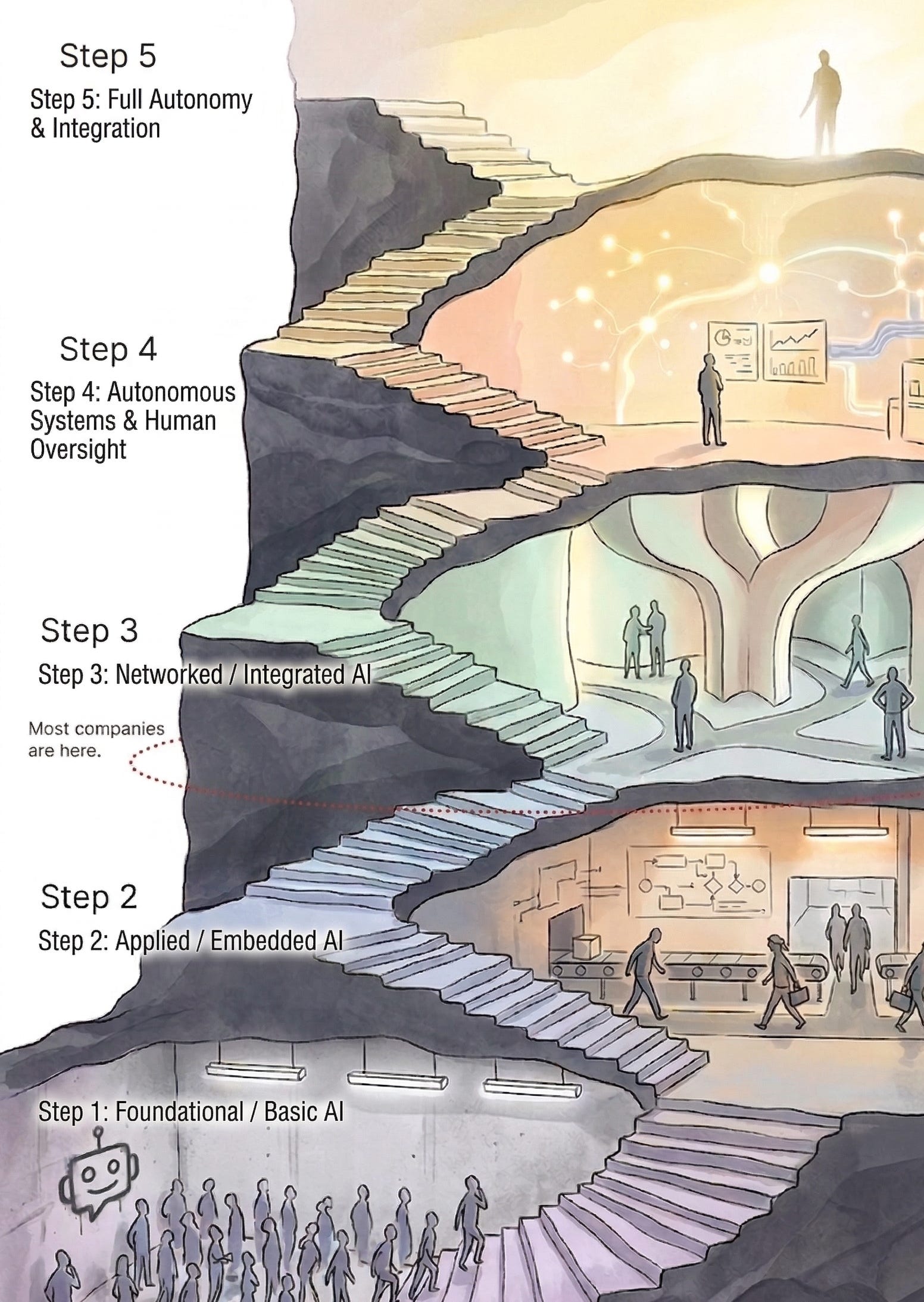
Stage 1: Sprinkle some AI in. Bolt a chatbot onto your product. Add “AI-powered” to the landing page. The model does something vaguely useful in the background, and your Series A deck gets a bump.
Stage 2: Build the workflow with AI. Now you’re actually using it. AI handles steps in an existing process - drafting emails, summarising calls, scoring leads. Useful. Incremental. Safe.
Stage 3: AI defines the workflow. This is where it gets interesting. The AI doesn’t just execute your process - it decides what the process should be. It looks at a lead and determines whether to call, email, or wait. It sequences its own outreach. It adapts.
Stage 4: AI is the employee. The agent writes the workflow, runs the workflow, and iterates on the workflow. You don’t manage the process anymore. You manage the outcome.
Stage 5: AI just is. The distinction between “the AI” and “the business” disappears. There is no “AI department.” There’s just the business, and it runs.
Most companies are stuck somewhere between stages 2 and 3. The industry, meanwhile, is selling stage 4 while delivering stage 2.
That gap - between the promise and the reality - is where the real opportunity lives.
The Shovel-Sellers
Right now, the dominant playbook is platform-first. Founders are building infrastructure: tools that let you build your AI employee, configure your AI workflow, deploy your AI agent.
This makes sense from a venture perspective. Platforms scale. Platforms have network effects. Platforms are what got funded in the last decade.
But look at what’s actually being sold. An AI SDR that sends outreach. A pipeline assistant that qualifies leads. A support bot that handles tier-one tickets. These are fragments of an employee’s job. They’re individual tasks wrapped in an agent-shaped package.
No customer woke up and said, “I need a better AI platform.” They said, “I need more revenue.” Or “I need to onboard customers faster.” Or “I need a sales pipeline that actually converts.”
The tools are a means. The outcome is the point.
The Builder’s Bias
So why does everyone keep building platforms?
Because builders build. It’s what we know. Technical founders default to infrastructure, to enablement, to “here’s a powerful tool, you figure out the rest.” We optimise for features, flexibility, and capability because those are the things we understand and can measure.
Historically, platforms equal land. Own the platform, own the territory. Every wave of technology produces the same land grab - browsers, social networks, app stores, cloud. The platform is the territory, and the territory is the business.
But platform land has brutal physics. Build it and nobody comes? Over-engineered ghost town. Build it lean and it goes viral? It collapses under its own success. You’re either dying of irrelevance or dying of popularity. Either way, you’re dying of platform.
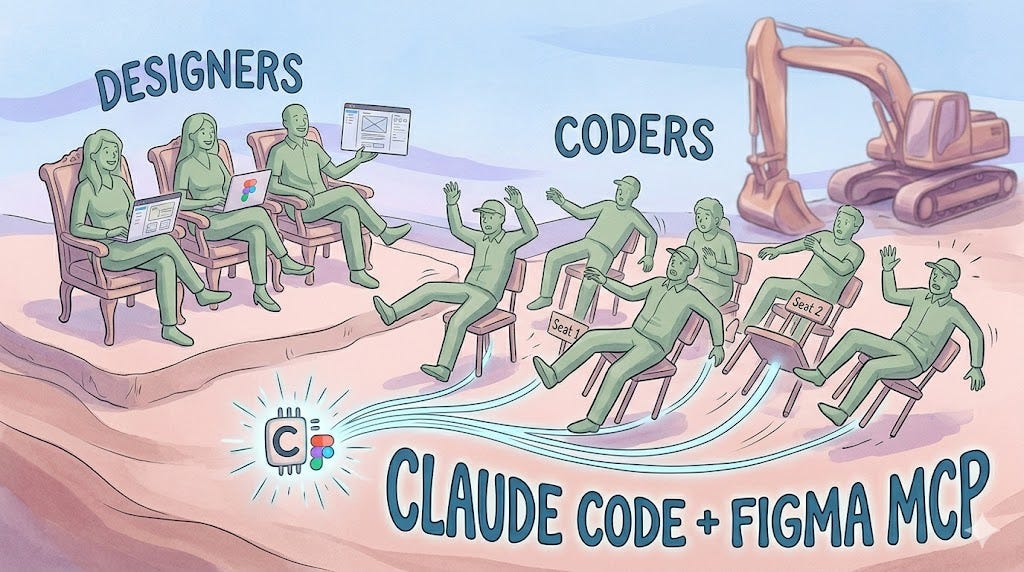
We’re already seeing this. Figma rolled back features from their MCP server. Why? Because once developers could interact with Figma through agents, they didn’t need as many seats. The platform was selling shovels - then the digger turned up for free. Where a team once had ten seats, now they need three. The very AI capabilities platforms enable are eroding the need for the platform itself.
But now there’s a new option. Stop obsessing over the land. Start obsessing over what the land produces.
The competitive advantage isn’t in the platform anymore. It’s in what you do with it. The founder who verticalises - who uses the platform to deliver outcomes rather than selling access to the platform itself - builds something that compounds. Because they’re not selling capability. They’re selling results.
And this is where the current crop of AI employees falls short. An AI employee replaces a person. It guarantees outreach will happen. It doesn’t guarantee 10 new leads this month. What comes of the outreach? Still your problem. One is $100 a month for a tool. The other is $10,000 a month in commission.
What if, instead of “here’s an agent that does your sales,” the pitch was: “We’ll deliver you 10 qualified leads this month”? One sells labour. The other sells results.
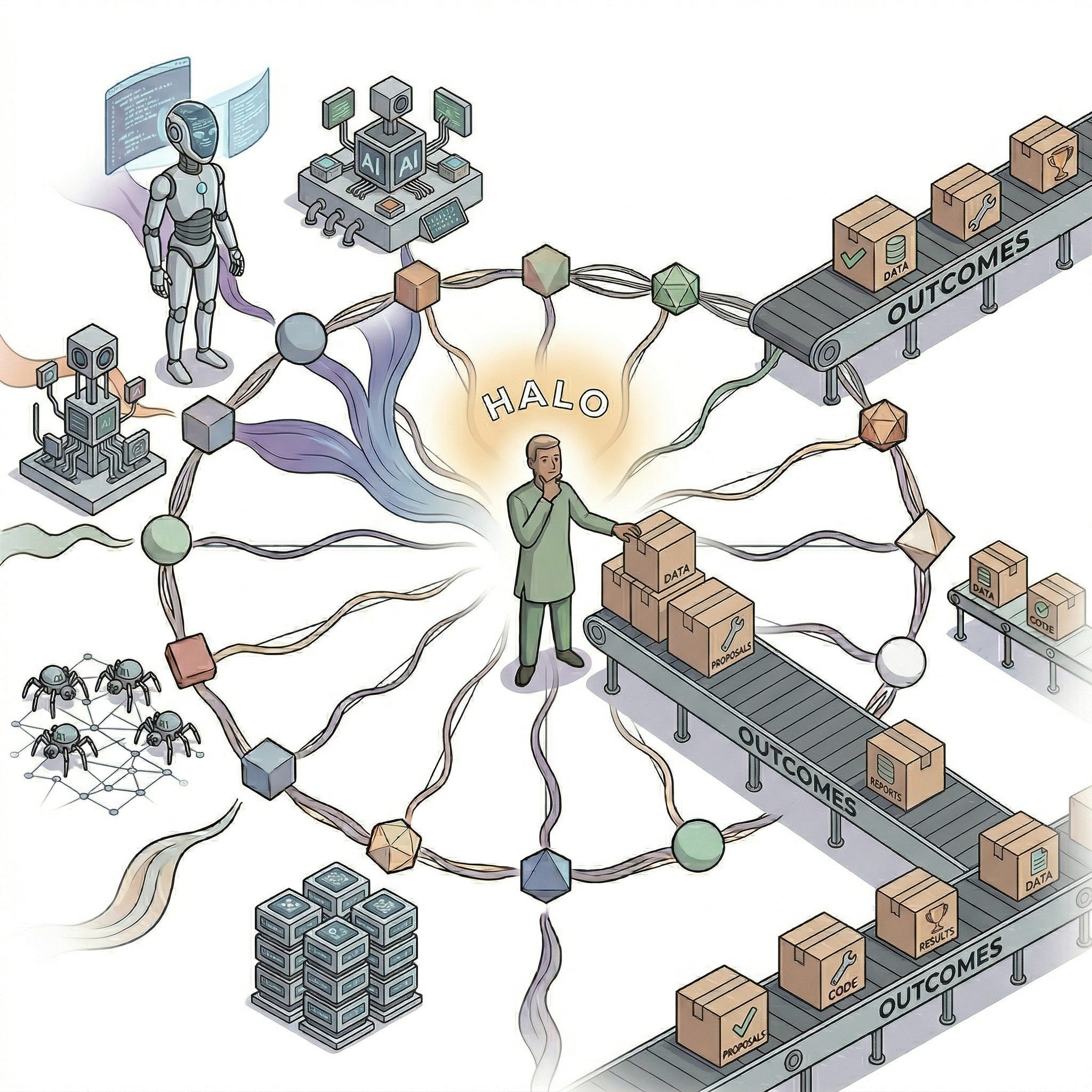
The model for delivering that isn’t a solo AI agent. It’s something new - a human operator wrapped with an army of agents, accountable for an outcome and remunerated by the result. Not a department in the traditional sense. A Human-Agent Led Operator (HALO)
HALO - Human-Agent Led Operator. A single person backed by an army of AI agents, accountable for delivering a specific business outcome. They don’t sell access to tools. They sell results. Think of it as a one-person department that performs like a ten-person team.
Sales as the Clearest Example
Take the sales function, because it makes this concrete.
Today, a company buys a CRM, subscribes to an outreach tool, maybe bolts on an AI SDR. They still need a sales leader to design the process, reps to run it, and an ops person to keep the stack together. The AI handles tasks. The humans handle the function.
Tomorrow, a company hires a HALO for sales. One operator, backed by an army of agents. Pipeline generation, lead qualification, follow-up cadences, conversion optimisation, reporting - all of it, end to end. The company pays for revenue generated, not seats occupied.
The customer doesn’t want better tools. They want revenue.
Any founder who can deliver that - who can package the entire sales function into an outcome-driven service - will outcompete every point-solution AI agent on the market. Because you can swap an agent. You can’t easily swap an operation that’s generating your pipeline.
Beyond Sales
This pattern isn’t unique to sales. It applies everywhere.
In education, the traditional model is: “Here’s a platform to build your academy.” You get the tools - content authoring, distribution, payment processing, analytics. You build the thing yourself. The verticalised model flips it: “We build and run your academy.” You show up with expertise. The HALO turns it into a revenue-generating education business - or, if you’re B2B, a trained and certified workforce. The outcome changes. The model doesn’t.
Sales is a revenue HALO. An academy is an education HALO. Customer support is a retention HALO. Every business function becomes a HALO - one person, accountable for the result.
I’m making this shift myself. I built a personalised learning platform. For a long time, the plan was to sell the platform. That’s shifted. Now I’ve stopped saying “we’re a learning platform” and started saying “we run academies.” Same technology underneath. Completely different business on top.
The Replaceability Problem
When a good salesperson leaves your company, they take institutional knowledge with them. They take relationships, context, intuition built over years. Replacing them is painful and slow.
When an AI sales agent underperforms? You swap it out on a Tuesday afternoon. You plug in a different provider. You don’t even need to update the CRM.
The agentic nature of these products - the very thing that makes them powerful - also makes them trivially interchangeable. If your product is an agent that sits inside someone else’s stack, you’re one API call away from being replaced.
And honestly? This is a good thing. Replaceability is a filter. It means you can’t half-arse it. You can’t coast on a mediocre agent and collect subscription fees. If you’re a HALO, you have to genuinely care about the outcome - because the moment you stop delivering, you’re gone. That pressure forces focus. It rewards the people who actually love the domain they’re operating in, not the ones chasing the latest trending vertical.
Agents are replaceable. Platforms are bypassable. But a HALO that generates revenue and retains customers - that’s sticky. The customer isn’t buying your tool. They’re buying what your tool produces.
The Case for Verticalisation
Verticalisation means packaging AI into domain-specific, outcome-driven systems. It means going narrow and deep instead of broad and shallow.
Why it wins:
It commands higher willingness to pay - because you’re charging for outcomes, not access. Retention is earned by results, not locked in by contract. ROI is unambiguous - the customer can point to revenue generated or tickets resolved. And competition is thinner - because building a vertical solution requires domain expertise that most horizontal tool-builders don’t have.
But here’s the more provocative argument: every platform company should eventually verticalise into professional services.
Think about it. You’ve built the tool. You understand it better than anyone. You know every edge case, every optimisation, every workflow that actually works. Why sell that knowledge to customers who’ll use 30% of it when you could use 100% of it yourself?
Spin up a services arm that uses your own platform to deliver outcomes. Over time, you might stop selling the platform to others entirely. Because the competitive advantage was never the tool - it was knowing how to wield it.
The platform becomes your internal edge, not your product.
The reason this never worked before is that professional services meant human capital. Consultants. Account managers. Delivery teams. The margins were terrible and it didn’t scale. Every new client meant hiring more people. That’s no longer the constraint. A HALO can run a professional services function that used to require a team of ten. The cost of standing up a services arm just collapsed - but the value it delivers hasn’t.
The Business Model Shift
This changes how you charge.
The old world was SaaS subscriptions. Pay for access. Pay per seat. Pay for the privilege of doing work inside someone else’s software.
The new world is pay for outcomes. Revenue share. Value-based pricing. You don’t pay for a sales HALO - you pay a percentage of the pipeline it generates.
This is a fundamental shift. Builders become operators. Software companies start behaving like service providers - but with the unit economics of software. That’s the unlock.
What This Means for Founders & the C-Suite
If you’re building in AI right now, the most important question isn’t “what can I build?” It’s “what outcome can I own?”
Ask yourself:
Which business function can I fully own - not assist, not augment, but own?
Where is ROI the clearest and easiest to measure?
What can I deliver end to end, so the customer never has to think about the how?
The temptation is to build horizontal. To serve everyone. To be the platform. But platforms are being commoditised, and agents are interchangeable. The defensible position is vertical: pick a function, own it completely, and charge for results.
What Comes Next
If HALOs are the next wave, the wave after that is entire AI-native businesses.
Not one person trying to do everything - but a network of HALOs, each owning a function, working together. A sales HALO partners with a delivery HALO. A support HALO plugs into an education HALO. Each one independent, accountable for their outcome, but connected into something larger. Think less solo founder, more partnership network - lightweight, outcome-driven, and composable.
The humans don’t execute anymore. They orchestrate.
This isn’t science fiction. The pieces exist today. The models are capable enough. The tooling is mature enough. What’s missing is the ambition to stop selling tools and start owning outcomes.
Thanks for reading AI with breakfast! Subscribe for free to receive new posts and support my work.
Comments
Nothing yet. Say the first thing.
Sign in to join the conversation.