
👋 Welcome to the AI Content Strategist
I’m obsessed with how AI changes Search, Content, and marketing. I do believe that AI is no longer optional for content strategists. This newsletter is your guide to leveraging it effectively. Thanks for being a part of this journey with me!
🔊 AI news on my radar: Going is cleaning up its SERPs. They want to promote useful content and fight spam.
💎 AI Content strategy “how-to” gem: Google SGE, pillar page, topical authority, keywords research, tone of voice, and more.
📚 AI Content strategy insights & resources: Google De-Indexation Data Study.
🛠️ The AI Content Strategist Toolkit: My curated selection of AI tools and GPTs to power your content strategy from idea to execution.
📍Bookmark this: More noteworthy AI news – still relevant to content, but slightly broader in scope.
This past week saw Google’s biggest algorithm update since the Panda update, which eradicated content farms. Google’s goal is to make finding helpful information easier. SEO experts agree this was one of the most significant updates in years. This core update focuses on two main pillars:
Improved quality ranking: Algorithms are being tweaked to prioritize the most useful and original content available. This will help reduce the visibility of copied or unoriginal material.
New and improved spam policies: Google is cracking down on spam to improve search experience. This includes addressing issues like expired websites being used to spread spam, and spam sites abusing obituaries for traffic.
Here are the most important insights for you:
Pretty rare, for the first time in years, Google talks to mainstream media about its spam update. Their way of fixing the communication failures of the past months.
The Verge: Google is going to squash more spam and AI in Search Results (🔗 Here).
Wired: Google is finally trying to kill AI clickbait (🔗 Here).
Fast Company: Google is taking new steps to fight the onslaught of spammy websites (🔗 Here).
Google blog: New ways we’re tackling spammy, low-quality content on Search (🔗 Here).
Google’s FAQ: Page to help website owners and marketers with this update (🔗 Here).
Google: Google updated its Search Quality Evaluator Guidelines (🔗 Here)
Search Engine Roundtable: Google March 2024 Core Update Ranking Changes Have Begun. Barry Schwartz did a terrific job checking the volatility of the SERPs through several SEO tools and regrouping the top commentaries on the topic (🔗 Here).
Search Engine Land: 6 insights on manual actions taken by Google to remove websites (for some, overnight!!). Roger Monti emphasizes that Google is wasting no time in removing low-quality sites from the search results. This has reached some historic levels since Panda and Penguin updates (🔗 Here).
‘We expect that the combination of this update and our previous efforts will collectively reduce low-quality, unoriginal content in search results by 40%’.
Elizabeth Tucker, Director of Product, Search at Google.
Barry Schwartz: This is part of a massive move from Google, since integrating AI deeply, Google is now sharing tons of social media content within SERPs. It started with LinkedIn and Reddit. Now, Google may show your social media posts if you add your social media profile links to your Google Business Profiles (🔗 Here).
Gael Breton: Double standards: Google is giving 2 months for large publications to remove spam from their sites. For small businesses, they deindex them overnight. Ugh. (🔗 Here).
Lili Ray: She is keeping track of 200 sites hit and she noticed that the biggest losers had been wiped off Google. She adds: “I think Google has removed the worst offenders algorithmically this week and even with pure spam penalties in some cases. The content is very generic, bland, low-quality, often pure AI content, stock photos, ads everywhere, etc. (🔗 Here).
Aleyda Solis: Not only Reddit but also Quora and Medium are dropping in organic search visibility (🔗 Here). Same observations by Lily Ray: ‘It is still possible that Reddit’s exponential SEO growth is coming to an end. I’m seeing Reddit lose visibility for various high-volume keywords. (🔗 Here). Both use the same SEO tool, Sistrix.
Marie Haynes: This tweet will explain to you why Reddit is relevant for Google (🔗 Here).
Glenn Gabe: I’ve already had multiple people ping me about sites being completely deindexed. And those sites have a ton of AI content, some with terrible UX, aggressive ads, copied content, and more. And the scale of content is big (🔗 Here).
What’s the connection between massive spam, overwhelming presence of Reddit in SERPs, Google’s acquisition in Reddit and the Core update from this week?
Google is battling a surge of spam, fueled in part by AI-generated content. Reddit, a discussion-rich platform, is both a source of helpful information and a target for spammers. Google’s investment in Reddit likely aims to improve spam detection and surface quality content, while its recent algorithm update targets the overall issue of AI-powered spam techniques.
Generative AI has completely transformed content strategies. We’re now working with a whole new set of ‘ingredients’ (tactics) to achieve success: SGE instead of SEO, newsletters instead of social media, Forum instead of commentaries, Communities instead of platforms, Topic clusters instead of websites, Live and raw content instead of “clean one”, etc. Yes! No matter how old you are in content marketing, we’re all getting back to school. So let’s be humble. And learn from each others.
AI for content creation, yes or no: Using AI to create content won’t automatically hurt your website’s ranking in Google updates. Depends on what we call “creating”. Using AI to brainstorm content ideas, finding the right outline of a blog post, creating personas or rephrasing content is all good. Using AI to create content from scratch and at scale, no matter how good the prompt is, is not.
Focus on quality: Google’s focus is on content quality, not how it was produced. Spammy, unhelpful, low-value content is the problem, regardless of whether it’s AI-generated or not.
Don’t trick Google: Follow Google’s content quality guidelines to ensure your content remains valuable to users.
Be useful: If you use AI heavily, prioritize the quality and helpfulness of your content. Have a human expert edit it. Provide a point of view. Personalize it by challenging the status quo. Share personal stories. Anything that can make your content look like “you”.
Be UX-focused: Being useful means providing your user with a nice online experience. Design is crucial and 100% part of your content strategy. My friends Frank Prendergast and Jim McLeod are both my go-to people when it comes to Design and the intersection with AI.
Be transparent: Disclose your use of AI tools or how you used AI.
Understanding how SGE works: A fantastic 5-minute whiteboard Friday to understand how Google SGE’s answers are calculated and what it means for how marketers can potentially impact the results (🔗 Here).
From Rand Fishkin.
How to optimize for SGE? SGE is a search engine that uses LLMs to generate predictive responses. The presence of your product/service in the LLM’s training data is crucial. SGE allows you to see the training data that Google uses. Ensure you are included in this data to maximize your chances of being mentioned by SGE (🔗 Here).
From Chris Long.
How to get ready for SGE (again): 8 ways for content strategists to get ready with Google SGE (🔗 Here).
From me.
How to use social for customer service: 25 effective ways to enhance your social media customer service, including ways to leverage UGC and chatbot use for instant responses (🔗 Here).
From Brooke Sellas.
Tone of Voice: Crushing your tone of voice will be crucial to creating differentiating content. Here is a 7-step list of tips to make your reader stick to your content (🔗 Here).
From Tim Denning.
Topical Authority: How to earn topical authority, including a great zooming on what is an authoritative author and a brief history of authority in Google SERPs. One of the best posts I read on this topic. (🔗 Here).
From Zoe Ashbridge.
Pillar page: Zooming on the 4 types of content pillars and a 5 steps framework to create your content pillar and build topical authority (🔗 Here).
From Julia McCoy.
Keyword research: How much does it cost to rank for a single keyword? Great post highlighting how we underestimate both the cost of SEO and Content production for a single keyword and the ROI of the project (🔗 Here).
From Garrett Sussman.
Analytics & GA4: Google Analytics URL Builder helps you track and how to track campaigns in Google Analytics 4 and tells you which campaign is successful (🔗 Here).
From Amanda Gant.
Thought Leadership Content: How can we distribute our thought leadership content using SEO? The question occurs when you coin a new term that no one is searching for! Brian Dean did this with its Skyscraper Technics. The solution is bridging the gap between the existing online conversation (SEO keyword) - and introducing new concepts that change the conversation (thought leadership) Great framework (🔗 Here).
Ashley Faus.

Google De-Indexation Data Study- by Originality.ai
The update impacted about 1,500 sites in their dataset.
In total, 2% of the monitored sites were impacted by the update
100% of these websites had some type of AI content
50% of the websites had 90% or more content written by AI
The vast majority of those websites had a Domain Rating of 20 or under
At least 1,446 Google Manual Actions have been applied since March 5th (to websites such as Mediavine, Raptive, and Ezoic (out of 79,000 sites looked at). These sites are completely deindexed…
Cumulative traffic loss of 20 million visitors per month. 3 websites were getting over 1 million organic visitors a month.
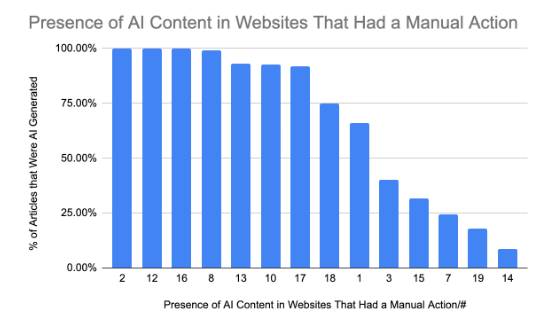
Sources - The Full Report 👉 Google March 2024 AI Content Manual Action Update - List of deindexed sites (🔗 Here).
Sources - The full list 👉 To see the full list of the 837 websites deindexed by Google, check it (🔗 Here).
Across the 10,000 search results, the ‘Discussions and forums’ feature was present in 7,702 (77%) of them and linked to 766 individual forums.
Reddit and Quora were listed 18,095 times. These two domains have more than 3X the presence of every other site combined.
The increasing popularity of Reddit, along with Google’s recent core update targeting spam, has led to a resurgence of a classic form of user-generated content (UGC): discussion forums. While major platforms still use forums, many brands have abandoned them as part of their marketing strategies.
Glenn Allssop wanted to know if forums can rank well. He analyzed 10,000 keyphrases where product reviews ranked highly. He answered the following questions: How many individual sites does Google promote them? Do any other sites besides Reddit dominate the results? Do forums on subdomains or subfolders tend to rank better? Are the top-ranking forums owned independently or by media goliaths?
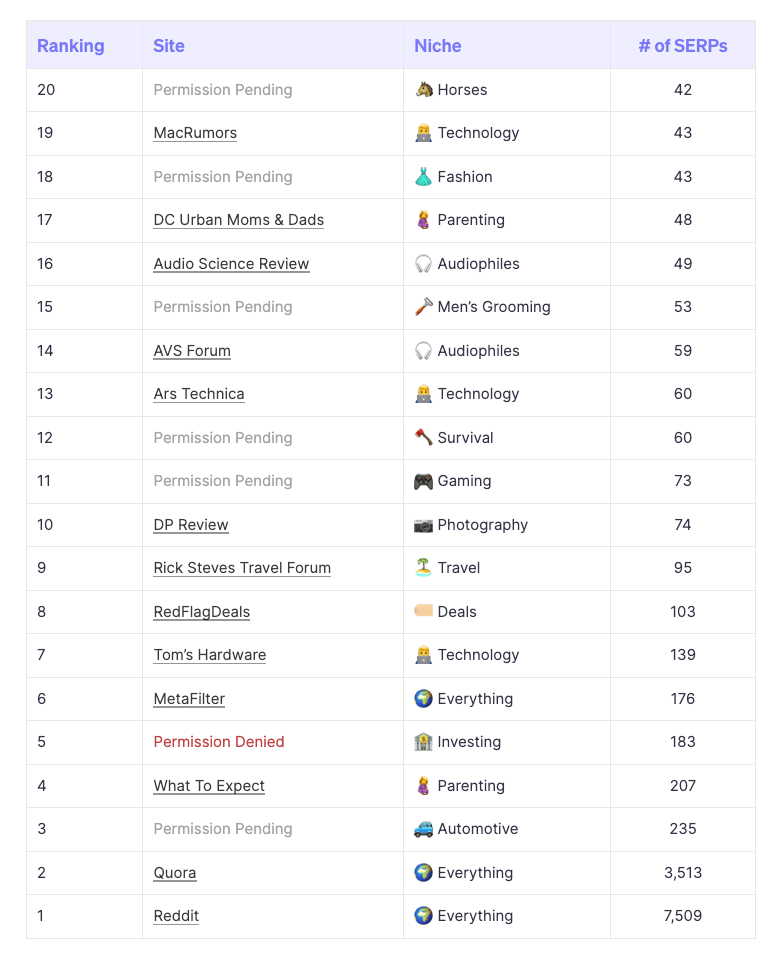
Sources 👉 Check the full research on Detailed’s blog (🔗 Here).
Keywords research is just market research for the 21rst Century
Brian Dean - Founder of Backlinko & Exploding Topics
Sources 👉 Excerpt from the blog post (🔗 Here).
Consensus Your AI Research Assistant. Search 200M academic papers from Consensus, get science-based answers, and draft content with accurate citations (🔗 Here).
By Consensus. app.
Ahref: They released a new feature: forecasting search volume. Tim Soulo made a demo (🔗 Here).
Ddevi: an AI Lead Generation assistant. It has several features: create websites and landing pages, Instagram reels, or even sales and support chatbot or bookkeeping. But the one interesting in the context of today’s issue is that it can help you monitor keywords to find leads and outreach using AI in Facebook groups, Linkedin, and Reddit (🔗 Here).
Check.Factiverse.ai: I don’t believe that much in AI tools that supposedly can detect AI-generated content. If they working efficiently, Google wouldn’t have released its core update about Spam. But Factiverse is interesting because it helps you fact-check if your AI-generated content is accurate - or not. It helps you quickly find evidence and fact-check any text (🔗 Here).
Bluedothq.com: An AI-powered Chrome extension for Google Meet (🔗 Here).
AIcarousel.com: A social media carousel maker and generator for LinkedIn, Instagram, and Tik Tok (🔗 Here).
Why Walmart’s quick success in generative AI search should have Google worried (🔗 Here).
Inside Reddit’s long, complicated relationship with Open AI’s Sam Altman (🔗 Here).
Open AI says Elon Musk wanted full control of the company (🔗 Here).
Meet the Arc Browser – The Reason I Uninstalled Google Chrome after 15 years (🔗 Here).
Perplexity is poised to become the latest AI start-up to hit unicorn status - Report (🔗 Here).
AI prompt engineering is dead (🔗 Here).
🟣 I’m Karine. I help you adapt your content strategy to AI Search and GEO through a masterclass and a community focused on AI marketing. The next session of my GEO masterclass in english will be in May. Want to join?
No posts
Comments
Nothing yet. Say the first thing.
Sign in to join the conversation.