
My goal during this keynote was to provide you with answers to the following questions:
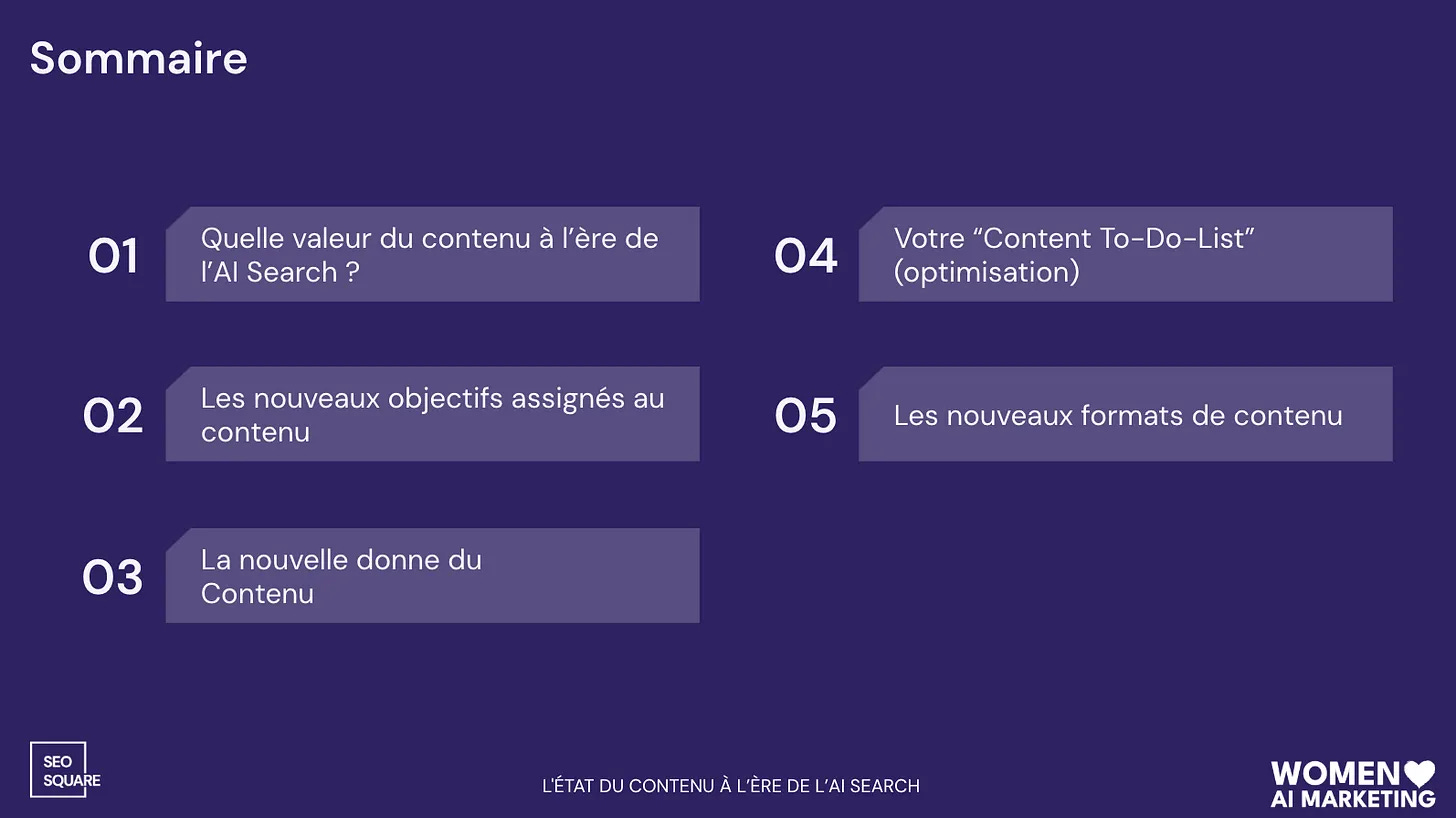
What is the value of content in the AI Search era?
What new objectives should we assign to content?
What is the new playing field for content?
What are the fundamentals of an AI-optimized content strategy?
What are the new content formats imported by the generative AI wave?
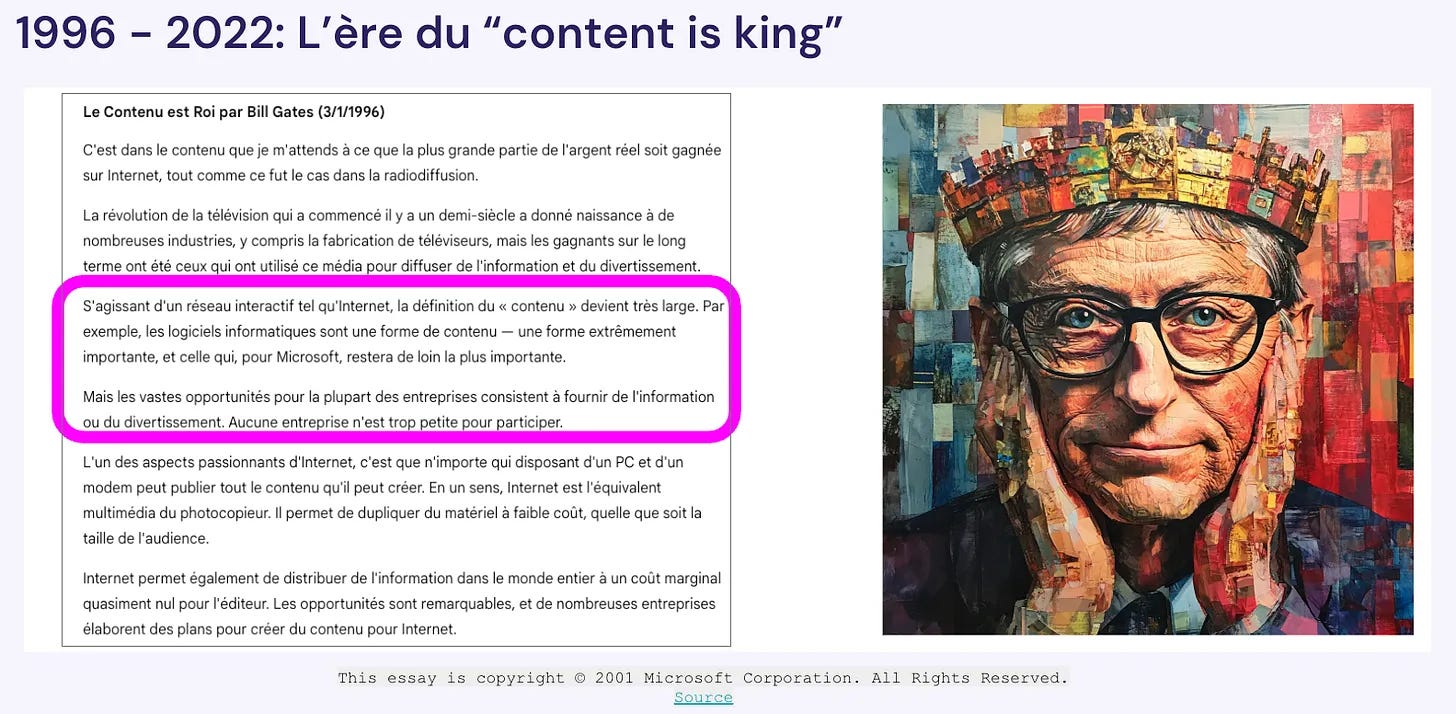
In 1996, B. Gates’s essay published on Microsoft’s blog compared the first Internet content model to broadcasting: companies pushed information to a passive audience, much like TV viewers. B. Gates even wrote:
“Content is where I expect much of the real money will be made on the Internet, just as it was in broadcasting.”
“Content” was then text and software created by professionals and distributed via a one-way channel. The historic “Content is King” truly summarized the first 25 years of the internet as we knew it... at least until November 2022.
The initial reaction from most content creators (including myself): panic mode.
“If an AI can produce in seconds what took me several days, in 3 years I’ll be unemployed.”
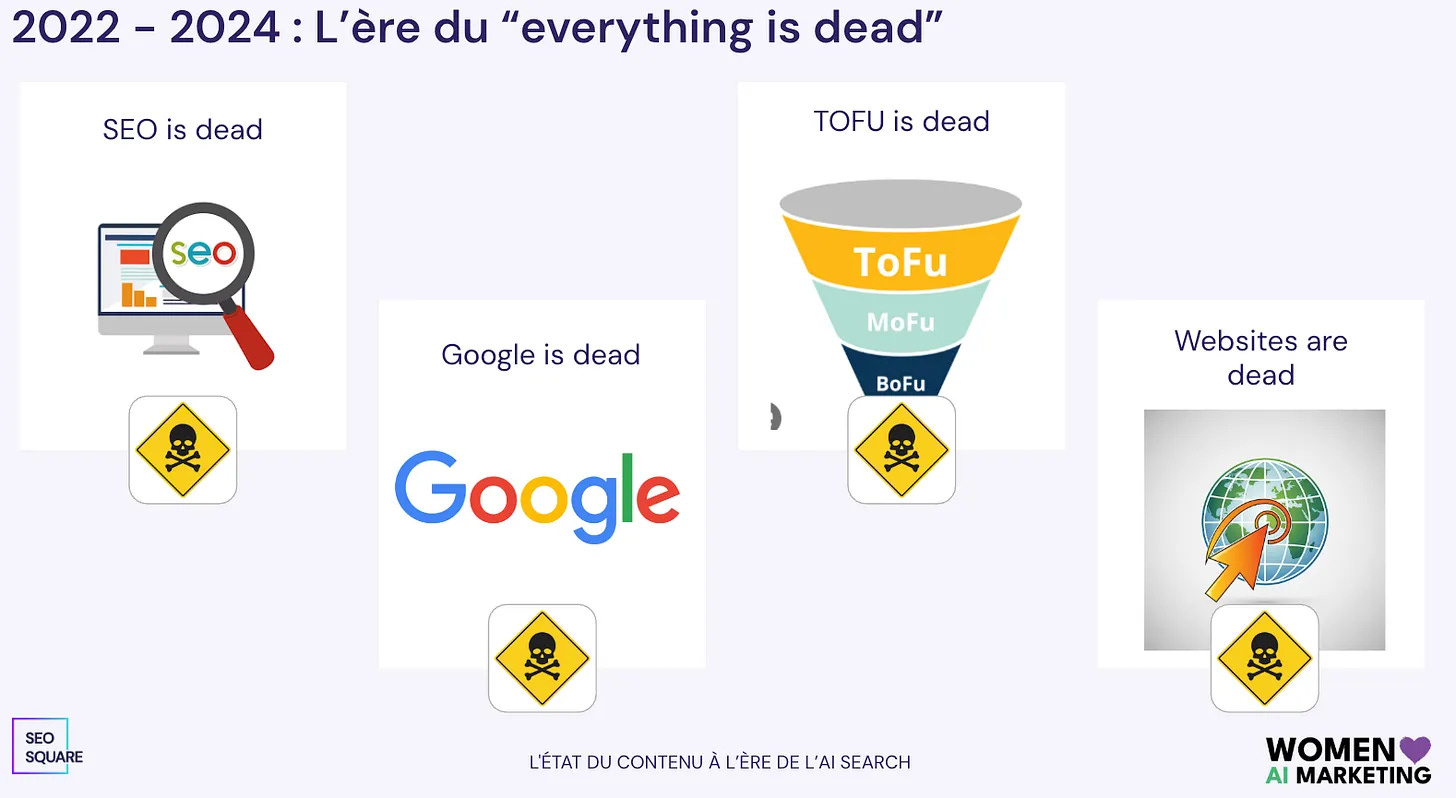
This concern quickly gave way to apocalyptic discourse. “SEO is dead,” “TOFU content is dead,” “Google is finished,” “websites are has-been.”
This type of reaction is a classic pattern in the face of every technological disruption. Fear breeds generalized anxiety where everyone convinces themselves that everything is doomed.
For years, content was considered an asset.
👀 Its sole purpose: to be distributed via the Internet, which played the role of universal distribution channel. This channel, open 24/7 and with low production costs, enabled a real revolution by democratizing creation.
In this paradigm, the end user had a passive role: they consumed information, read, and clicked to navigate. This was the first generation of the web.
Today, AI has only accelerated a transformation already underway: the shift to a new ecosystem.
The internet is no longer a simple channel, but a set of platforms.
The main objective of these platforms? Keep the user as long as possible (you’ve probably already noticed the crappy reach close to -30% of your Facebook post where you inserted an external link to your blog article 😩).
Content has changed function.
It’s no longer an asset meant to be passively consumed, but a tool designed to generate interaction.
👀 We’ve moved from a passive consumption model to a paradigm where content serves as a pretext for dialogue, engagement—a like, a comment, a share. Content has become the trigger for conversation.
The content landscape has become much more complex, interactive, and user-centric.
Content is now a dialogue that includes user-generated creations and interactive formats: blogs, short videos, podcasts, quizzes, lives, AR/VR experiences.
A content creator is now a vast and diverse group of individuals—”creators” or “influencers.” AI tools assist and optimize creation workflows. The audience consists of active participants who share, comment, create, and influence a brand’s narrative through user-generated content.
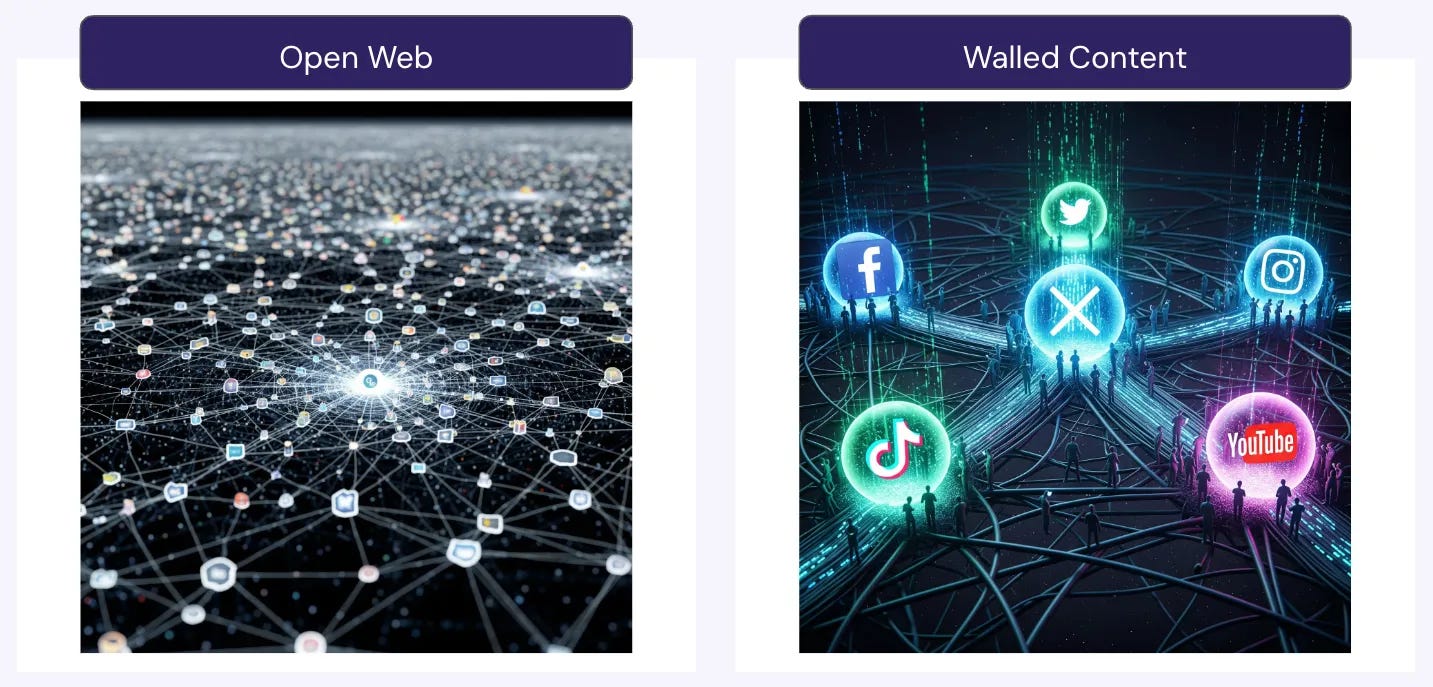
AI has obviously accelerated this transformation, we’ll see how. But to move beyond bar talk where everything would be either catastrophic or miraculous, we need to look closely at the numbers.
From the content perspective, we’re not being replaced by AI. And it’s not happening tomorrow.
However, AI has inserted itself into our creation process. Before, we started from a blank page: find the theme, structure, write. It took considerable time. Today, we use AI not to generate content, but to help us create our content.
Two recent studies perfectly illustrate this evolution:
The blogging study conducted by Orbit Media’s Andy Crestodina, which analyzes how bloggers now use content
Ahrefs’ study, “State of AI and Content Marketing,” which surveys content professionals on their AI usage
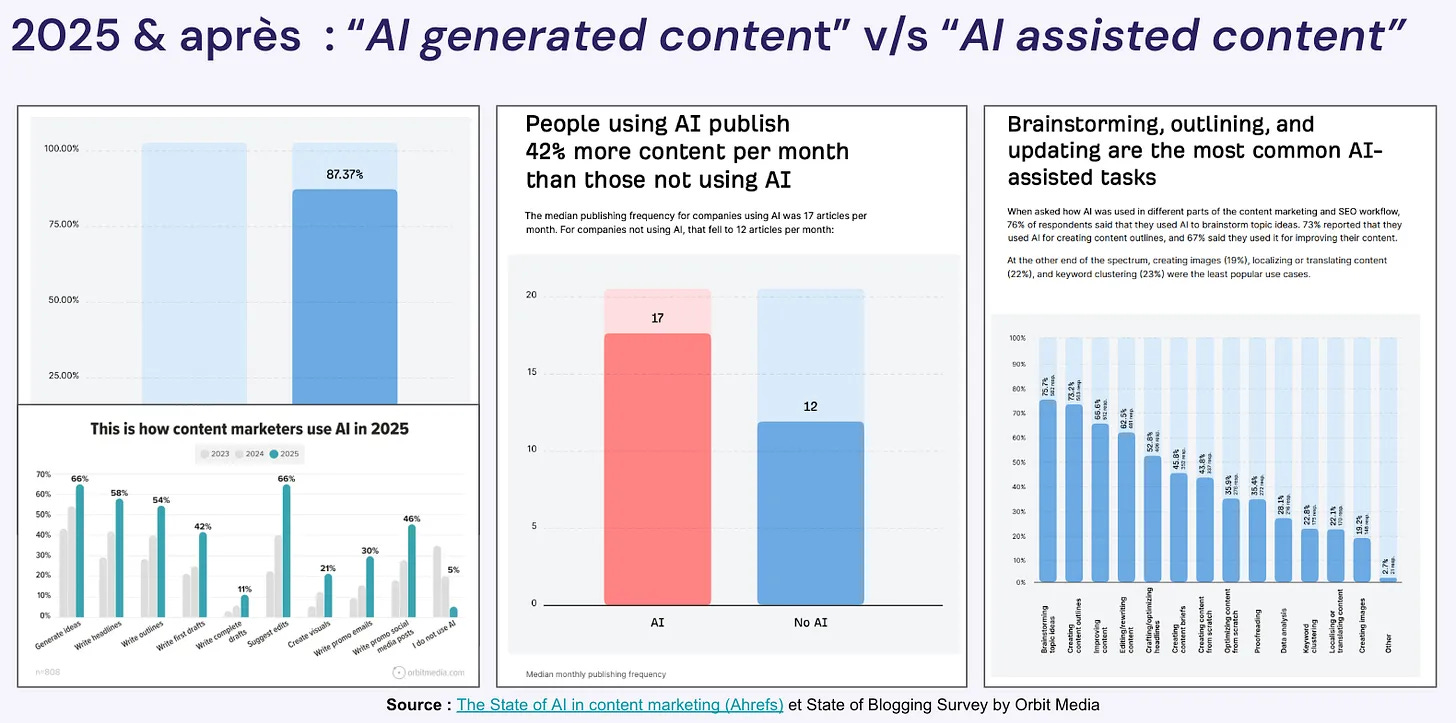
Concretely, what do we use AI for?
To brainstorm, instead of organizing endless meetings
To correct, proofread, translate
To get ideas. I use it a lot to identify what’s missing in my content, what I forgot
Or to rephrase when it’s poorly expressed, to condense ten sentences into one
And almost never to create complete content
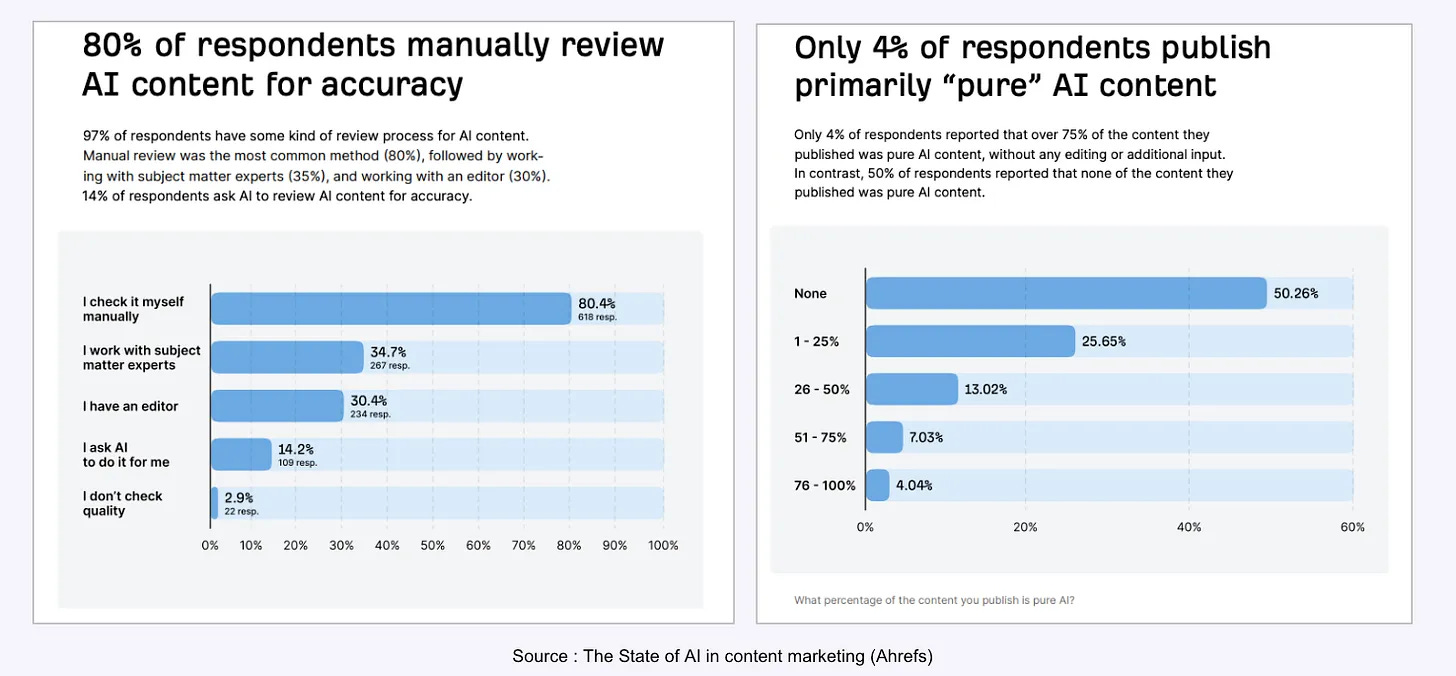
👀 Today, except for beginners, only 4% of content marketers use AI 100% to create content from scratch. AI has become an assistant, not a writer.
The SEO and content ecosystem is currently bathed in apocalyptic discourse: end of the web, end of SEO, end of traffic, end of clicks, death of media. A real festival of pessimism. Total depression. Heavy... Every week, following AI news for my marketing newsletter, I tell myself we could legitimately want to drop everything and change careers (I think about it sometimes, I admit).
BUT...
We must differentiate between the photo and the film.
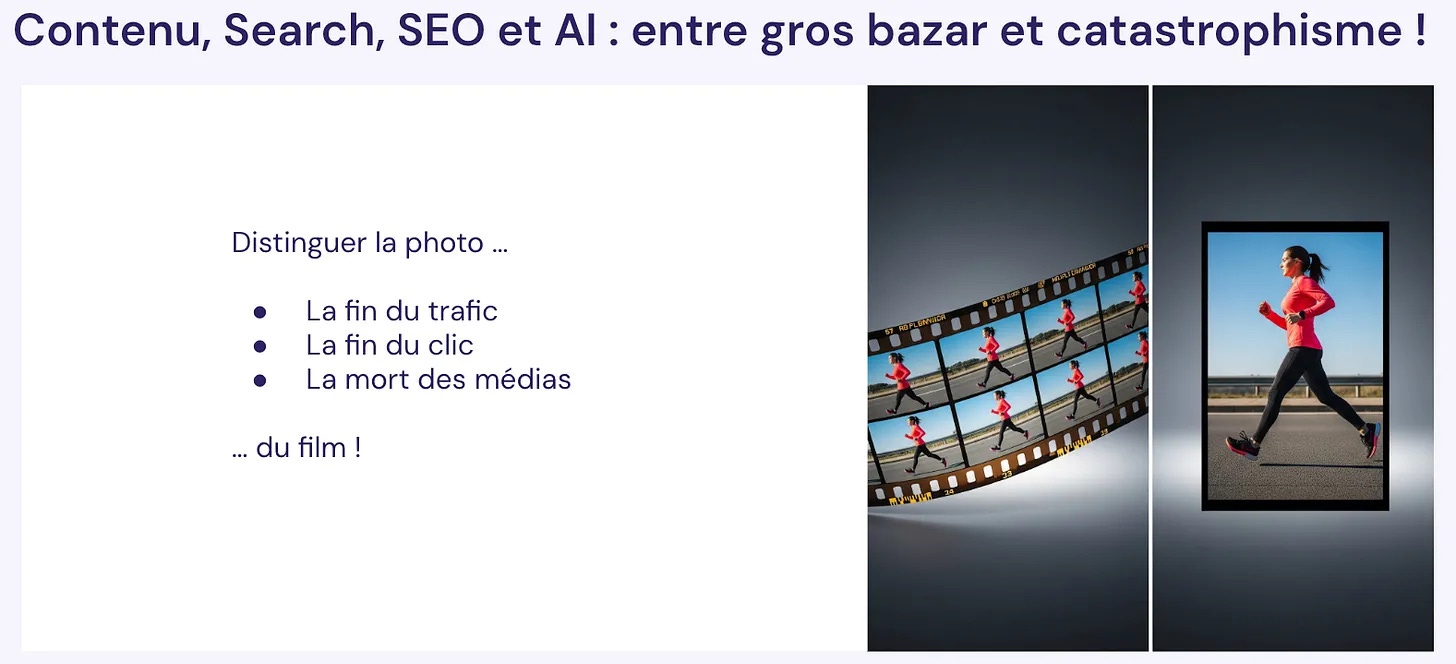
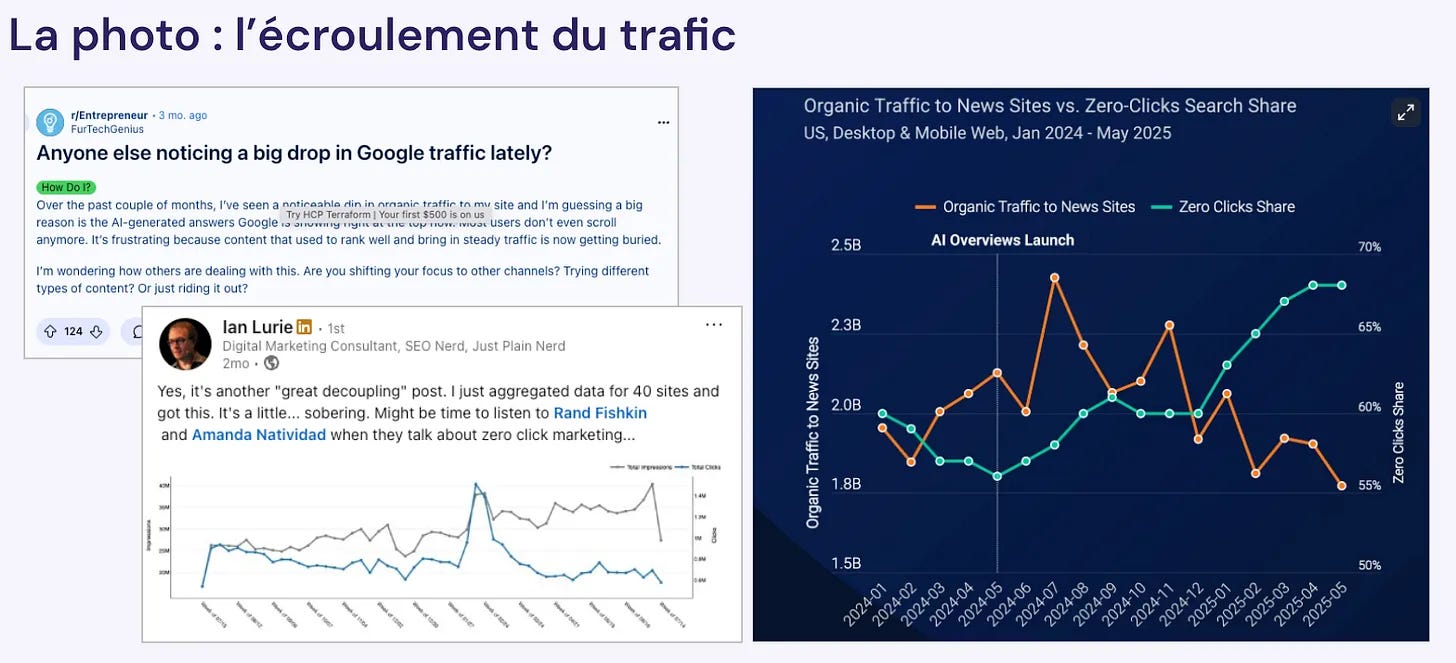
The photo of today? It’s true. Traffic drops, sometimes up to 66%. Clicks collapse. Media are in a very difficult situation. These observations are real and verifiable. Does that mean we’re all doomed? No.
👀 The photo is what it is. But the film tells another story. Behind this crisis, we all—marketers and entrepreneurs—have a major opportunity.
The Pew Research Center study is striking (I had spotted it this summer): zero-click explodes (in green on their graph) while traffic collapses (in orange).
When this study came out this summer, Google hastened to downplay it, saying everything was fine, that AI Overviews were great, and that sites continued to prosper. I had even done a retrospective on Google’s somewhat ridiculous storytelling zigzag.
Except I have dozens of case studies that prove otherwise. B2B, B2C, small bloggers, big brands: traffic plummets everywhere. It’s factual.
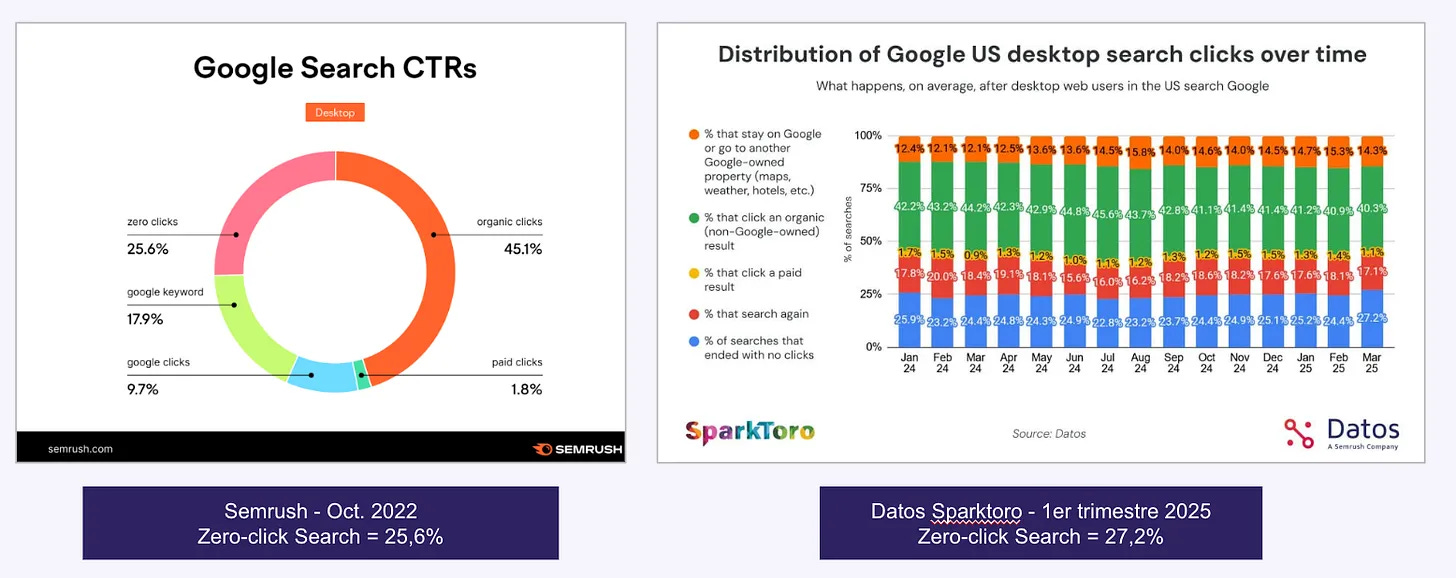
Rand Fishkin, brilliant and true US marketing guru who popularized SEO in the early Google era and founder of SparkToro, invented the expression “zero-click search.” This situation where the user on Google no longer clicks on one of the ten blue links on the search results page to find their result by surfing the web.
With the arrival of ChatGPT and AI Search solutions like Perplexity, the situation has worsened.
Except in reality, this problem has been latent for 10 years. Honestly, saying Google sends less and less traffic to websites is a bit like saying climate change is worsening year after year. It’s just become an even more visible storm due to ChatGPT’s success and conversational AI.
The numbers are accurate: between 25 and 27% of users no longer click on Google because they already have their answer.
But on the other hand... Google has never hidden its game.
Since 1995 and the injection of backend AI into its algorithm to better detect search intent, Google, initially a search engine, has transformed into a platform that offers content and wants to keep its users. Like all other platforms.
👀 This is called the new SEO: where Search Engine Optimization is replaced by Search Everywhere Optimization (I even made it a section in my newsletter). abonné
Yes, we’re alarmed about the end of the click, but we were already getting there progressively. AI just accelerated the movement. And yes, it’s also true: media are taking the first hit.
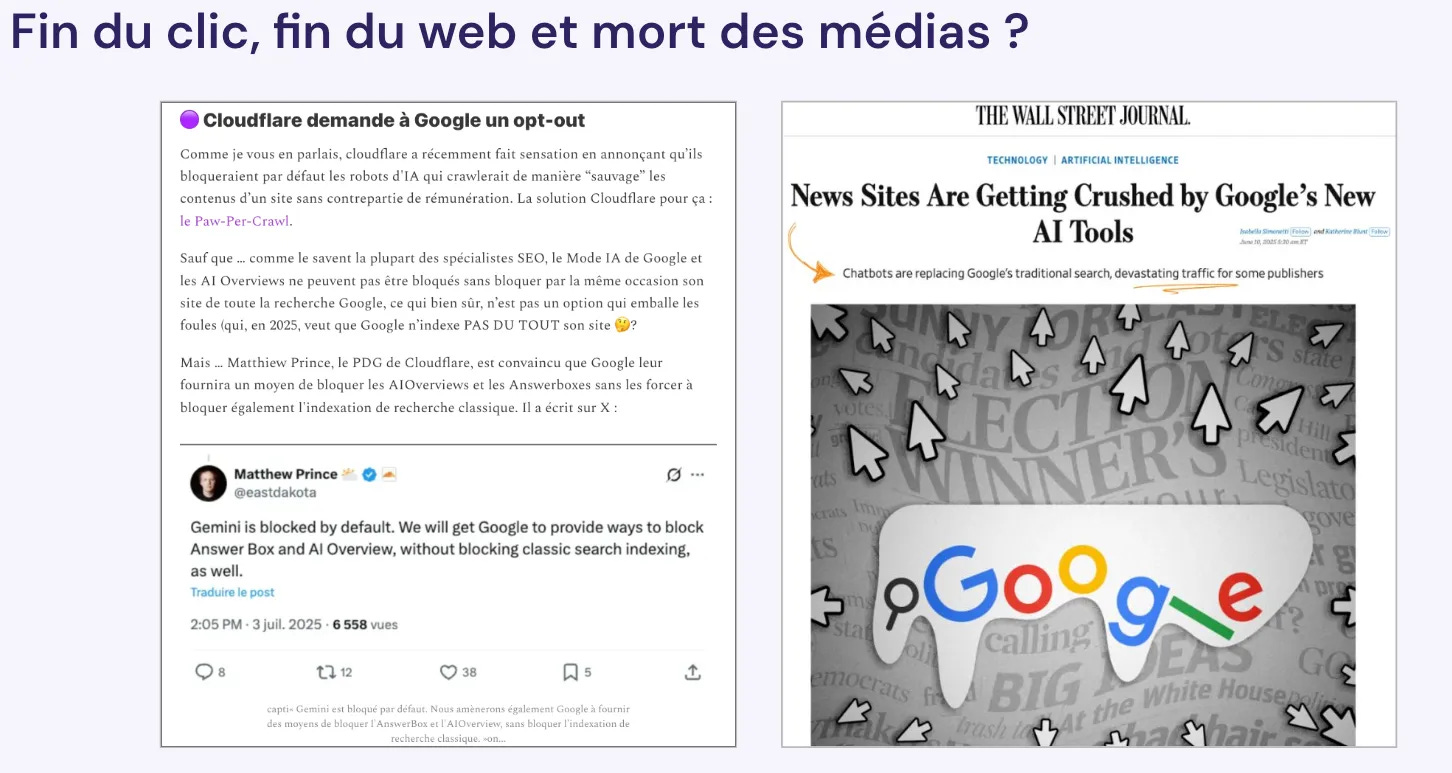
In the United States, complaints are pouring in. In France and Europe too, lawsuits are piling up. Media outlets are protesting every day.
Honestly? I sometimes have trouble crying with them.
Google with its AI Overviews, ChatGPT, Perplexity give informational answers. Naturally, that kills media whose job is precisely to give information. It’s logical.
Except, deep down, what are we surprised about?
Google is an advertising agency. That, from day 1, has never changed...
Their brilliant innovation from 25 years ago—which consisted of inventing natural referencing to make paid referencing even more credible—aimed to educate us to click on links as the preferred navigation mode on this giant new medium that was the Internet at the time.
No one should be surprised: their goal was never to direct traffic to natural results. Google’s ultimate business? Make us click on ad links.
It’s the story of the glass half empty or half full:
We benefited from natural traffic for 25 years. Now, either we spend the next 25 years multiplying lawsuits trying to preserve an obsolete advantage, or we start right now reinventing the model—while thanking those 25 years that allowed us to exist.
I understand it upsets a well-established model. But Google isn’t the only culprit. Media must reinvent themselves. Many are already doing so in the United States, with intelligence and inventiveness. They have a promising future.
AI is now designated as the main culprit for the end of traffic and clicks. In reality, it’s mainly the last nail in the coffin—the one that makes the problem truly visible.
To understand the ongoing transition, let’s put ourselves in the shoes of the user searching for something today on Google or OpenAI.
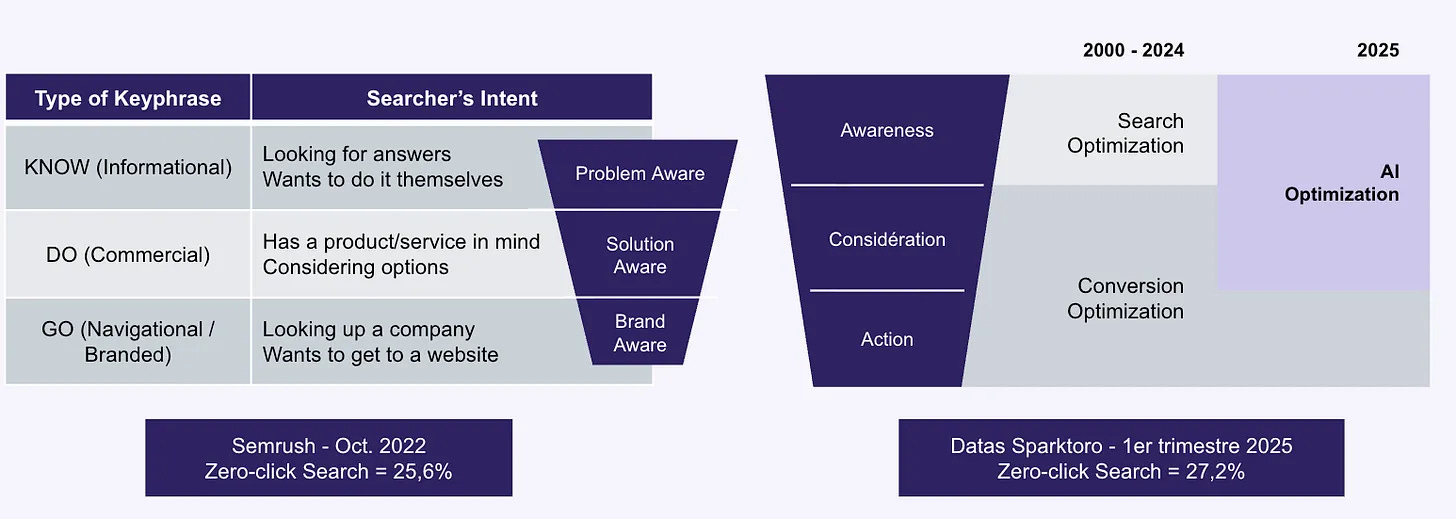
Until 1995, Google was really a search engine operating with keywords: you put 1, 2, 3, 4 words maximum in the search bar. We were even told not to make queries too long to avoid landing on irrelevant sites. You had to target your keyword to get the right pages.
In 2015, Google made one of the deepest updates to its search engine by injecting AI into its algorithm via updates like Hummingbird and Google RankBrain. This AI worked in the background to better detect the intent behind our queries. The funnel was then quite clear: informational, commercial, then navigational.
Since 2022, what changed with AI is that it was injected front-end, directly into the user exchange interface. ChatGPT launched the first arrow. Google followed, moving from a search engine to an answer engine.
What new opportunity?
👀 We’ve moved from a short query composed of a few keywords to a real monologue: the prompt. This (famous) text that can now be extremely detailed that Google or OpenAI will dissect to detect our real search intent.
Consequence: searches have become not only much more contextual, but also much more personal. They are hyper-refinable and detectable from the start. AI optimizes these first two parts of the funnel.
The truth is, AI doesn’t kill the click: it exposes it. Yes, 60% drop on desktop, 50% on mobile. It’s real. But change perspective.
The good news:
You can prove to your boss or client it’s not your fault—everyone is experiencing this drop
You can adjust your traffic objectives more realistically
You can justify budgets to explore alternatives
And especially: a click from AI is about 4.5 times more likely to convert than a traditional click
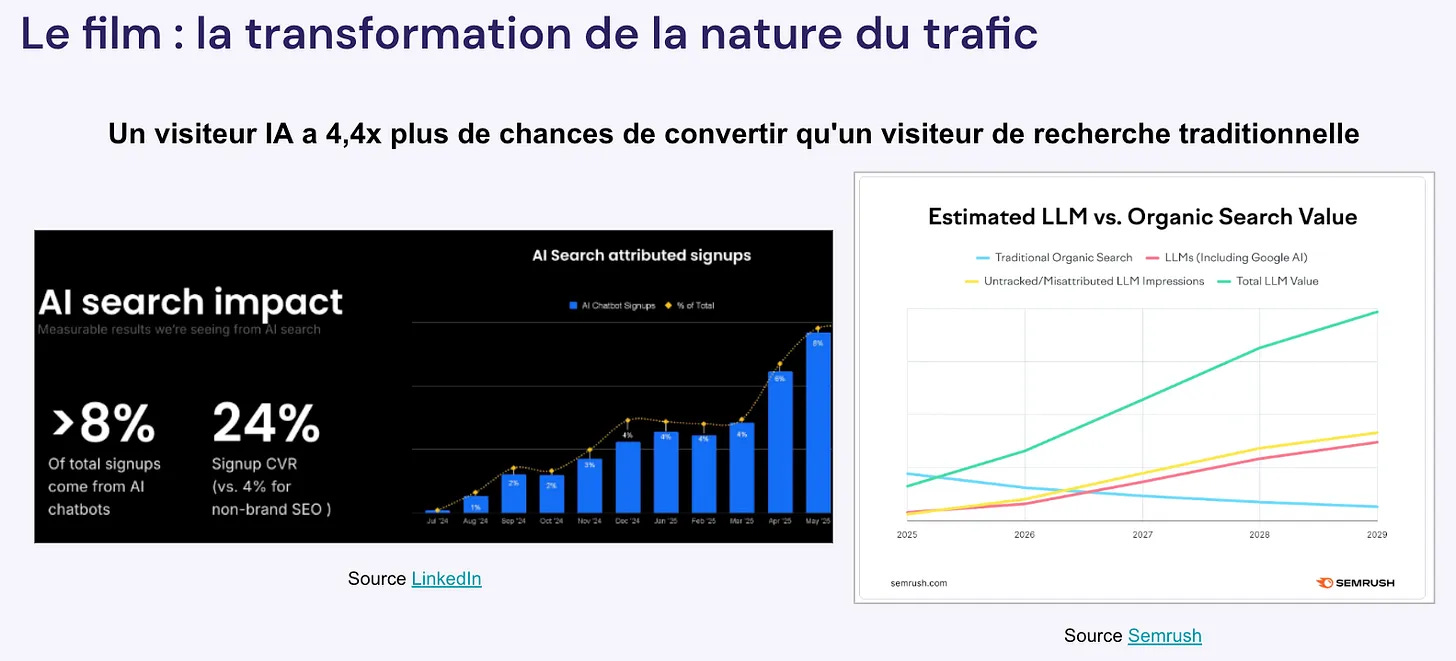
Why?
Because the user who clicks after reading an AI Overview is already ultra-qualified. They’ve already had their dose of information, compared options, done their checks. When they arrive at your site, they’re “hot,” ready to buy.
American studies confirm it: the website isn’t dead. Blogs, yes, because the info they provided is now furnished by AI. But strategic pages—homepage, product, service, contact—are bouncing back.
👀 This doesn’t mean the website becomes the sole point of contact, but it remains fundamental. You’ll need to be present on many other channels, but these essential pages regain their importance.
You need to change your perspective.
AI doesn’t kill your traffic, it qualifies your customers for you. Not only can AI bring you traffic (so zero-click search isn’t really so “zero”), but especially it also saves you traffic by filtering out what you don’t need.
👀 I often hear: “how should I recover my traffic?” But why do you want to recover your traffic if they’re visitors who behave like people in a store who look without buying? You don’t want them to look, you want them to buy. AI acts as a filter.
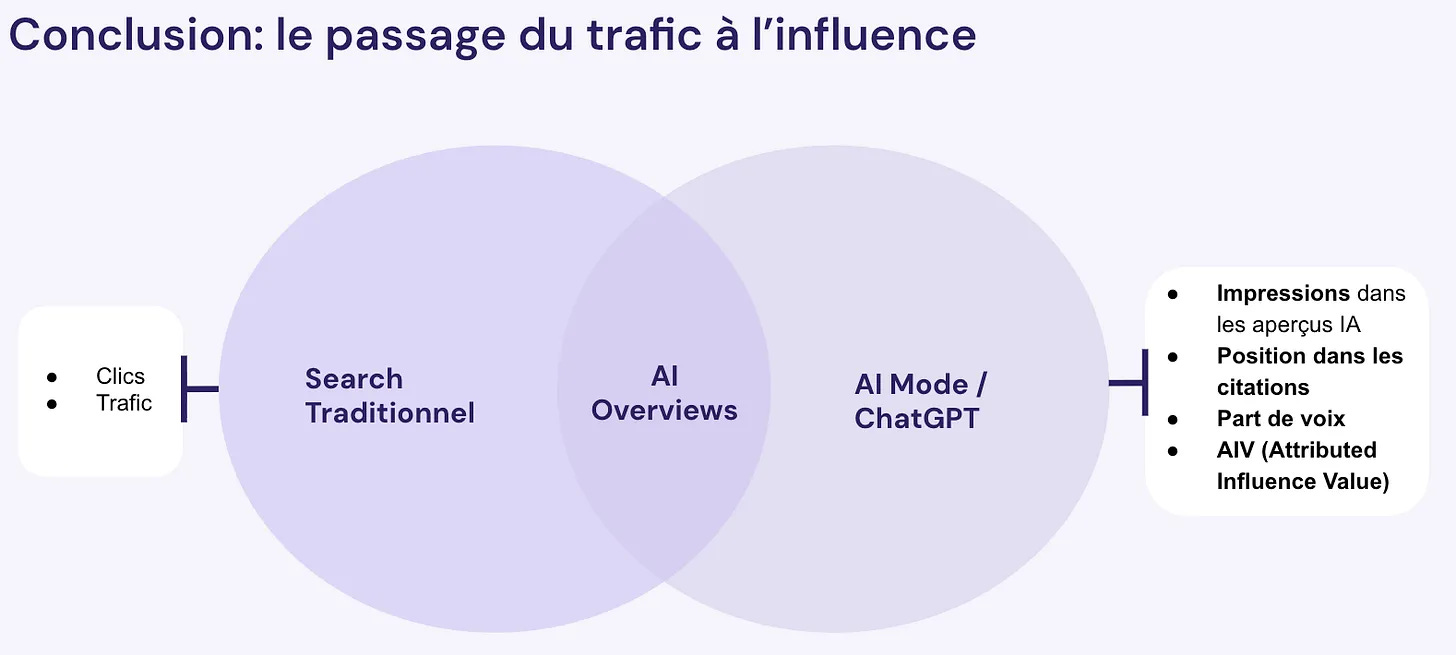
It’s scary, it’s a big change, but it completely modifies the objectives assigned to content. Before, we were obsessed with clicks. Now, we talk about impressions, position in citations, share of voice, Attributed Influence Value (AIV).
Before, the query was simple: “Pilates classes in Miami.” Google offered sponsored links and natural results.
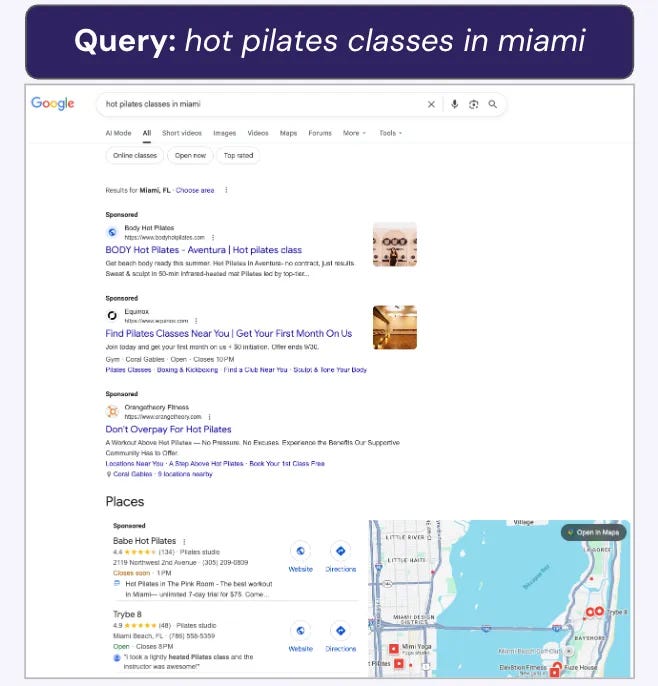
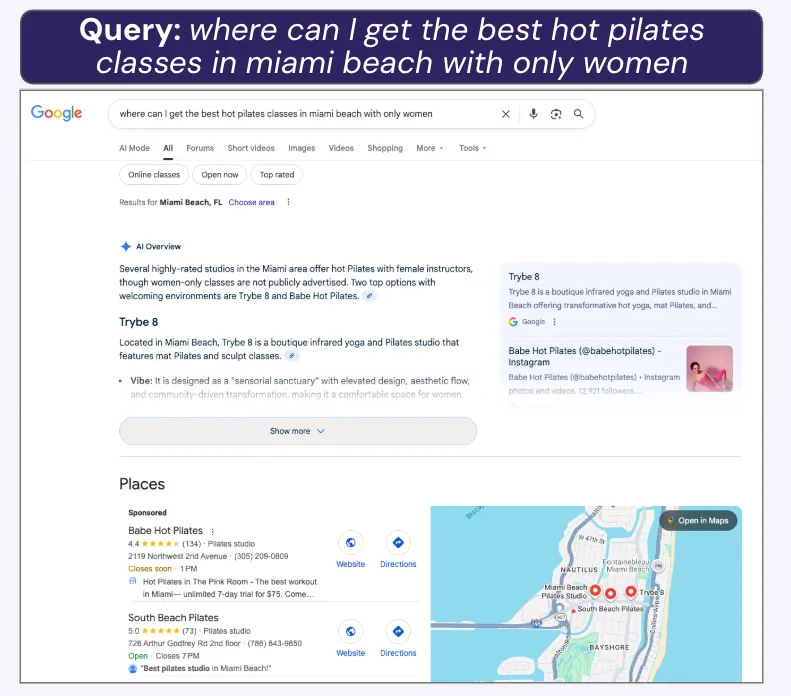
When Google started evolving, it already offered some answers directly on its site.
Today, with AI mode, I can tell my life story: “I’m coming back from surgery, I need Hot Pilates of a certain style. I’d like to find in Miami Beach or Surfside, women-only classes, at least 45 minutes.” AI offers an incredibly personalized answer, even suggesting specific studios with recommended instructresses like... Julia!!
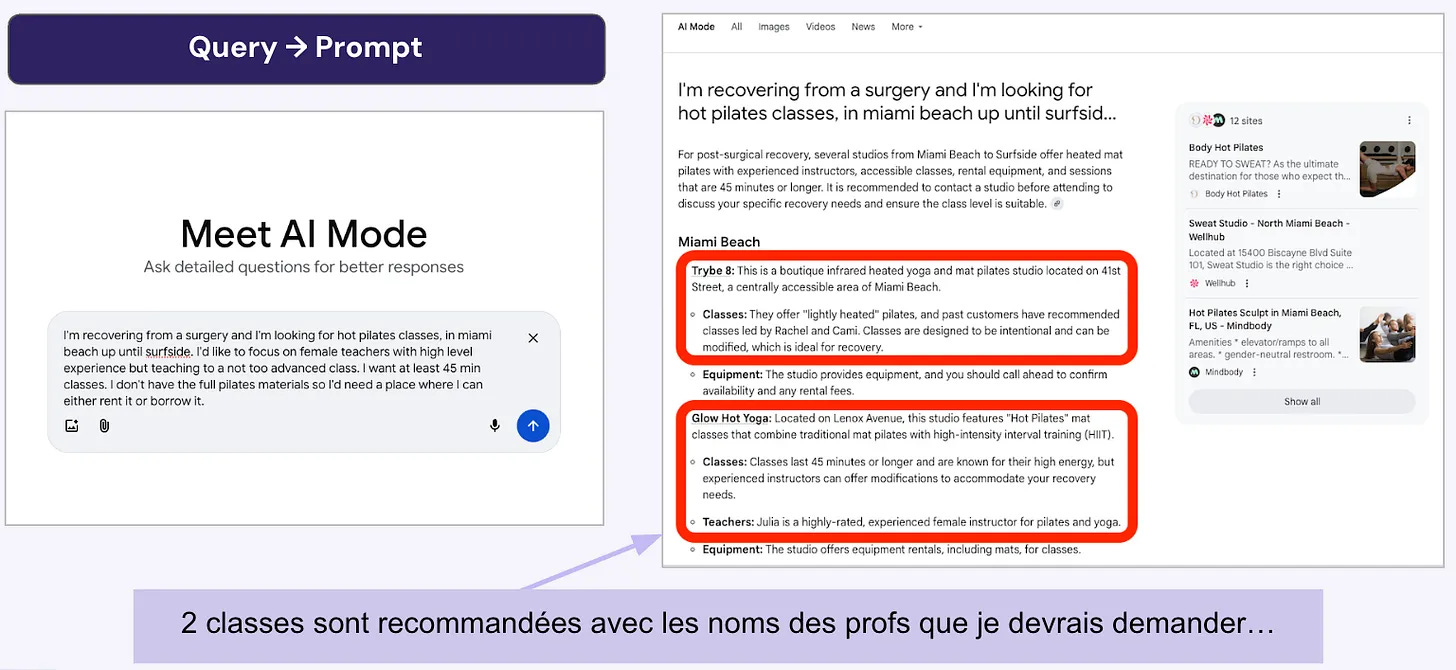
From the user perspective, it’s unbeatable.
This is the new Internet. I know you don’t have it in France yet, but it’s coming—Sundar Pichai repeats it in all his interviews. This will be the new Google.
Today, we’re in an intermediate period. Google will probably orchestrate a mix of the three modes: traditional Search, AI Overviews, and full AI mode.
Forget the old KPIs. Make way for impressions, position in citations, share of voice, AIV. Each citation is an influence signal.
👀 Conclusion: AI Overviews inflate impressions and suffocate clicks. But the clicks that survive have real purchase intent. Now, if your conversion rate explodes, traffic volume becomes secondary.
Let’s now move to the more micro-economic aspect of this transformation. Two fundamental pillars structure this new content reality.
👉 First pillar: understanding how AI modes work: Google has shown some transparency on the subject. The day after their annual conference last May, they published a technical document explaining the operation of “query fan out”—the mechanism at the heart of AI modes.
🤫 This transparency is still somewhat hypocritical: while Google explains the theoretical operation, we still can’t track performance in AI modes via Google Analytics 4 which provides no data (suffice to say SEO technicians are seeing red).
Nevertheless, we still have quite a few elements to understand the new mechanisms.
👉 Second pillar: analyzing user behavior: Beyond the algorithm itself, it’s crucial to understand how users interact with these new AI modes. A particularly relevant recent study enlightens us on these new behaviors. This understanding of the relationship between users and algorithm forms the basis for developing new content strategies adapted to this era.
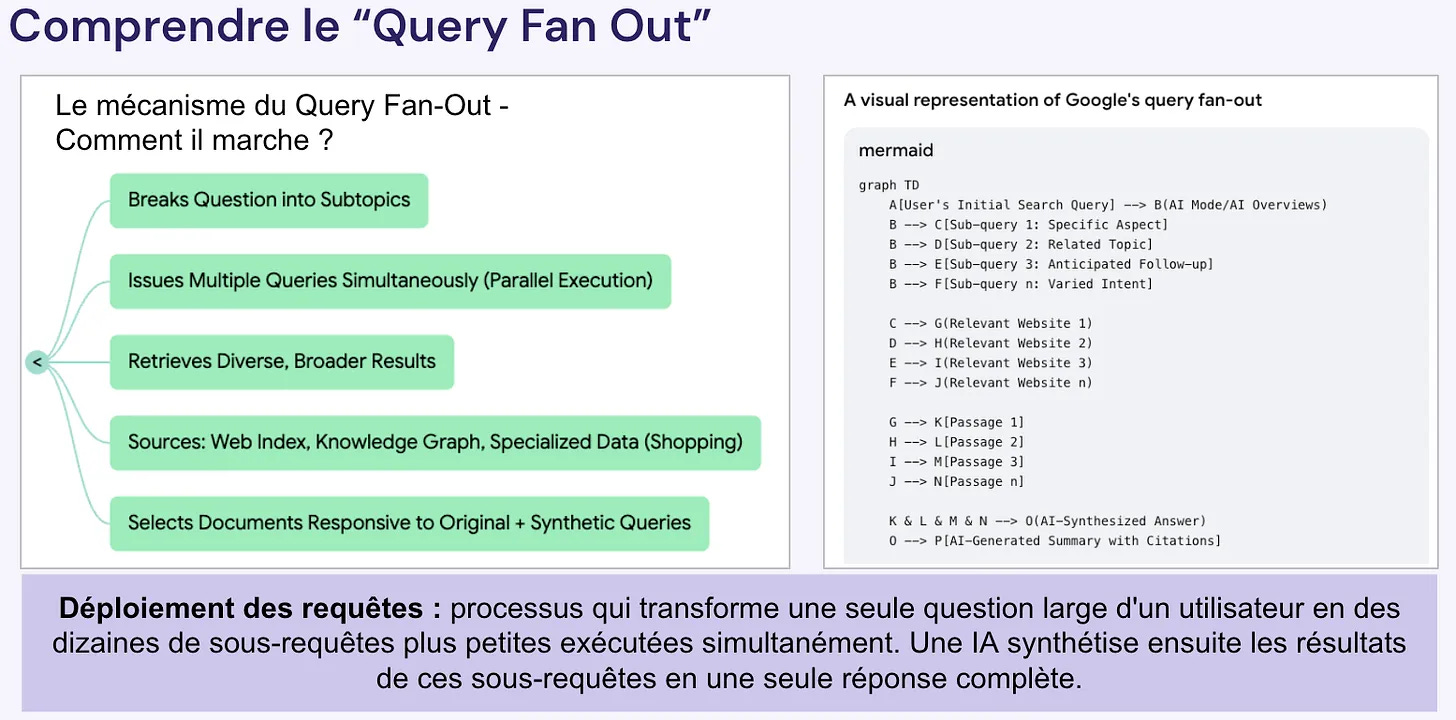
The central mechanism behind visibility in Google’s AI Mode is the query fan-out technique.
👀 Query fan-out is an information retrieval method used by the AI system (like Gemini 2.0 or 2.5) to deeply understand a user’s complex question.
Decomposition: When a user submits a query, AI doesn’t search for that exact string. Instead, it uses a large language model (LLM) to break down the query into multiple more specific sub-queries (called synthetic queries). These synthetic queries reflect various reformulations of the original intent, such as implicit, comparative, related, or historically co-searched terms.
Parallel retrieval: The system executes these synthetic queries simultaneously. It retrieves documents from the search index not only for the original query, but for the entire fan-out of sub-queries, drawing from various sources like the live web, Knowledge Graph, and specialized data.
Corpus creation: This parallel retrieval creates a temporary “personalized corpus” of highly relevant documents, specific to this user and this query.
Synthesis: AI then processes information extracted from this personalized corpus, combining elements from various sources to produce a single complete, synthesized natural language response.
This process takes only a few minutes.
When Elizabeth Reid was presenting AI Overview two years ago, she summarized the promise thus: “Let Google do the Search for you.”
Today, this vision has become reality.
AI does the search work for you: you no longer need to click on different links, reformulate your queries, or navigate between multiple sources.
AI analyzes your initial question and anticipates all the related questions you wouldn’t have thought of, simply by decoding the words of your request.
It builds a complete answer by exploring these multiple dimensions.
👀 This is where a complete paradigm shift for SEO resides. This transformation fundamentally changes the challenge of online visibility. We’re moving from optimization centered on isolated keywords to matrix logic, where you must think in terms of networks of interconnected questions and themes.
👉 We’re moving from optimization centered on isolated keywords to matrix logic, where you must think in terms of networks of interconnected questions and themes.
This second dimension is based on a major study conducted by Kevin Indig in collaboration with Similarweb. This data, although likely to evolve in the coming months, reveals truly interesting behavioral trends to guide our content strategies today.
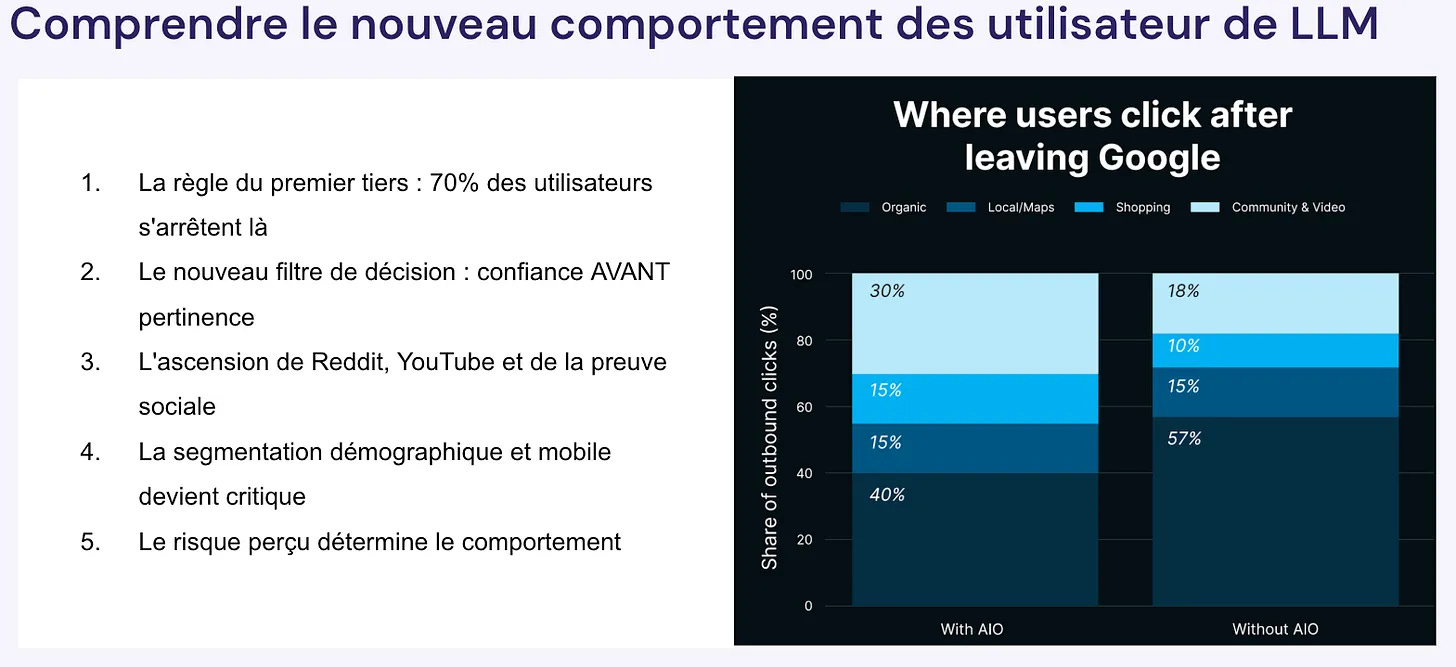
70% of users don’t go beyond the AI Overview. So if your content doesn’t appear in the top 30% of this synthesis, your visibility chances become almost zero.
Nearly 90% of users skim the overview without thorough reading, in only about thirty seconds. However, three profiles are distinguished by more attentive reading: 25-35 year-olds, mobile users, and people performing “YMYL” (Your Money, Your Life) queries—health, finance, and high-stakes economic decisions.
The study reveals a fundamental change in the decision-making process: 58% of users favor recognized brands before even evaluating the response’s relevance. They don’t verify information, they directly trust the brand.
This dynamic radically simplifies decision-making to only 2 steps:
Do I trust this brand?
Does it answer my question?
👀 To-Do: Building a brand that inspires trust and reliability should be your top priority.
Nearly 18% of clicks from AI Overviews go to forums and social platforms, Reddit leading the way. This phenomenon reflects a clear and not new preference: we give more credit to peer-to-peer exchanges than to official information.
YouTube also establishes itself as the big winner of this transition to AI, with strong promotion in results.
About 40% of users open a second link to verify information.
To-Do: AI Overview + Reddit = the winning equation to multiply your conversions by X.
Data reveals notable differences by age and tool used.
Mobile regains central importance: 54% of users scroll on mobile versus only 29% on computer.
A generational divide also appears clearly: those over 45 continue to check traditional “10 blue links,” attached to 25 years of search habits. The younger ones, on the other hand, stick to the AI Overview without looking further.
High-stakes queries: For high-stakes queries (called “Your Money Your Life”), 38% of users open a second link to verify information, showing more cautious and affinity-based behavior toward these new interfaces.
👉 Your absolute priority (1): appear in AI results. Becoming visible in AI-generated results must now become your primary objective. This doesn’t mean your website becomes the sole channel—as previously mentioned—but it remains an essential pillar of your digital presence. Your key pages—products, services, contact, about—must be impeccably optimized.
👀 Example: I can confirm all this through our own tests on my community site: AI captures and uses even pages deemed secondary, systematically mobilizing them to contextualize and enrich its responses. The results of this optimization appear quickly.
👉 Your absolute priority (2): be present in the sources that feed AI. This new deal implies strategic presence in all sources consulted by these algorithms. Two fundamental levers emerge: Build and develop your brand authority. Which necessarily involves building your topical authority.
👀 Recognized thematic expertise becomes the foundation on which all visibility rests in this AI-driven ecosystem. How to develop solid topical expertise? Through the quality and depth of your digital content; through the semantic richness of your publications; through generating qualified traffic; and through optimal technical structuring of your site. I develop this below👇👇.
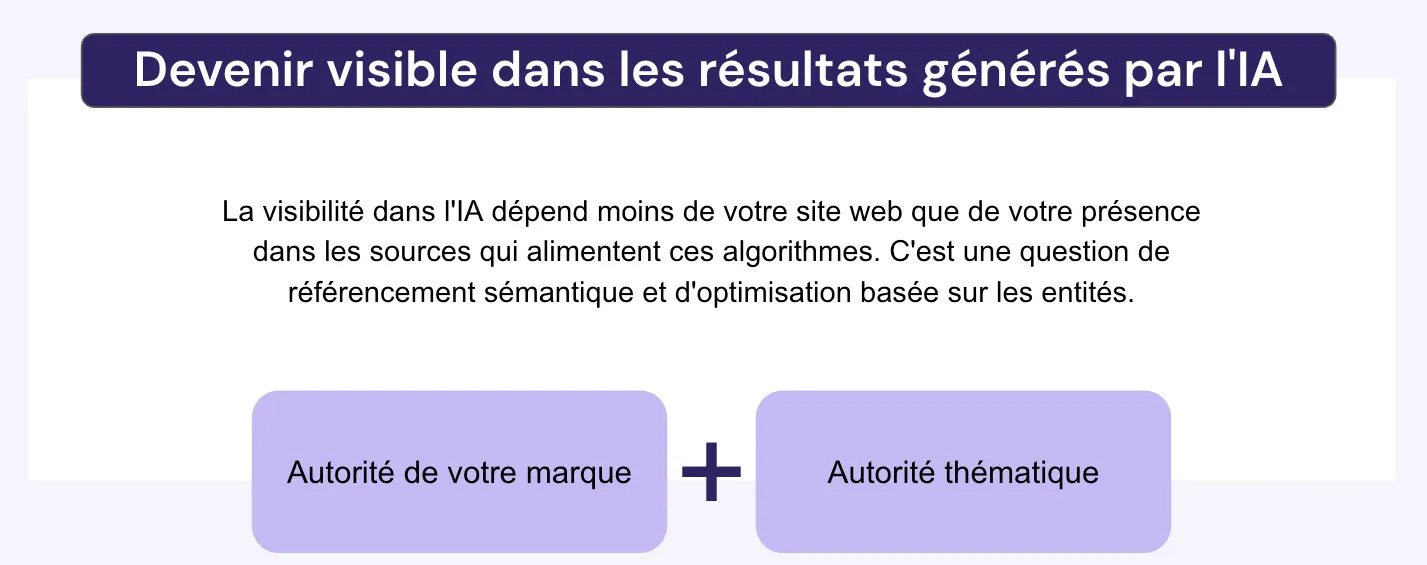
Start by precisely determining how you want to be recognized by your customers: define your positioning. Once done, develop your expertise through thematic clusters.
For years, natural referencing rested on a simple principle: identify keywords, assign them dedicated pages, then publish content optimized for these precise terms. This method was based on literal correspondence between the user’s query and words present on the page.
In 2025, this approach reveals three major limitations:
Superficial content: narrow articles, vulnerable to competition
Cannibalization: multiple pages from the same site compete for the same queries
Blind spots: absence of coverage on sub-themes, persona-specific questions, and real audience issues
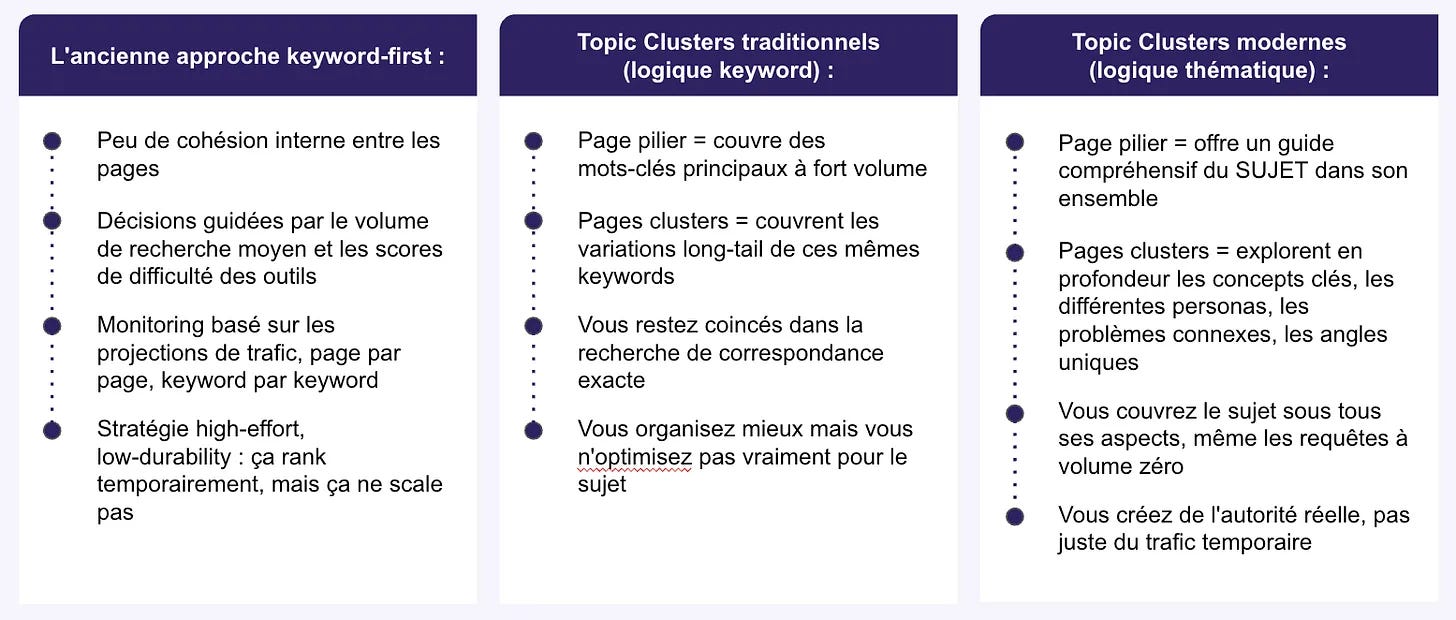
The traditional approach was characterized by weak internal cohesion between pages, decisions guided by search volumes and difficulty scores from tools, and monitoring based on page-by-page traffic projections. This strategy requires much effort for limited durability: it generates temporary ranking but doesn’t allow scaling.
While the concept of clusters and topic clusters isn’t new—dating back to RankBrain and Hummingbird era, popularized by HubSpot in the US and Laurent Bourrelly in France with his semantic cocoon—its application in the AI era requires quite a significant overhaul.
Many teams think they’re already applying a thematic strategy by creating topic clusters. Yet most maintain a keyword-centered mentality, which changes everything.
Traditional topic clusters (keyword logic):
Pillar page covers main high-volume keywords
Satellite pages treat long-tail variations of these same terms
Optimization remains focused on exact matching
Organization improves, but without true thematic optimization
Modern topic clusters (thematic logic):
Pillar page offers a complete guide to the topic as a whole
Satellite pages explore in depth key concepts, different personas, related issues, and unique angles
Coverage includes even zero-volume queries
The objective is real authority, not just temporary traffic
The pillar-cluster framework can help structure your content, but only if implemented with a thematic-first approach.
The key lies in a holistic approach centered on themes rather than isolated keywords. So... your referencing strategy no longer starts with keywords. It starts with your personas, their problems, and topics that truly interest them.
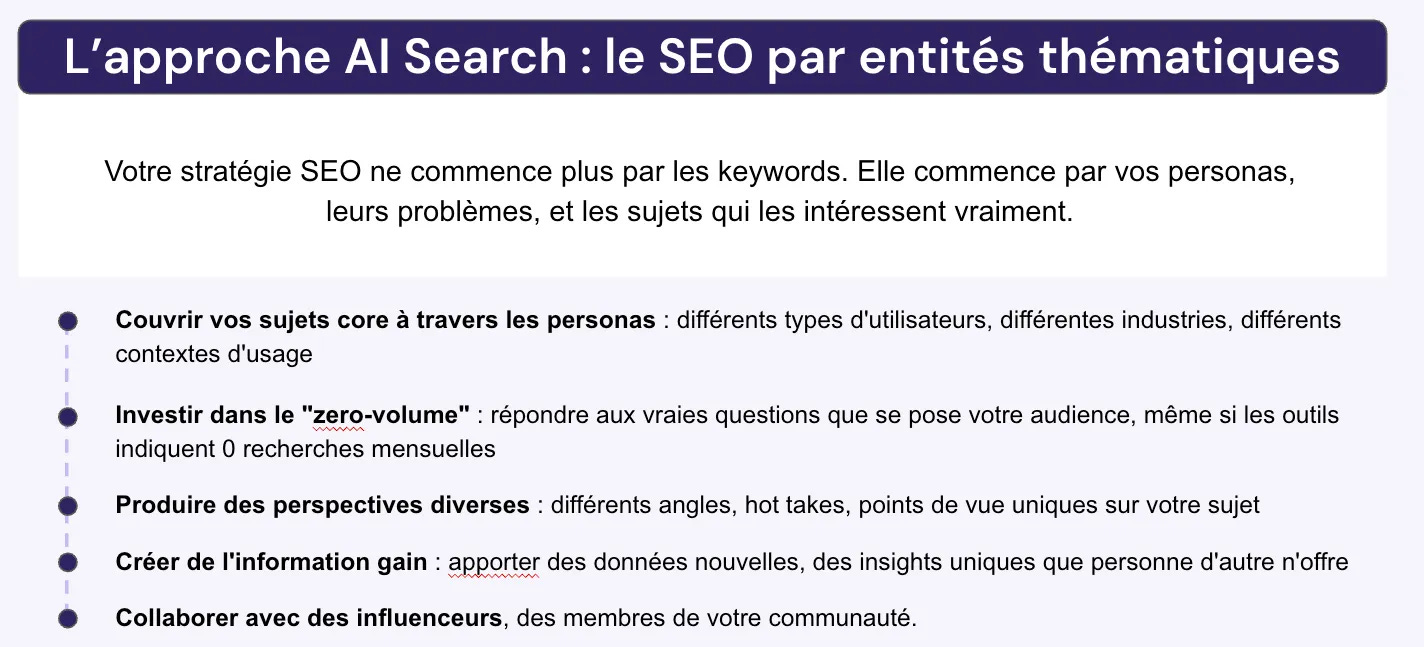
Thematic SEO consists of:
Cover your main topics across personas: different user types, industries, and usage contexts. To treat a topic exhaustively, keywords alone no longer suffice. You must conduct in-depth analysis of your personas and audience: precisely understand their behaviors, their readings, the channels where they consume information, and how they approach each topic.
Invest in “zero volume”: answer your audience’s real questions, even if tools indicate zero monthly searches. This is undoubtedly the most difficult aspect to get clients, bosses, etc. to accept. I know, and I sincerely sympathize. But... it’s an essential point of evolution: Query Fanout exploits implicit queries, those no one would have spontaneously thought of. To truly master a topic in all its dimensions, you’ll often be led to cover unsearched queries: either because no one has thought of them yet, or because they don’t correspond to any natural formulation in your theme.
Offer diverse perspectives: different angles, positions, and unique viewpoints on your topic. To achieve this, collaboration with influencers is fundamental.
Create information gain: provide new data and unique insights found nowhere else
Because it accounts for Google’s deep evolutions over 1 year:
Entities trump keywords: Google no longer looks for literal matches. It understands concepts and relationships between entities via its Knowledge Graph.
Query Fan Out: Google now transforms a single query into dozens of variations and sub-queries thanks to its language models. A well-optimized thematic page can rank for over 100 long-tail queries without ever mentioning these exact terms.
Content journeys: you no longer answer an isolated query, but build a content system that accompanies different users at different stages of their journey.
Sustainability: a site that deeply treats a topic from all angles naturally attracts quality backlinks and better resists algorithm changes.
It’s a fundamental change in perspective, not just better organization of your keywords.
Choose your target entity and precisely define how you want to be recognized. Build your topical authority by creating interconnected content clusters. In the AI Search era, the only way to ensure lasting visibility is to adopt a change in approach:
➡️ You move from “Which query to target?”
➡️ to “which topic to master?”
👀 This latter approach will ensure you semantic referencing AND entity-based optimization which are today the two new fundamentals of visibility in AI. This implies moving away from strategies exclusively centered on search volume and keywords, to explain the value of zero-volume searches and ultra-targeted content oriented toward personas and pain points.
Several studies—notably those from Profound, Ahrefs, and SEMrush (the most relevant in my eyes)—have analyzed this question and offer us interesting statistics, even if sometimes contradictory.
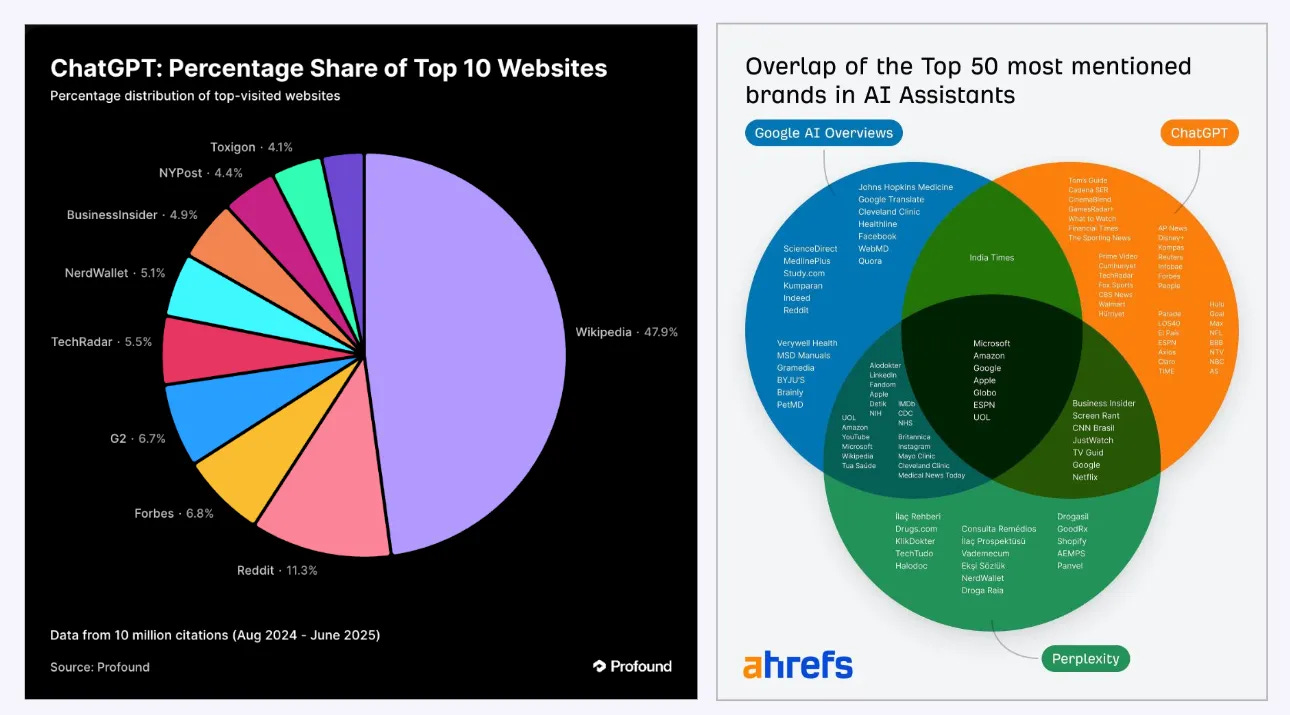
When you optimize for AI algorithms, you naturally go beyond Google’s perimeter alone to reach multiple platforms. Studies show ChatGPT draws more from Reddit, Google from Quora (and vice versa, with cross-influences), others from LinkedIn...
👀 But beware of misinterpretation!! This doesn’t mean you should be “everywhere”—or be on Reddit just because everyone is on Reddit. A bit on Reddit, a bit on Quora, a bit on LinkedIn.
The real message is elsewhere: AI considers as a reliable source conversations between real people. Which by nature take place on forums like Reddit, Quora, or elsewhere. Being on Reddit is one tactic among others. The strategic approach, however: is finding a space where you’ll host conversations—therefore creating and developing your own community. Build a platform—whatever it is—where people can authentically exchange about your topic. It’s this community dynamic that will fuel your strategy and naturally generate discussions on other platforms.
Wikipedia, TrustPilot, and other reference sources are indeed among sources consulted by AIs. Should you therefore throw yourself body and soul into creating a Wikipedia page? No. It’s data to keep in mind, nothing more. If it’s relevant and possible for you to be there, do it. If not possible, no big deal. Being cited by a source that itself references Wikipedia produces the same effect.
The important thing isn’t necessarily having your own Wikipedia page—besides, you may not have the required legitimacy—but being present in the ecosystem of reliable sources.
The data is clear: 50% of citations in AI results come directly from websites. Your website therefore remains fun-da-men-tal.
Imperatives for performing content:
Ultra-niche and exhaustive: cover all possible FAQs, all nuances, micro-themes, hidden intents
Zero search volumes included: don’t be afraid to address topics your client hadn’t even thought of
Extreme depth: treat each micro-topic lengthwise, widthwise, and crosswise
The guiding principle: in building your brand, avoid excessive diversification. Favor depth over breadth.
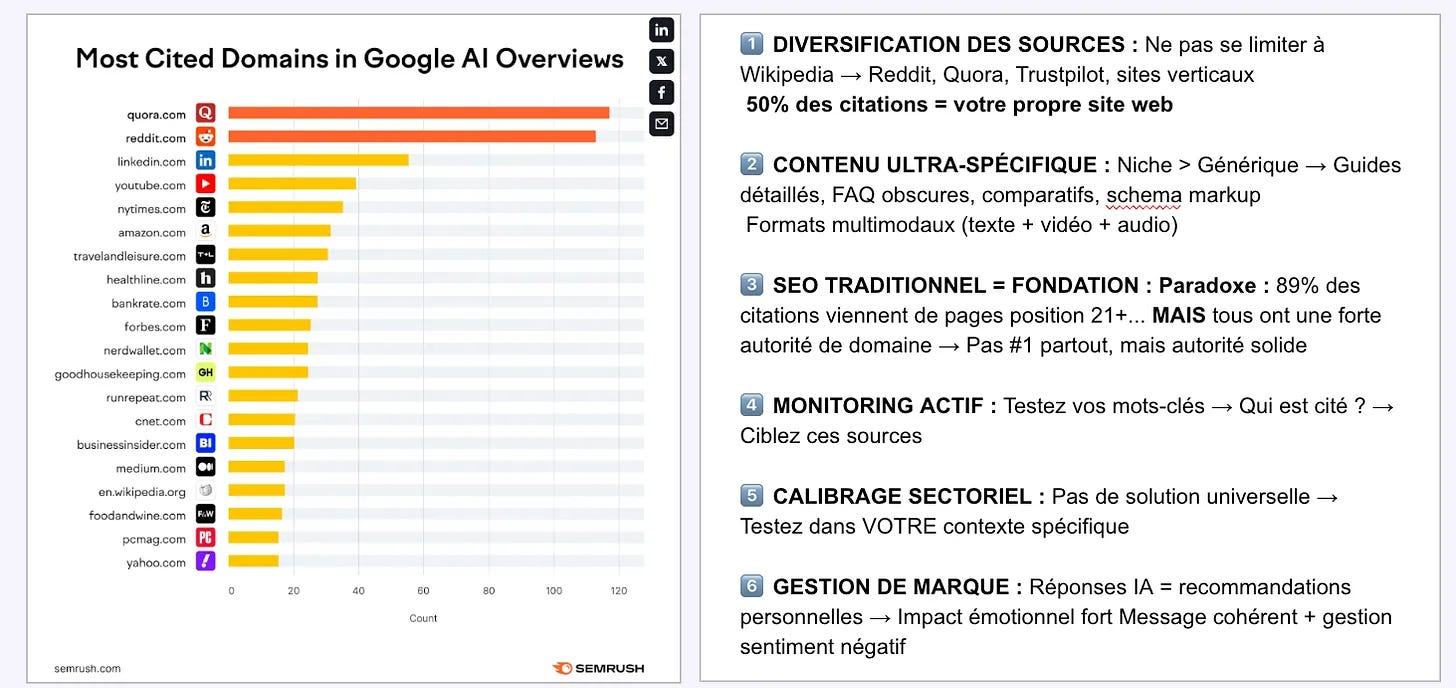
I synthesize here the essential principles, largely documented elsewhere, but I list them here anyway to help better understand the overall logic.
Accessibility and indexing: Your site must be perfectly readable and indexable by AI. The temptation to block robot access to protect your data proves counterproductive if you want to appear in AI Overviews. That’s why the Cloudflare solution—which proposes charging for AI bot access—isn’t as explosive as it seemed when it came out: most actors prefer to authorize indexing to maximize their chances of appearing in Google results.
Strengthen thematic expertise: As the query fan-out principle demonstrates, the more you cover a topic in depth—anticipating the various search intents and related questions of your users—the more you increase your chances of appearing in AI Overviews and other AI modes.
Optimize by relevant segments: Crucial point: AI no longer just seeks to evaluate a page’s overall quality, but identifies and extracts specific segments that best answer each intent detected in the query. The relevance of these micro-contents—targeted paragraphs—becomes determining. Each synthetic query generated by query fan-out must find its optimized answer in your content.
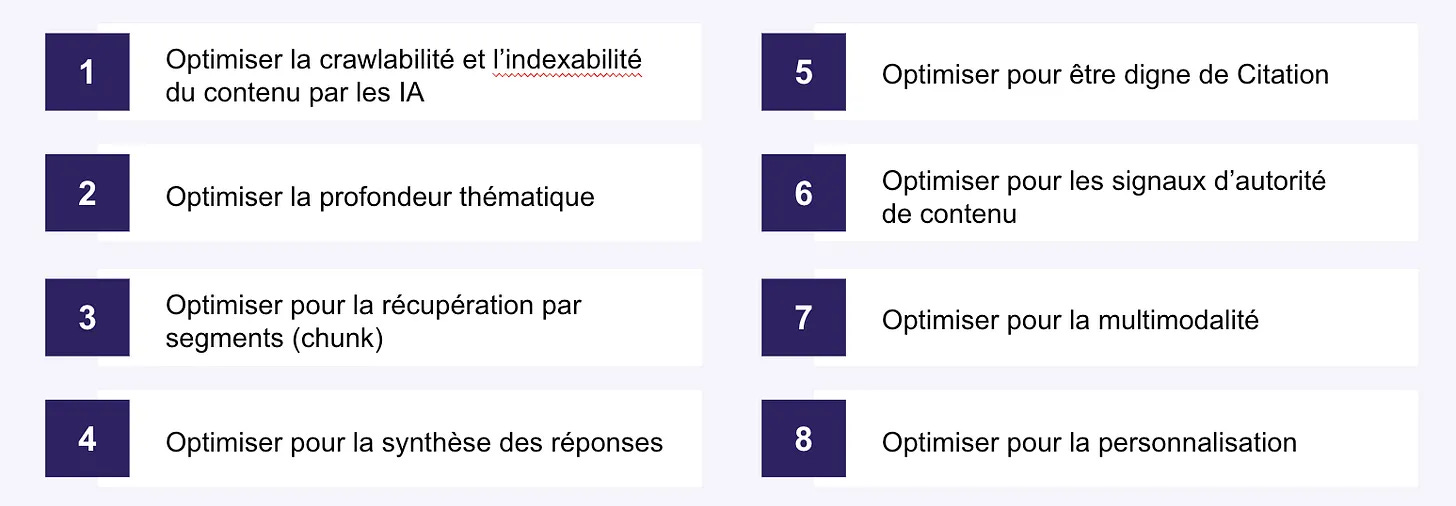
Facilitate AI’s work: Since AI becomes your first “salesperson,” make its job easier. Structure clear syntheses indicating what you want it to remember. Strategically integrate your identity keywords and brand name in this content. For local businesses, systematically mention your location. These elements must irrigate both your informational content and your institutional pages.
Multiply authority signals: Everything related to “citation dignity”—your legitimacy and credibility—must show through in your content: media mentions, expert and influencer contributions, respect for E-E-A-T criteria (Experience, Expertise, Authoritativeness, Trustworthiness). These authority signals considerably strengthen your positioning.
Adopt multimodality: Text no longer suffices. Visuals—infographics, diagrams, illustrations—must be perfectly integrated and readable by AI. Many tools facilitate this approach, which becomes absolutely essential in the current ecosystem.
Contrary to what we hear, blogs, far from being dead, simply deserve to be rethought. I talked about it in detail here.
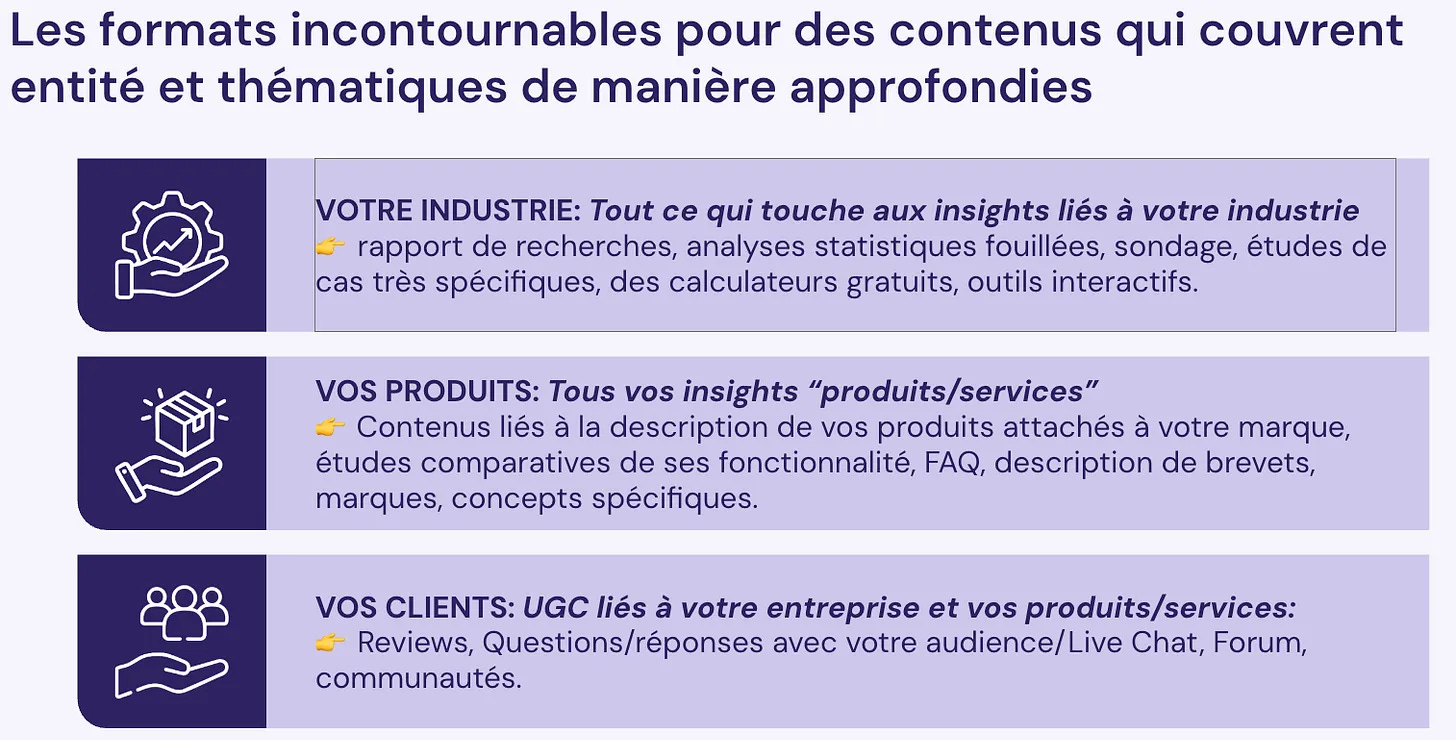
All content must be articulated around three central pillars: your industry, your products, and your customers. These three axes form the playing field for your AI Search content strategy.
The good news: a multitude of tools is now available to create original content and, in particular, the holy grail of foundational content: original research.
With a well-thought-out strategy upfront, you can create in a few days sector studies that would have previously cost a fortune.
Here are several ideas for you:
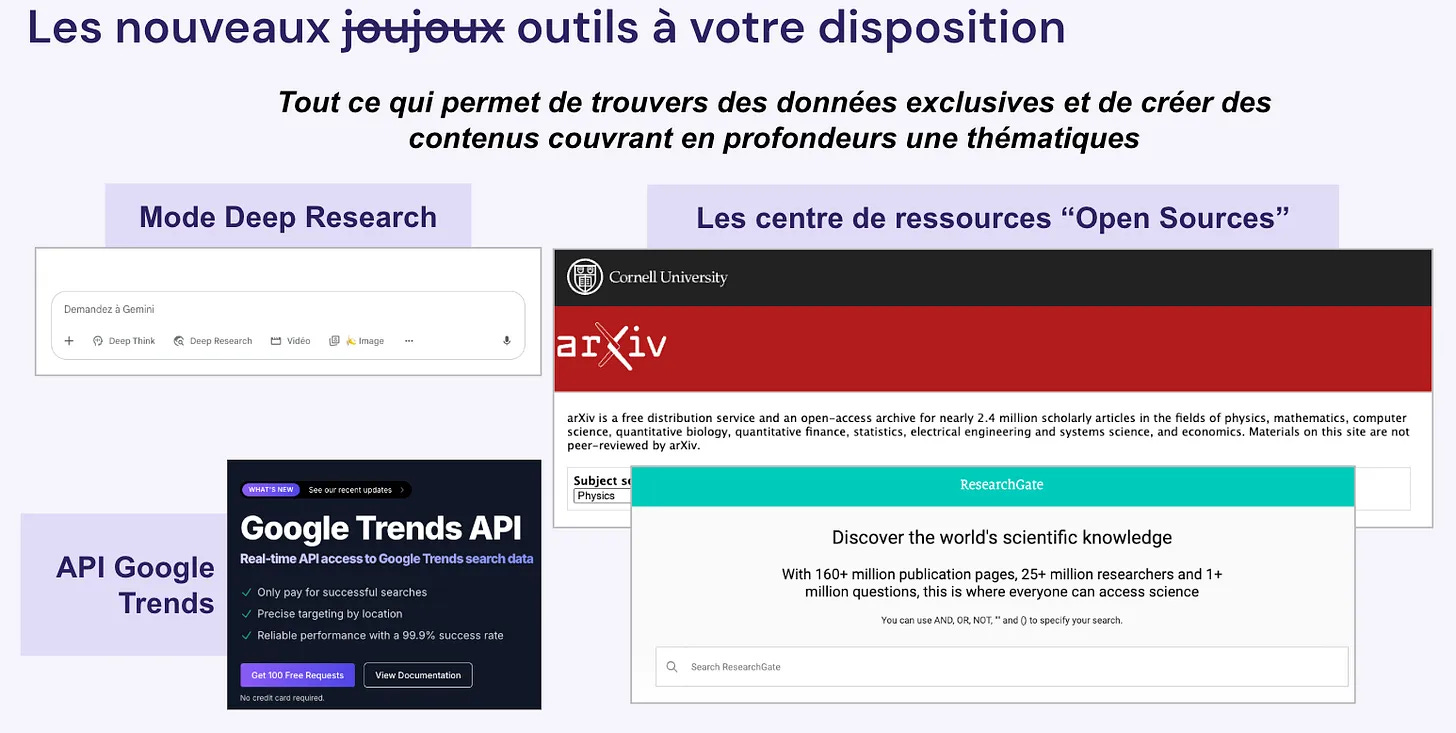
✅ Google is notably preparing the deployment of its Google Trends API, which will provide valuable data specific to your sector. Invest in in-depth research.
✅ Look at university sources. Let me explain: among the sources most cited by AI, two databases deserve particular attention:
ResearchGate: this platform gathers research from around the world and is among the most consulted and cited sources by artificial intelligence.
arXiv: less known but essential, this open archive hosted by Cornell University (an American Ivy League) publishes cutting-edge research. The first document on GEO was published there by students, demonstrating this resource’s value for documenting emerging trends.
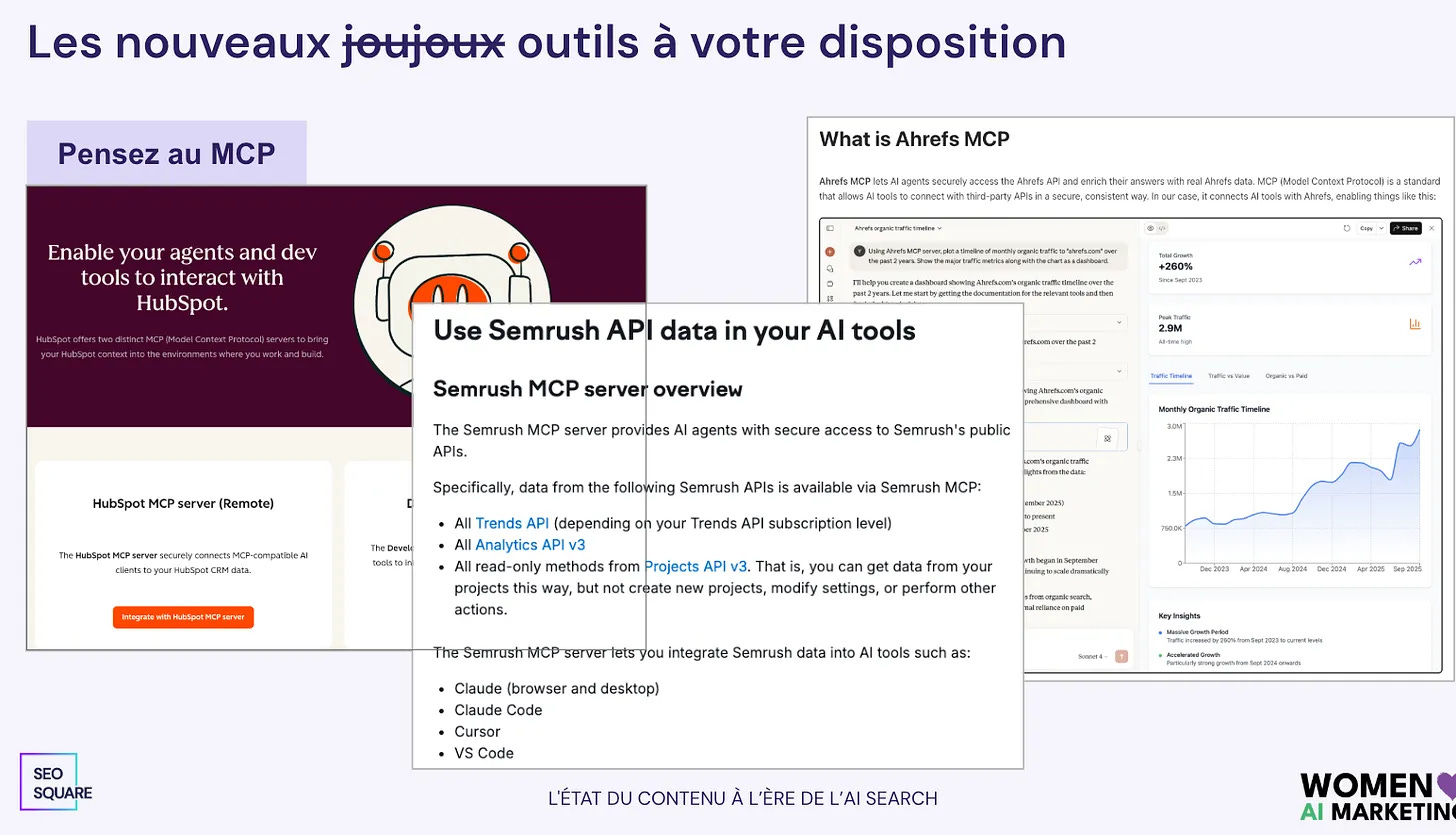
The Context Protocol transforms Google from a passive search engine into an intelligent executive assistant. Think of it this way: before, Google gave you links to information. Now, it can connect directly to your data and business systems and act on your behalf.
Example of use:
Before MCP: You search “e-commerce conversion rate Q4 2024.” Google lists 10 articles to read. You spend 30 minutes manually compiling your data and a bunch of time cross-referencing.
With MCP: You ask “Compare my Q4 conversion rates to sector benchmarks and identify improvement points.” Google accesses your Google Analytics, your CRM data, and recent market studies. You get an actionable comparative analysis in 2 minutes.
The fantastic impact: less time spent searching and compiling, more capacity to create ultra-personalized content enriched with your own data and ideas, without significant budget.
Several platforms have developed their own MCP (Model Context Protocol), notably HubSpot, SEMrush, and Ahrefs. Implementation requires some code but remains accessible. And you have at your fingertips a goldmine of data for WOW content!!
“Vibe coding”—or ambient coding—radically simplifies content and application creation. No longer need to develop line by line: just describe to an AI (like Claude, ChatGPT, or Cursor) what you want for it to generate it.
You say “create me a modern landing page for my SaaS product with a contact form” and 30 seconds later, you have a functional webpage. That’s vibe coding. You give the “vibe,” the intention, and AI builds.
You may not know it, but you’re certainly already using Vibe Coding tools without knowing it. Google has created several in recent months that are absolutely fantastic.
I’ll give you my favorites:
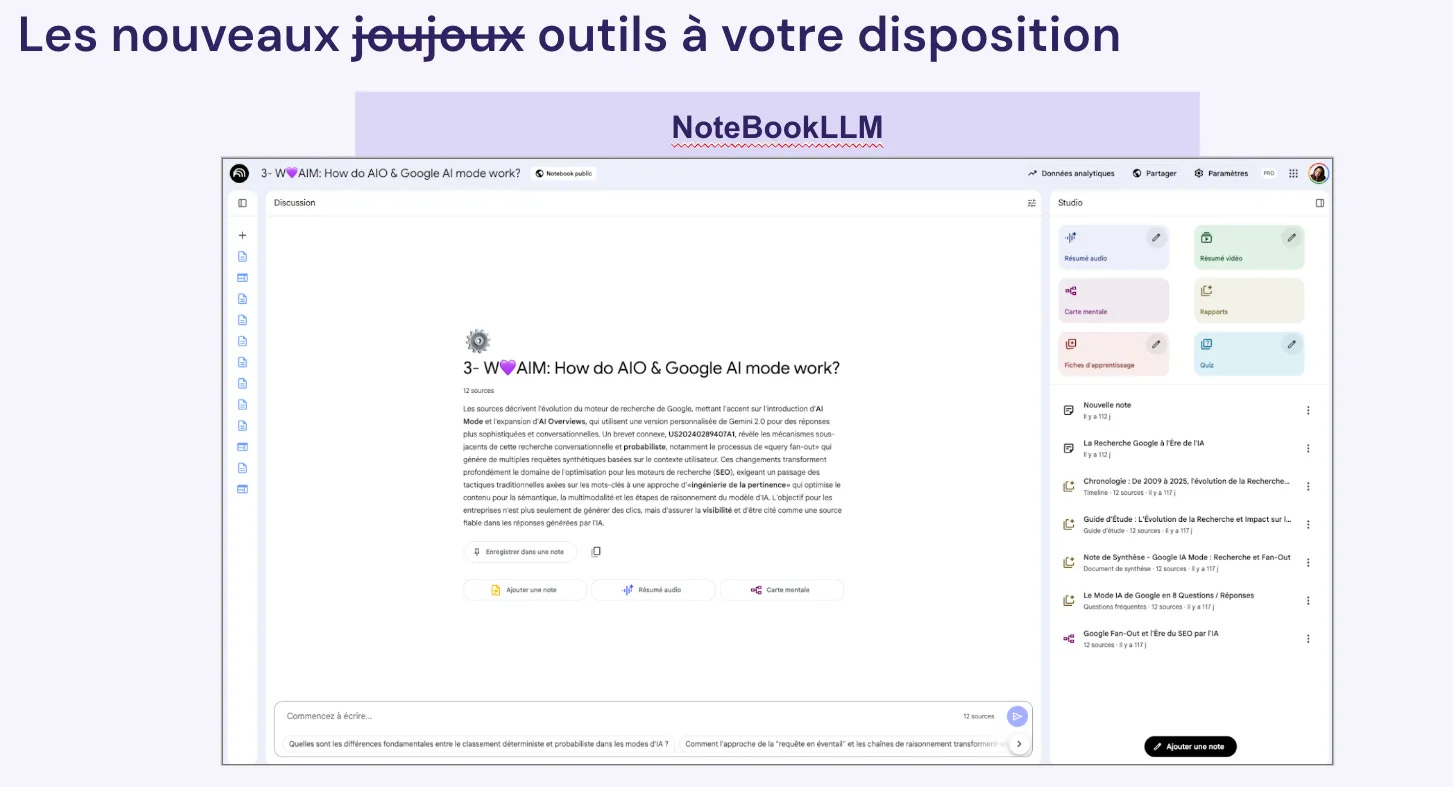
✅ Notebook LLM: the favorite tool for creating practically any type of content. It can replace or complement a blog and now allows generating videos and other formats. I’m an absolute fan. I’ve created tons for all my curation. I’m sharing this one which allows you to know everything about Notebook LLM precisely.
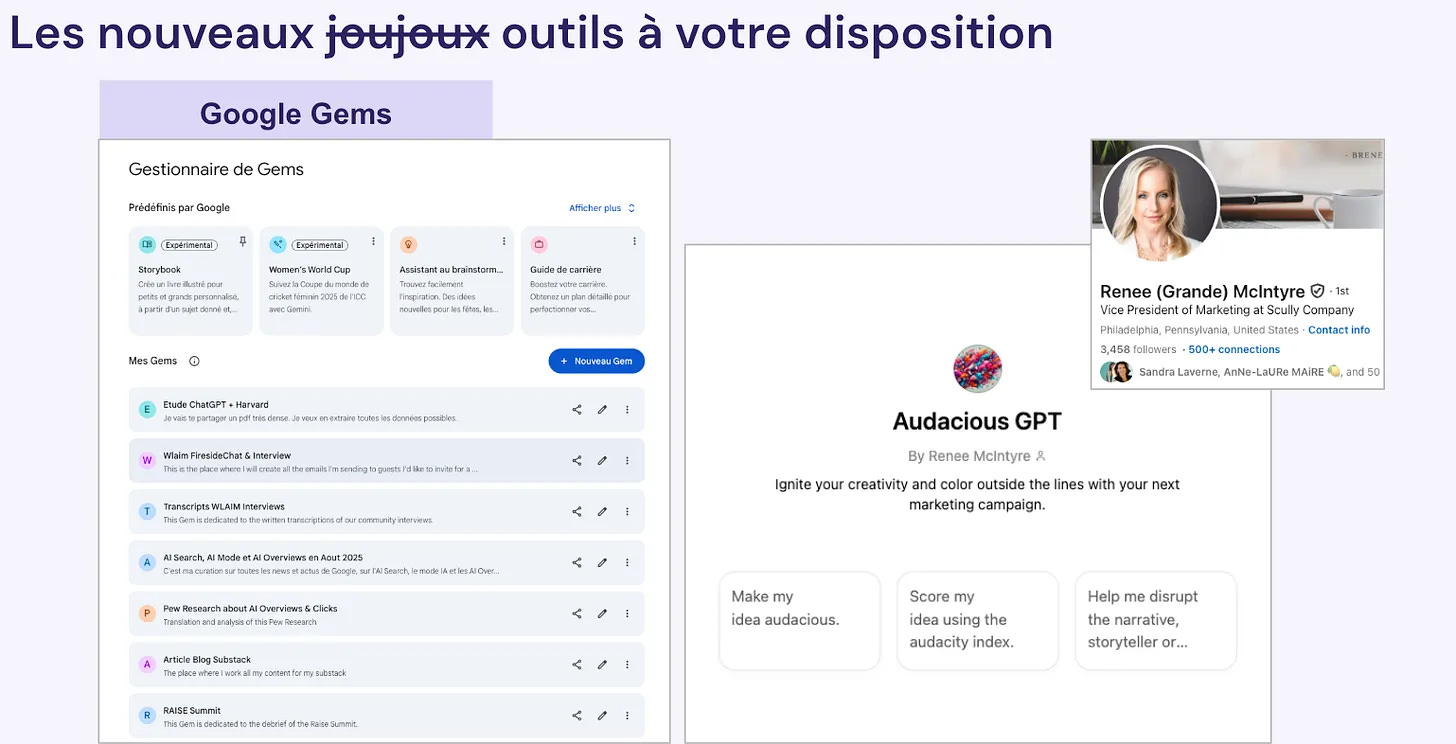
✅ Google Gems and GPTs: community members create remarkable GPTs based on reference works, offering extraordinary possibilities.
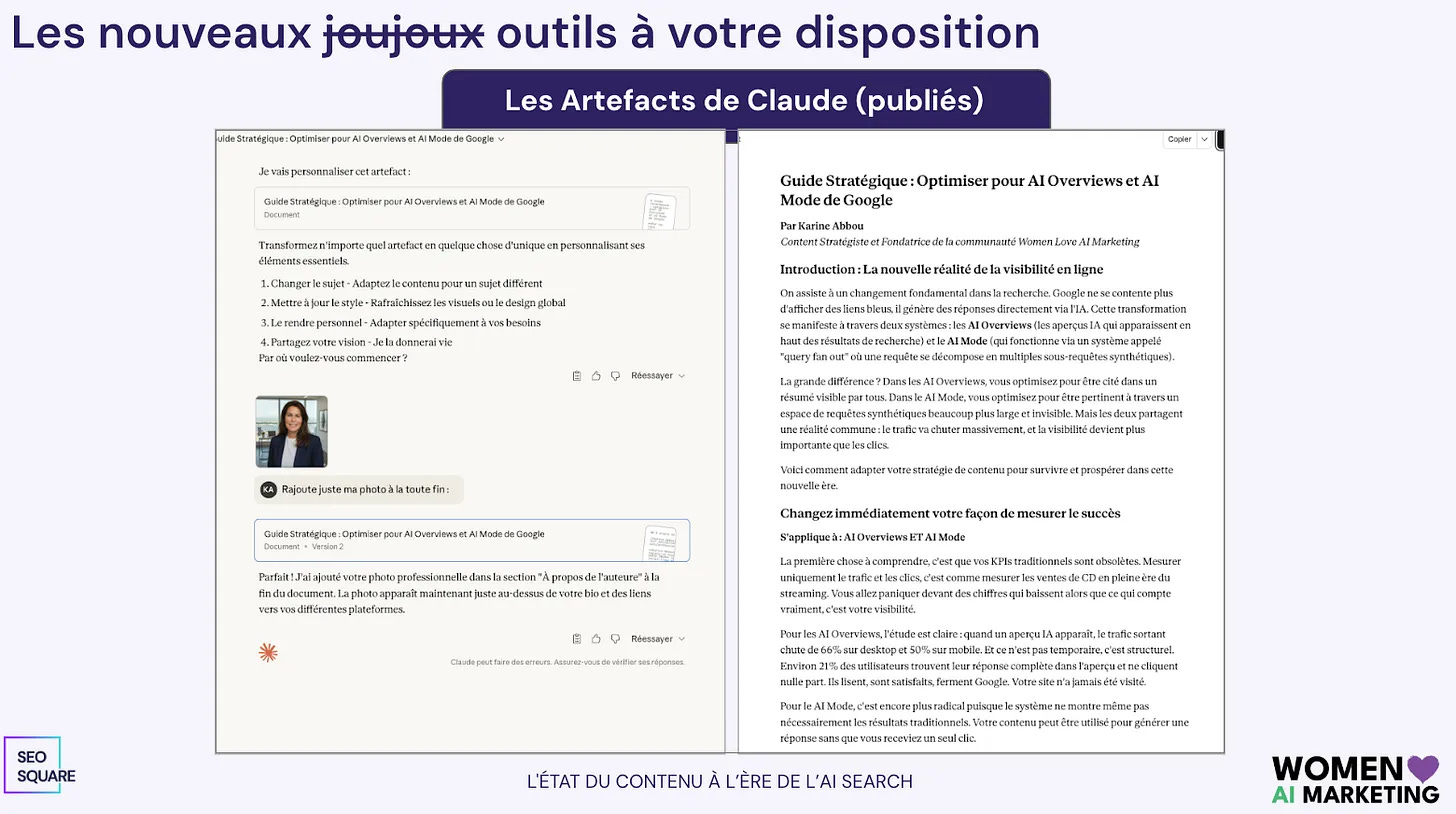
✅ Claude’s artifacts: widely adopted for their efficiency.
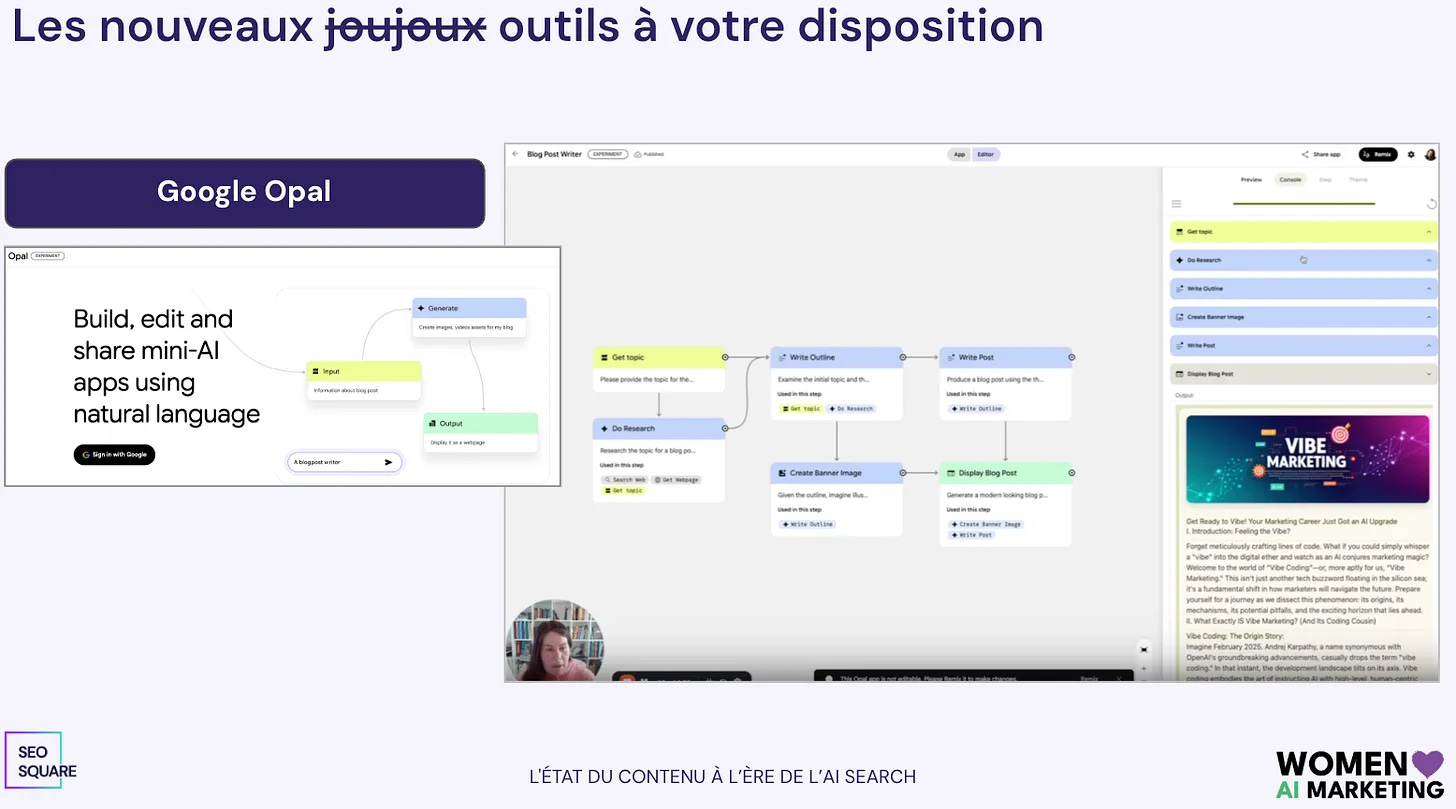
✅ Google Opal: a gem for juggling from one content format to another (from blog to video via podcast) all starting simply from a sentence that generates a tree structure. Opal being still in testing only in the US, I tested it for my community in a Loom.
🟣 I’m Karine. I help you adapt your content strategy to AI Search and GEO through a masterclass and a community focused on AI marketing. The next session of my GEO masterclass in english will be in May. Want to join?
No posts
Comments
Nothing yet. Say the first thing.
Sign in to join the conversation.