
Is the Size of AI Search Overestimated or Underestimated? Both.
Here’s Why.
Within the span of a few weeks, two major studies on online search behavior circulated through the American AI Search & SEO community. Two rigorous studies, two documented methodologies, two recognized authors in their respective fields. And conclusions that appear to contradict each other.
Rand Fishkin — founder of SparkToro, published on March 2, 2026, an analysis conducted with Datos on desktop search behavior in the United States.
→ AI tools account for 3.2% of searches. Google still dominates at 74%.
Conclusion: The hype around ChatGPT is disconnected from behavioral reality.
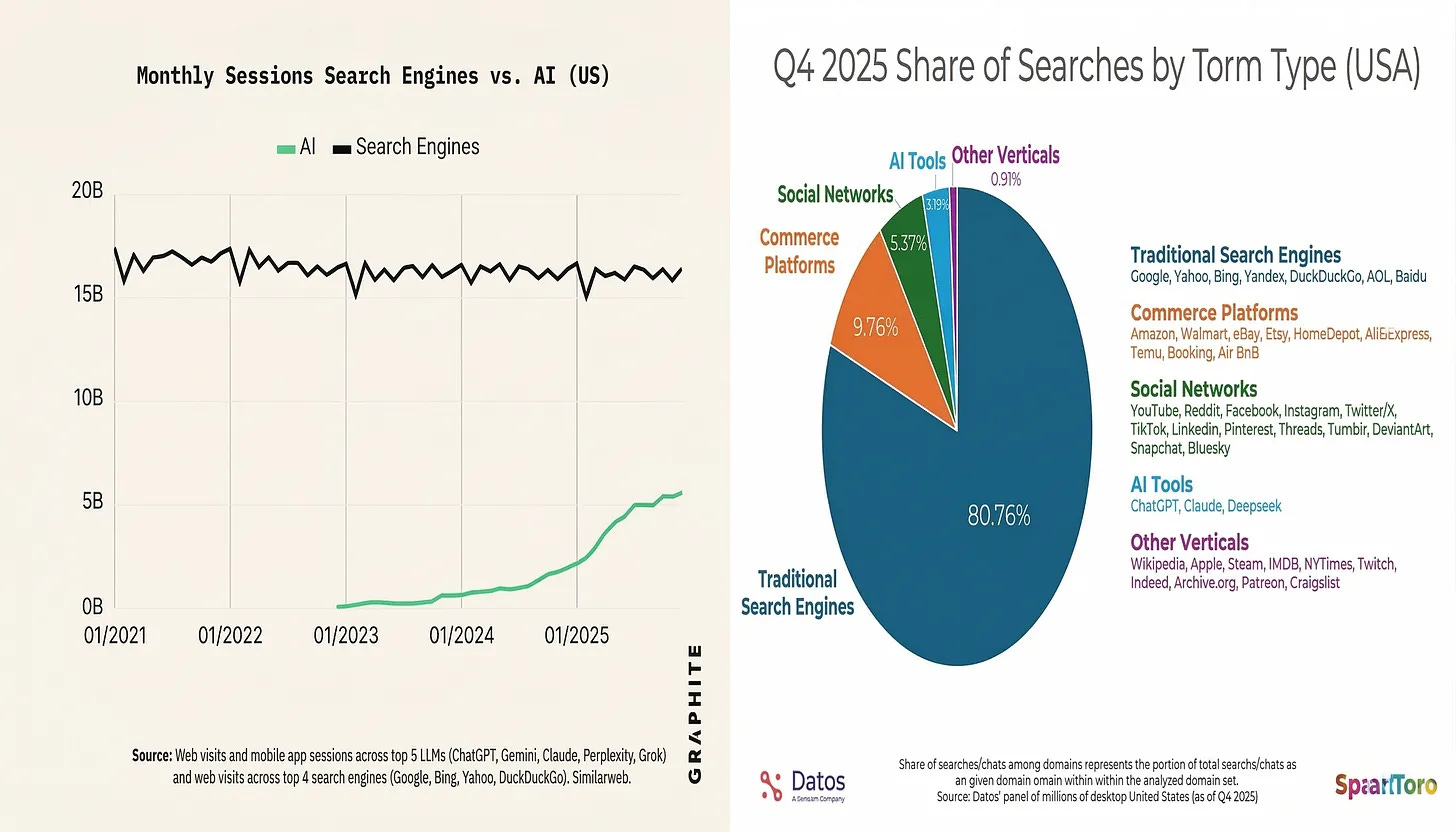
Ethan Smith — CEO of Graphite, an agency specializing in SEO and AEO (he is, incidentally, actively pushing to popularize the term AEO over GEO to describe AI Search) — published a study drawing on Similarweb data.
→ AI now accounts for 56% of global search volume and 34% in the United States. ChatGPT alone represents 20% of global search traffic.
Conclusion: AI is underestimated, not overestimated.
Both studies went viral.
They were read, shared, and hotly debated. Rand even commented on Ethan’s LinkedIn post, calling it “nonsense.”
Before diving into the details of each, let’s frame the two core questions at stake:
The more obvious one: What is the actual size of AI Search?
The underlying one: How do you select the right data to inform your AI Search strategy — and, by extension, make sound marketing budget allocation decisions in 2026?
Over the past two years, we have witnessed an explosion in the number of studies published on AI Search — from agencies, SaaS platforms, independent researchers, and media outlets alike.
The volume has become so significant that it is increasingly difficult to separate genuine data from marketing demonstration. Because behind every study, there is an author. And behind every author, there is an industry, a positioning, a business model.
This is not a value judgment. It is simply a reality we need to factor into how we read and interpret this data. Many of these studies are not worth retaining or analyzing in depth.
These two are.
I’ll break them down for you — decoding their findings, examining their limitations, and unpacking their disagreement — and, as always, I’ll share my 2 cents on the broader trend I draw from both the substance and the form of these two studies. Because taken together, in any case, they open the door to an increasingly fascinating debate.
Let’s get into it.
👉 Sparktoro study published on March 2, 2026..
For 25 years, Google was the gateway to the internet. Searching the web was synonymous with searching on Google.
Over the past two and a half years, Google has lost its monopoly on internet search. Other tools have entered the equation.
This does not mean the end of Google — it means the addition of new ways to search and new platforms on which to search. The second layering on top of the first, not replacing it.
The central question the latest SparkToro and Datos study set out to answer was one that matters to any marketer:
→ Where does Search actually happen on the internet in 2026?
From the outset, Rand Fishkin raises a framing question that cuts to the heart of the matter: if we call Claude and ChatGPT search tools, why wouldn’t we also call Instagram, YouTube, or Amazon search tools?
This is precisely the famous platform shift that Sundar Pichai never tires of referencing — and the inescapable constraint it places on us as marketers to perform the “platform dance,” given that every platform now operates its own proprietary algorithm.
Rand’s answer is unambiguous: search happens everywhere.
Calculating total search volume on the web requires including every single place where humans type queries to find information, a product, a service, or an answer.
Methodology:
The methodology is rooted in the annual analysis conducted with Datos, covering the 250 most visited sites in the United States and Europe.
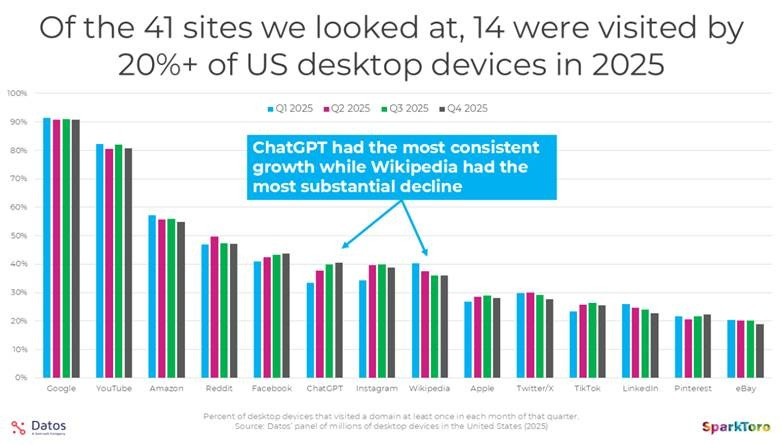
From those 250, Rand Fishkin selected 41 sites, divided into five categories — traditional search, commerce, social, AI, and other verticals.
Two immediate observations worth flagging upfront:
14 sites alone reach more than 20% of Americans,
and the analysis is conducted exclusively on the desktop.
The study aimed to answer four key questions:
Where does search happen on the internet?
How has the share of search evolved throughout 2025?
What is the difference between a “Visitor” and a “Searcher”?
How has the number of searches per user evolved in 2025?
The study’s baseline finding is unambiguous: ChatGPT is far smaller than commonly assumed.
Google remains responsible for nearly 74% of all desktop searches across the 41 domains analyzed in the United States, in Q4 2025.
The full breakdown of desktop search behavior is as follows:
Traditional search engines capture 80% of searches.
Commerce sites — Amazon, Walmart, Booking, Airbnb, eBay — capture 10%.
Social networks come in third at 5.5%.
And AI tools currently represent 3.2%.
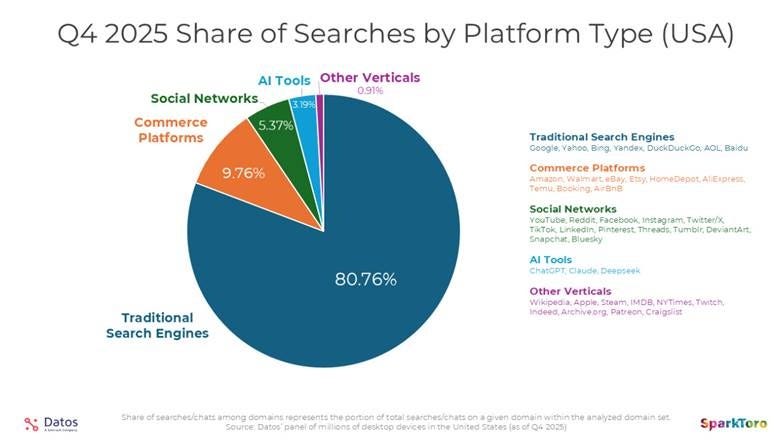
The numbers tell a story that is radically different from the surrounding AI hype.
The report highlights three major trends in traffic behavior:
First trend: the decline of Wikipedia. This is directly linked to the drop in traffic sent by Google. A complementary observation worth noting: Wikipedia is nevertheless massively cited within LLMs. ChatGPT in particular is the platform that scrapes Wikipedia most heavily. This is a perfect illustration of the current moment — less direct traffic, but more citations within AI tools.
Second trend: the rise of Instagram’s desktop traffic. Historically a mobile application with very limited desktop functionality, Instagram has firmly established itself on computers as well.
Third trend: ChatGPT’s growth followed by stagnation. What everyone had already identified.
But it is the fourth observation that is the most significant — and the least discussed. Even before ChatGPT, other domains are generating more desktop search activity:
Amazon — unsurprising.
Bing — more surprising.
YouTube — owned by Google.
These three platforms receive more desktop searches than ChatGPT, today, in 2025. And marketers have invested infinitely less in them than they have in LLM optimization over the past three years.
The collective obsession since 2022: being referenced in ChatGPT.
The result: Amazon, Bing, YouTube, and Google have been neglected in favor of a platform that, in real behavioral volume, remains marginal on desktop.
For Europe, the trends are broadly identical, with three nuances. Google is slightly more dominant there — approximately 5 percentage points higher than in the United States. Amazon, YouTube, and Bing hold somewhat smaller shares. And ChatGPT is used marginally more — about 1 percentage point higher — consistent with the strong adoption of AI tools across Europe.
The fundamental shift in search behavior is not a migration toward AI. It is a transformation in how we search. We no longer perform a search the way we used to. We inject prompts.
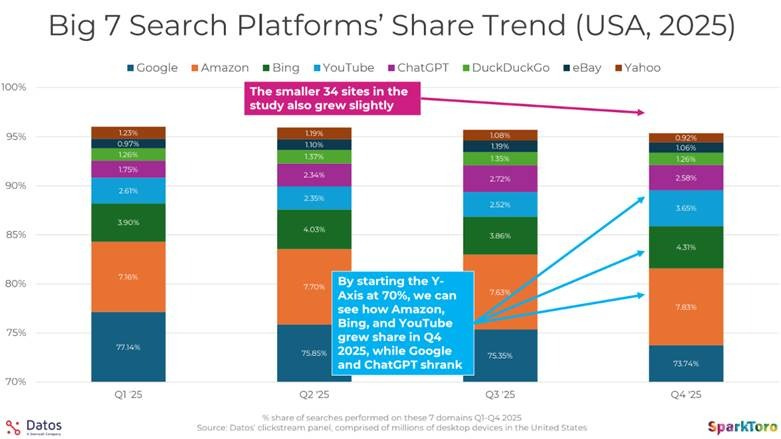
To analyze trends beyond Google — too dominant to allow a clear visualization of the other platforms — the axis was adjusted to start at 70% market share. Two distinct trends then emerged clearly.
First trend: the 34 sites outside the top 7 increased their share of search. This is counterintuitive. The conventional assumption is that the very largest sites become ever more dominant over time. Here, the smaller platforms gained ground. This is the inverse of the scenario most commonly anticipated.
Second trend: Google declined slightly, in favor of Amazon, Bing, and YouTube — all of which grew considerably. ChatGPT, meanwhile, also declined — and not by a negligible margin.
In Europe, the picture is slightly different: the top 7 is more stable, Google declined less, ChatGPT declined less, and the most striking growth belongs to Amazon.
This is perhaps the most important distinction in the entire study — and the one most frequently omitted from audience analyses.
The difference between a visit and a search.
A person who visits a site is not necessarily a person who performs a search on that site.
Many users arrive on a platform without ever typing a single query: the scrolling behavior — you land on LinkedIn or Instagram, you consume, you do not search.
Platforms where more than 70% of visitors perform a search include Google, DuckDuckGo, Bing, Craigslist, and Amazon. Logical — these are tools whose primary purpose is search.
The rate drops to approximately 50% for eBay and for ChatGPT.
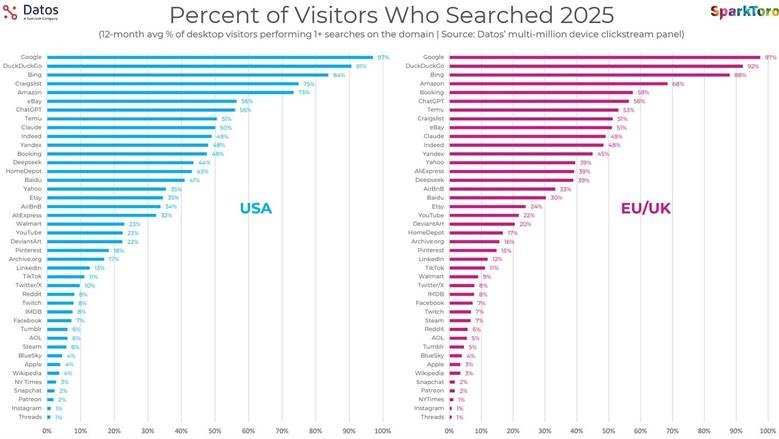
Why is ChatGPT at 50%? When you land on ChatGPT, nothing prompts you. You don’t see other users’ conversations. You are alone facing the chatbot — and if your intent isn’t already clearly formed before you arrive, you leave without having searched for anything at all.
Why is eBay also at 50%? Category browsing, auctions, sales tracking — everything is displayed immediately upon arrival. The user doesn’t need to search to find what they came to see.
Direct conclusion: using visits as a proxy for platform usage is a biased metric — particularly for AI tools. A visit and a prompt are two fundamentally different things. Analyses built on traffic data rather than actual prompts are actively misleading.
Rand Fishkin divided the 41 sites into three groups based on the volume of searches or prompts per user per month.
ChatGPT is the only AI tool in this group — and it dominates clearly within it. Google, DuckDuckGo, and Amazon also feature here. Only Bing experienced a slight decline over the course of 2025. The overall trend for this group is stable.
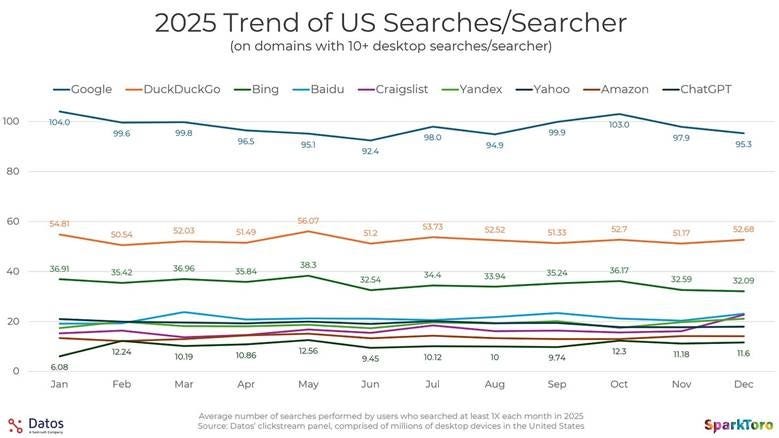
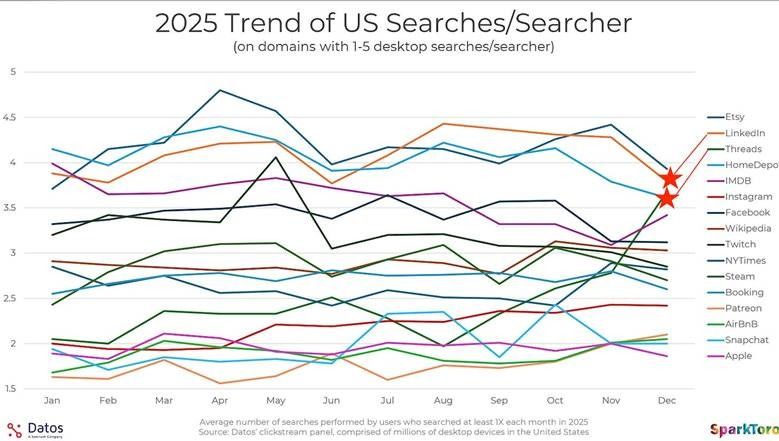
Two trends stand out sharply.
Pinterest is showing remarkable growth — already flagged in the Datos and SparkToro State of Search report. A platform not to be underestimated.
A steep decline for eBay, by contrast.
LinkedIn appears here, which surprises Rand Fishkin himself. He had expected it to be a more popular search destination. The explanation comes down to a single sentence: Google is more efficient for searching within LinkedIn and Reddit than their own internal search engines. Users don’t search on LinkedIn — they search on Google, and LinkedIn results surface from there.
A notable and unexpected data point: the growth of Threads. From roughly two searches per user to approximately four over the course of 2025 — a much more intensive usage pattern. In January 2026, Threads surpassed Twitter’s daily active user count on mobile.
👀 My Two Cents
1. — Search happens everywhere humans have intent. Going online is synonymous with “searching.” The marketer’s priority — since the very beginning of marketing — has always been to place their message where their potential buyers are looking. This is not new. What is new is that we had forgotten it.
2. — This is the conclusion that changes everything. Search is not a behavior. It’s a channel. Which means the real job is not to optimize for Google or for ChatGPT. It’s to identify where your audience searches — and to be there. Fishkin calls this Search Everywhere Optimization.
3. — We really need to stop with the tired (and frankly unfounded) “ChatGPT has killed / will kill Google” narrative. But the number does need refining. Google is still too often cited at 90% market share. That figure is wrong — or at the very least, incomplete. The study places it closer to 70%. And probably nearer to 65% in reality, since the 41 sites analyzed exclude all long-tail editorial properties that would mechanically bring that figure down further. In Europe, Google is more dominant than in the United States — around 80% — but still far from the 95% that traditional methodologies continue to report.
4. — Most AI searches are already happening on Google — not on ChatGPT. This is the least discussed point in the entire study. Even adding up every single ChatGPT, Claude, DeepSeek, and other LLM prompt combined, Google crushes them all. Why? Because 16% of its results now display AI Overviews. Google is not losing the AI battle. It is already, by a wide margin, the number one AI search engine in the United States and Europe. With one exception: France, where AI Overviews have not yet been deployed — which considerably changes the equation for the French-speaking market.
5. — The study assumes equivalence across all types of search queries. This is an acknowledged limitation, not an oversight. But it is precisely this point that Smith will attack — and which we unpack in the next section.
Graphite’s study on the size of AI Search draws on Similar web data, enriched with prompt intent data from an OpenAI study covering approximately one million messages.
It covers five major LLMs — ChatGPT, Gemini, Perplexity, Grok, and Claude — and six major search engines: Google, Bing, Yahoo, DuckDuckGo, Yandex, and Baidu. Other discovery surfaces — Amazon, social networks — fall outside the scope of this study.
Ethan Smith begins from an initial hypothesis that is the inverse of his conclusion. He originally believed that AI usage was overestimated. After analyzing the data, he concludes the opposite: previous estimates were significantly undervalued — sometimes by a factor of 4 to 5.
Because the majority of prior analyses only accounted for desktop web data — entirely omitting mobile.
Yet 83% of AI sessions worldwide take place via mobile applications. In the United States, that proportion is 75%. Comparing Google’s web visits with ChatGPT’s web visits while ignoring mobile usage is the equivalent of measuring half the phenomenon — at best.
Monthly AI-related sessions now represent 56% of global search volume and 34% in the United States. These figures are 4 to 5 times higher than previous estimates, which were based solely on web data.
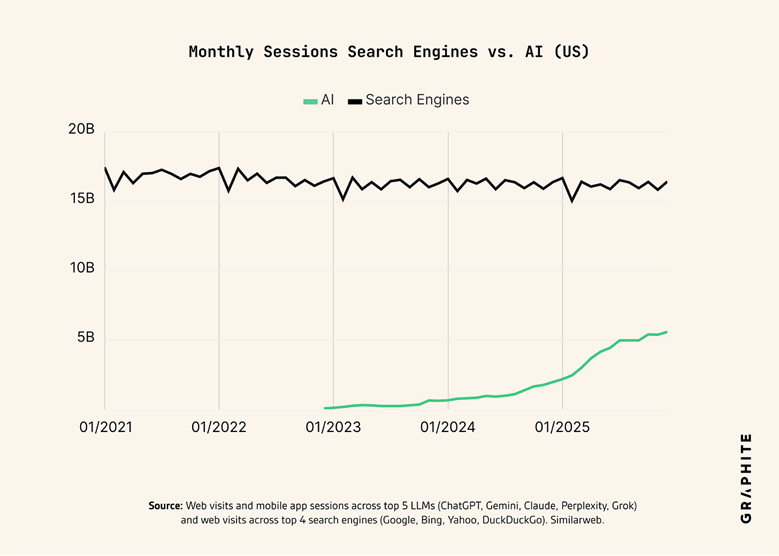
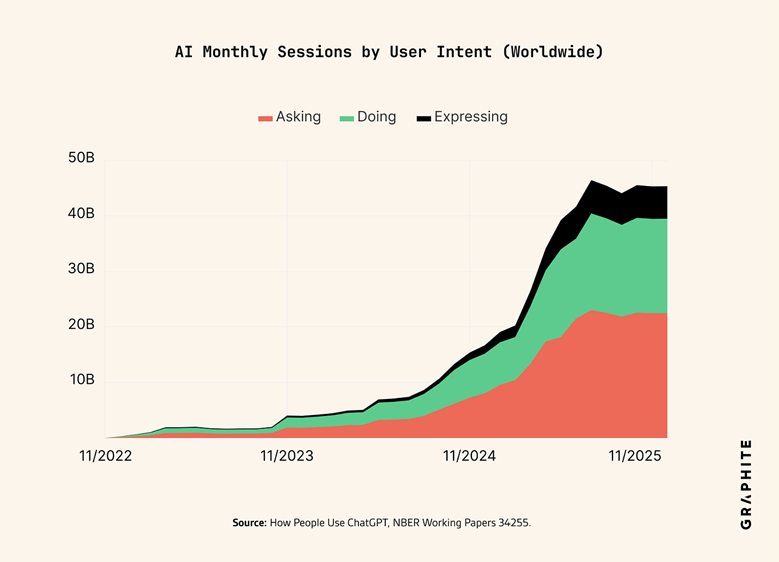
In absolute volume, AI totals 45 billion monthly sessions worldwide, of which 5.4 billion are in the United States.
But Ethan Smith makes an important distinction. AI usage related to search — meaning question-type prompts, which he terms “Asking” prompts — represents 28% of global search volume and 17% in the United States. Because not all prompts are the equivalent of search queries. According to OpenAI’s classification, only 52% of prompts are of the Asking type.
[INSERT VISUAL: Global vs. US AI Sessions — comparison with search volume — Similarweb data]
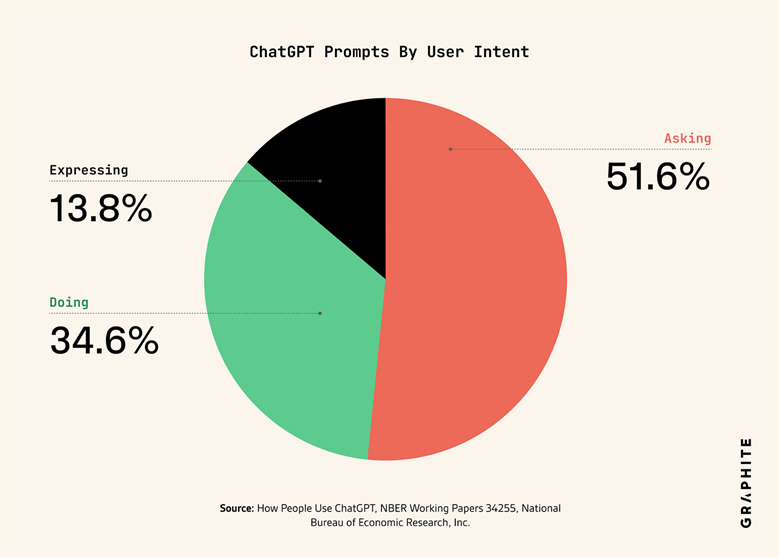
The OpenAI study on which Smith draws classifies prompts into three categories:
Asking prompts — seeking information or advice — represent 51.6% of usage.
Doing prompts — requests to execute tasks — account for 34.6%.
Expressing prompts — personal expression — make up 13.8%.
Only Asking prompts are relevant when comparing AI to traditional search. And even within this category, not all of them are interchangeable with a classic search query — some involve complex conversations or requests for advice that would never have been entered into a search engine in the first place. Smith acknowledges this directly in the study.
This is one of the most important conclusions in the study — and one of the rare points on which Fishkin and Smith implicitly agree.
Since the launch of ChatGPT, the overall use of search — traditional engines plus AI combined — has increased by 26% globally and 16% in the United States between Q1 2023 and Q4 2025.
Search is not dying. It is expanding. AI is adding to search rather than immediately replacing it.
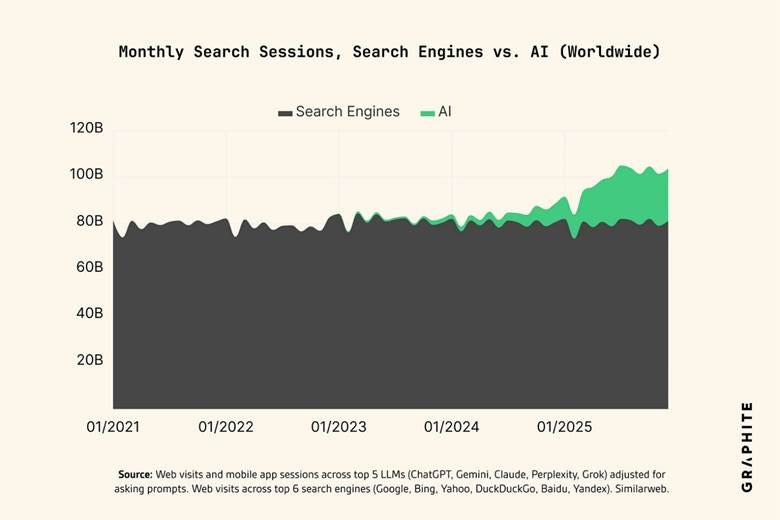
This follows the same logic as the arrival of mobile applications in 2008. At the time, Wired magazine ran a cover headline in September 2010: The Web Is Dead. Long Live the Internet. Mobile apps did indeed reach massive adoption. But the web never disappeared — the market simply expanded. Smith draws this parallel explicitly.
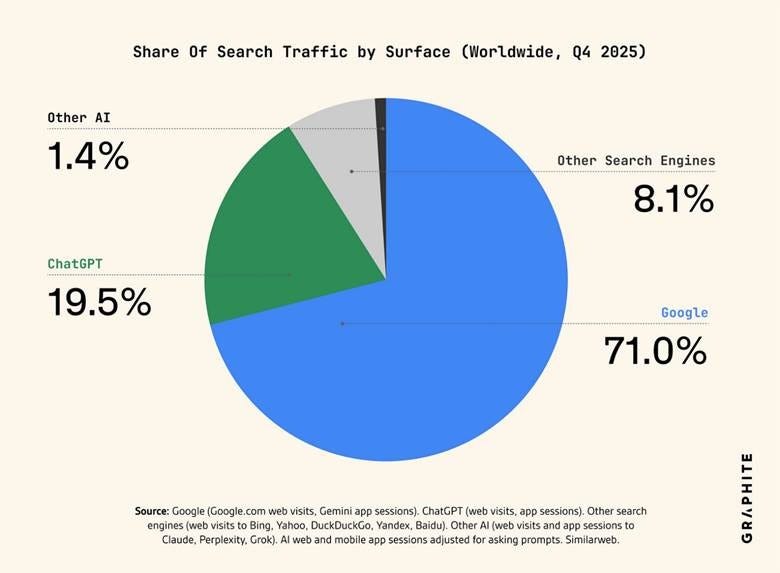
ChatGPT accounts for 89% of AI sessions worldwide and 86% in the United States. This represents near-total domination of the LLM market.
Against traditional search engines, the dynamic is real.
Google’s share of traffic would have fallen from 89% in 2023 to 71% by the end of 2025. ChatGPT would now represent 20% of global search-related traffic and 12% in the United States.
Global usage is more than 7 times higher than US usage alone. This figure deserves serious attention: the bulk of AI growth is happening in the rest of the world, not in the United States. At the global level, AI sessions have stabilized since July 2025.
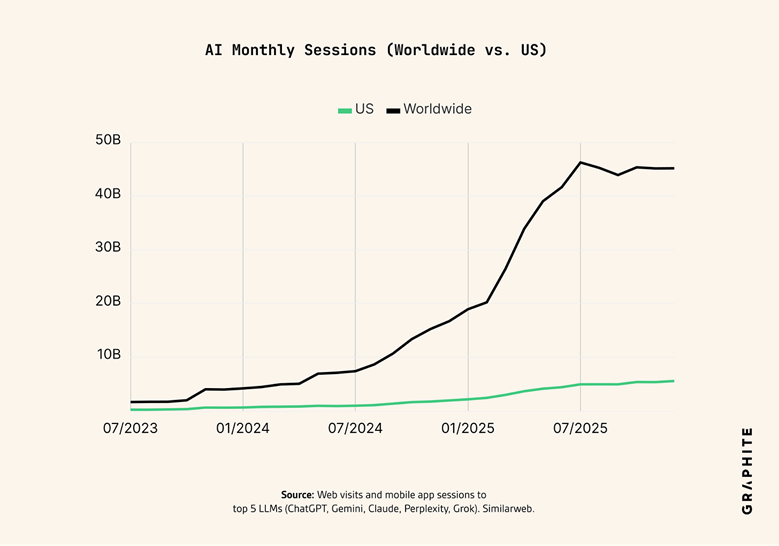
In the United States, however, usage continues to climb, with a 300% increase in December 2025 compared to December 2024.
The author is transparent about the limitations of his work. The correlation between Similarweb data and proprietary data — Google Analytics, Search Console — is very high for web data, with a median correlation of 0.86. However, Smith explicitly acknowledges that he is unable to independently verify the mobile data. This is precisely the point on which Rand Fishkin will intervene.
Following the publication of the Graphite study, Rand Fishkin responded publicly on LinkedIn:
“I don’t believe this data. It doesn’t match anything others have observed, the linked Google Doc cites neither an original source nor a methodology, and the 83% mobile figure seems dubious at best (and the only source appears to be Graphite, the agency itself). Sorry, but I have to say this looks like complete nonsense to me.”
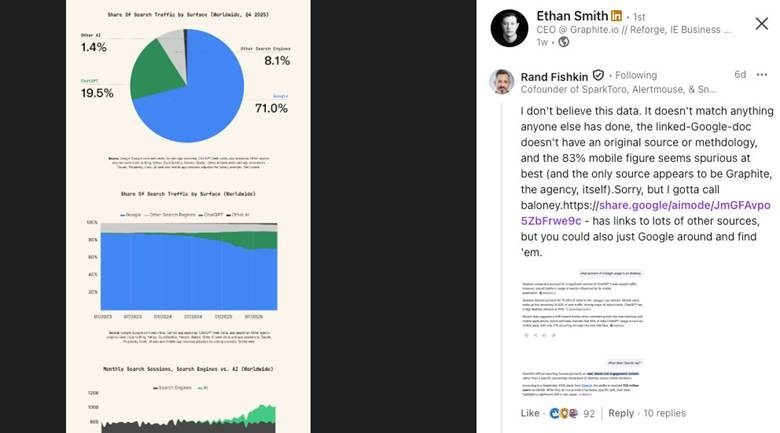
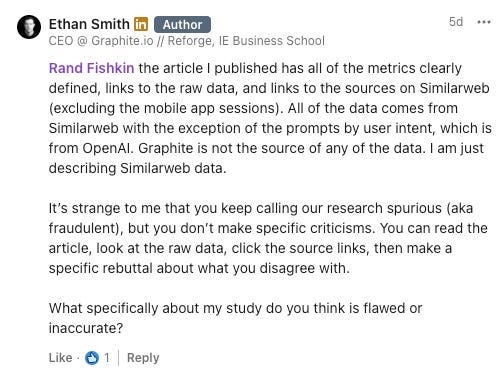
Ethan Smith responds:
“The article I published clearly defines all metrics, includes links to the raw data as well as to the Similarweb sources. All data comes from Similarweb, with the exception of queries classified by user intent, which come from OpenAI. Graphite is the source of none of the data. I am simply describing Similarweb’s data. I find it strange that you continue to characterize our research as dubious — or even fraudulent — without formulating any specific criticism.”
The End of the Saga — With a Further Response, dated today, March 17.
Ethan Smith subsequently published a detailed response to these criticisms. In it, he offers two clarifications that merit close attention.
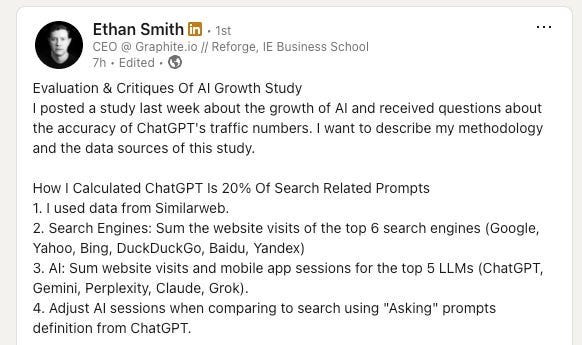
Rand Fishkin had initially used ChatGPT’s American MAUs (Monthly Active Users) to challenge global figures — a scoping error he himself acknowledged and corrected. This does not change the substance of the disagreement, but it does temper the force of the critique.
Ethan Smith acknowledges that he did not fully account for Google’s mobile app usage in his calculations. This is potentially significant — if Google’s mobile usage is underestimated, the share attributed to AI in his figures could mechanically be overstated. He indicates he is working on an updated version.
The tension between these two studies is real — but misframed.
Those two studies don’t contradict each other. They are just not measuring the same thing. The problem is that they are presented — and perceived — as directly comparable.
The SparkToro study analyzes desktop only. Explicitly. Its scope: 41 sites, desktop behavior, Q4 2025. Result: AI represents 3.2%.
The Graphite study incorporates both web and mobile applications. And this is where the numbers explode: 83% of AI usage takes place via mobile. By excluding mobile, you exclude the majority of real-world LLM usage. Graphite’s result with mobile included: 56% of global search volume.
Rand Fishkin contends that the source of the 83% mobile usage figure is Graphite itself. In other words: the author of the study would be his own source on the single most decisive point of his entire argument.
Smith’s response: all data comes from Similarweb, not from Graphite. Graphite is merely describing Similarweb’s data.
Similarweb’s mobile data cannot be independently verified. Something Ethan Smith himself acknowledges in the methodology section of his study. The correlation with Google Analytics and Search Console applies only to web data — not to mobile sessions.
The SparkToro study only counts behaviors where a user actually types a query on a platform. It distinguishes between visit and prompt, and shows that only 50% of ChatGPT visitors actually perform a search.
The Graphite study starts from total AI sessions, then applies a filter: Asking prompts represent 52% of all prompts according to OpenAI. Even these prompts are not all interchangeable with a classic search query — Smith acknowledges this — but he uses them as a proxy.
The Scope of Platforms Analyzed
The SparkToro study analyzes 41 sites including Amazon, YouTube, Bing, Reddit, Pinterest, and Threads. It encompasses the full spectrum of search behavior on the web. Result: AI represents 3.2% of a very broad market.
The Graphite study compares only 5 LLMs against 6 search engines. It explicitly excludes Amazon, social networks, and other discovery surfaces. Because its reference market is narrower, the share attributed to AI is mechanically higher.
The Points of Convergence Between the Two Studies (Unspoken)
Both studies agree on one central point that nobody cites enough. The core of the demonstration.
Search is not dying. The market is expanding.
The SparkToro study shows that Google remains dominant but that alternative platforms are gaining ground. The Graphite study quantifies overall search volume growth at +26% across both engines and AI.
This is not AI v/s Traditional Search. It’s :
What is the real size of AI in this new landscape, how do we measure it — and above all, what is the strategic importance of knowing this number when designing your own content strategy?
Understand the subtext:
Does it actually make sense to invest your marketing budget in this AI Search that everyone is talking about — but that very few people truly know how to evaluate and measure?
And then, the question within the question:
How do you sort through the data — identifying what is reliable enough to inform your content strategy and guide where you invest your €€€/$$$ — versus what is noise?
Both questions are worth asking.
Why?
→ From a brand perspective, publishing original research that leverages your proprietary data is one of the most effective content formats for standing out from the “AI slop soup” that AI itself despises — and it is the dream content format for being sourced by AI, positioning your brand as trustworthy, with sufficient authority and legitimacy for AI to recommend you. This is what I call creating “WOW content.”
→ From a marketer’s perspective, knowing how to read these studies — and sort the genuinely objective content that truly informs a trend worth factoring into your content strategy (and therefore your budgets) from the irrelevant — is a real and pressing skill.
Over the past two years, I have never witnessed such a proliferation of studies on AI Search.
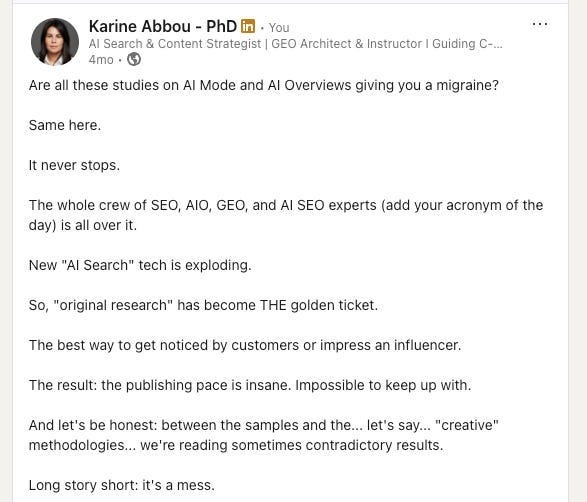
Semrush, Conductor, SparkToro, Graphite, Webflow, Brightedge, BrightLocal — and many more. Dozens of tech brands and marketing agencies are publishing reports, analyses, and benchmarks. Especially since AI Search and GEO are already considered multi-billion dollar industries after just a few years of existence.
I have been tracking AI Search’s pulse every single day for nearly three years, and the volume of my Notion curation is growing at a staggering pace and speed. The rhythm is accelerating. Genuinely.
And with it, the risk of confusing data with demonstration.
Because behind every study, there is an author. And behind every author, there is a positioning, an industry, a business model. This is not an accusation. It is a reality that every informed reader must factor into how they consume this content.
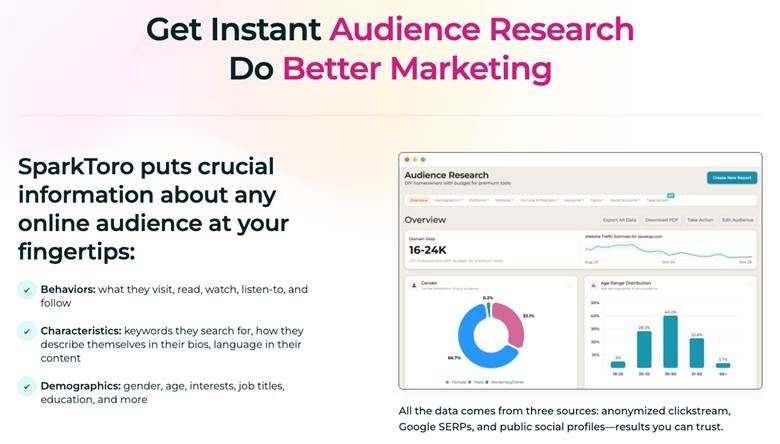
The SparkToro study builds a precise argument: AI Search is not synonymous with exclusive optimization for LLMs. It is synonymous with Search Everywhere Optimization. Its central conclusion is both powerful and correct: search is not a behavior, it’s a channel. What this means in practical terms is that before investing in optimizing your presence within AI tools, you need to analyze where your audience actually spends its time. And that audience does not necessarily spend its time in LLMs — it may spend its time on YouTube, on Amazon, on Pinterest, on Threads. Rand Fishkin founded SparkToro, an audience intelligence tool designed precisely to answer this question: where does your audience live online?
The Graphite study moves in the opposite direction.
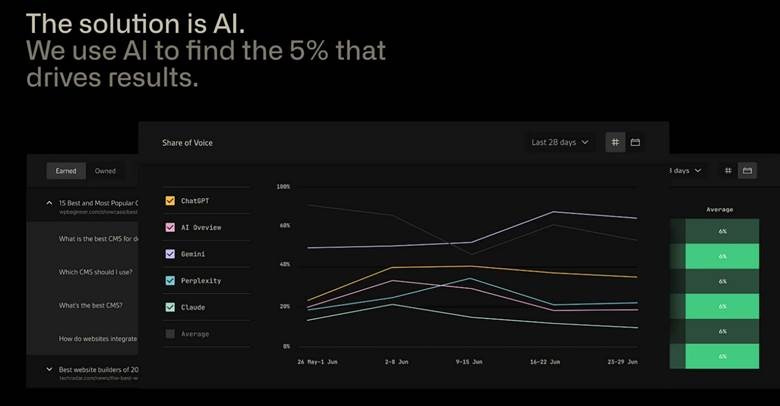
The agency has positioned itself as one of the most advanced players in optimizing brand presence within AI agents and answer engines. Its expertise, its business model, its reputation are all built on the conviction that AI Search is the immediate future of digital marketing. AEO is the solution.
Regardless of which figure you adopt — 3.2% or 56% depending on the methodology — one conclusion transcends the debate:
Search is not a behavior. It’s a channel. And AI Search is simply one more — with its own rules, its own audiences, its own visibility mechanics.
What this means in practical terms for marketers is a hierarchy of decisions — not a checklist of platforms to tick off.
Andy Crestodina, founder of Orbit Media, describes precisely what has changed:
“A new layer has been placed on top of the internet. Not a replacement. An overlay. And exploring this layer is a tremendous additional opportunity for marketers.”
His reading of the transformation is surgical.
Informational traffic has collapsed: Google’s AI Overviews answer directly. LLMs do too. For a large portion of informational queries, the answer is already there, on the page, with no click required. Discovery content marketing — the idea that a blog post generates massive organic discovery — is over, or nearly so.
Content remains indispensable: for emails, for social networks, for sales teams, for existence and for being cited. But it no longer generates the mass traffic we once knew it for.

→ Appearing in an AI response for a query with commercial intent is one thing.
→ Being recommended is another. And that is what matters now.
Because the prospect does a large part of their deliberation inside the model — within the generated responses — before ever landing on a website.
What this produces is measurable: conversion rates from ChatGPT are meaningfully higher than those from Google. The prospect arrives warm, qualified, often already decided.
Regardless of the channel — Google, AI Overviews, ChatGPT, Claude, Copilot, Gemini — the job remains the same: be present, feed it, be recommended.
Being present everywhere your audience searches no longer serves only to be found by humans. It also serves to be ingested by AI models.
LLMs don’t only scrape websites. They scrape Reddit, YouTube, LinkedIn, specialized forums, niche communities, public databases.
Wherever content exists and carries authority, AI absorbs it. This means a brand present on YouTube with authoritative videos in its sector is not only optimizing for YouTube. It is also feeding the models that will recommend it tomorrow in their responses.
The existing internet — with all its platforms, communities, and formats — is becoming the training and citation ground for AI models.
Multi-platform presence is therefore no longer purely a reach strategy. It is an AI algorithm-feeding strategy.
The question is no longer just “where does my audience search?” but “where does my audience search AND where will AI models draw from to recommend me?”
In many cases, the answer is the same. Which makes the multi-platform presence strategy doubly profitable — immediately for humans, structurally for the models.
Audience knowledge is the single foundational building block that will transcend every era and every major disruption of the web and marketing at large. On the web or off it, before the internet or after, with Google or with LLMs — marketing and sales are simply impossible without it. This is not a conviction. It is a constant. It existed before the internet. It will exist after generative AI. It will survive every technological disruption because it is not a technique. It is a principle.
Before launching an AI Search strategy or chasing citations in LLMs, analyze your audience: does my specific audience actually live there? Not the global audience. Not the aggregated figures that vary by a factor of five depending on the methodology. The audience of your sector, your market, your product. If it is on YouTube, on Amazon, on specialized forums — that is where you need to be visible first. And that is also where AI models will go to draw from.
The desktop data makes it clear: Amazon, Bing, and YouTube receive more searches than ChatGPT.
These are three surfaces where marketing investment remains far below the actual audience volume. For a brand whose audience spends time on these platforms, this is a direct opportunity — often far less competitive than LLM optimization. And as a bonus: these are also sources that AI models cite massively.
16% of Google results display AI Overviews. Google is already, by a wide margin, the largest AI search tool in volume. Optimizing for AI Overviews — and therefore for AI search — means optimizing for Google first. Your SEO fundamentals remain relevant, even if they are no longer sufficient on their own.
With one exception: France, where AI Overviews have not yet been deployed — which changes the equation considerably for the French-speaking market (unfortunately).
ChatGPT traffic converts better than Google traffic. The prospect arrives warm, qualified, often already decided — research done inside the model before they ever land on your site.
If your audience is in LLMs, being recommended is not optional. It’s a priority.
But being recommended NOT EQUAL as being cited. The real stakes are no longer visibility — they’re active recommendation. And that changes everything about the content you need to create.
No posts
Comments
Nothing yet. Say the first thing.
Sign in to join the conversation.