
👋 Quick aside before this month’s edition (dense, again…).
Today is my birthday 🎂, and for once, Google I/O isn’t happening on May 14th. Birthday gift to myself: no screen today. YAY!!!
I’m using May 14th anyway to invite you to join the community my friends and I launched two years ago: Women Love AI Marketing.
I won’t rehash the whole story. At the pace AI is moving, it’s become a group of girlfriends (men welcome too, upon referrals 😉) working in marketing — directly or indirectly — and trying their hand at AI like everyone else. Sometimes with great wins, more often with a few headaches.
If I had to sum it up: we’re a group of marketers with direct, fast access between France and the US — because I live in the US, I work there, and some of my dear American friends are genuine marketing rock stars, brilliant at applying AI to their craft. They’re part of the group too.
We share our tests, our prime content, our AI struggles. Every month: community chats, conversations, business referrals, and private sessions with American stars (sometimes French) of AI, marketing, and content. Plus two years of content on Circle — real stuff.
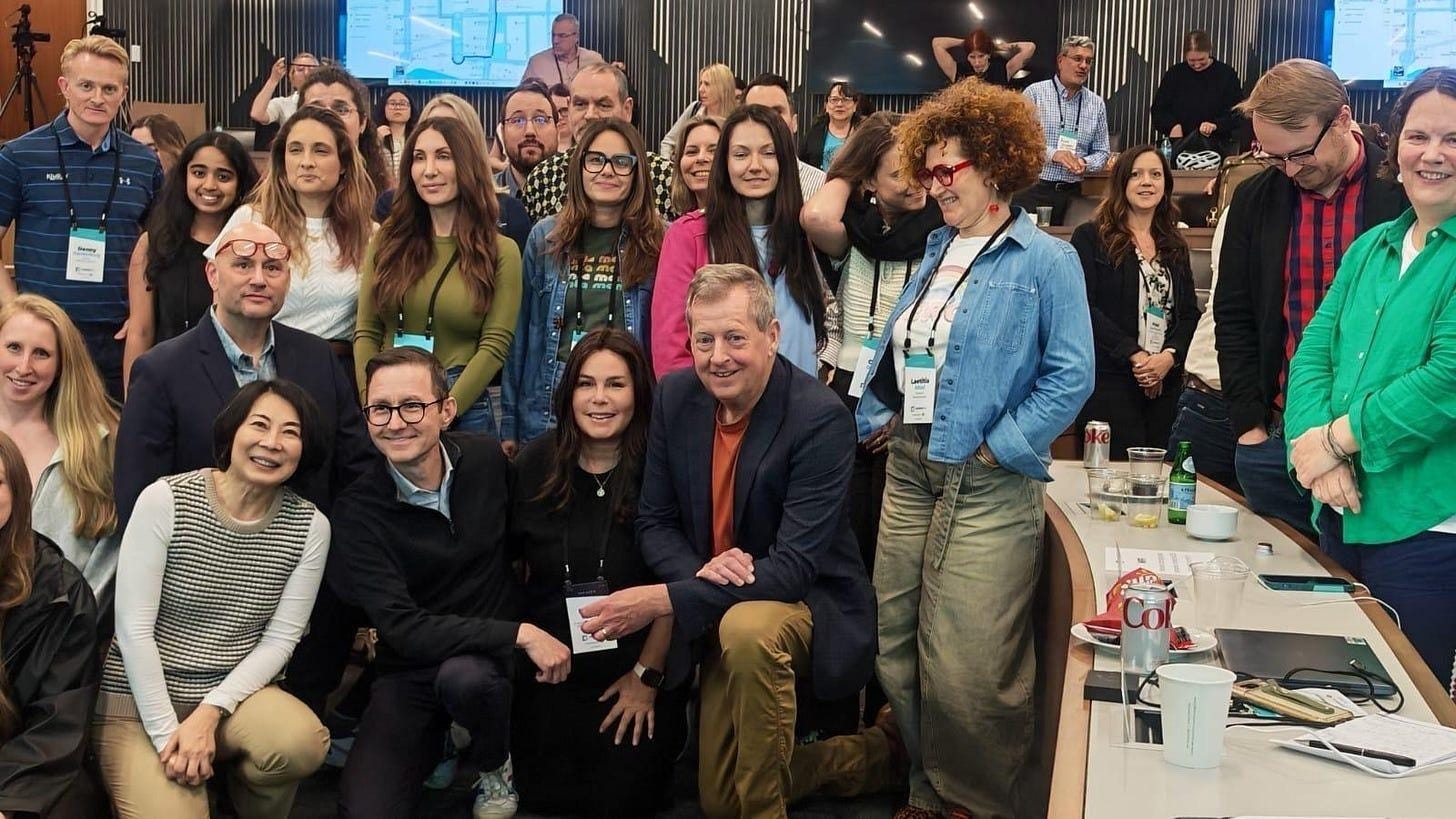
Some of us have organized dinners in Paris. Recently, we met up in Chicago where I was running an AI Search workshop with the one and only and awesome Andy Crestodina. Unforgettable (group photo below with my friend Pam Didner and John Jantsch👇).
So. We’re evolving.
We’re opening the doors: the WhatsApp group and a good chunk of our Circle content are becoming accessible. Mostly free, the rest à la carte (you buy what interests you) — demos, tools, masterminds, experience sharing. And those who want to share their experiments, demos, or tutorials will be paid by the community too 😉.
If that speaks to you, it’s right here 👇. We review every application.
One requirement only: at least 5 years of marketing experience.
Besides that, come as you are — evening gown and Jimmy Choo, or flip-flops with watermelon and chia seeds after a Pilates session, both work.
We’re waiting for you 💜.
Here we go with my selection of the best AI search tactics , tools , strategies , and stats to help you design your content strategy in the age of GEO. Like every month:
🟣 Top searches & data – AI Search stats to help you design your strategy
🟣 The AI Search tech corner – A “ugh” term from the tech side of AI Search
🟣 Search Everywhere Optimization – Beyond Google
🟣 GEO Strategies – GEO strategies for your Executive Committee
🟣 GEO Tactics – Field tactics from top experts
🟣 Reading of the month – The content that everyone is talking about
🟣 SEO vs. GEO – The naming war continues
🟣 AI Search Tools – The tools that matter ( mostly free )
Go! 👇 .
Josh Blyskal (Profound) finally answers THE question everyone was asking but not saying. To do so, he analyzed several billion logs, tracking approximately 900 new marketing pages back to their first mention in ChatGPT and Claude. The numbers:
6.81 days in median (50% of pages are cited before this deadline)
18.68 days for 75% of the pages
37.10 days for 90% of the pages
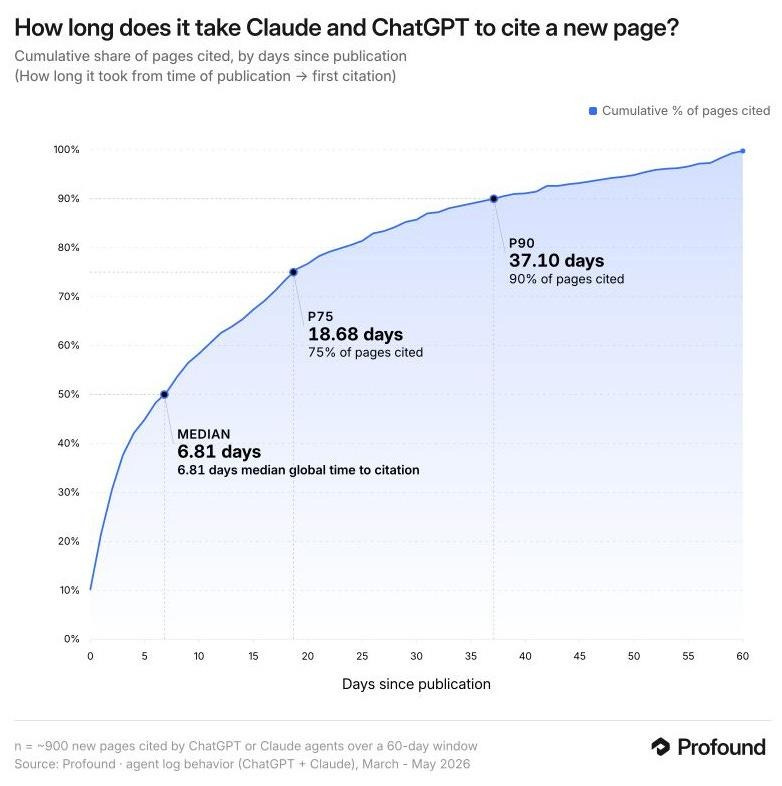
Not sure that these figures are cast in marble, so to be taken even with caution. But it still gives some very interesting orders of magnitude for evaluating our jobs. I see 3 ways to put it in practice.
The 37- day rule = a first level of diagnosis. If a page on which you have particular work is not mentioned by ChatGPT or Claude after 37 days → the problem is probably from your ( page too deep , robots.txt blocking , accessibility) (defective ). The type of blockage that Orbit Media’s AI Readiness Tool (↓ Tools) detects in One minute. Add it to your process .
Within 6 days, you ‘re performing above average. If a new page is cited in less than a week , you do something good ( authority) (topic , freshness of the domain ). Identify what works and replicate it
Your commitments may Finally be No more numbers. No more “we should see results .” from here for a few weeks ” . Now 90 % of the pages are cited within 37 days . Otherwise, we’ll see. “Why ?” Not yet the answer to all the questions, but a good way to move forward with a little clarity .
But above all… thanks to these figures, you have Finally, something to answer your SEO agency converted in “GEO guru” since the week last 😉 When She ‘ll give you her spiel about “GEO is SEO, that’s it.” walk Likewise, allow at least 6 months (so 6 months “A minimum subscription of €3,000 per month before seeing the first results. “ Not 6 months , but 1.5 months . do .
📎 Josh Blyskal’s LinkedIn post
A study that definitively debunks the myth of “ I optimize for fan-out queries and I’ll get cited . “ The methodology is a bit simplistic , perhaps. to be - but which reveals a sample which I believe is duplicable, so I’m sharing with you: 100 purchase intent prompts (B2B, B2C, SaaS, services, physical products), each generating 2-4 fan-out queries, compared to Google and Bing results.
The verdict is clear:
Only 27% of the sources cited by ChatGPT They rank in the Google Top 100 for the corresponding fan-out queries. 23% on Bing. With the overlap between the two search engines, we reach a maximum of 40%.
60% of ChatGPT quotes do not come so NOT from the SERP — they come Furthermore: training data, response cache past, hidden queries turning side OpenAI server, and 10 to 14% hallucinations pure (plausible URLs that lead to pages that do not exist).
78% of the cited sources are traditional SEO content: listicles, product pages, homepages, pricing pages.
The number that changes everything: if we count at the domain level (and no longer at the URL level) (exact), the match with Google increases from 27% to 50%. ChatGPT acknowledges the authority topic of a domain, even when he doesn’t cite the exact page that ranks.
Those who compare prompt research to keyword research are misleading you. You will never know the true prompts that your customers type ( remember Rand Fishkin’s study on the subject ). That’s the authority of your topic domain that decides if ChatGPT quotes you — not one A series of optimized pages. The consequence for your Codir: instead of scattering 100 articles across 100 angles, focus your work on 5 to 10 topics that you want to really possess . Depth theme > volume.
📎 Only 40% of ChatGPT Sources Come from Google & Bing for Known Fan-Out Queries
A study directly related to the one above 👆 . Tomek Rudzki analyzed 5 million fan-outs generated on ChatGPT, Perplexity, and Grok between April 1st and 21st , 2026. Verdict: the three engines do not behave at all the same way . And each adds keywords . that you have never typed .
Volume radically different by engine —
Perplexity: 1.4 fan-outs per prompt (it simplifies).
ChatGPT: 2.1 fan-outs (it adds brands, comparisons, reviews).
Grok: 6.8 fan-outs — he transforms your question into true strategic research with year, brand comparisons, and queries targeted at specific areas.
The word that ChatGPT injects most often is: “best”. For advice-type questions or recommendations , ChatGPT reformulates 24.3% of prompts in “best of” — even if you have never typed that word. That’s why listicles dominate AI responses .
The third most frequently used word: “reviews”. ChatGPT is looking for reviews even when no one told him on request . So your Glassdoor profile, your G2 score, your Sitejabber reviews feed directly the way ChatGPT describes you .
Grok target Explicitly cites sources via the site operator: in 18.3% of its chats. Reddit appears in 10.5% of cases . And 100% of the Wirecutter and Consumer Reports citations are injected by Grok — the user never requested them .
The algorithm behind all this: Reciprocal Rank Fusion. ChatGPT scores content that appears in multiple fan-outs higher.
Your AI visibility strategy is no longer a “Website” strategy. That’s an ecosystem strategy . If Wirecutter, G2, Glassdoor and Reddit are piloting a significant part of how AI describes you, your digital PR budget and your review management program become one of the central pillars of your GEO strategy. During my workshop with Andy Crestodina at Content Jam, this was one of the main points of my presentation : the big change before and after AI in your content strategy starts here: The essentials of your content must now be planned for outside of your website. This significantly alters the underlying strategy . But you might as well get on with it right away.
📎 https://peec.ai/blog/patterns-we-see-in-chatgpt-query-fanouts
Another longitudinal study that should put a stop to those still selling SEO by volume. In fact, that’s why I’m sharing it with you, because I’m infuriated when I hear about the budgets (again!) some of my clients are spending on “by-weight” content 😠.
For 16 months, 2,000 AI-generated articles published on new websites were tracked for their SEO performance. The pattern is undeniable: a peak at launch, then a gradual collapse to almost zero traffic. Regardless of the topic.
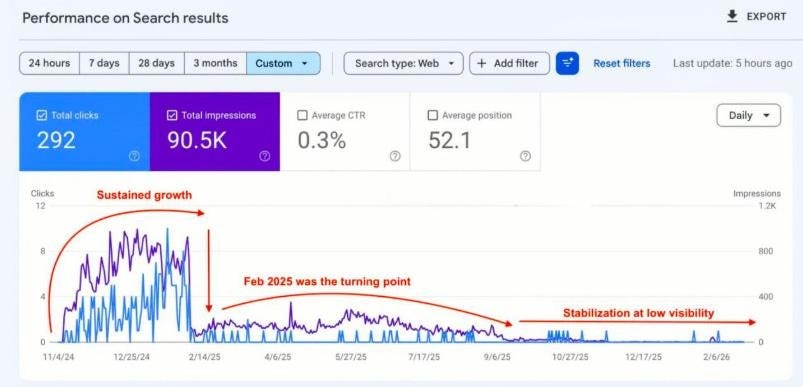
Identified causes: No backlinks, no identified authors, content redundant with what already exists, none Internal mesh. Incidentally also, editorial “soup”.
This study is nothing like a revelation. We even envy adding an obvious statement: who will Seriously, bookmark, share, subscribe or return to a site with content boiled? But beyond that, it gives you a solid argument to answer your SEO agency converted in “GEO guru” since the week last 😉 (the same (as above): any agency that still offers “300 AI articles per month to boost your visibility”, leave running. More simply reply, “It doesn’t work, and that’s documented now, therefore Let’s move on to something else. The key KPI to remember: how many people return to your site without being there returned by an algorithm? If the answer bothers you, you know Or focus your efforts in 2026.
📎 Slop doesn’t pay: A 16-month study of 2,000 AI articles
Remember: For the past 12 months, we have been explaining to you everywhere that the LLMs.txt file is the equivalent Modern sitemap.xml. The entire GEO industry has it sold like a must-do. That’s why. that I have selected this analysis there: The author spent 6 months analyzing server logs from 900 domains, representing over 45 million requests. from AI bots. Verdict to verify How many AI bot requests for a file LLMs.txt.zero.
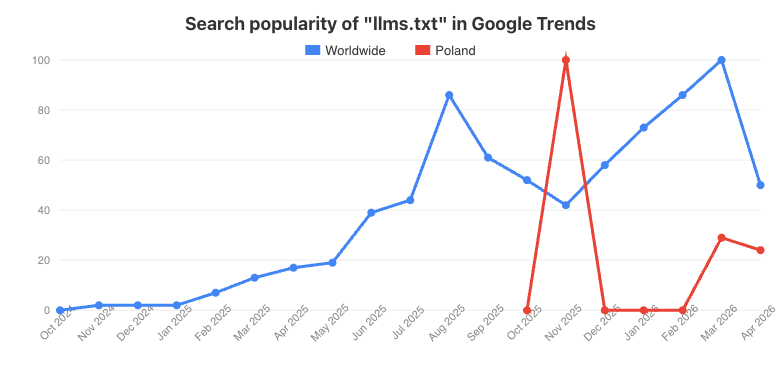
—> The answer…: Across the entire dataset, only 1,227 queries for these files — about 6 per day. And among the users of these files, none true AI bot: essentially tools SEO audit and an aggregator (Data provider).
I share this at each of my AI Search masterclasses → if a GEO provider sells you the implementation of LLMs.txt as critical deliverable at an indecent price, pass your path. And there you have a first, fairly good number. reliable giving: very few real AI bots read this file in 2026. More broadly, the guiding principle to be imposed: any GEO tactic must be able to be validated by server logs, tracked prompts, or attributable conversions. If the justification stops at “everyone, does it,” then it’s time for you to stop too.
Markdown (extension .md) is a lightweight markup language created in 2004 by the American developer John Gruber. His principle: write text structured with very simple conventions — **bold** for bold, # Title for titles, - element for lists — which remain legible to the naked eye and convert automatically in HTML.
Imagine a Word document that you would have Removed all the styling: no fonts, no colors, no images Integrated, no fancy layout. Just the words, and a few very simple symbols to indicate “this is a title” Or “this is a list”. This is a Markdown file. It’s the simplest format available for structuring content. writing.
You have it probably already encountered without realizing it: This is the format of README files on GitHub, the default export format for Notion, and the one in which your developers document their projects between them.
Templates are reusable content blocks that you can insert into any post. Use them for content you repeat frequently, such as:
Legal notice or standard disclosures
Calls to action ( subscribe , share , etc.)
Separators personalized or recurring sections
Post templates or standard text
To create your own Markdown, I have recorded all the tools relevant to my community 👇👇👇.
For the past 12 months, a fashion has become established in the industry GEO: publish Markdown files on your website, in parallel to HTML pages, supposedly to “help AI better read content”. The reasoning sold:
“LLMs are trained on text, so the cleaner and more structured the text, the better “They understand us. “Several GEO SaaS companies have the same idea of this tactic as their priority offers. Except that the reality is more nuanced. And a few independent voices. They are starting to say it.
Mark Williams-Cook (↓ more on this in the AI Search tactics section), drawing on Google’s guide “Build agent-friendly websites,” dismantles the reasoning. Modern AI agents don’t read ONLY text—they combine three signals simultaneously: screenshots of the rendered page, raw HTML, and tree structure.
Profound (one of the most in-depth GEO SaaS providers) view these times because that they have just raised millions) led an experience controlled: no statistical impact significantly related to the publication of .md files on AI visibility.
Imagine that your website is a television program broadcast yesterday evening.
HTML is the episode complete: images, sound, lighting, editing, subtitles, voice-over, atmosphere.
The Markdown file is the written transcript of this episode. All the lyrics are There , in order . But everything else is missing — which makes the experience understandable , lively and meaningful .
—> For a viewer: video is essential.
—> For a journalist who wants just to know what has been said: The transcript is sufficient.
For an AI agent that needs to understand your site AND accomplish a task (buy, reserve, compare): he needs the broadcast Complete. Not just an isolated transcript . Because it doesn’t belong to him. It’s not enough to “ understand the words” — he must understand the interface , identify possible actions, follow a hierarchy .
Imagine two versions of the same product page on an e- commerce website:
→ HTML version:
Title stylized “Nike Pegasus 40”, carousel of 8 high- resolution photos, price of €130 highlighted in large print, “Add to cart” button clearly identifiable in orange, score 4.7/5 with 2,432 reviews, breadcrumb “Home > Running > Pegasus”, metadata Schema Product + Aggregate Rating + Offer.
→ An AI agent can understand what product, what price, what popularity, and above all where Click to buy.
→ Markdown version (.md):
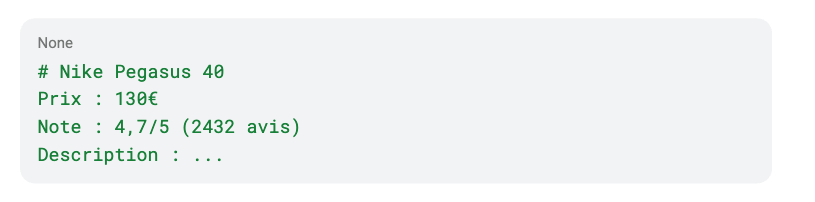
→ Clean text. Readable. But no identifiable action button, no hierarchy signal Visual, no photo, none TREE accessibility.
Which of the two formats do you think allows an AI agent to actually make a purchase? The first one. Not the second one.
Stop the .md sitewide deployment for AI visibility. No evidence empirical that It works (Profound, Williams-Cook, and Shepard document it ). Redirect this budget towards the real ones Foundations: Semantic HTML, stable layouts, proper accessibility. Bonus: what is useful is that the AI agent also serves Human Disabled. Best infrastructure ROI of 2026.
BUT keep Markdown for your DIRECT interactions with AI. Orbit Media just types: This is not a format for crawling; it’s a format for prompting. Two uses to be implemented industrially: (a) upload your best contents in .md in the knowledge files of your custom GPTs (internal assistants, brand clones) or Claude Cowork and Code; (b) force the formatting of AI outputs in adding “generates a markdown table” to your audit prompts or analysis — no more unreadable blocks of text, you get usable matrices in meeting.
Exception: if your product is aimed at AI coding agents (Claude Code, Cursor, Windsurf…). Here , the public files llms.txt, AGENTS.md, skill.md become part of the infrastructure. Agentic , not decoration . It’s the angle by Addy Osmani (↓ Reading of the month).
Markdown is neither the Holy Grail of GEO, nor a useless format. We have just been deceived . Publish it en masse on your site to “please LLMs”? IT costs nothing. Use it in your direct AI workflows — train Your GPTs, structuring your prompts, formatting outputs— that , yes , makes all the difference. The real question to ask your teams and your providers is no longer “is it that we should use Markdown?” but “at what point in our value chain AI?
→ On the public website: Clean HTML.
→ In your interactions with AI: Markdown.
Two formats, two uses, one alone logic — giving the machine what knows how to read best , there Or She really needs it .
“About this place” section appears on some Google Business Profile listings on the desktop, primarily for food and beverage establishments . And in this Section? Reddit discussions, injected directly through Google.
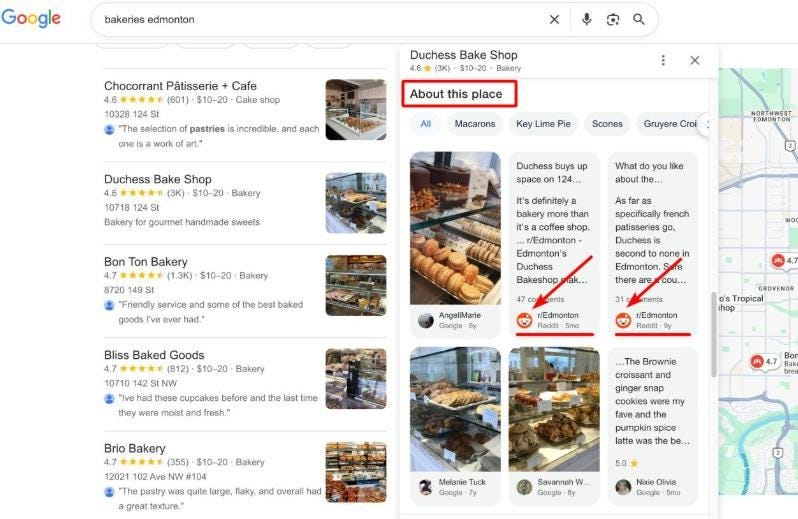
This is the first integration Also Explicit link between Reddit and the Google Business ecosystem . Google no longer simply displays Reddit in its regular SERPs — it aggregates it now in your local listing interface .
For multi-channel brands, this is a signal that changes local decision-making. For ten years, the GBP strategy was held in four pillars: consistent NAP, reviews, photos, posts. Google adds Today a fifth dimension — this that said the Reddit community of you, integrated directly into your profile.
👉 Three actions to give your local team this week:
Identify the Reddit discussions that Google references on YOUR listings (and those of your direct competitors)
Engage in these threads: answering questions, thanking people for recommendations, correcting inaccuracies — without astroturfing
Map the active subreddits on your category + geographical area as a fully- fledged marketing asset
👉 The underlying trend:
Reddit is no longer fair a source for ChatGPT (read again) This which we have already mentioned 👆👆). Reddit becomes a visibility infrastructure Also structuring than Google reviews. For retail, hospitality , restaurants, and all local businesses , ignoring Reddit in 2026 is no longer justifiable in Codir .
A great interview about the role of Substack’s strategic approach in the era of LLMs. The observation holds true. in a line: “By default, Substack is free. Thereby, it is seen by LLMs.”
The figures: 5 million of paid subscribers on Substack by 2025, tens of millions of players in total According to Morning Brew, LLMs are crawling. prioritize sources with strong engagement and authority editorial — exactly what Substack aggregates by construction.
For brands, Lamp makes three simple points:
Substack pitches out like a media outlet, not like a blog. Identify the newsletters that resonate with your audience, check if they accept pitches/ partnerships , and enter through the utility door ( exclusive data, expert access ), not through the door commercial .
Embrace the logic Community-based. Like Reddit, Substack operates through micro- communities . The rule: make yourself known BEFORE pitching. Subscribers They want an email from a fan, not a press kit .
Winning format: brand + ce that the audience obtains by following you. Examples cited — Rare Beauty (Selena Gomez) launched behind-the-scenes content on Substack before that the product doesn’t happen in stores. The RealReal covered Fashion Week in a Gossip Girl style, giving an angle that person else had not.
If you’ve been following me, you know that I published this newsletter about Substack - and that I am an absolute fan 🥰 of this platform that I considered like the most brilliant mix of the last 5 years between blog, website, community and social network. This PR Daily article only put the numbers and the right words on this that we/you, early adopters, advocate for ages .
👉 Three strategic implications for your C-suite
1. Substack is no longer a platform for writing. It’s a fully- fledged earned media GEO channel. For your PR teams, it’s a new category to add to their mapping media — at the same level that the press specialized , podcasts and review sites . The qualification criterion is not “ what is the print run”. but “what is the authority editorial in the vertical”.
2. Successful brands do not pitch the way they used to. Lamp’s Reddit/Substack parallel is apt: on these platforms, you enter through the door of utility, or you are Ignored. This requires a specific team briefing — your communications team needs to learn to give before you ask . That’s Exactly what requires also the GEO on all third-party sources (cf. DiNardi ↓ Strategies ).
3. The first-mover window is still open. Not for much longer. Lamp says so. Clearly: there are “first- mover prizes. “ That’s still true in mid-2026. It won’t be true in 18 months, when all the somewhat reputable B2C brands will have their own Substack newsletter + their partnerships team with creator newsletters. The window is closing . If you don’t have a Substack strategy for 2026, you’re leaving one of the few opportunities for the competition. channels that combine human reach + visibility agentic .
📎 How to turn Substack into your earned-media advantage in the AI age
Kyle Poyar interviewed more than a dozen B2B marketers — including the CMOs of beehive, Help Scout, Click Up and Web flow — to identify what produces a real pipeline in AEO/GEO in 2026.
AI research represents at least a third of all searches, AI Overviews triggered on 21% of Google keywords, and ChatGPT alone accounts for the equivalent of a fifth of Google’s volume.
1️⃣ The KPI has changed. AI visibility → pipeline influenced. beehiiv has abandoned the tracking of “share of voice LLM” and measurement Sign-ups are now assigned to LLMs. Observation: their visibility was good, but the LLMs described the product poorly. They have rewrites the most cited pages ( in particular their landing enterprise) and the leads attributed to LLMs have detached without any change in visibility .
2️⃣ The number one problem is not AI. It’s your Internal inconsistency. Reply.io had 500+ articles describing their product differently . Align the whole house around alone The promise propelled them into the top 3 on 25% of tracked prompts . PR = the new AEO: Web flow mobilizes from now on its entire marketing team to build its off-site authority (media, review sites, communities, partnerships).
3️⃣ The mid-funnel becomes the only profitable pitch. Eli Schwartz decides: Optimizing for “best family cars” is visibility at the expense of empty calories. The average search on ChatGPT is 60 words, compared to 3.4 on Google. Everything is long-tail. Air saw its visibility climb to dedicated pages for each case of use , and conversions affected these pages before the purchase .
4️⃣ YouTube surpasses Reddit. Seriously. YouTube is now cited in 16% of LLM responses , compared to 10 % for Reddit. ClickUp pushes the video and sees its content appear in 20 to 40% of AI Overviews. Their LLM-driven workspace acquisition has been multiplied by 22.
4️⃣ Actionable bonus: Kevin Indig observes +15% of citations on average just by adding a “last updated” date for the pages. Cost: zero. To be included in your brief web team on Monday.
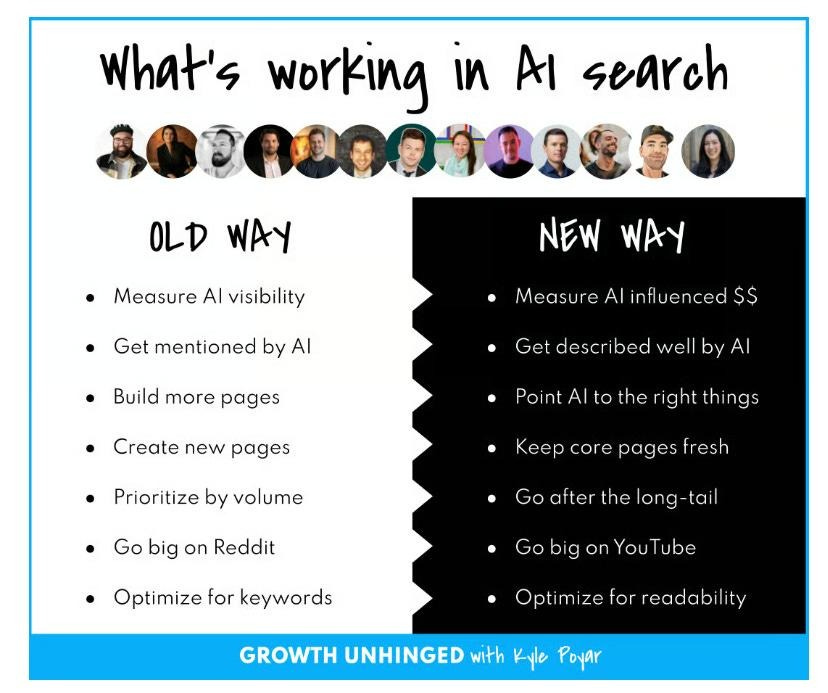
When the CMOs of Help Scout, beehiiv, ClickUp, and Webflow describe the same pivots in the same terms, it’s a sign of maturity. AEO/GEO has moved beyond the experimental phase. The debate is no longer “should we invest?” but “how do we structure the organization to do it right?” And the issue is cross-cutting: as long as your PR, content, and product teams are telling three different stories, LLMs will describe you in three different versions. And good luck to your future clients trying to find you in ChatGPT. #JustSaying 🤷 ♀️ .
📎 What’s working right now in AI search
Following his article last month on the 9 truths to explain to your CEO, Gaetano DiNardi delivers This will be accompanied by a document to be sent directly to your CMO and your Chief Brand Officer.
The majority of GEO tips circulating are this that we call In English, ‘ busy work’ (the kind of work that fills up your to-do list to make it look like “I’m working”) a ton” but (is not necessarily the most effective). In this case, we’re talking about FAQ blocks, llms.txt files, Markdown pages, “key takeaways” ... Dozens of brands are ticking these boxes. All the boxes are still not recommended .
For what?
Because LLMs do not reward good signage . They reward brands that are understood consistently , correctly categorized and validated All over the web — homepage, product , PR, reviews, comparisons , Reddit, analysts sector-specific . If no source tells the same story about you, there’s no consensus → no recommendation . At best a quote. Which is not at all the same thing.
Coldreach ranks #1 on “best AI SDR agents”, obtains a URL citation in the AI response, and does not appear in the list Recommended. Position #1 + citation = ne That’s no longer enough.
The 6 questions to ask in Codir (and not to your SEO lead):
LLMs recommend us, or do they cite us?
What category do they put us in? Is it the one we want to belong to?
Are they matching us with the right user, the right use case?
Are third-party sites (Reddit, reviews, analysts) shaping our AI visibility more than our own content?
Do we have a coherent narrative on all our surfaces?
Are we trying to force visibility with listicles , or to gain recommendation status through market alignment ?
As long as you delegate GEO to your sole SEO lead, you ‘re only managing 20% of the challenge. GEO is a team sport —PR, content , product , brand, partnerships. The end of silos! My plea for almost 18 years. that I do this job… #IWillGetThere
📎 Why GEO is a reputation problem
Rand Fishkin stands by his statement (and I agree 👏): the middle and bottom of the funnel no longer happen on your website. They happen in ChatGPT, on Reddit, in Reels, on YouTube, in AI Overviews. Your website no longer has the same function . Not at all… (it was one of the pillars of my presentation at Content Jam).
For 25 years, the playbook was stable:
Capture attention at the top of the funnel via search/social/ads, then unroll education and comparison on one’s own ground. The golden rule held in five words: “TOFU on leased land, MOFU and BOFU on owned land, or nothing.”
This playbook is broken.
The evaluation phase has migrated elsewhere . B2B, B2C, all sectors confused . The buyer no longer browses your site to understand what you do — he asks the question to an LLM, scrolls through Reddit, looks at a 90- second video . He only arrives at your home to finalize a decision already made elsewhere .
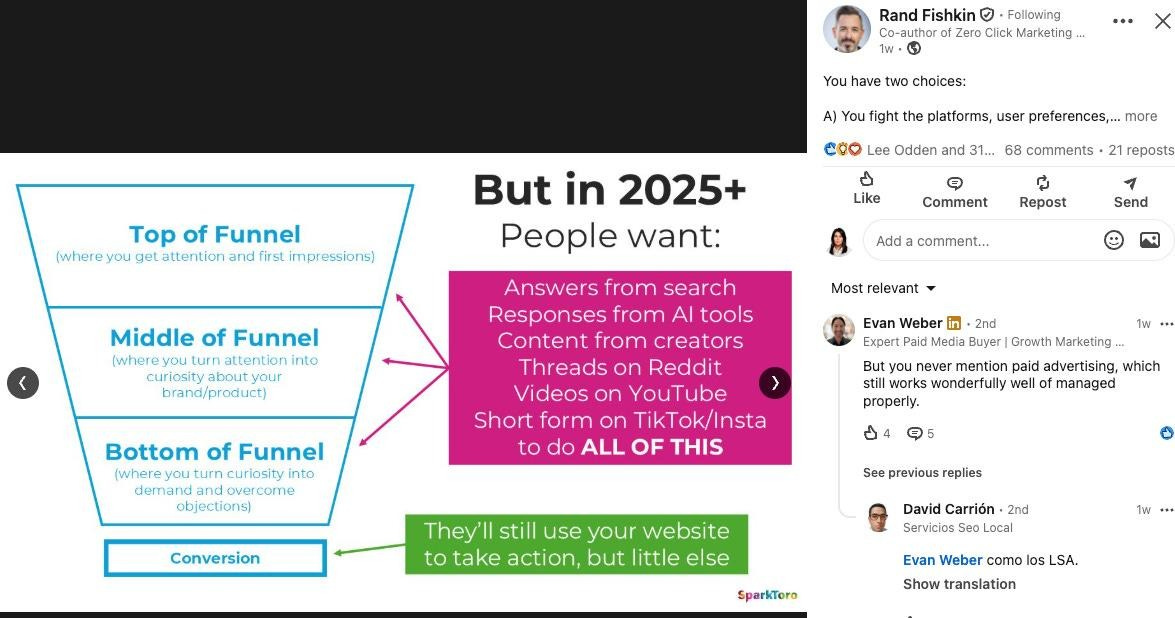
The example: for a mushroom picking course in Seattle, the route real in 2026, it’s Reddit → YouTube → Google AI → short content → website. Your website is no longer the second step. It’s the last .
I can’t stress this enough, and it’s essential that all the Executive Committees incorporate Really This structural shift in the way we think about content marketing. No… “ your website is NO LONGER your “Primary marketing asset .” Your site remains one of the AI scraping sources over which you have full control and a conversion asset — but no longer a discovery asset nor of consideration .
A direct consequence for your 2026 strategic decisions: your content budget should no longer be allocated 80% to your blog, but 80% to content creation outside your website. It must be distributed across the platforms where decisions are actually made: third-party editorial presence (media outlets, review sites, online communities), video (YouTube, short-form content), Reddit, and—of course—visibility in LLMs (Low-Level Marketing). And the key question that should emerge from your next marketing executive committee meeting is: “On which third-party platforms do we truly have a presence?” If the answer can be counted on one hand, the problem isn’t your SEO. It’s your online presence strategy.
Cyrus Shepard asks the question that should precede any marketing and management debate on the decline in traffic SEO: When you see a graph falling, what’s your first thought?
A. Bad SEO
B. Google has changed Google review /update
C. Third - party traffic tools are not reliable
Marketing industry — and all too often CEOs — are inclined automatically to answer A. Cyrus decides: the correct answer is almost always B (with a little bit of C as a bonus). Since 2023, Google has deployed a series of major algorithmic updates that have deeply modified content types valued . And the traffic has not disappeared: it has been redirected to Reddit, YouTube, forums, and proprietary news sources. Cyrus clarifies —and this is important— that the company whose graph he was showing in freefall They are commercially very successful and are among the most competent SEO teams. that he knows . You remember the case HubSpot …
The strategic mistake to avoid this year: cutting your SEO budget in response to misinterpreted figures, only to reinvest that money in a “100% GEO pivot” through the first convincing agency. You’d be dismantling a long-term skill set to buy storytelling. The right approach: keep your SEO talent, expand their scope to include GEO, Search Everywhere, and next-generation KPI management. Evolution, not replacement. How many times do we have to say it...? As many times as necessary, Captain 🫡.
📎 Cyrus Shepard’s LinkedIn post
In my GEO masterclass, I help you redefine your content strategy to move from producing volume (to cover keywords ) to a Source coverage strategy and relevance engineering . The next session is in June, you can join the list waiting here 👇👇 .
Ryan Law, Director of Content Marketing at Ahrefs , has just published the details The complete system that allows Claude Code to write 100% of the Ahrefs blog. Not “ AI- assisted .” Not “ AI- edited .” Written from start to finish, draft ready to publish In 6 to 12 minutes. ~15 articles already published , ~30 updated. And nobody notices the difference .
The 7 pillars of his system:
23 skill files that reproduce each step of its editorial process human (keyword research, gap analysis, structuring, drafting, etc.). Each skill can turn alone , or be chained via a main blog-pipeline skill.
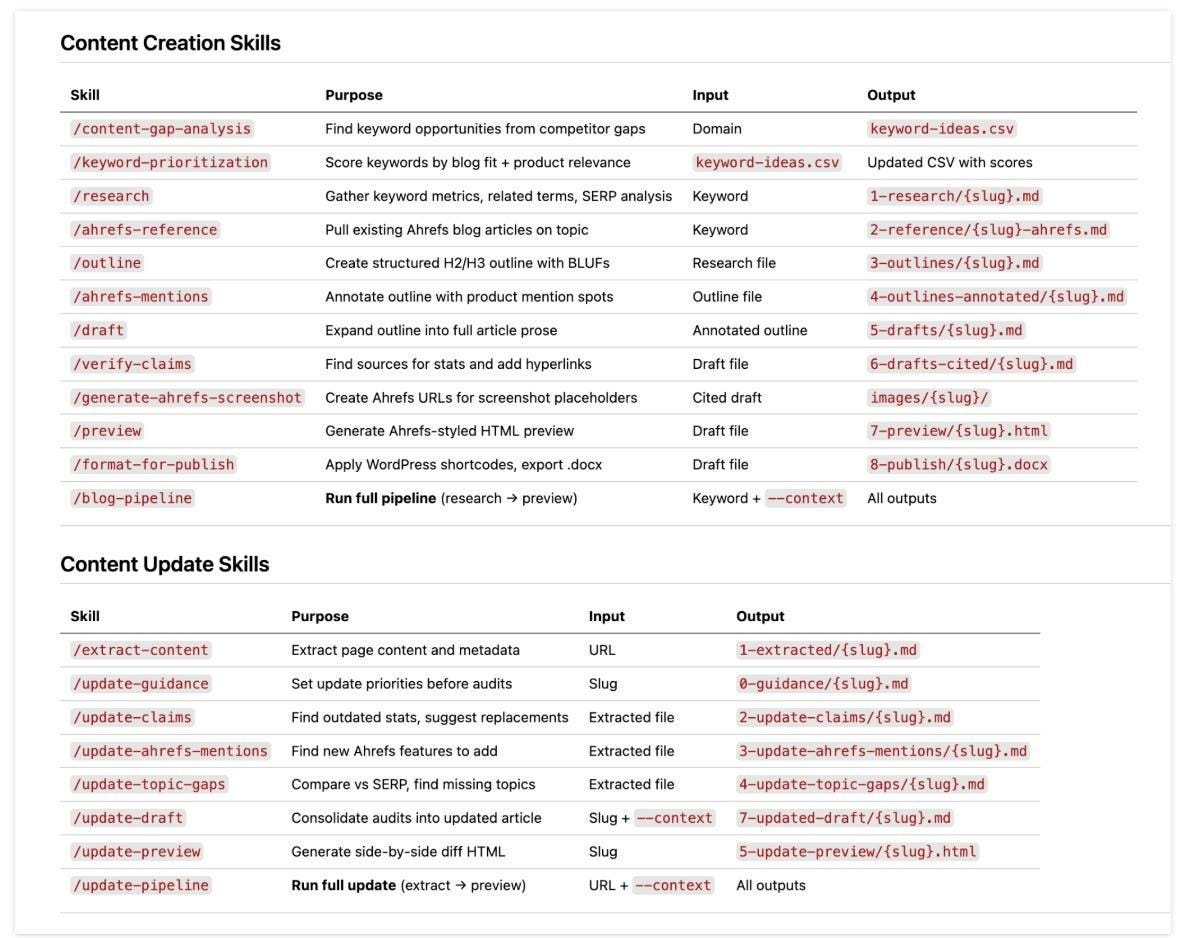
Output at each stage: Each output is saved in a separate Markdown. When the final result is bad , it knows Exactly Or It derailed and restarted since this step.
Recursive self-improvement via the Anthropic skill-creator: The AI tests each skill with and without guidance, identifies This works, and offers optimizations. As a result, skills become shorter and more efficient over time.
Solid data required via Ahrefs MCP: Claude directly accesses the Ahrefs data (volumes, intents, SERPs, questions), which eliminates the hallucination of SEO figures.
centered management upstream, not in Downstream: Ryan injects 1 paragraph of context at the start (angle, sub-topics to cover, product features to include) (forward). More effective than editing 2000 words at the end.
Interactive HTML Preview: each generated article Opens an Ahrefs -style preview in Chrome for human review. Ryan reads every word before publication.
Member customization team: each editor Ahrefs forked the repo and adapted it to his style, his sources, his obsessions. Not a system Ahrefs unique — one copilot per human .
Incidentally , here’s a comment that should calm everyone down. those who think that with AI “there “ that’s what you have to do,” Ryan quoted from a comment LinkedIn:
“Ryan’s SKILL files are good because Ryan already knew what to put in it. Most people who use blank-slate tools are not 13 years old. Experience editorial to build on it.”
Before panicking or to dismiss your Editors, remember this: This is not generic AI content. It is a content engineering infrastructure industry , built on 13 years of editorial standards humans translated in Markdown. The difference between Ahrefs and a site that collapses after 16 months of AI slop (see the Jason Patterson study ↑ Top searches & data) is precisely this infrastructure and this authority topical pre-existing . The real one construction site for your Executive Committee It’s not about “how to automate faster “ — it’s about “how to build expertise, editorial and domain authority that make profitable automation ”.
📎 How I do content engineering with Claude Code
🔄 Bonus - Also read: Chris Long relayed this even approach in a LinkedIn post that nicely summarizes the 5 pillars of the system (skills files, improvement Recursive, real SEO data sourcing, human input in upstream, personalization per member (of the team). Confirmation that The Ryan Law article is now has become the current benchmark in content engineering within the industry.
Cyrus Shepard has (again!!) published some crazy content - in the occurrence of a framework that any team contains should pin it above your desk. The context: 60% of Google searches do not generate now none click to a third-party site. The question is no longer “how to generate traffic ” . but “ What type of content still deserves to exist on your site in 2026? ”
The verdict is clear — the fundamentals of content marketing from the last 10 years are at the bottom of the pile:
🟢 Very strong: Owned Audience (newsletters, email communities), Transaction Pages (product, booking, subscription)
🟢 Solids: Original Research, UGC Communities, Creator Video & Podcast, In-Depth Reviews & Tests, Brand Pages
🟡 Moderate: Directories/databases with proprietary data, Expert perspectives, Templates, Case studies, original reporting, Documentation
🔴 Weak (to clear from your strategy 2026):
Generic Guides & Explainers — ChatGPT Explains better This what is a CRM
FAQs & Glossaries — except if you are the definition canonical of your sector
Listicles “Top 10” / “Best of” — now tracked and demoted by Google
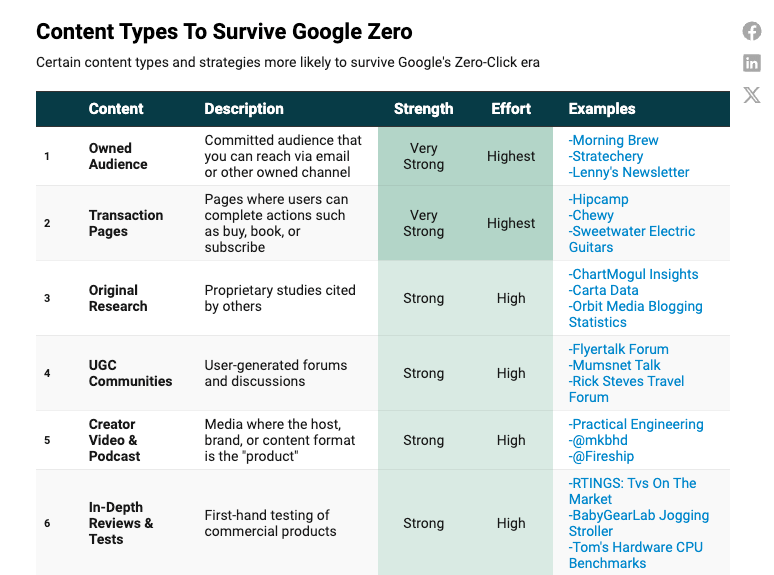
The criterion common to all winners: proprietary, experience - based, niche, and which allows for completion of a task beyond simply to provide information.
Print this Create a matrix and pass it on to your content team. Too brilliant. Not to generate debate —to conduct an honest audit . What percentage of your 2025 output falls into the “ Low “ zone? If 80% of your blog consists of guides and listicles, you know... NOW Why your traffic: Pick up the phone . And where? Redirect the budget: towards proprietary audiences, powerful transaction pages, and original search content. The rest is a wasted budget.
📎 17 Content Types to Survive Google’s Zero-Click Future
For 10 years, everyone learned the same rule: to improve your SEO, write the most comprehensive article, cover all subtopics, and anticipate every follow-up question. Be the page that has it all. Amanda Natividad buried this doctrine this month, supported by two independent studies that point in the same direction—one from Google, the other from ChatGPT.
🔍 Study #1 — Cyrus Shepard (Zyppy): Sites that win on Google have 5 specific characteristics. Of 400+ sites analyzed YoY, 5 traits predict the winners: (1) offering a product or service, (2) allowing the user to complete a task, (3) owning proprietary assets, (4) maintaining a tight topical focus, (5) having a strong brand that people search for by name.
The striking statistic: Sites with 0 traits → 13.5%-win rate. With 4 traits → 68.1%. With all 5 → 69.7%. Amanda’s concrete comparison: Byrdie (loser) talks about beauty products; Dermstore (winner) talks about the products and sells them. “You can read about the thing AND you can do the thing in one place.”
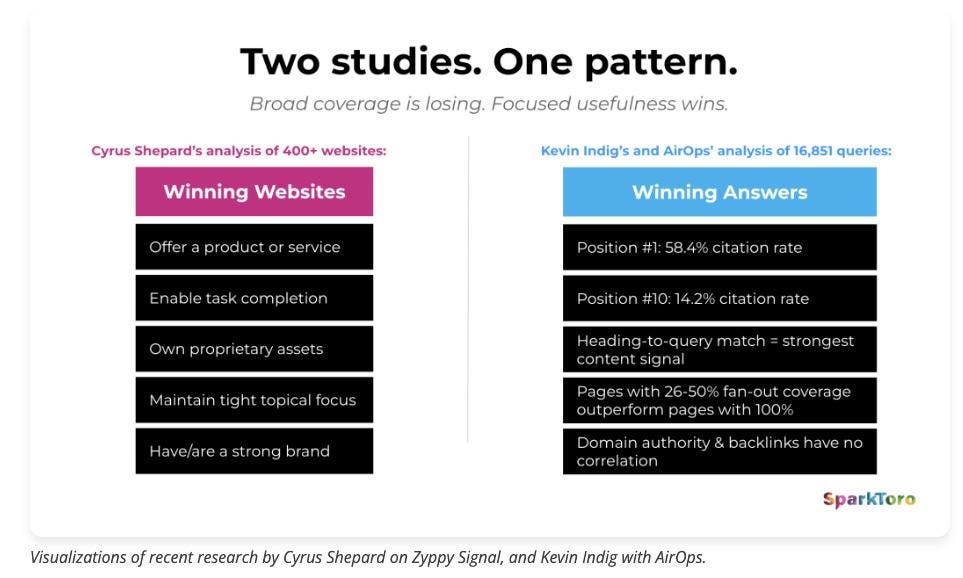
🔍 Study #2 — Kevin Indig + AirOps: What happens between your prompt and the ChatGPT quote: 16,851 queries, 353,799 pages analyzed in the ChatGPT retrieval pipeline. Three figures to remember:
Retrieval position = factor # 1: the page in position 1 of the retrieval results has a 58.4% chance of being cited. The page in position 10 → 14.2%.
Content signal #1 = the similarity of the H2/H3 with the query Initial. Not the length. Not the completeness . The precision of the match.
The bomb: similarity primary Equally, pages covering 26 to 50% of the fan-out subtopics beat pages covering 100%. Literal conclusion d’Indig: “A page that nails one question outperforms a page that adequately addresses five.”
And the cherry on top is that the sellers will grind their teeth Authority: In this dataset, domain authority and backlinks were NOT correlated positively with the quotes. It’s no longer about authority global which cites — that’s the accuracy of the match.
emerging trend: Cyrus describes what the winning website looks like (usefulness) distinct, reason for existing clear); Indigo says what the answer looks like winning (an asset worth mentioning). It’s no longer a question of format. It’s a question of editorial and business defensibility.
Take your top 10 ultimate guides and ask yourself THE question: is it that This page asks a specific question, or is it what address Correctly five questions? If it’s the second one, break it down into 3 to 5 focused pages , each with a matching H1. a true request . You will win on both counts: best Google ranking and best ChatGPT citation probability. That’s exactly the opposite of this that you sold your agency in 2018.
📎The Death of the Ultimate Guide?
Here is a method that should replace your next classic SEO audit .
The principle: Your site is not just a collection of pages; it’s a comprehensive thematic signal sent to Google and LLMs. And most sites do not lose their authority at once — they drift slowly. An old article. A campaign landing page A forgotten resource . A product that no longer has a product behind it. A related topic that made sense three years ago. The calendar editorial Publish , never clean . And after five years , your site tells Google a story that is no longer yours .
His solution: a semantic map of the domain whole. Each page becomes a point. The center = your Main topic . Distance from the center = degree of drift .
Four zones: Core, Focus, Expansion, Peripheral. (See example) Of the 318 pages it shares, 84% of the site is aligned — a healthy site . On many others , the diagnosis is brutal.
The protocol in 7 steps (to give to your SEO lead):
Crawl the site (Screaming Frog or equivalent )
Extract the main content from each indexable URL
Generate one vector embed per page
Reduce in 2D space
Plot each page like a dot
Calculate the distance to the center semantics
Sort into Core / Focus / Expansion / Peripheral
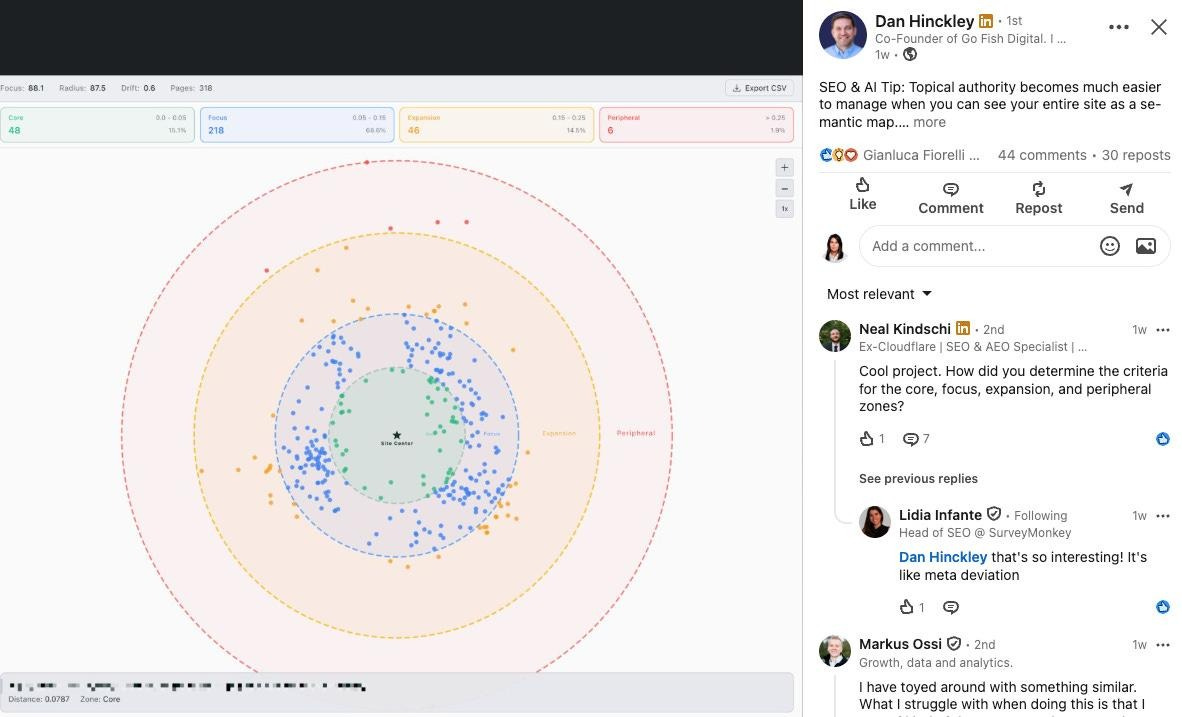
You get a real map. Visual . Readable by your C-Suite teams. And above all, measurable over time — you can track if your content strategy authority builds or disperses attention .
Take out the “Peripheral” pages and compare them to your current business strategy . Three options: Delete, consolidate via 301 redirect, or re- mesh to the core. That’s it. exactly the kind of exercise that brings back mechanically your authority topical — and therefore , as they watch The Grow and Convert study ↑ Top research & data, your probability of being cited by ChatGPT.
📎 Dan Hinckley’s LinkedIn post
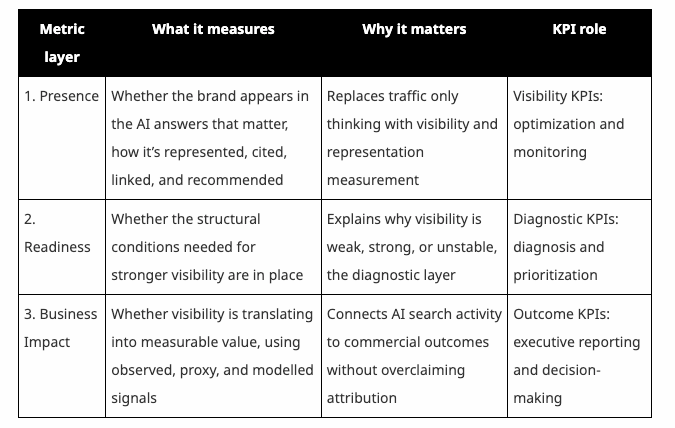
Aleyda Solis has just published which could be the standard for measuring AI Search by 2026. Not just another dashboard . A three -layered governance architecture , designed to avoid confusing “ measurable ” with “ meaningful ”.
Layer 1 — Presence: Does the brand appear, and how? Five KPIs: prompt coverage, recommendation rate, linked citation rate, comparative win rate, representation accuracy. Aleyda explains Which KPI should dominate? your dashboard according to your business model.
e-commerce → linked citation,
SaaS → recommendation + comparative win,
media → linked citation + prompt coverage.
Layer 2 — Readiness: Are you structurally ready to appear? 10 characteristics: Accessible, Extractable, Useful, Fresh, Differentiated, Recognizable, Consistent, Corroborated, Credible, Transactable. Each weakness in Layer 1 should point to a precise readiness diagnosis.
Layer 3 — Business Impact: Visibility Does it generate value? The most important insight for your CFO:
The observed AI traffic is the floor, not the ceiling, of the impact of real AI Search.
Four layers of trust that should NEVER be mixed in a single dashboard: Observed (trackable sessions), Proxy own (branded search lift, survey), Third-party proxy (Similarweb ), Modeled (estimates).
line question that reveals the influence of AI that Your analytics are not seeing it. And the observation that everyone agrees on: The influence of AI on your customers is largely invisible in Google Analytics and in most of your SEO tools.
Two examples concrete examples to understand:
A customer sees Your brand is mentioned in ChatGPT; close ChatGPT, then type your name into Google → your analytics record it as an “organic search for your brand”. ChatGPT’s influence is invisible.
Another copy- paste customer Your link from ChatGPT on their phone → your analytics records it like “ direct traffic ”. ChatGPT ’s influence is still invisible.
In both cases , you ‘re missing out. completely the fact that It was ChatGPT that triggered the visit .
Aleyda’s solution is one simple disarming.
👉 add just ONE question to your form registration or demo request:
“Before you sign up, have you seen [ your brand] in an AI assistant like ChatGPT, Perplexity, Claude, Gemini or Copilot? Options: Yes / No / I don’t know.
Place this after the main fields . Optional . No follow-up questions ( otherwise people will abandon the process ). This question, combined with your analytics data, reveals what none tool cannot see: How many of your customers arrive? actually via an AI mention, even When Your analytics attribute them to something else.
👉 To do:
Ask your data team to create an “AI traffic” channel in Google Analytics — to identify visits coming Directly from ChatGPT, Perplexity, Claude, Gemini, Copilot. 30 minutes of work.
Add the question Aleyda to your form Registration. One hour of development . It’s the only one method that will make this visible that neither Google Analytics nor the €500/ month GEO tools can structurally measure .
The whole thing can be deployed in 2 weeks for a first functional version .
The phrase to engrave in marble for your Teams: “The observed AI traffic is the floor, not the ceiling.” What you measure today is not that a fraction of the influence real AI impacts on your business.
Beware of tools that sell you a single “AI Visibility” score in mixing two very different things: what they have Really measured, and this that they have Deduced through modeling. This is not piloting, it’s decoration.
Conversely, Aleyda’s one-line survey question solves in one hour of development what €500/month SaaS solutions claim to solve with opaque models. It’s probably the tactic with the best return on investment in this entire edition.
The rule to impose in your GEO reports: what is measured must be clearly distinguished from what is merely estimated. Without this Separation , you’re no longer in control — you ‘re reading a disguised commercial narrative in data.
📎 A 3 Layer Framework to Measure AI Presence, Readiness and Business Impact
Reddit ranks, Reddit sticks, and Reddit is now cited in a massive portion of AI responses (see Tomek Rudzki’s study at the very beginning of this newsletter; it even showed that Grok injects Reddit into 10.5% of its fan-outs, even when the user doesn’t ask for it).
A direct consequence that no one formalizes: a negative thread about your brand that ranks on Google’s first page is no longer an SEO problem. It’s an AI Search problem.
Because this thread directly feeds into how ChatGPT, Perplexity, Grok, and Gemini describe you. And unlike a Google Business review, there’s no obvious “report” button.
But… There’s a lever that 99% of brands ignore: Reddit’s 8 official content rules. A thread that violates one of them can be reported—and removed.
The trick is that “this thread is mean” isn’t enough.
A precise case needs to be built: pinpoint the exact rule, cite the exact content, and explain why it qualifies. And that’s precisely what RedFlag Checker does. This tool scans a Reddit thread (post + all comments + usernames) against the 8 rules and provides you with a structured report: identified violations, severity (Low/Medium/High), direct citations, and a clear explanation for each violated rule. The output can be used as is for a Reddit report, a client brief, or a legal team.
The 4 rules that matter really for one brand (out of the 8 in the framework):
Rule 1 — Harassment, hate, threats: targeting nominative of employees, pile-on coordinated. Your strongest card.
Rule 2 — Spam & manipulation: competitor astroturfing, fake reviews posted such as “experiences authentic”. Much more frequent that we don’t believe .
Rule 3 — Privacy violations: team doxing, addresses, numbers Personally, Reddit takes this is very serious.
Rule 4 — Identity theft: fake ex- employees, fake brand representatives. Reportable .
Monitor your brand on Reddit in continuous (Alert mouse - which I told you about) (The March edition does the job very well). When a toxic thread emerges and persists, before panicking Or instead of investing in content marketing to demote it, launch the RedFlag Checker. If a violation occurs, report it on Reddit . rule . That’s free , it is quick , and it’s probably the brand reputation tactic with the best ROI for your 2026 — especially that each thread removed is also an unfavorable AI source that disappears from the LLM training and citation diet .
📎 Reddit Thread Policy Violation Checker
If there is the only reading to impose on your Executive Committee this month , it’s That one . And that’s a paradox . that No one is pointing the finger: while Google remains opaque about the mechanics of its With AI systems, Bing is becoming the undisputed leader in transparency and education. in AI Search. Month after month, Microsoft AI publishes the most influential technical articles in the field. This one is undoubtedly the most important of 2026 (even more so than that of the previous edition ).
Three Microsoft AI engineers have just published one of the rarest technical analyses of the year on Bing’s official blog .
The topic: how the index should evolve to move from page ranking to grounding (anchoring) AI responses.
The sentence that sums it up All:
“ Search indexing has been designed to help humans decide what they must read. Grounding is being designed to help AI systems decide what they must say.
And the article developed precisely what That change:
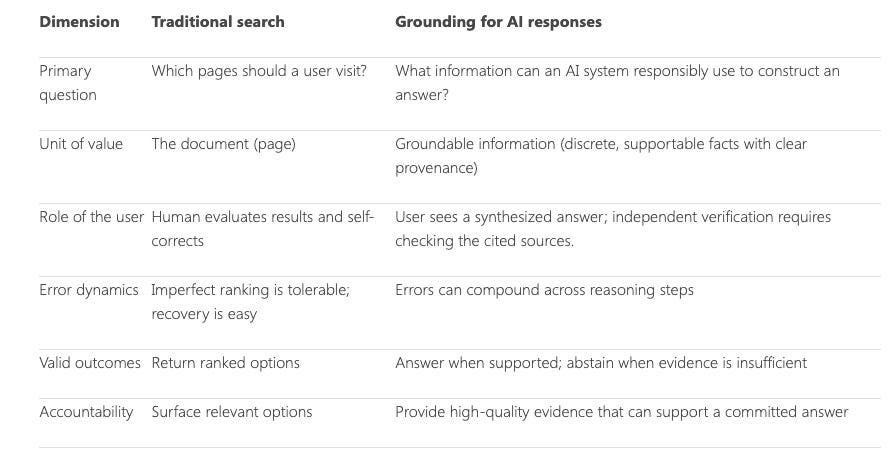
“ Anchor an answer AI- generated introduction of a constraint fundamentally the difference is that the system no longer simply points to information, it uses it. The objective shifts from “ retrieving the best documents” to “ retrieving the best information and synthesizing it.” in an answer reliable and verifiable ”. (…) The unit of value shifts from documents to information Groundable — discreet, tolerable facts with a clear origin.
Three key points to remember:
The unit of value changes: we no longer classify pages, we evaluate “ groundable “ facts — discrete, tolerable, traceable. Several sources can now condense into a single sentence, and the errors accumulate at each stage of the AI ‘s reasoning . Accuracy is critical.
Abstention becomes an answer valid: When The evidence is insufficient, outdated Or Contradictory, AI must remain silent. This is a deliberate choice , not a failure .
Freshness changes in nature: in SEO content date lowers the ranking, grounding a dated fact product a answer False. “ Freshness failure carries a categorically different cost . ” entails a cost categorically different . “)
And the formula:
… the one that is due to land as is in your brief, because that she clearly distinguishes between the two worlds:
“A search function is responsible for presenting options. A grounding function is responsible for the quality of the evidence. “ What provides an AI system which will, in turn, engage in an answer that the users will then be able to verify.
In other words:
A traditional search engine is responsible for presenting you with options. A grounding system is responsible for the quality of the evidence. that he provides to an AI which will , in turn , engage in an answer . It’s not the same responsibility. It’s not the same Optimization. It’s not the same job.
It is probably the most important blog post of the year for your C-Suite. And most person Don’t talk about it. Because It’s Bing… Three things to engrave, not one more.
1️⃣ The “SEO = GEO” debate is same” (#Heaviness) is officially Buried. Not by a marketing consultant. By the engineers who build the machine. When Microsoft AI explains it to you in black and white. that we are talking about two problems optimization different Built on the same infrastructure, we stop debating . Pedro Dias ( ↓ SEO vs GEO) is right on the fundamentals —many GEO tactics are just folklore . But those who conclude that the GEO is not even rebranded SEO ( hi Piet, March newsletter) is mistaken . Grounding is involved. His own metrics — fidelity, factual , provenance, conflict detection , abstention — which have none equivalent in traditional SEO . This is not an opinion. It is an architecture.
2️⃣ Your unit of production is changing. Officially. You ‘re no longer writing pages, you ‘re producing tolerable facts . Each section of each article must be able to hold standing. It’s on its own , with a clear origin , and doesn’t contradict the rest of your site. precisely what Krishna Madhavan says in his 4- gate framework (↑ GEO Tactics Pulse, gate 3 “ groundable ” ). This is no coincidence — it’s the same author. The official word has been dropped: Groundable information. Impose it on your content team on Monday . And while you ‘re at it , remove the phrase “ write a full article on topic X” from their brief .
3️⃣ Abstention is a valid response.” Something to think about at length. In concrete terms: your brand may NOT be cited not because that it is invisible, but because that the system judges that the evidence against you is insufficient and outdated. Or contradictory . It is exactly the point of Gaetano DiNardi (↑ Strategies ) — except that this time it is said by the engineer implementing the decision . If your third - party sources do not corroborate your message, if your pages tell three different stories, if your “last updated” dates are fanciful: AI doesn’t quote you. It remains silent . And you’ll never know — no analytics track you. a non- recommendation .
The real strategic signal for your C-Suite - While Google remains opaque, Bing publishes the manual. And more broadly , Microsoft AI is now assuming an educational role that person else doesn’t occupy — neither Google, Anthropic, nor OpenAI. If you want to understand what I think really, the machines in 2026, that’s there that it’s readable. Not in proprietary “AI Visibility Indices .” Not in GEO agency portfolios . On the official blog of a search engine that decided that transparency was his best marketing product .
📎 Evolving role of the index: From ranking pages to supporting answers
Nick LeRoy is fed up (and frankly , we’re both). In a post with a straightforward title — which we can translate freely by “The SEO debate against GEO? “Stop everything, this is ridiculous” — he analyzes Why This war of acronyms refuses to die , and especially who is waging it .
His analysis class in three main Categories: the voices that dominate LinkedIn today . And this framework is really quite useful for addressing the debates on this topic within your team.
1️⃣ “SEO is dead, I’m GEO” — the newcomers Opportunists. Recent marketers who prefer to brand themselves with new acronyms (GEO, AEO, AIO) rather than to learn Really traditional SEO . Nick LeRoy doesn’t mince words . words: “GEO is newer, more ambiguous, and harder to measure — therefore the perfect playground for those selling insurance without any evidence.”
2️⃣ Leaders facing profitability in freefall. The only one category for which Nick LeRoy has empathy . The tension is real: Google’s AI summaries (the famous “AI Overviews”) are racking up clicks, and management is asking legitimately Why SEO still costs so much Expensive for results that deteriorate. Its formula: “The fear of missing the next big turn wins often based on confidence in the long -term value of SEO.”
3️⃣ “AI is a passing fad” — old- school SEOs denial. Those who think that he is enough to wait Let the storm pass. Nick LeRoy’s verdict: “Different suit. Same fear .”
His thesis main one, embroidered throughout the post: This it’s not a replacement, it’s an expansion. SEO is not dying —it’s expanding into new territories. Go on , we’ll say it again. As many times as necessary .
The typical trap:
A GEO consultant with two years’ experience comes to sell you “SEO is dead, we need to reinvent everything.” Category 1.
→ Consequence: you rebuild from scratch a strategy that worked probably, in throwing to the winds fundamentals that remain perfectly valid.
Conversely , a senior SEO consultant tells you “nothing has Really changed , let’s continue “as before” . Category 3.
→ Consequence: you’re missing out expansion into new territories where your brand absolutely must exist now — Reddit, YouTube, quotes in chatbot responses, AI agents.
This post should land on each desk Marketing director. Not for the content (you already know the song about expansion not being a replacement), but for its analysis grid of speaking voices around you. The best way to navigate in the fog ambient Choosing a side in 2026 is not about taking sides — it’s about learning to recognize which category your next consultant falls into, before he gets you to sign a quote.
Your Search team ‘s job in 2026 is not to pivot — it’s to expand. Keep the fundamentals of SEO (Google remains by far the largest search engine in the world, whether we like it or not). or not — the Datos/ Semrush study ↑ Top searches & data reminds us that Google adds mechanically more requests each month (that ChatGPT, Gemini, Claude and Perplexity combined ), AND add the new layers: follow Or Your brand is cited by AI, multiply your presence in third-party media and active communities , prepare Your website for AI agents.
Finally, a detail that is not insignificant: Nick LeRoy casts a spell on a fantasy Dangerous. The label n / A none value strategic . Rename your team “GEO Team”, transform the title of your SEO manager into “Head of GEO”, or have heavily loaded slides printed with acronyms brand new nine — that’s Exactly what he describes as “pretending to have invented the future .” Winning brands In 2026, they don’t rename anything. They do the job. On both fronts.
Corey Northcut, the CTO of Orbit Media founded by Andy Crestodina with whom I animated My 4-hour GEO workshop in Chicago last month, has just released a tool free which should be the stage zero of any technical GEO routine. It mimics user agents from over 36 major LLMs to detect three types of blocks invisible to traditional SEO teams:
calibrated robots.txt rules
User agents banished without nobody cares report
Selective security headers that filter some crawlers
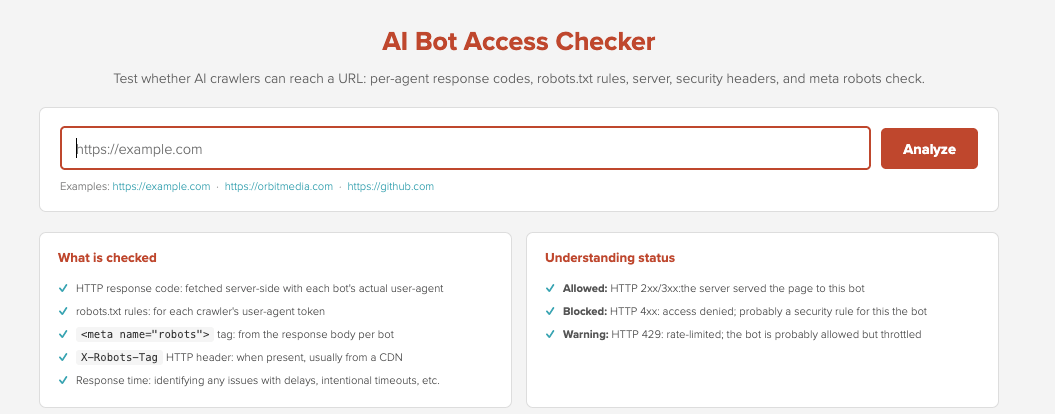
Corey’s observation: every time he ran a major brand website through his tool, he found significant surprises. The reason: IT security philosophies evolve as quickly as the web itself, and AI bots often arrive blocked by default.
💜 Why Do I Love It? Your AI visibility can be strangled by your own infrastructure without nobody cares notice. No visible drop in traffic , no SEO alert , just a gradual absence in LLM responses . This test takes one minute.
👉 AI Readiness Tool — Orbit Media
Bing has just previewed the upcoming AI Search reporting features of Bing Webmaster Tools. Not yet live, but screenshots shared by Azeem Ahmad at SEOWeek show what appears to be the first institutional GEO measurement offering from a search engine. Three key new features:
“Citation Share”: the proportion of citations your site receives in Bing/Copilot AI search results. The equivalent of “share of voice,” but measure directly through the engine — not through a third-party tool costing €500/ month.
Intent of request Contextualized: 15 categories intention predefined to analyze at what point in the journey You are a user (or (you are not) cited.
Recommendations oriented GEO: Bing directly suggests actions to take to improve within the tool your visibility in AI responses.
💜 Why Do I Love It? It’s a real game- changer. that we were waiting (and Bing is going all out to make it attractive Copilot in Despair …?). While Google remains opaque , Bing is transforming GEO measurement into an official and free standard . When these features will be live, your teams will be able to Finally measure your AI visibility without relying on proprietary GEO tools for indicators often weak, and sometimes even Doubtful. Ask your SEO lead to monitor the official release .
👉 Bing Webmaster Tools teases new AI reporting updates
Ahrefs’ AI agent combines Anthropic models , access complete with Ahrefs data (more endpoints) than the API or the standard MCP) and a library of Skills, Apps and Reports pre-configured for SEO/AEO.
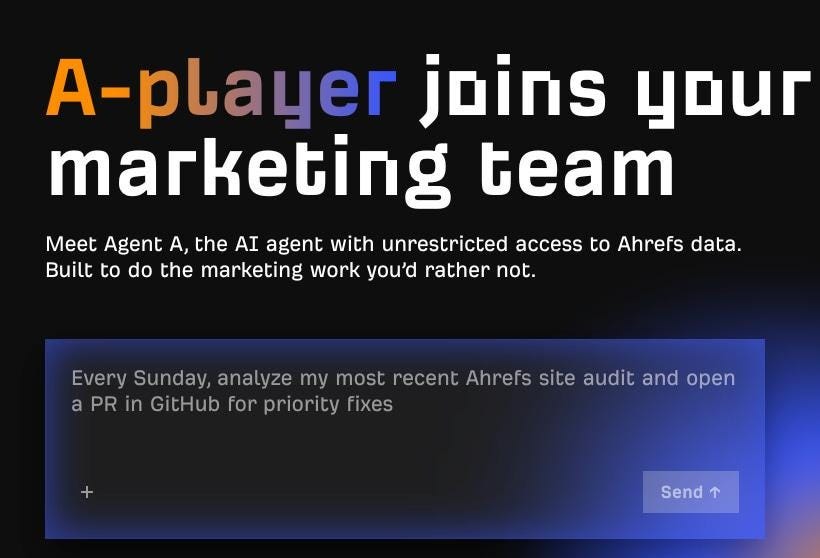
💜 Why Do I Love It? It’s the first mainstream SEO SaaS to transform its tool in environment operational Agentic . You describe the task , the AI agent executes it with your Ahrefs data in context . Vibe coding of marketing apps included . Free trial in Course . Canon, right?
IntentGaps, created by Mark Williams-Cook (who can be found ↑ GEO Tactics Pulse). You enter a URL, the tool identifies your topic, then uses the AlsoAsked API to map all the “People Also Ask” questions that your page doesn’t address.
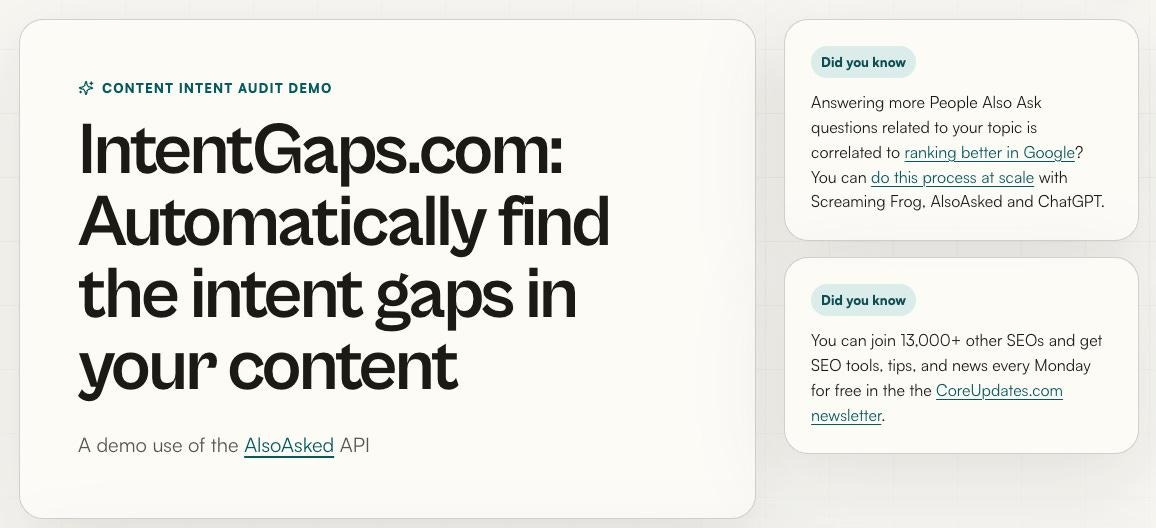
💜 Why Do I Love It? Editorial planning based on intent data Real , not based on guessed keywords . I LOVE IT!! Three concrete actions — check that you cover the obvious questions , identify those that deserve a new section, AND… spot those that justify a dedicated page (with a highly relevant internal link ) .
👋 That’s all for this month! Thanks for reading. I’ll see you again in June with the same format.
No posts
Comments
Nothing yet. Say the first thing.
Sign in to join the conversation.