
Big News! 🎤 Join Andy Crestodina (and me 🥳!!) at Content Jam 2026.
On April 22nd, I’m in Chicago for something special. I’m joining Andy Crestodina Andy Crestodina and Orbit Media Studios Media to lead a 4-hour deep dive on the most important topic in marketing right now: “AI Search: How AI Decides Who Gets Recommended”.
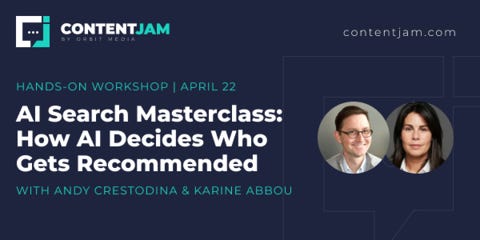
No fluff. Just 4 hours of tactics and strategy on how to ensure AI (Gemini, ChatGPT, Perplexity) actually know—and cite—your brand. It’s happening in the best city in the States, at the best lead-gen agency in the business. Are you joining us? 🙌.
🟣 Cloudflare is trying to build a two-speed web. (Proceed with caution.)
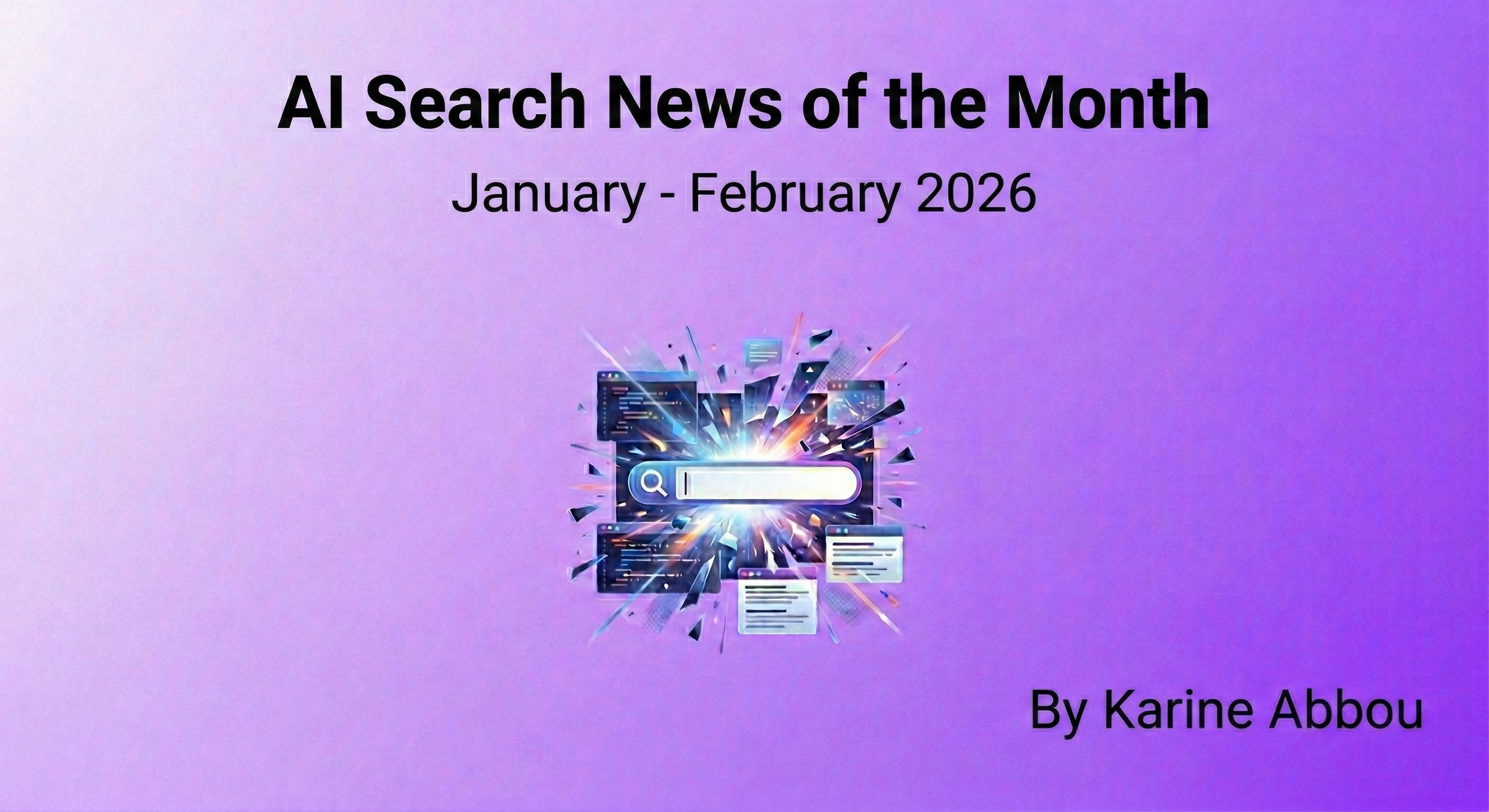
On February 13th, Cloudflare quietly launched a feature every CMO should have on their radar: Markdown for Agents. A pretty historic announcement: for the first time, a major infrastructure player — powering roughly 20% of the web — is officially offering to serve machines a different version of your pages than the one humans see. And doing it completely “legally.” Let me explain.
What it actually does: AI crawlers hate HTML. Too heavy, too noisy, too token-expensive. A blog post that weighs 16,180 tokens in HTML drops to 3,150 in Markdown — a lightweight, clean text format. That’s an 80% reduction. Cloudflare now automatically converts your HTML to Markdown at the network level — in real time — whenever an AI agent requests it.
The question is: when the AI knocks on your door, do you answer in a language it actually understands?
Thanks to this automatic conversion, Cloudflare offers a “clean” option. For you and your human visitors: nothing changes. For ChatGPT, Claude, or Perplexity: your site becomes a perfectly readable document — no HTML noise, no ad scripts, no navigation menus. And contrary to what you might think, it doesn’t create a separate URL — just a different representation of the same page based on request headers.
Why it matters: A typical HTML page costs an AI up to 16,000 tokens to process. The Markdown version: 3,000. Cheaper to index, faster to read, fewer hallucinations. Your content mechanically has a better shot at being cited.
The caveats — and they’re worth taking seriously: John Mueller at Google called it a “stupid idea” — LLMs were trained on normal web pages from the start, so why show them something no user ever sees? Microsoft echoes the same concern. Fabrice Canel piles on: serving a Markdown version doubles crawl load, and Bing will check both versions for consistency anyway. And SEO consultant Jono Alderson raises the real underlying issue: the moment two representations of the same page exist, AI systems have to decide which one reflects reality. “You’re not removing clutter — you’re removing judgment and context.”
The most serious risk? Cloaking. What some SEO experts are calling the “ghost web”: sites could inject hidden instructions or manipulated product data exclusively into the Markdown version — machine-only content that humans never see.
👀 My 2 Cents:
Let’s be honest. Cloudflare didn’t invent anything. They just officially scaled up a practice as old as SEO itself — one that used to live firmly in the Black-Hat category and that Google officially classifies as spam: showing one version of your site to humans, another to machines. Before, the machine was Google. Now it’s AI agents. Same game, new players.
And Google’s disapproval? Not exactly a surprise. Google built a $2 trillion empire teaching us to create content that fed its algorithm. Now someone else is writing the rules for the machine layer. Of course they hate it.
That said, the arguments against are serious and deserve airtime. Two versions of your content means two versions of your truth. AI systems will have to decide which one to believe. The real, concrete risk: a product page could show accurate prices to humans while feeding AI agents manipulated comparisons. That’s not optimization. That’s deception. And control mechanisms on the AI agent side are still embryonic — which is exactly why some people are rushing to exploit the gap right now. I know marketers testing this quietly. It can work. For a while.
Quick reminder that’s not entirely useless: BMW (not exactly a small brand) tried cloaking once. Google handed them what the British press called the “Death Penalty” — complete deindexing. AI platforms will do the same, and faster.
Two things to take away as a business leader: These decisions can’t be delegated entirely to your developers. The business risks are too significant to stay in the technical room. You need to be part of the conversation.
Should you adopt Markdown? Case by case — but caution is warranted. We don’t have enough hindsight yet. And to play it safe: the best page to get cited by an AI is exactly the same one that works for your users. Well structured, clearly written, technically solid. No dark magic required.
As my law professor used to say: “If you won’t be honest out of conviction, at least be honest out of intelligence.” The price of algorithmic deception has always been too high. Nothing suggests that changes with AI.
📎 Source : Introducing Markdown for Agents — Cloudflare Blog
🟣 Ads are coming to ChatGPT. And they cost a for-tune.
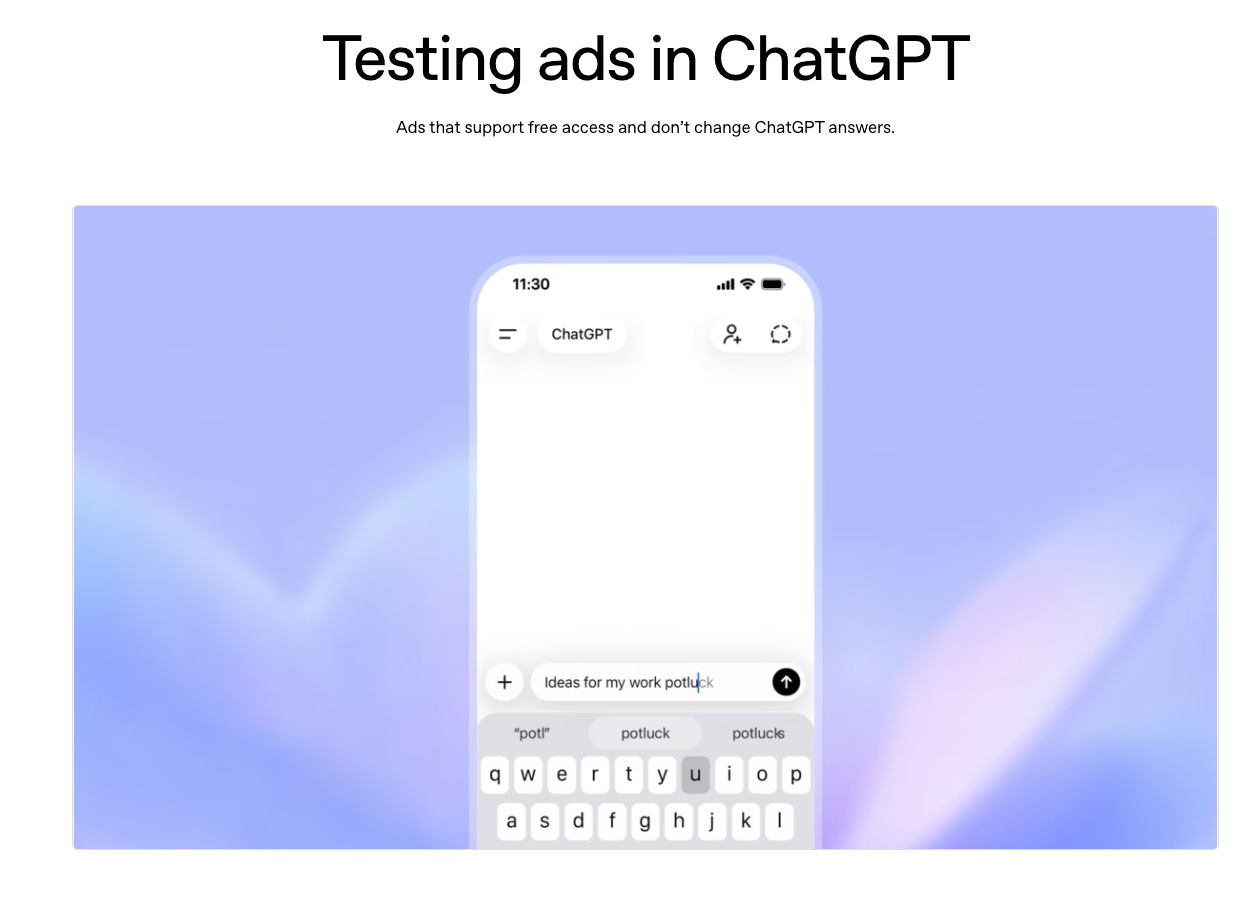
On February 9th, OpenAI officially launched its first ads in ChatGPT. Currently limited to free users and the Go plan in the US. Plus, Pro, and Enterprise subscribers won’t see them. For now.
The price tag? Sit down. $60 CPM — cost per 1,000 impressions — versus $8–9 on Meta, $4–6 on TikTok and YouTube, and around $27 for premium streaming like Netflix. Translation ? ChatGPT is positioning itself above premium TV out of the gate. And there’s more. Minimum spend for advertisers is set at $200,000. No room for SMBs. Big brands only — led by agencies like WPP, Omnicom, and Dentsu, with clients in retail, software, and travel.
The format? Ads displayed at the bottom of ChatGPT responses, clearly labeled as sponsored, triggered by conversation context. OpenAI promises ads don’t influence responses and advertisers don’t get access to user conversations. On the measurement side though: zero conversion tracking, zero attribution, zero measurable ROI. Impressions and clicks only. In 2026. Welcome to classic display, AI remix.
While OpenAI was launching ads, Anthropic went straight for the jugular. Their Super Bowl campaign — darkly comic scenarios where a chatbot interrupts an intimate conversation to recommend a cougar dating site — shot the Claude app from 41st to 7th in the US App Store, with a 32% download spike. The tagline: “Ads are coming to AI. But not to Claude.” Simple. Effective. Painful for OpenAI. Sam Altman, visibly irritated, called Anthropic’s ads “clearly dishonest” and “deceptive” — which is exactly the reaction Anthropic was hoping for.
The supreme irony: as OpenAI opens the advertising floodgates, Perplexity — which had launched its own ad network — is reversing course and ditching ads to refocus on a subscription model. Two visions. Two opposite bets on the future.
👀 My 2 Cents:
Ads in AI is THE trap that’s been set for OpenAI since the beginning (I’ve written about it before). And they jumped in with both feet. Read the post by Fidji Simo announcing ChatGPT ads. It reads less like a blog post and more like a 4-point legal disclaimer: no, ads don’t influence responses. No, advertisers can’t access your conversations. No, your data isn’t being sold. No, AI objectivity isn’t compromised. When you spend that much time saying what you’re not doing... you know exactly what everyone’s thinking.
The real risks are real: content objectivity, information neutrality, data privacy. And then there’s the elephant Sam Altman tried to flip into a marketing argument — “AI should be accessible to everyone, not just those who can pay” — casting himself as the Robin Hood of artificial intelligence. Rich, given that OpenAI has committed to $1.4 trillion in infrastructure spending over eight years, largely financed by Microsoft. Robin Hood... seriously?
On the numbers: the model is hard to defend right now. ChatGPT offers neither the scale of major media nor the measurement sophistication of mature digital platforms. At $60 CPM with no conversion tracking, you’re paying a lot for a promise. Worth testing? Maybe, for large premium brands hunting new territory. But to drive ROI? Nobody can tell you. Not even OpenAI.
📎 Sources: OpenAI — Testing ads in ChatGPT | Ads in ChatGPT Help Center |
🟣 Profound raises $96M and hits unicorn status. GEO is officially an industry.
Profound, barely 18 months old, just closed a $96M Series C at a $1 billion valuation. Lightspeed Venture Partners led the round, with Sequoia Capital, Kleiner Perkins, and South Park Commons joining. Total raised: $155 million.
What is Profound? One sentence: the marketing platform for the AI era — helping brands understand, control, and scale their presence in AI Search. Simply put, their software tracks how AI models describe and recommend your brand across millions of real queries — not just whether you appear, but why, and what your competitors are doing differently. Their internal research shows up to 90% of sources cited in AI responses can change over time, and different models draw from largely distinct source sets. In other words: optimizing once for one search engine no longer cuts it.
Numbers that hit hard, 18 months in: 700+ enterprise clients, including 10% of the Fortune 500 — Target, Walmart, Figma, MongoDB, U.S. Bank. And a new product launched this month: Profound Agents — autonomous workers that generate and distribute marketing content in real time, covering content, monitoring, AEO, and PR, letting marketing teams scale their AI presence without constant manual effort.
👀 My 2 Cents:
When top-tier investors put a billion dollars on an 18-month-old startup, the message is pretty clear: visibility in AI will be the most important marketing category of the next decade — and it will surpass budgets traditionally allocated to paid search.
Second message: urgency. This new marketing imperative isn’t something to plan for in two years. It was needed yesterday. The market confirms it: 32% of digital directors have declared GEO their #1 priority for 2026, up from 12% in 2025. This is no longer interest — it’s a budgeted strategic mandate.
But the real signal? This record investment financially validates that the critical marketing infrastructure of tomorrow is the agentic web. We’ve officially entered the era of agentic marketing. After Adobe’s acquisition of Semrush a few months ago, this raise drives the point home.
Meanwhile, legacy SEO players trying to pivot to AI Search are doing their best to be “gracious losers” — with... let’s say, pointed congratulations. You can’t really blame them.
📎 Source: As AI threatens search, Profound raises $96 million to help brands stay visible
🟣 Bing does what Google refuses to do: shows you how AI cites your content.
On February 10th, Microsoft launched a public preview of a feature that should have existed from day one of AI Search: AI Performance in Bing Webmaster Tools. For the first time, you can see how often your content is cited in AI-generated responses — with clear visibility into which URLs are referenced and how that activity evolves over time.
The dashboard gives you four new metrics:
total citations of your site in AI responses;
average pages cited per day;
“grounding queries” — the internal queries AI uses to fetch your content;
and citation activity by URL, to identify your most-referenced pages.
Coverage includes Microsoft Copilot, Bing AI summaries, and select partner integrations.
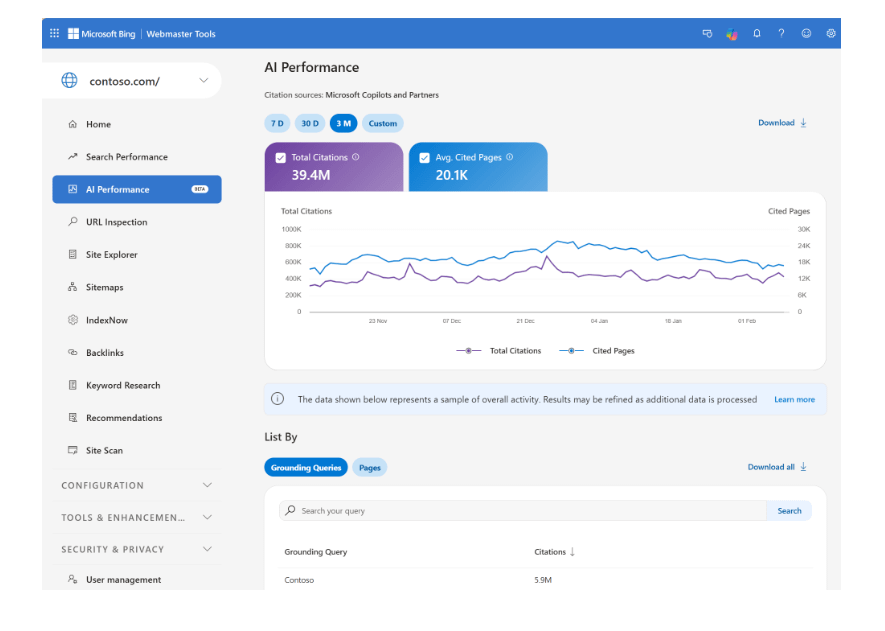
The limitation? These metrics show citation frequency only. They don’t indicate ranking, placement in the response, or — the real missing piece — whether citations actually drove clicks or traffic to your site. Microsoft acknowledges this and promises more data throughout 2026.
The SEO community’s reaction? Unanimously positive. Aleyda Solis called it “the first official AI Search visibility tool.” Wil Reynolds exclaimed: “Bing is finally giving us grounding queries!” The full wave of reactions is over at Barry’s roundup.
👀 My 2 Cents:
Pause. A search engine just created the first official GEO measurement tool in history. This isn’t small news. It’s institutional validation that GEO is a real discipline — with real metrics, a real dashboard. No longer a trend for SEO geeks. A measurable economic reality. And a kick in the door of the opacity that’s defined AI visibility for the past two years... courtesy of Google.
Now, the elephant in the room: this is Bing. Not Google. And that changes everything.
The SEO reaction is pretty unanimous: “I wish this had been Google or ChatGPT. We need this type of reporting. Too bad Bing/Copilot doesn’t have the users Google or GPT does.” That’s exactly the problem. The tool is excellent. But the platform is still marginal. ChatGPT holds over 80% of global AI usage. Google AI Mode is growing. And Bing... is still Bing.
So why does it still matter for you? Two reasons. First: this competitive pressure may eventually push Google to build equivalent reporting. Bing has always led on transparency — Google has often followed, in a watered-down version, but it has followed. Second — and this is the real strategic lesson — if you’re not measuring your AI visibility yet, start now. Not because Bing is the priority. But because grounding queries — the internal queries AI generates to retrieve your content — are a unique window into how machines think about your brand. What you learn there, you apply everywhere. Including for ChatGPT and Google AI Mode.
Measuring AI visibility is no longer optional. It’s a baseline skill. And it’s official confirmation that traffic is no longer the Holy Grail it was for 25 years. The AI Search industry is structuring itself. Fast.
👀 Other AI Search news worth your attention
I publish the full newsletter — covering all tactical and strategic aspects of AI Search (trends, key stats, tools, content creation and distribution in the AI era) — every Monday 🇫🇷 and Tuesday 🇺🇸.
🟣 Google AI Mode is coming in French. Just not necessarily to France.
Google has updated the official language list for AI Mode: French is now included. Good news on the surface — except supported language ≠ available country. France doesn’t appear on the list of countries where AI Mode is live. Belgium, Switzerland, Luxembourg — yes. France — no. European regulatory constraints (AI Act, GDPR) likely explain the glaring absence. Translation: you might access it in French... from abroad.
📎 Google — AI Mode availability
🟣 Microsoft creates a marketplace to pay publishers when AI uses their content.
Microsoft is launching the Publisher Content Marketplace (PCM): a platform that lets publishers license their content to AI systems and get paid based on the value delivered. Publishers set usage terms; AI builders access premium licensed content. Voluntary opt-in, transparent usage reporting. Co-designed with Business Insider, Condé Nast, Hearst, The Associated Press, Vox Media, and others. Signal to watch: it’s the first formal infrastructure for compensating content creators from AI platforms. If it scales, it structurally reshapes the relationship between content producers and AI engines. Key word being “if.”
📎 Building Toward a Sustainable Content Economy for the Agentic Web
🟣 Google is reinventing the purchase journey. Your site becomes the checkout, not the salesperson.
Google is developing a Universal Commerce Protocol (UCP) with Walmart, Target, Shopify, Etsy, and Wayfair — an open standard that gives AI agents a “common language” to manage the entire purchase journey: discovery, comparison, checkout, and post-purchase support. Native Checkout lets users complete a purchase directly inside AI Mode or Gemini, with zero redirect to your site. Vidhya Srinivasan, VP Ads & Commerce at Google, summed it up: “We’re not just bringing ads to AI experiences. We’re reinventing what an ad is.”
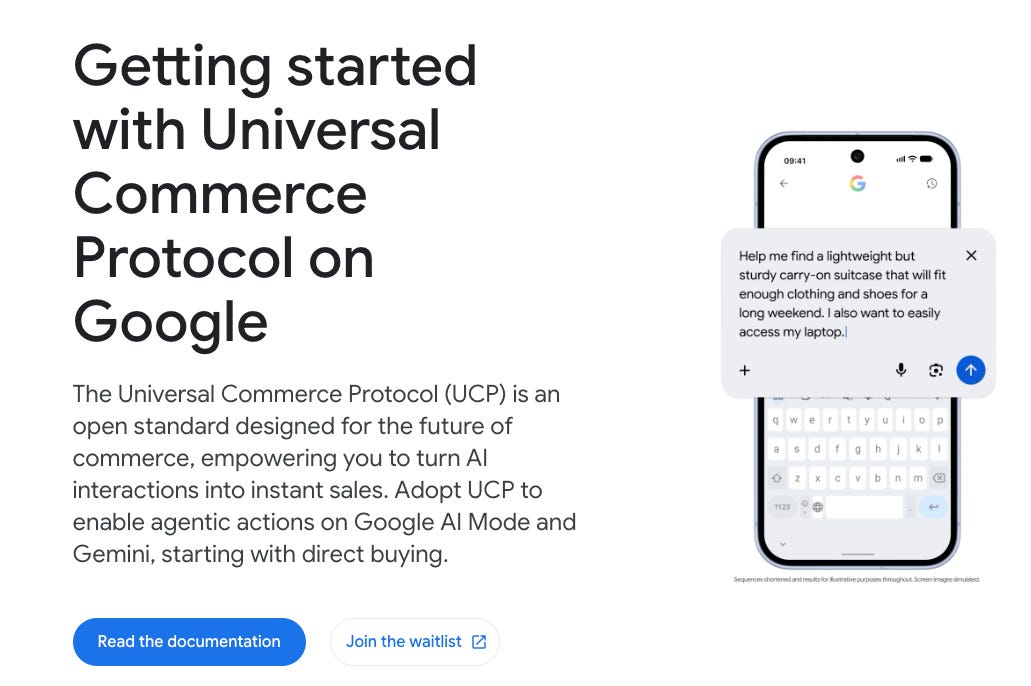
This isn’t an advertising story. It’s an existential strategic story. What Google is building is the end of the purchase journey as you know it. Discovery → evaluation → checkout: all happening inside the AI interface. Your site becomes the transaction layer, not the decision layer. The UCP is a concrete technical protocol. If your product listings don’t “speak” this language, no AI agent will be able to recommend you, compare you, or sell you. The real question for your board: has your e-commerce strategy factored in the possibility that customers are deciding inside AI before they ever come to you?
📎 Google’s Universal Commerce Protocol (UCP)
🟣 Google Search Console gets an AI upgrade: analyze your data in plain language.
Google Search Console is rolling out its AI configuration tool for everyone: instead of manually setting up your filters and comparisons, you just describe the report you want in natural language and the AI handles it. Useful for non-technical marketing teams. Notable limitation: it only covers the Search Performance report. Not Discover, not News. Log into your Search Console and look for the “New! Customize your Performance report using AI” banner. The bigger question: is this Google’s timid, slightly off-topic response to the AI visibility transparency that Bing just took the lead on? Maybe. But honestly, it doesn’t quite hit the mark.
🟣 Google acquires ProducerAI and folds it into Google Labs.
The platform lets you create and refine music via generative AI, powered by Lyria 3, Gemini, and Veo. What sets it apart from other tools: a conversational interface. Not a simple “prompt → result.” A genuine back-and-forth collaboration with an AI agent. For content creators: a strong signal. Google is building an ecosystem where everything is created, published, and distributed without ever leaving its platforms. Google as THE AI brand...? Honestly, we’re nearly there.
🟣 Bing rolls out multi-turn search globally.
While scrolling results, a Copilot box appears at the bottom of the page for follow-up questions — without starting over. Conversational search is settling in everywhere. Another Bing answer to Google AI Mode, which does exactly the same thing. The underlying trend: search engines want us inside their walls, and they’ll do whatever it takes to keep us there.
🟣 HubSpot pivots to agentic AI and redefines what a CRM is.
Yamini Rangan announces the “Agentic Customer Platform”: a system where humans and AI agents collaborate around a single context layer — customer data, decision history, business knowledge. The CRM-as-record-keeper is dead. It becomes the operational brain of the entire company. Reading this, my main thought is: an AI agent that doesn’t know your brand, your products, your tone, and your real customer cases can’t represent you properly in AI responses. Before optimizing to get cited by ChatGPT, structure your internal context. What AI doesn’t know about you, it can never tell your future customers.
Comments
Nothing yet. Say the first thing.
Sign in to join the conversation.