
For a cultural moment in which fanfiction and smut continually appear on the New York Times bestseller list, one would expect an entire subcategory of cinematic auteurs working in the field of sexual depravity. This hasn’t been the case, in large part because of how much TV shows like Bridgerton and Heated Rivalry have gobbled up the genre. But this deficiency of big-screen smut is also a key reason for the rise of Emerald Fennell, one of the few filmmakers working today (give or take a Luca Guadagnino) whose filmography is based principally on sensual thrills.
In 2020, Fennell exploded onto the filmmaking scene with Promising Young Woman, a post-#MeToo rape-revenge story brimming with righteous rage. Saltburn, her sophomore effort, had a similar vision of underclass individuals seeking sexual revenge against their social superiors, this time with a satirical eye on the British class system. Both films were tremendously divisive. Her particular blend of evocative visuals, shifting social dynamics, and sexual schadenfreude operated as a litmus test for provocative cinema. (I myself found the thematic intentions of Promising Young Woman an effective gambit; on the other hand, I am the world’s foremost Saltburn hater.)
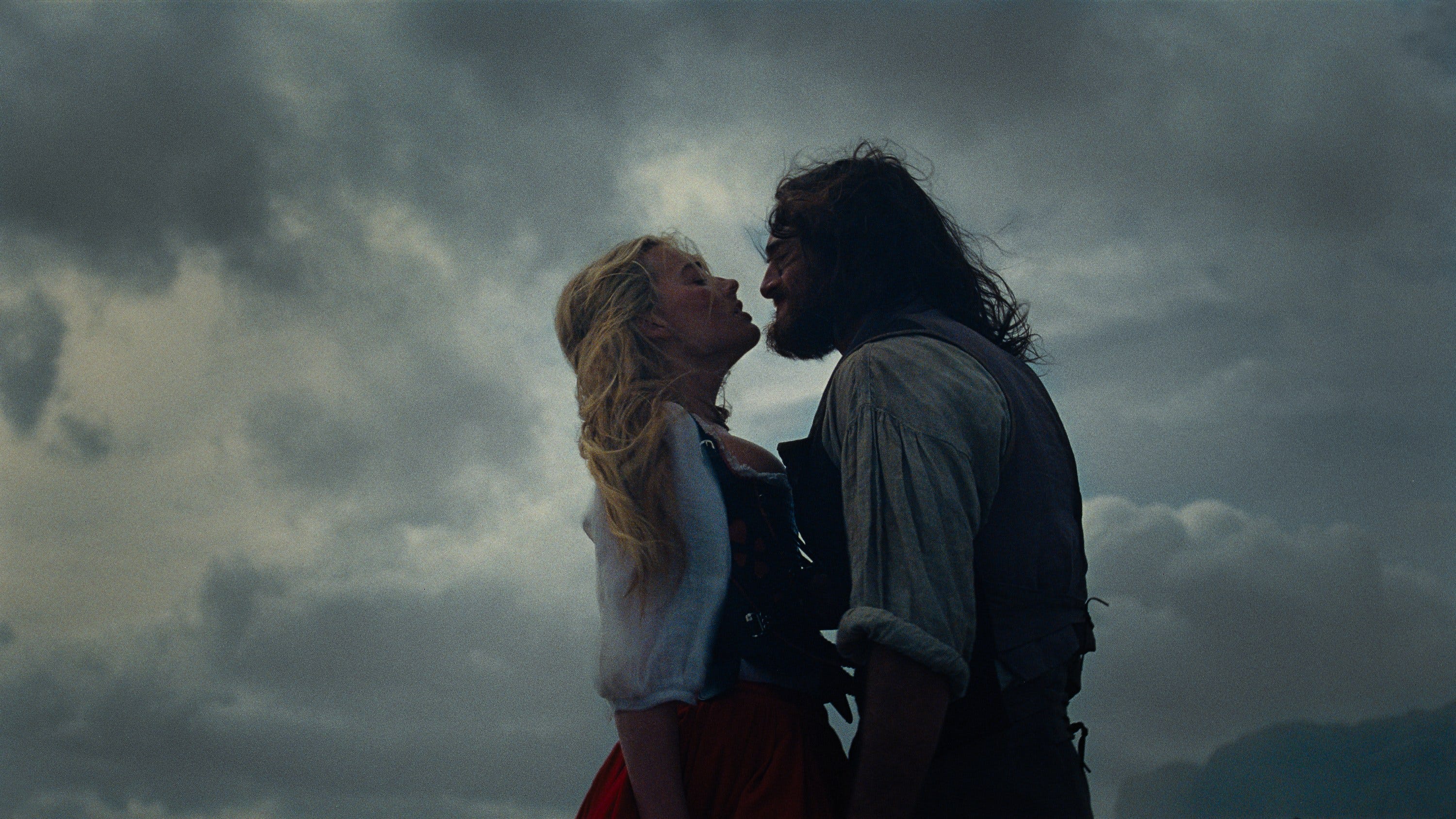
“Wuthering Heights”, her third feature, blows up Fennell’s provocation-for-provocation’s-sake filmmaking style to blockbuster scale, and in some ways is the better for it. Whereas her previous films tilted at social commentary, this $80 million epic is a big-budget romance and has no pretentions of being anything else. With sweeping, rouged vistas that foreground a star-crossed romance between Catherine Earnshaw and Heathcliff (played by Margot Robbie and Jacob Elordi in what is the most Botox-friendly portrayal of these two characters ever put to film), Fennell has concocted an Emily Brontë adaptation that pulls equally from Romeo + Juliet as it does MGM musicals. The film is an intoxicating visual cocktail, teeming with liquids: egg yolks appear as an image of viscous longing; the film lingers on an image of a slug’s mucus trailing on a window. Such a stirring focus on fluids goes some way in explaining the film’s triumph at the global box office: audiences are starved for big-screen romance, and “Wuthering Heights” presents a lurid vision of love.
But these stylistic purchases, however compelling, are distractions from the film’s woeful lack of depth. I am not one to criticize literary adaptations on the basis of what has been added or removed, and I likewise do not begrudge Fennell’s fundamentally altering “Wuthering Heights” from revenge story to tragic romance. (After all, it’s been done enough times.) But something has been lost in Fennell’s reading. “There’s a version that I remembered reading that isn’t quite real,” explains Fennell, describing her reason for putting the film’s title in scare quotes. “And there’s a version where I wanted stuff to happen that never happened. And so it is ‘Wuthering Heights’, and it isn’t.”
“Wuthering Heights”, then, isn’t so much an adaptation of the 1847 Emily Brontë novel as it is Fennell’s attempt to recapture her memory of reading it as a horny teenager. In this interpretation, Catherine is a petulant young girl (Charlotte Mellington) born to the wealthy Earnshaw family of the Yorkshire Moors. Her father (Martin Clunes) is a villainous, abusive sort who one day brings home a young boy (Owen Cooper) rumored to be his illegitimate son, and who Cathy names “Heathcliff” in an act that approximates something between formally adopting a brother and taking ownership of a pet. Such is the basis for the psychosexual tryst that the two develop in their later years, in which the love between a peevish young noblewoman and her hunk of a servant is constrained by their class.
This setup elides or removes numerous characters and plot points from the source material, most notably the character of Hindley, Catherine’s brother and Heathcliff’s years-long tormentor. In the novel, Hindley’s bullying is a key reason for Heathcliff’s quest for vengeance against the Earnshaw family; in “Wuthering Heights”, Heathcliff returns to Catherine purely for love. There isn’t anything inherently wrong with such an act of radical reimagination, but it’s hard to ignore the sheer fanfiction of it all: Elordi’s overly swooning performance as Heathcliff and Robbie’s discordantly juvenile interpretation of Catherine are clear byproducts of Fennell’s need to realize her fifteen-year-old self’s dream of seeing these two characters in love.
And boy, does she show these two characters in love! Much like Saltburn, a film that reveled in the slurping of human liquids, “Wuthering Heights” conveys romance through sexually suggestive setpieces that fail to produce anything meaningful. Fingers are constantly being inserted into mouths before grandiose backdrops, reinforcing Fennell’s desperate need to titillate and inflame. Her visual capacities are sometimes so astonishing that you want to forgive her shallowness—the design of Wuthering Heights and Thrushcross Grange are particularly supple, filled with objects and patterns that would not be out of place in 1920s German expressionism. But there’s always that creeping feeling of a fifteen-year-old behind the camera, giggling with each passing act of sexual deviancy.
Fennell’s penchant for visual suggestion is powerful, and it helps explains why her films have gone on to achieve cult status. She has a real capacity for sexual intrigue, particularly as it pertains to young lust—she excels at visualizing emerging libidos. The problem is that lust must eventually give way to love, or at the very least a more sophisticated form of longing, and it is here that Fennell falls short. She is unable to conceptualize feelings beyond desire, and while that might make her an excellent director of music videos, where immediacy reigns supreme, it leaves something to be desired in her feature films. “Wuthering Heights” can’t run on horniness alone.
Dir. Matt Johnson
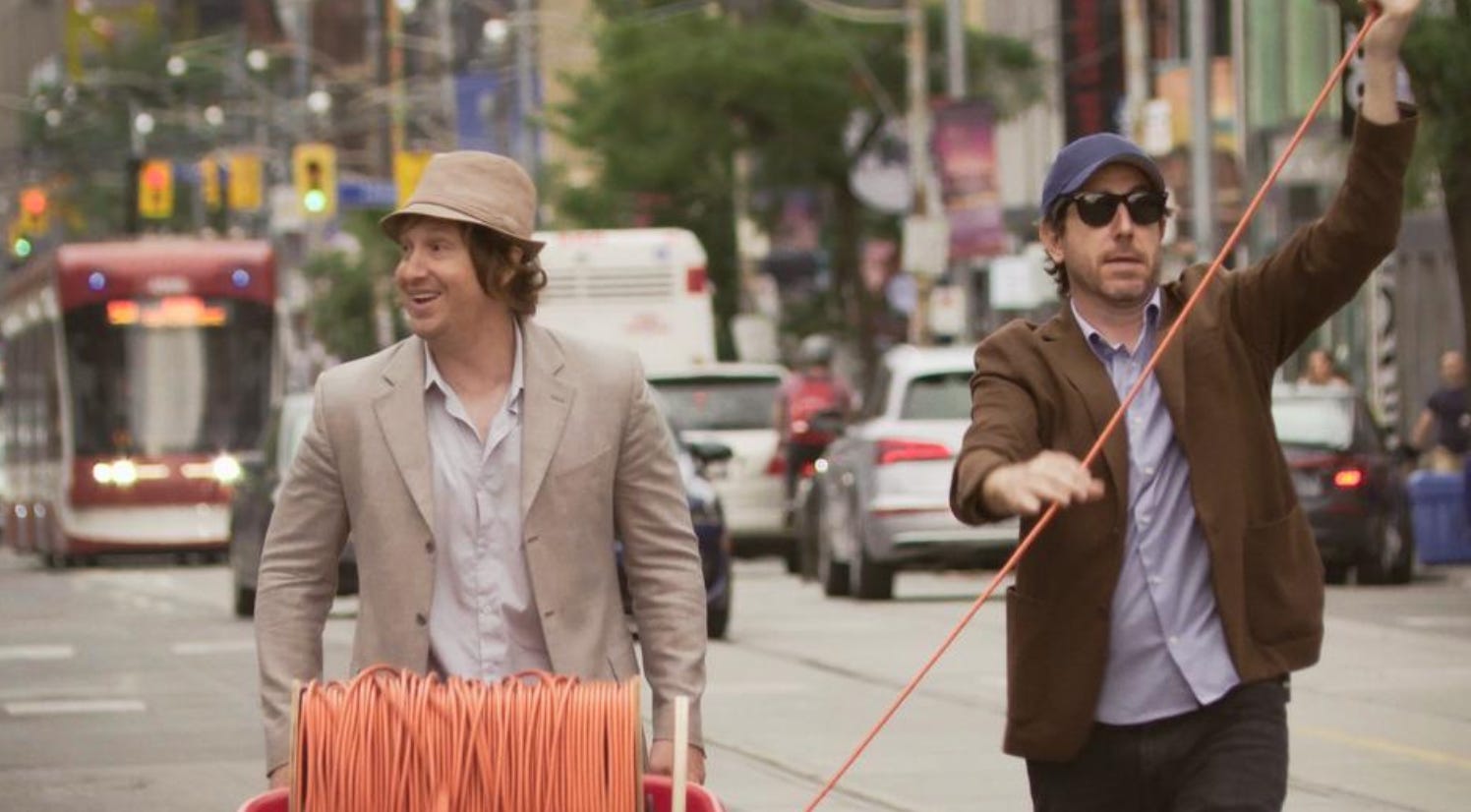
I had not heard of Nirvanna the Band the Show before watching Nirvanna the Band the Show the Movie, and wonderfully, I didn’t have to. The adventures of Matt Johnson and Jay McCarroll, two Toronto edgelords playing fictionalized versions of themselves across space and time, are instantly accessible to audiences that are unfamiliar with The Rivoli or the Wii Shopping Channel’s update day, and we are all the better for it. Nirvanna the Band the Show the Movie is the most delightfully strange comedy film in recent memory: a DIY gem whose hand-made absurdity is as hilarious as it is creatively inspired.
The story of Nirvanna the Band dates back to 2008, when broke filmmakers Matt and Jay concocted a crank webseries about their attempts to get their eponymous band into the Rivoli, a middling performance venue that was last cool during the mid-2000s Toronto indie boom. The series’ running joke centered on the arrested development of these two man-children, who continually convince themselves that the only way to perform live is to trick a venue into letting them do so. The joke of Nirvanna the Band the Show the Movie is that nothing has changed. Seventeen years later, the two are still hatching harebrained schemes to headline the Rivoli—except this time, Jay is considering going solo.
Unwinding as a delirious, deliberately messy hairball of a movie, Nirvanna the Band the Show the Movie takes full advantage of its $5 million budget without ever straying from the webseries’ original premise. What begins as Yet Another Episode of a no-budget Canadian sketch comedy show steadily transforms into a full-blown Back to the Future parody, complete with high-flying stunts (Matt and Jay skydive off the CN tower) and unexpected tenderness at its conclusion. It’s also f*cking hilarious. In other words: one of the best movies of the year.
Thanks for reading Airplane Mode! This post is public so feel free to share it.
No posts
Comments
Nothing yet. Say the first thing.
Sign in to join the conversation.