
Last week, on the keynote stage at Scaling New Heights in Orlando, we got to do something I have been looking forward to since the day we opened nominations: name the inaugural class of the AI Native Accounting Award winners.
It felt like a fitting moment to mark where we are. The podcast turned one year old at the same time, and the Foundation itself is just four months old, which still catches me a little every time I say it out loud given how much ground we have covered already: a stellar Advisory Council to ensure independence, a rigorous nomination and review process run for the first time, a scholarship program launched, and now an inaugural awards class that has shown us the breadth of AI adoption applied in some of the largest firms all the way down to solo-practitioner.
None of this happens without the seven people who turned our nomination process into something credible rather than ceremonial. Tom Hood, Arianna Campbell, Barry Brown, Amy Vetter, Joe Woodard, Ellen Choi, and Randy Johnston each gave their time and judgment to a rubric built around measurable outcomes, governance, and replicability, and the winners below show it. It was no easy task for them to choose the winners!
I also want to thank the sponsors who not only support the Foundation’s broader mission, but were dedicated to recognizing responsible AI adoption: our founding sponsor Digits, along with Truewind, Bill, Karbon, Fieldguide, Black Ore, Aider, Filed, 4impactdata, Vega, and Ignition.
One more thing before we get to the winners: we recorded a podcast episode onsite at Scaling New Heights, so stay tuned for that drop in the coming weeks.
Now, the part I have actually been waiting to write…
∼ Kacee Johnson, Executive Director
Each category reflects a different piece of what responsible AI adoption actually looks like in practice: the governance that makes it sustainable, the implementation that proves it works, and the individual innovation that shows what one person can do. Here is the inaugural class.
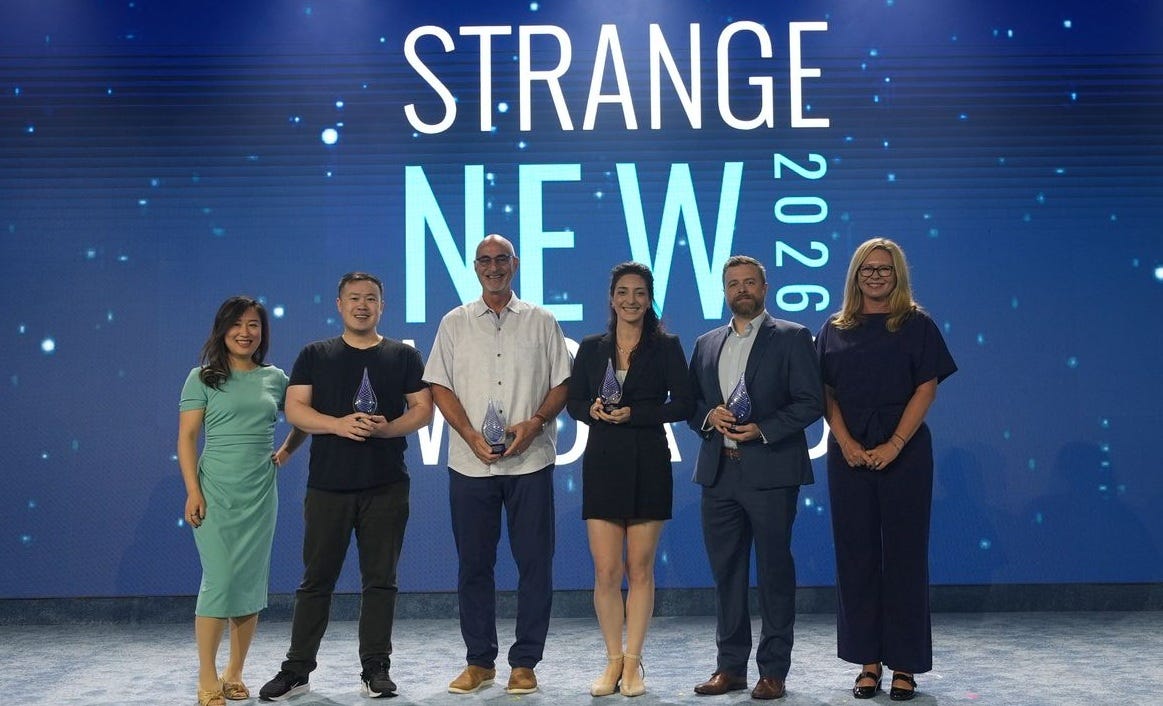
Bebe Kim, Angel Zhen, Tim Sernett, Emily Forden, Mike Anderson, Kacee Johnson
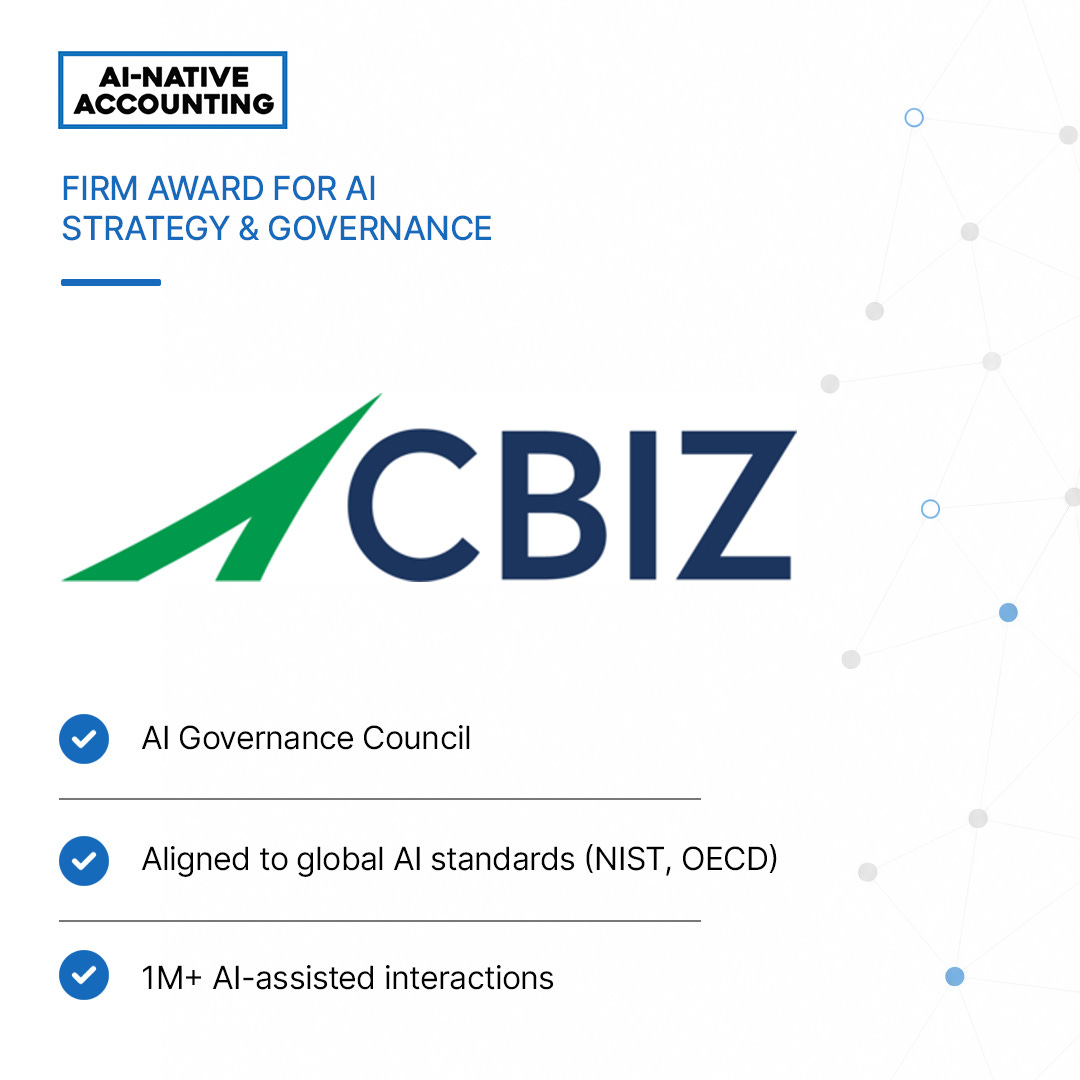
CBIZ built one of the most comprehensive AI governance frameworks we have seen anywhere in the profession: a cross-functional AI Governance Council, a formal AI Usage Policy, and structured training grounded in the NIST AI Risk Management Framework and OECD AI Principles. Built on Microsoft AI, the firm has logged more than one million AI-assisted interactions since launch. What earned them this award wasn’t the scale alone — it was the deliberate infrastructure they built around using it responsibly.
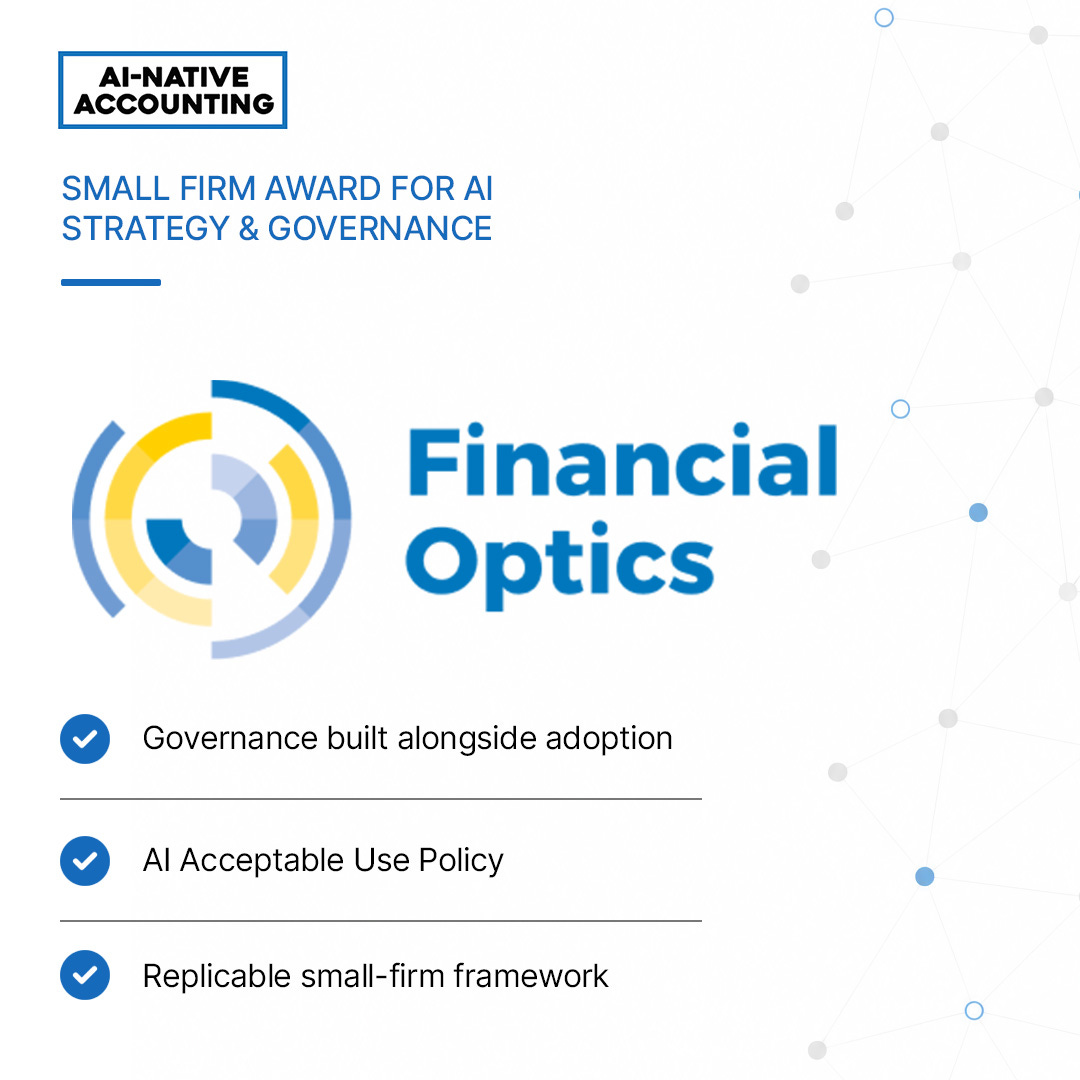
Financial Optics is a three-person boutique firm, and they proved governance isn’t a resourcing problem reserved for large firms. They built their AI adoption on a documented Acceptable Use Policy and an AI Tool Decision Framework that maps tool categories against client-data sensitivity, developing the guardrails alongside deployment instead of after it. It’s an approach almost any small firm could realistically copy.
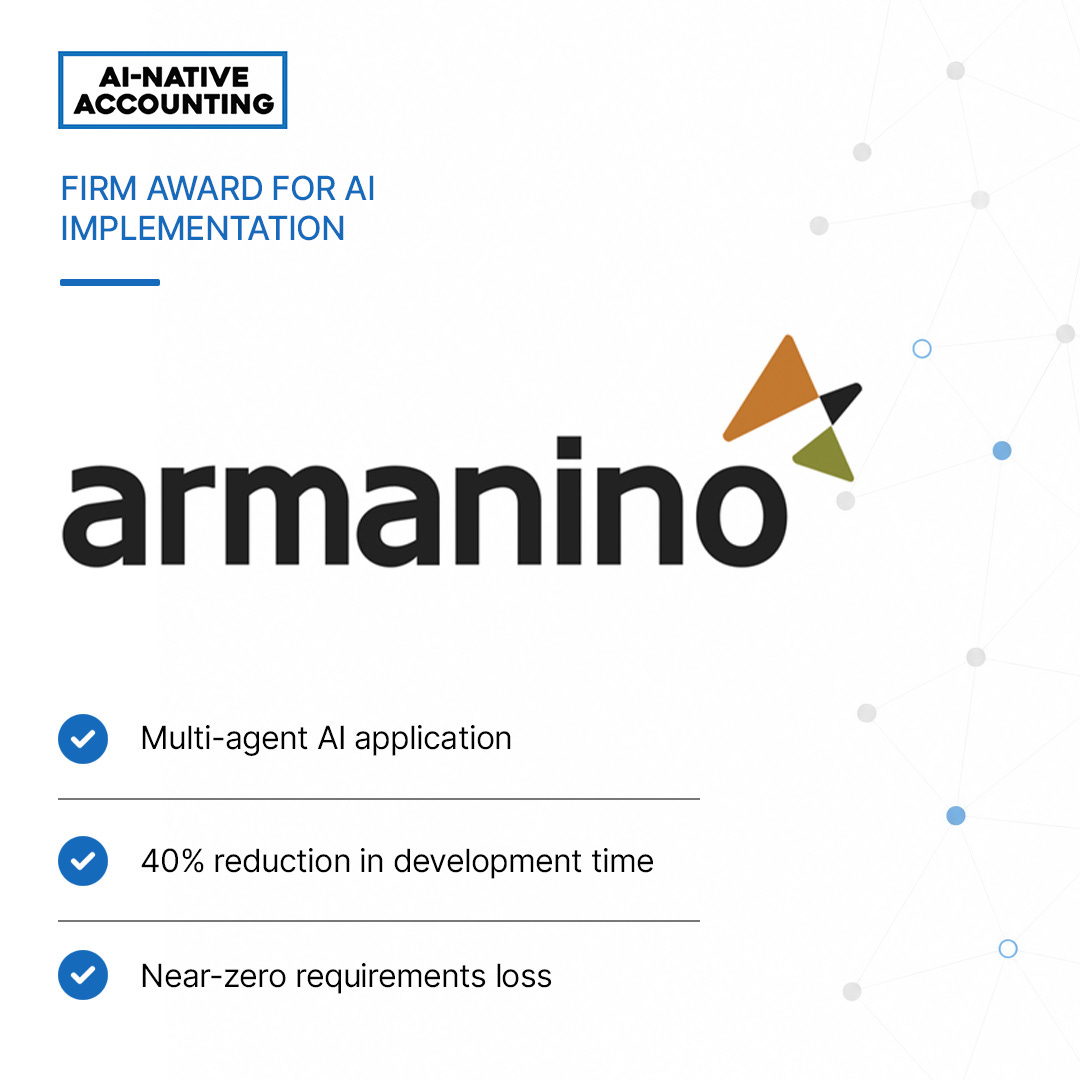
Armanino built and rolled out Requirements Miner firm-wide, a purpose-built, multi-agent AI application that changed how the firm runs client discovery. Consultants no longer have to split their attention between facilitating a conversation and taking notes, because Requirements Miner captures, analyzes, and drafts requirements in real time, with every output traceable back to its source in the conversation — what Armanino calls “glass box AI.” The results: roughly a 40% reduction in requirements development time, one to two weeks eliminated from discovery per engagement, and near-zero loss of requirements.
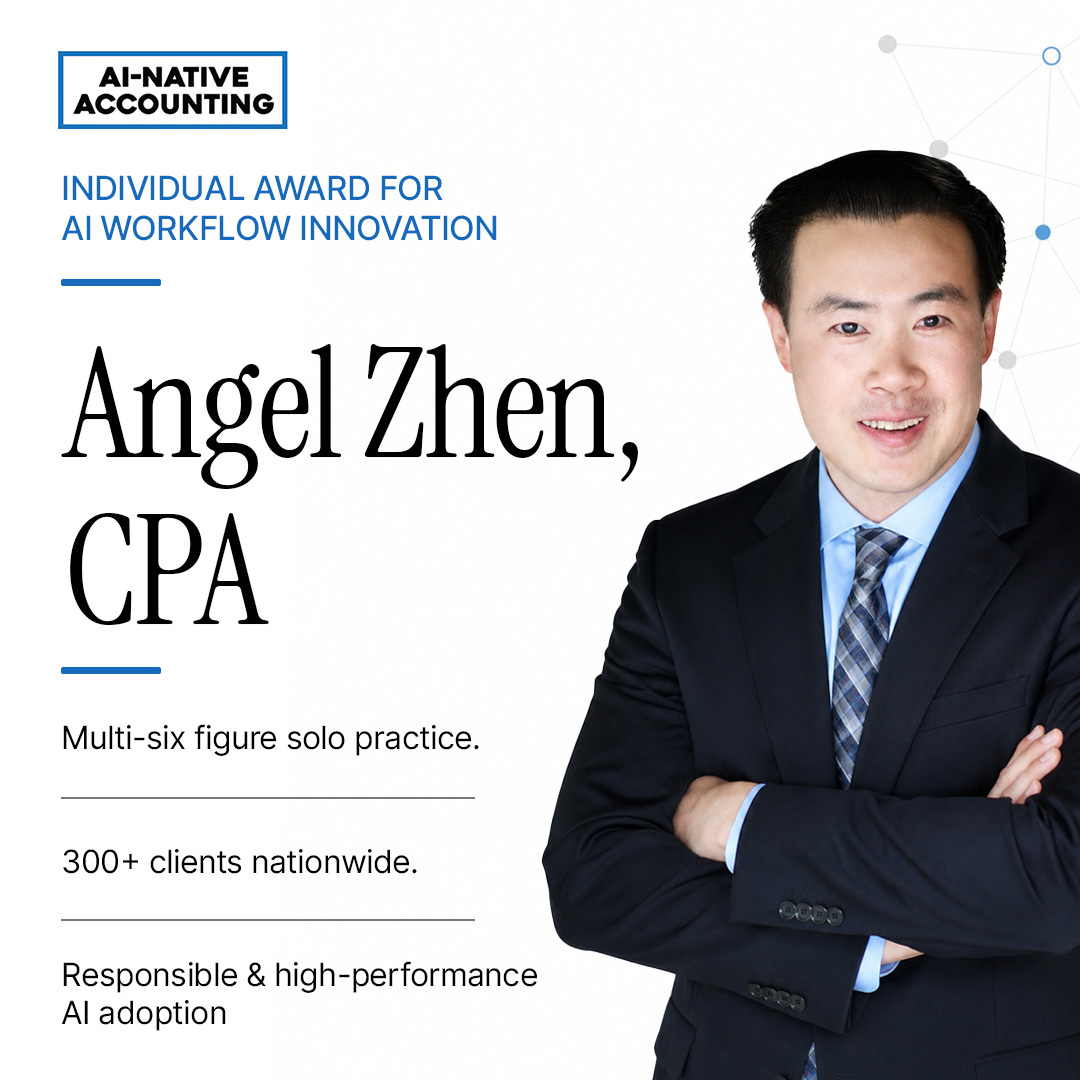
Angel Zhen runs a multi-six-figure solo practice with no employees and more than 300 clients nationwide — all while taking twelve weeks off every year. That’s what responsible, high-performance AI adoption looks like at the individual level, and more importantly, it’s a model other solo practitioners can actually replicate.
“What stood out most in reviewing this inaugural group of award recipients is how broad the field of AI adoption has become. From sole practitioners to top-25 firms, leaders of every size are making meaningful progress. The firms and individuals we recognized are proof that size is no longer a barrier to doing something significant with AI. Whether you’re a one-person practice or a national firm, the opportunity is the same, and so is the urgency. There has never been a better time to start.”
— Barry Brown, Founder, EBITDA Advisors
“It was a pleasure to review the innovative applicants and vote to select these winners. While many more could easily win, this represents the best of the best.”
— Randy Johnston, Founder, Network Management Group
Each of this year’s winners will get a dedicated episode of the AI Native Accounting Podcast, along with a full case study, so the rest of the profession can see exactly what worked, what didn’t, and what they’d do differently.
Applications are also open now for our first scholarship program: two $5,000 awards for undergraduate and master’s students building real AI use cases in accounting, tax, audit, advisory, or finance. Applications close September 15, 2026. Details at ainativeaccounting.org.
Comments
Nothing yet. Say the first thing.
Sign in to join the conversation.