
I was in a conversation recently with a firm leader who had just finished rolling out their AI policy. He was proud of it — and honestly, he should be, because a lot of firms still haven’t done even that much. But when I asked what the policy actually covered, it came down to this: don’t put client data into ChatGPT, get approval before using a new AI tools, and document what you’re using. That is a reasonable starting point but I don’t think it’s enough for where we are headed. Because over the next 12 to 24 months, firms will deploy agents that reconcile accounts, prepare workpapers, route client communications and execute workflows.
Most of the AI governance frameworks that firms have put in place were built for AI that generates output — not AI that takes action. And that distinction is about to matter a great deal, especially for governance frameworks.
When AI was a chat interface, there was a built-in pause. A model gave you an answer, and a human decided what to do with it. You could read it, reject it, or edit it entirely. The worst case was that someone acted on poor advice — which is bad, but recoverable. That forgiving shape is what most current policies were designed around.
Agentic AI removes that pause. An agent that can access client records, run reconciliations, draft and route communications, or execute multi-step workflows isn’t generating a suggestion for you to review — it is doing work, sometimes faster than anyone is watching. And when the action happens before the review, the consequence of an error is no longer recoverable in the same way. This is the shift most firms are not yet governing for.
Sarah Bird, Chief Product Officer of Responsible AI at Microsoft, said something in a recent interview that reframed this for me: the work isn’t about making AI responsible. “Ultimately humans should be responsible,” she said. It is about making AI trustworthy — and trust is never generic. You don’t trust AI in the abstract. You trust a specific system, for a specific task, with specific access, under specific consequences. In accounting, where the work product carries professional liability and the data belongs to clients, that is not a philosophical point…it is an operational one.
So what does governance actually look like when it’s built for agents, not just chatbots? The Council on AI Governance published a practical playbook last year that I think maps well onto where accounting firms need to focus.
The first place to start is AI strategy — not a values statement, but an actual map of where in your firm agents can add value, what your risk appetite is for autonomous action, and how AI decisions connect to your business model. Most firms I talk to have pockets of AI activity everywhere but no real framework for deciding where agents should and shouldn’t operate.
The second is risk and compliance — and this is the biggest gap I see. A policy is a starting point, but what you actually need is a formal assessment process that runs before any agentic tool goes into production, real-time monitoring of what AI is doing once deployed, and clear escalation paths when something goes wrong. This isn’t overhead; with professional liability exposure, it’s the minimum viable governance for playing in this space responsibly.
The third is workforce literacy by role. Not a one-time training you check off, but a living framework for what different people in the firm actually need to understand about the AI they’re using. A staff accountant using an AI tool for document review needs to know different things than the partner who authorized the deployment. Most firms I talk to haven’t drawn that distinction, and when a tool changes or a model is updated, no one knows who’s responsible for making sure the team is current.
The fourth is procurement and oversight — and this one is underrated. Do you know every AI tool that’s actually in use across your firm right now, including the ones that weren’t formally approved? Shadow IT is a huge problem right now! Do you have a consistent process for evaluating new tools before they touch client data? Can you produce a log of what an agent did and why, if something goes wrong? If the answer to any of those is no, that’s where to focus.
Last, Observability – logs, audit trails, approvals and version history become essential once AI is taking action on behalf of the firm.
All of this doesn’t have to happen at once, but firms need to be moving on all four fronts…not just iterating on the acceptable use policy.
One reason we created the AI Native Accounting Foundation Awards was to surface governance models the profession can actually learn from; our inaugural AINA Award winners in AI Strategy & Governance, CBIZ, are the clearest example I’ve seen of what this looks like when it’s done well: a cross-functional AI Governance Council, a formal policy grounded in the NIST AI Risk Management Framework, and structured training that rolled out before they scaled adoption across the firm. We will be building out a full case study on exactly how they did it, and we will be sharing that with the community when it’s ready. If governance is on your agenda this year, it will be worth the read.
The tools your team is already asking for are built for agentic workflows. The question is whether your governance structure is ready to move with them.
— Kacee Johnson, Executive Director
Pascal Finette is the co-founder of radical and one of the sharpest thinkers I know on how organizations learn (or fail to!) when the pace of change outstrips their internal capacity to absorb it. His new book, OUTLEARN, is built around a deceptively simple theorem: the speed of learning is inversely proportional to the cost of failure. The cost of experimentation has dropped by a factor of a thousand. The volume of experiments most firms are running has not kept pace.
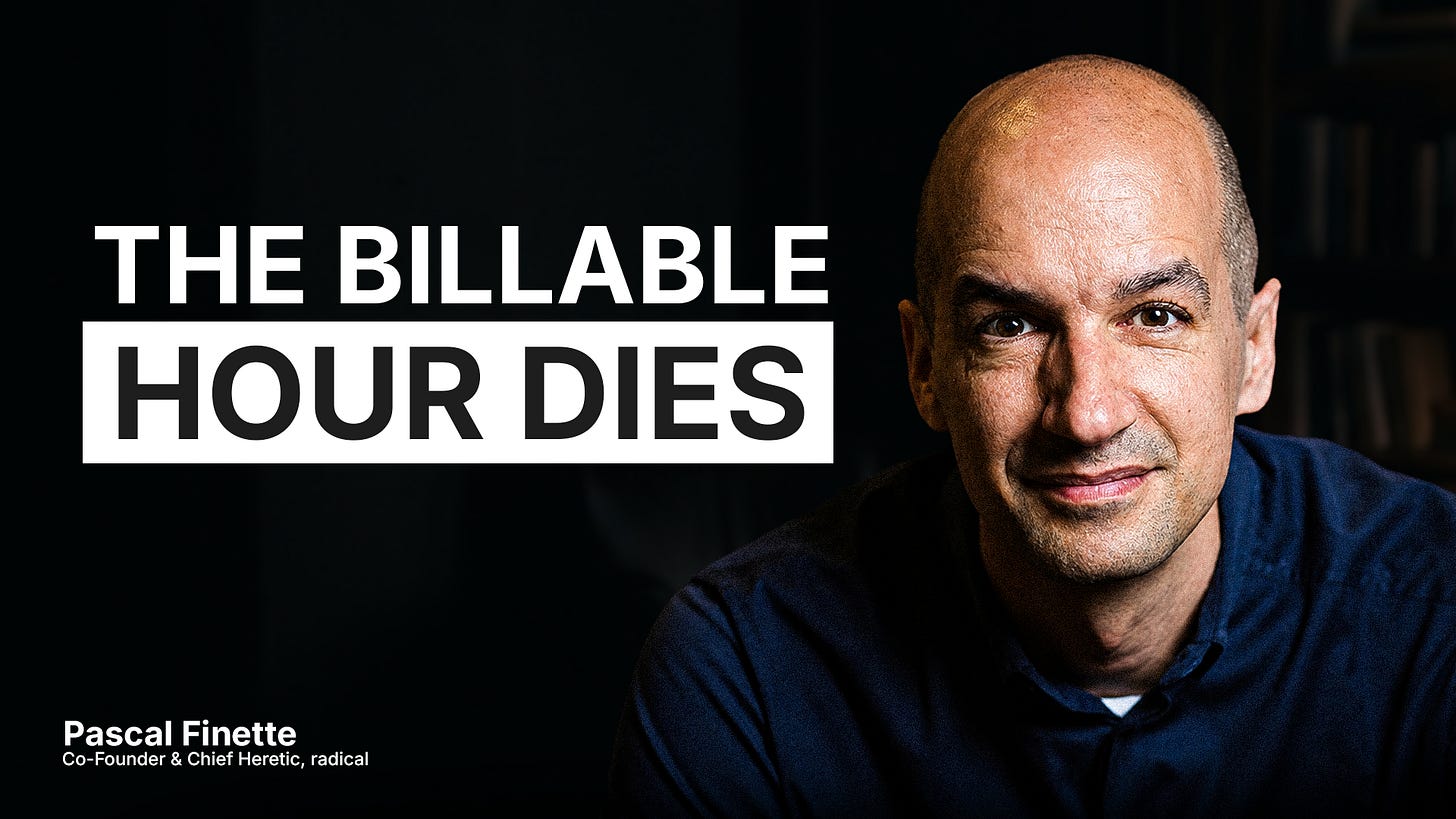
A few things we got into:
· The Consumer–Builder gap: why some teams are getting 10–20% productivity gains while others are seeing 10x to 100x, and what actually separates them
· The Two Engines problem: every firm has an Execution Engine and a Sampling Engine, and the Execution Engine almost always wins. In accounting, where precision is the product, that tension is particularly acute
· What “engineering failure” looks like inside a firm and why the profession’s instinct toward zero-error culture is creating an innovation debt problem
· Who runs Engine 2 at your firm and how to protect it
Stream it on your favorite podcast platform or watch on YouTube. CPE available via Earmark.
We launched the AINA Scholarship Program this year, and applications are now open.
The scholarship is designed for accounting students who aren’t waiting for the profession to catch up — students who are already building, experimenting, and developing practical AI use cases that solve real problems. We’re not looking for essays about the future of AI. We’re looking for students who are already doing the work.
Advisory Council member Arianna Campbell commented on the launch:
“AINA’s scholarship program is exactly the kind of initiative the profession needs because it meets students where the profession is headed. By rewarding students who are moving beyond theory and building practical use cases that solve real problems, AINA is helping surface the creativity and problem-solving our profession needs.”
If you know a student who fits that description, please share the program with them. Details and the application are available at ainativeaccounting.org.
Anthropic published The Founder’s Playbook: Building an AI-Native Startup earlier this year, and while it’s written for founders, the framing applies directly to any team trying to build or evaluate AI-native products.
The through-line of the playbook is that AI-native startups are structured differently from the start; not because they use AI tools, but because they’ve reorganized around AI as infrastructure. The founder’s role shifts from individual contributor to orchestrator of agents. Headcount is no longer the signal of organizational momentum. The traditional validate → raise → hire → build cycle has been fundamentally compressed.
That’s consistent with how we define AI-native at the Foundation, so I want to be explicit about that frame as you read this resource.
We define an AI-native firm as structured around automation-first operations, with roles built for strategy rather than process. Agents handle the routine work (the data wrangling, the document review, the recurring reconciliations) which collapses overhead and frees staff to do the part of the job that machines can’t: interpret, advise, and exercise judgment. The org chart looks different, and the economics look different.
And we define an AI-native solution as built AI-first from the ground up. The workflow, the data model, and the user experience all assume AI is doing the work, not as a feature bolted onto an existing UI, but as the core of how the product functions. The product isn’t “powered by AI.” The product is AI doing the job, with the human in a directing role.
Both definitions matter together. An AI-native firm running on bolted-on tools is going to plateau faster than it anticipates. An AI-native product dropped into a non-native firm produces noise, not progress. The Anthropic playbook is a useful lens for evaluating where your own firm, or the products you’re buying, actually sit on that spectrum.
Got a question or topic suggestion? Comment on Substack or connect with us on LinkedIn.
Comments
Nothing yet. Say the first thing.
Sign in to join the conversation.