
AI Music Revolution is a reader-supported publication. To receive new posts and support my work, become a free or paid subscriber.
🧠 The Bottom Line Under Current U.S. Copyright Law
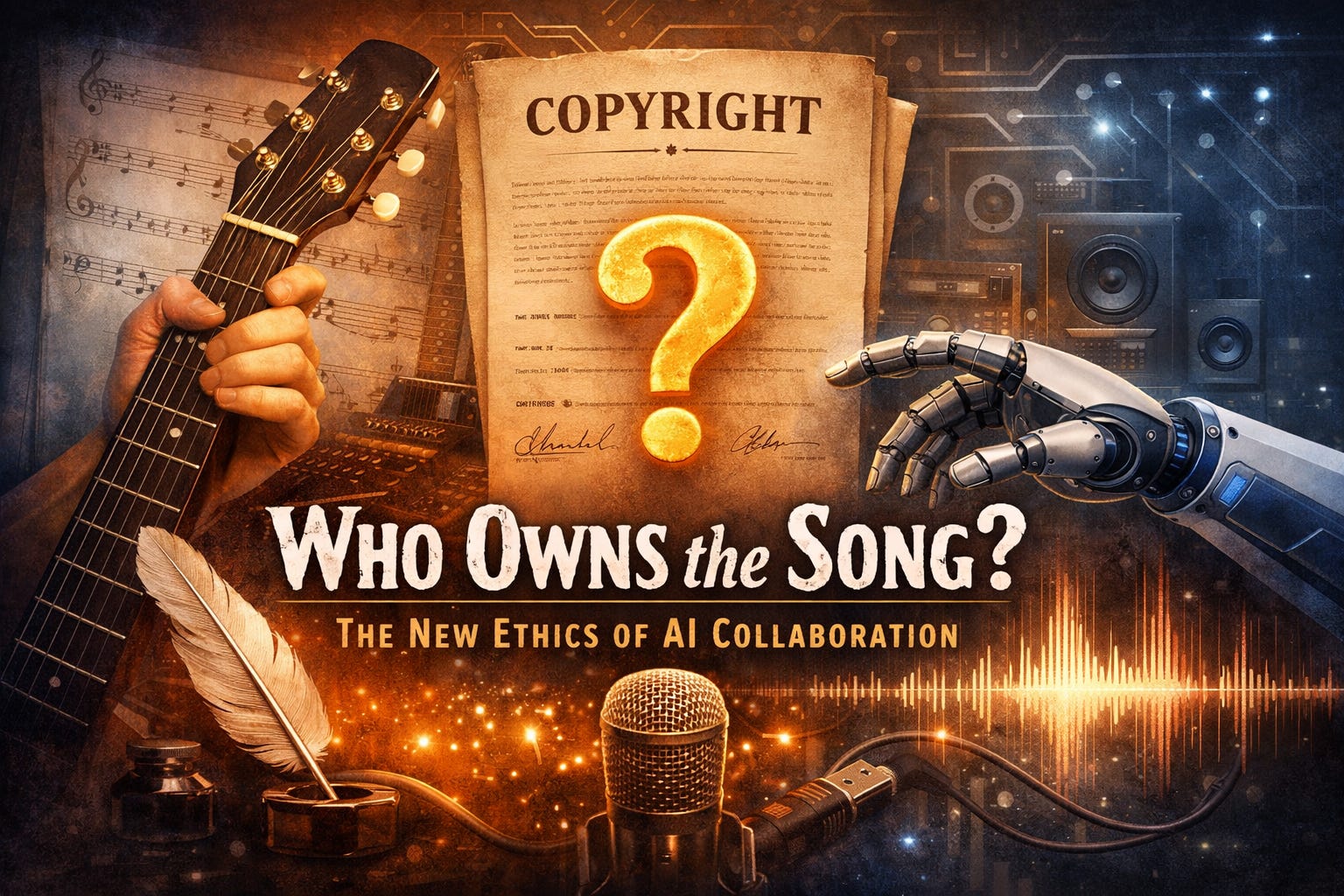
Under U.S. copyright law (similarly in many other jurisdictions), only works that contain meaningful human authorship can be copyrighted. That means:
Music created entirely by an AI with no substantive human creative input is not eligible for copyright protection. In practice, a purely AI-generated song (even if you prompted it) cannot be registered for copyright in the U.S., and anyone could potentially use or adapt it without permission.
AI-assisted music can be copyrighted if a human clearly contributed creative decisions such as substantive edits, composition choices, lyrics, arrangement, performance, or other expressive elements.
So legally, the presence of AI doesn’t automatically destroy copyright — it’s the quality of human contribution that matters.
🎯 What Counts as ‘Human Authorship’?
The U.S. Copyright Office and courts have emphasized that a work must be the product of human creativity to earn protection. That means:
Receiving a piece of music as a starting point from an AI and then shaping it through your own creative decisions is what tilts the balance toward copyright.
Simple prompt entry or minor tweaks may not be sufficient on their own; the contribution must be meaningful and evident in the final work.
In other words, AI is a tool like a synthesizer or DAW plugin — it doesn’t own the song; the human artist does if they are the one shaping the creative outcome.
🧾 AI Training & Derivative Risk
A related legal concern — separate from ownership of a new song — is whether the AI was trained on copyrighted material without permission. Many generative music models are trained on large datasets that may include copyrighted songs, and creators may face infringement claims if the AI outputs resemble pre-existing works.
This isn’t about who owns your song, but rather whether your song itself inadvertently copies — or was influenced by — copyrighted material used in training. That’s a distinct legal risk that’s escalating in lawsuits and industry contracts.
🪪 Disclosure: Transparency vs. Legal Requirement
Regarding disclosure norms:
There is currently no U.S. legal requirement to label a work as “AI-assisted” simply because AI was used.
However, transparency is increasingly becoming best practice — and in some platforms/markets, it may soon be an industry standard, if not a legal standard. For example, some streaming services now tag AI-generated tracks to protect artists and audiences alike.
So, how much transparency is enough?
Legally, simply owning the rights isn’t contingent on disclosure, but ethically and commercially, being clear about AI use:
Helps manage audience expectations.
Avoids reputational risk by not appearing to rely solely on machine output.
Reduces confusion about the extent of human artistry.
💡 Practical Takeaways for Artists
If you use AI tools to help write or produce music:
Document your creative process. Save versions, notes, stems, and edits so you can show your creative contributions.
Treat AI as a collaborator with you, not for you. AI is a tool that can generate ideas, but meaningful human shaping is what anchors copyright protection.
Review the tool’s terms of service. Some platforms grant certain rights to themselves or restrict commercial use. These contractual claims can outweigh copyright law in practice.
Consider transparency as a positive differentiator. Even where not legally required, clear labeling can build trust with fans and industry partners.
In Summary
Pure AI-generated music (no human authorship) is not copyrightable.
AI-assisted music can be copyrighted, but only if a human’s creative contribution is substantial.
Ownership is tied to human agency in the artistic process; AI itself can’t be an author under current law.
Transparency about AI involvement isn’t legally required yet, but it’s increasingly viewed as an ethical best practice.
Let’s hear what you have to say. Leave a comment.
Thanks for reading AI Music Revolution! This post is public, so feel free to share it.
Comments
Nothing yet. Say the first thing.
Sign in to join the conversation.