
This is the first of a three-part series on the dramatic impact of AI-licensed music. This issue focuses on the game-changing Udio-Merlin deal.
For the past two years, AI music has felt like the early internet: Wild. Fast. Unsettled.
Songs generated in seconds. Lawsuits flying. Artists divided between curiosity and fear. Platforms moving faster than policy.
Like a roller coaster, it’s been a mile-a-minute thrill ride, but on a coaster that is seriously unstable.
Every emerging technology eventually reaches an inflection point, a moment when chaos gives way to structure, and experimentation becomes an ecosystem.
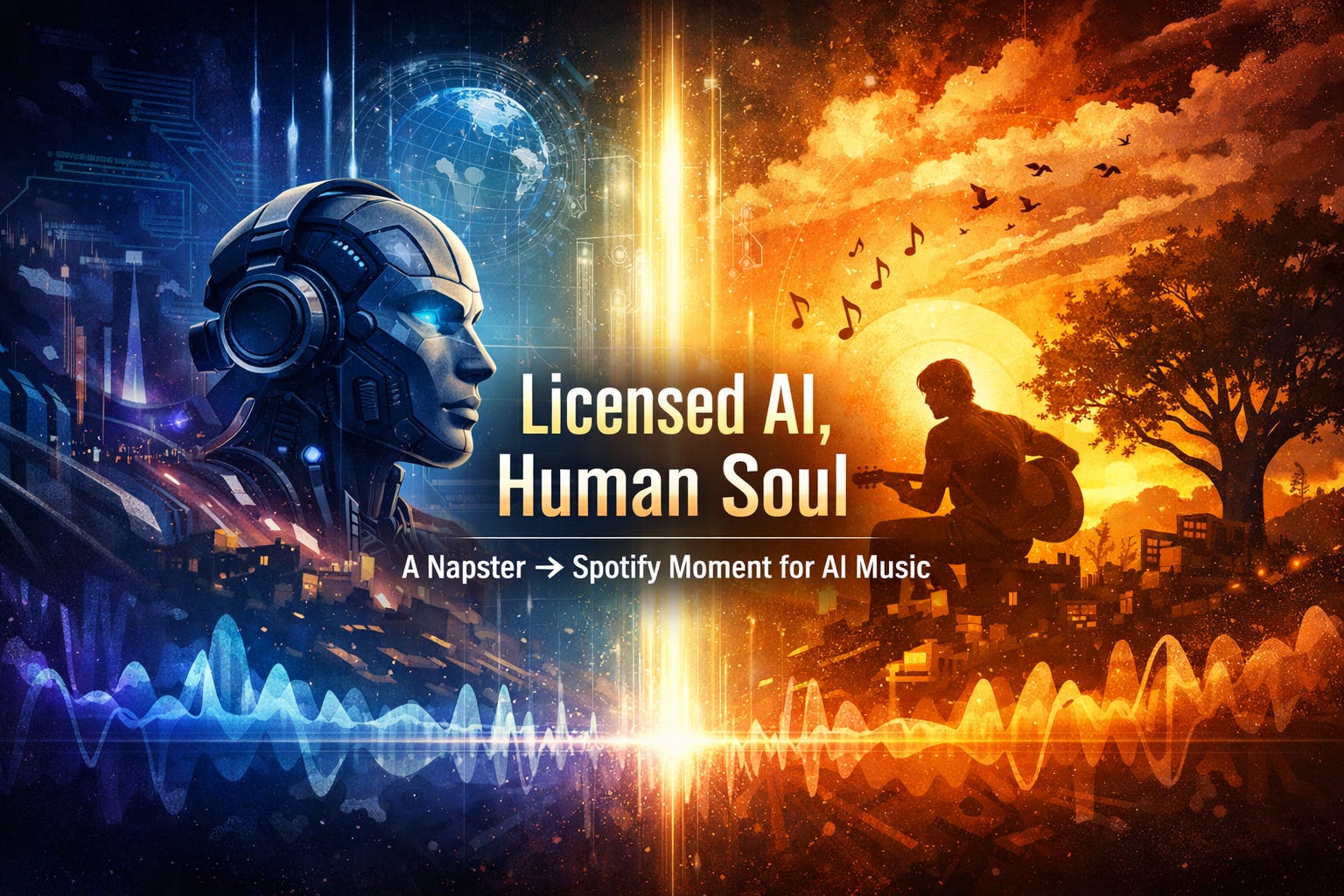
Streaming had that moment. Napster was the spark. Spotify was the settlement. Now, AI music may have just crossed its version of that line.
The catalyst? A licensing deal between Udio and Merlin.
This deal is not insignificant. In fact, it could be one of the most important turning points in the future of AI-assisted music.
At first glance, the headlines sound procedural: Udio signs a licensing agreement with Merlin, the organization representing a massive network of independent labels worldwide. But underneath the legal language is something much bigger.
For the first time at a meaningful scale:
AI training is happening with consent
Artists can opt in
Compensation is part of the framework
Human creativity is explicitly acknowledged as the source material
This is not scraping.
This is licensing.
And that distinction changes everything.
Why? Until now, AI music has largely existed in a legal gray zone, built on scraped data, contested ownership, and unresolved ethical questions. This deal begins to formalize something the industry has been circling: AI is not going away, so the question is no longer whether to stop it but how to civilize it.
To understand why this matters, it helps to zoom out historically.
Napster didn’t fail because people didn’t want digital music. It failed because there was no sustainable structure around it. Spotify succeeded not because streaming was new, but because it made streaming legitimate.
It aligned incentives:
Labels got paid
Artists got exposure
Listeners got access
The chaos didn’t disappear.
It got organized.
That’s what this Udio–Merlin agreement represents for AI music.
A shift from:
Experimentation → Infrastructure
From:
Wild West → Licensed ecosystem
From:
Extraction → Collaboration
And that reframing matters far beyond one platform because once licensing becomes viable, it becomes expected.
Most coverage of AI music has focused on major labels—lawsuits, takedowns, high-profile battles over voice cloning and catalog rights. But this deal quietly shifts the center of gravity.
Merlin represents a huge share of the independent music world. Thousands of labels. Countless artists who live outside the major-label orbit. That means this isn’t just a corporate handshake—it’s structural inclusion. For the first time, indie creators are not merely reacting to AI. They are being invited into shaping it.
That matters because historically, technological transitions often marginalize independents before eventually empowering them.
Streaming did that.
YouTube did that.
TikTok did that.
AI may follow the same arc. This deal feels like the beginning of that curve.
If this model holds, expect a new era of AI platforms defined by one key distinction: Not how powerful they are, but how they’re trained.
We’re likely heading toward a stratified landscape:
Licensed AI ecosystems built on opt-in data
Gray-market generators operating in legal shadows
Human-first communities defining ethical standards
That last category may prove the most culturally influential because, while infrastructure determines access, culture determines meaning—and meaning is what music has always been about.
One of the biggest implications of this shift is something I’ve written about often: The growing divide between AI-generated and AI-assisted music. If licensing becomes the norm, the industry will naturally favor models that preserve human authorship.
Why?
Because licensing frameworks inherently value provenance:
Where did this come from?
Who contributed?
What was the human role?
That creates an interesting inversion. The more institutionalized AI becomes, the more valuable human fingerprints become—not less.
In other words, the future may not reward those who remove themselves from the process. Instead, it may reward those who remain visibly inside it.
Another likely outcome: transparency stops being optional.
We may soon see:
Training disclosures
“Licensed AI” badges
Metadata showing human vs AI contribution
Not because regulators demand it (they might), but because trust will demand it. In an age of infinite generation, authenticity becomes scarce. And scarcity creates value. The artists who thrive will likely be those who don’t hide their process, but reveal it.
From where I sit—building Gumtree Collective and exploring what ethical AI-assisted creativity looks like in practice—this moment feels validating. For a long time, the conversation around AI music has felt polarized.
On one side: Uncritical acceleration.
On the other: Total rejection.
But there has always been a middle path. A slower, more human-centered approach that treats AI not as a replacement for creativity, but as an instrument within it.
That’s the lane Gumtree has been exploring from the beginning: AI-assisted. Human-led. Soul-forward.
This deal signals that the industry itself may be moving in that direction.
Not toward banning AI.
But toward shaping it.
Not toward removing artists.
But toward protecting them.
Not toward synthetic abundance.
But toward licensed collaboration.
That’s a very different future than the one many feared.
As AI platforms mature, they will inevitably become more corporate. More regulated. More infrastructure-heavy. Whenever that happens in creative industries, something else rises alongside it: Communities. Scenes. Collectives. Movements. Spaces where meaning is curated, not automated.
That’s part of what excites me most about this moment. If licensing becomes the backbone of AI music, culture becomes the differentiator. And culture is built by people, not platforms. Which means artist collectives—ethical, transparent, values-driven—may become more important, not less.
Ultimately, what makes this moment feel significant isn’t the deal itself. It’s what the deal represents.
We are watching AI music move from:
Speculation → Structure
Chaos → Systems
Possibility → Policy
This is the beginning of institutionalization. And institutionalization always changes the conversation.
It moves the debate from:
“Should this exist?”
to
“How should this work?”
That’s a quieter question but a far more consequential one.
If you’re an artist navigating this landscape, here’s the honest takeaway: The middle is collapsing. The future will likely belong to creators who choose clarity.
Clear authorship.
Clear ethics.
Clear process.
Not ambiguity.
Because as AI becomes normalized, the creators who stand out will be those who remain unmistakably human, even when they collaborate with machines.
I don’t see this moment as the end of uncertainty. I do see it as the end of the purely unstructured phase. The AI music conversation is growing up. And as it does, something interesting is happening:
The values we thought might disappear—authorship, soul, creative intent—are not vanishing. They’re being renegotiated. Which is exactly what every technological revolution ultimately does.
It doesn’t erase humanity.
It forces us to redefine it.
And maybe the deeper opportunity here is not just to decide what AI music will sound like, but to decide who we want to be in an age when creation itself is changing.
I welcome your questions, comments, or arguments. Let the readers know your thoughts and opinions about the sea change moment.
Thanks for reading AI Music Revolution! This post is public, so feel free to share it.
Comments
Nothing yet. Say the first thing.
Sign in to join the conversation.