
I’ve used AI in songwriting for years to create structure, explore melody, and shape style. During that time, I learned something important: the first draft is rarely the song. It’s just the clay.
If I release the first output, it may sound polished… but hollow. If I wrestle with it — rewriting choruses, simplifying phrasing, injecting lived experience — it starts to sound like me.
The truth is that while AI can generate language, it cannot generate conviction. Therein lies the difference.
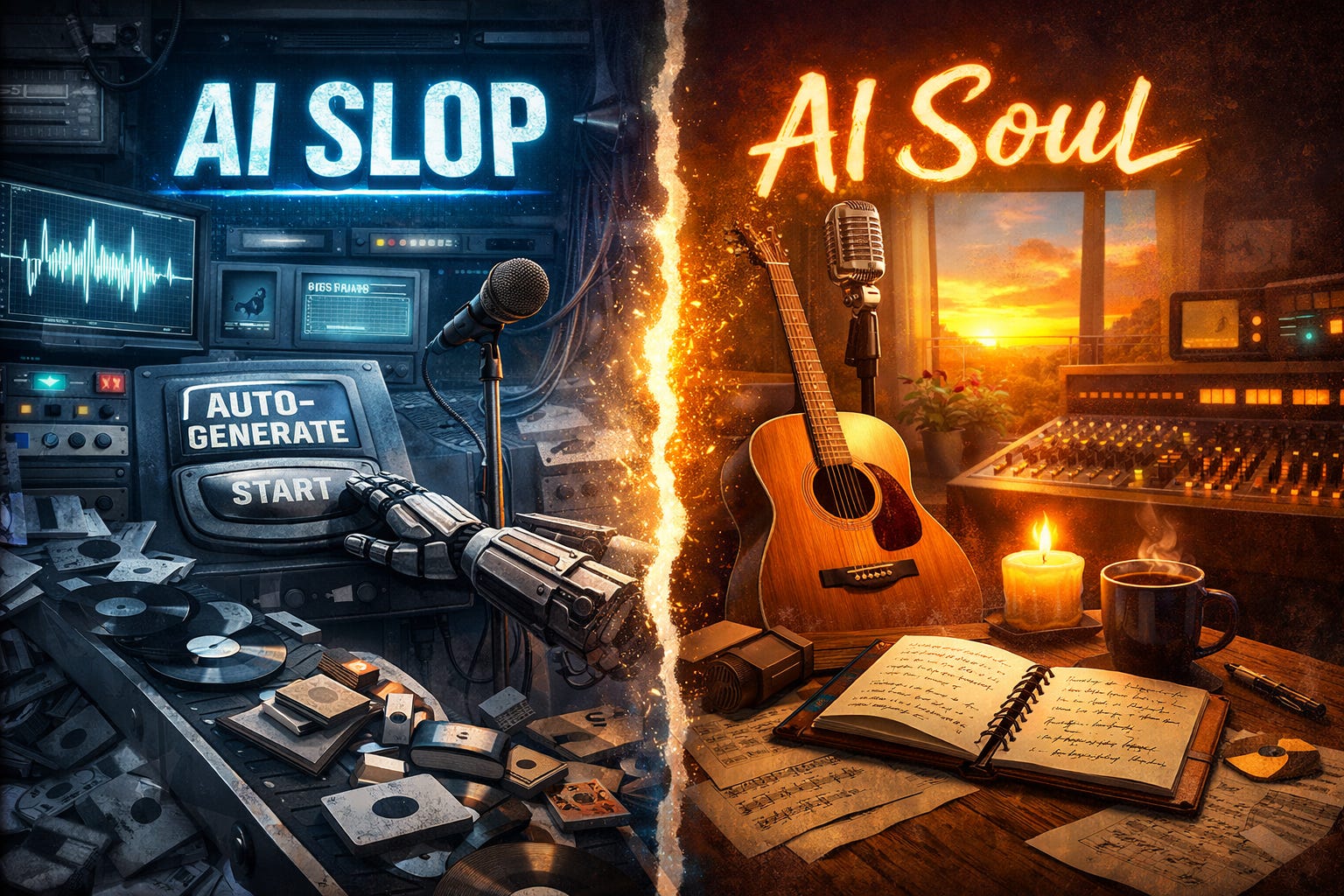
With that in mind, here are eight practical guardrails to stay on the right side of AI slop vs. the AI soul line.
AI Music Revolution is a reader-supported publication. To receive new posts and support my work, consider becoming a free or paid subscriber.
1. Start With Human Intention, Not a Prompt
AI slop usually begins with:
“Write me a sad indie folk song in the style of…”
And then… publish.
But compelling music begins before the tool is even turned on.
Ask:
What am I trying to say?
Why does this matter to me?
What lived experience is underneath this?
What emotional shift should the listener feel?
AI can expand, refine, or experiment.
But it should never supply the core meaning.
If the emotional thesis isn’t human, the output won’t feel human either.
2. Use AI as a Collaborator, Not a Replacement
Slop happens when the artist disappears.
Here’s what to do instead:
Rewrite the generated lyrics in your own voice (better yet, use lyrics you wrote to begin with).
Change phrasing to match your cadence.
Inject specificity (names, places, sensory detail).
Restructure predictable song arcs.
Strip away cliché metaphors (i.e., don’t be lazy!).
Regarding that last point, I’ve heard so much lazy songwriting where someone accepts a less-than-ideal rhyme, possibly AI-generated. Can you say “thesaurus,” anyone? (Who am I kidding? I’ve been guilty of similar laziness in the past.)
If the AI draft feels “generically beautiful,” it probably is… and that’s not good enough… because it’s not human enough. It lacks soul. Where are you in it?
Your job isn’t to accept the first draft.
Your job is to wrestle with it.
3. Add Friction
Great art has resistance. Have you ever watched a TV show or movie, or read a great novel, where conflict was not present? The dramatic tension is what makes the story interesting.
AI removes friction, which is both its power and its danger. So reintroduce it intentionally:
Rewrite the second verse from scratch.
Change the melody to make it less generic.
Replace one predictable chord progression.
Cut the most obvious lyric.
If it sounds too easy, it probably is.
Slop is frictionless.
Art rarely is.
4. Prioritize Sonic Identity Over Algorithmic Appeal
AI tools are trained on averages. (As one friend said regarding AI content: “It’s a race to the middle.”)
That means familiar chord structures, common melodic contours, safe tempo range, and standard production polish.
However, that’s not just limited to AI songwriting — plenty of songs completely human-written follow the same rituals. Take country music, for example. What’s the mantra: “Three chords and the truth.” Right?
If you don’t intervene, your music sounds the same as everyone else's.
So, ask yourself:
What makes my sonic fingerprint recognizable?
What imperfection feels mine uniquely?
Where can I lean into texture over perfection?
The vocal crack, the slightly off-grid rhythm, the unexpected lyric turn — those are not bugs. They’re signatures.
5. Tell the Truth About the Process
One reason “AI slop” triggers backlash is perceived deception. If you’re presenting something as fully handcrafted when it isn’t, you erode trust. Transparency doesn’t weaken art — it reframes it.
Instead of:
“Here’s my new song.”
Try:
“This began as an AI experiment, but I rewrote the bridge after realizing it lacked my fingerprint.”
That narrative gives the audience something to connect to.
You’re not hiding the machine.
You’re showing your humanity in the process.
I modeled this shift with Soul Harbor, moving from implied band authenticity to explicit AI construct. That wasn’t a retreat; it was maturity, grounded in my conviction that authenticity and transparency should be at the core.
6. Don’t Confuse Volume With Vision
AI can enable an artist to produce 20 songs a week, three albums a month, and endless genre experiments. But abundance isn’t artistry.
After inventing the factory assembly line, Henry Ford reduced Model T production time from over 12 hours to roughly 90 minutes — and they all looked exactly alike. "You can have any color you want as long as it's black," he said.

Don’t do that. Instead, ask:
Would I stand behind this song in five years?
Would I play this live without embarrassment?
Does this reveal something about me?
If not, don’t release it. Restraint is a sign of seriousness. It signals your ability to resist the emotional impulse to hit publish too quickly.
“The greatest freedom is to know when to restrain yourself.” — Unknown
7. Make the Human Layer Visible
AI can assist in drafting:
Lyrics and melody
Composition, arranging, sound design
Even vocal generation
But it can’t interpret, emote, restrain, or carry meaning (at least, not yet). That layer — the interpretive layer — is where authenticity lives. And if you’re using AI vocals or AI composition tools, adding the human layer can shift to concept, curation, ethical framing, and necessary transparency.
Art isn’t just sound.
It’s authorship.
8. Remember: Slop Isn’t About AI; It’s About Laziness
Here’s the uncomfortable truth: You can make “slop” without AI — and you can make profound work with it. The dividing line isn’t the tool. Its intention, craft, and accountability.
AI amplifies whatever you bring to it. If you bring depth, it expands it. If you bring shortcuts, it industrializes them.
My Personal Rules for AI-Assisted Songwriting
I’ve developed a few guardrails of my own over time. They are not intended to be rules everyone should follow, but they are worth consideration.
1. The First Draft Is Always Wrong
The novelist Stephen King said, “Write the first draft with the door closed. Rewrite with the door open.” By that, he meant write the first lyrics for yourself, without judgment (but for heaven’s sake, don’t publish them!).
He went on to say, “Once you know what the story is and get it right — as right as you can, anyway — it belongs to anyone who wants to read it. Or criticize it.”
I call first drafts "LFDs: Lousy first drafts.” Why? Because they usually are! I’ve only had one experience where a first draft was the perfect draft, capturing exactly what I wanted to say in the lyrics, style, and arrangement. It was a “God wink.”
2. If It Feels Generic, It Is
If I can swap my name with another artist and the song still works, it lacks my imprint. That said, I sometimes write a song with a specific artist’s style in mind. (You are welcome to criticize that in the comments.)
That’s one reason I tend to wrestle with a song until it feels right. I’ve iterated song styles, melodies, lyrics, 30 or 40 times (sometimes more) before I got it right — and even then had that artist’s sense of doubt as to whether it was any good.
3. The Simpler, The Better
I’ve written songs — and listened to many written by others — where I stuffed more words into a phrase than needed to be there. That’s a mistake many novice songwriters make… and a mistake I’m working to overcome (see my rule #1).
For example, the chorus of a song I wrote a few days ago reads:
”It all comes down to love,
It all comes down to love;
If we forget everything else,
Let us remember love.”
Simple. Direct. To the point.
4. Volume Is Not Vision
My motto is “just because you can doesn’t mean you should.”
Just because I can generate songs more quickly with AI than before doesn’t mean I need to release them all. I have several in Suno’s “workspace” that may never see the light of day. (And I published some in the past that, looking back, I wish I hadn’t.)
5. Garbage In, Garbage Out
The old computer mantra applies to prompts: When you write some simple prompt that lacks specificity, you get what you deserve — and it’s usually not good.
Admittedly, I use ChatGPT to help me craft a more compelling prompt — partly because it knows me very well and because it knows a lot of stuff that I don’t!
I’m still the project manager/creative director, and even with ChatGPT, there’s still trial and error, but it does help with elements such as style selection, tempo, key ranges, instrument choices, vocal styles, and more.
A Simple Gut Check Before You Release
Speaking of releasing songs, before publishing an AI-assisted track, ask:
Did I meaningfully reshape this beyond the first output?
Is there something here that couldn’t have come from anyone else?
Would I claim this proudly in a room of musicians?
Is it the best I can do?
If you can answer yes to all four, you’re probably not making slop.
Final Thoughts…
Consider these parallelisms, and let me know in the comments if you agree or disagree:
AI doesn’t threaten music. It threatens unexamined creation.
The future doesn’t belong to artists who reject AI. It belongs to artists who use it without disappearing inside it.
Thanks for reading AI Music Revolution! This post is public, so feel free to share it with your songwriters, musical artist friends… or anyone you think would benefit.
Comments
Nothing yet. Say the first thing.
Sign in to join the conversation.