

Most people got access to the most powerful AI model ever released, and they’re using it to write emails.
I’m not exaggerating.
Anthropic shipped Claude Fable 5, a model that sits in a completely new tier above Opus and the first “Mythos-class” model available to the public.
And what did the average person do? They opened it, asked it something they could have asked the free version, and moved on with their day.
That’s like renting a Formula 1 car to drive to the grocery store.
I’ve spent the past week pushing Fable 5 on real work: research, long documents, and multi-step projects. And I can tell you the gap between how 99% of people use this model and how the top 1% use it has nothing to do with intelligence. It comes down to five specific habits.
Before we get into them, here’s one thing you need to know right now:
Claude Fable 5 is included in Claude’s paid plans (Pro, Max, Team, and select Enterprise) only until July 12, 2026. After that, it moves to prepaid usage credits at $10 per million input tokens and $50 per million output tokens, which is the most expensive pricing Anthropic has ever published for a generally available model.
So this window is the cheapest opportunity you’ll have to try this model.
Everything below is written to help you extract the maximum value from it before the clock runs out.
With that said, let’s get into it.
Here’s the counterintuitive first lesson: using Fable 5 better starts with using it less.
Fable burns through your usage limits roughly 2x faster than Opus. And on your subscription, you can only spend up to 50% of your weekly limit on it.
So every time you use Fable to fix a typo, summarize an article, or write a quick email, you’re spending premium fuel on a task a cheaper model handles perfectly well.
The routing framework I use is simple:
Fable 5 handles the hardest, longest, most ambiguous work. Think architecture decisions, deep research sprints, large migrations, multi-hour autonomous tasks, and anything you’d normally hire an analyst or senior engineer for.
Opus 4.8 handles solid everyday work. Good code, good writing, good analysis.
Sonnet or Haiku handles routine tasks, quick answers, formatting, and summaries.
Anthropic’s own guidance backs this up. Teams seeing the best results point Fable at their hardest unsolved problems, because testing it on simple workloads literally undersells what it can do and wastes your quota in the process.
The pro move: spend your Fable allowance on planning, auditing, and architecture. Have it produce plans, specs, and documentation. Then let cheaper models execute against those plans after July 12.
The plan outlives the access window, but the chat log doesn’t.
Just so you know:
Everything I’ve shared here is something I actually use.
If this post changed how you think about AI even a little, that didn’t happen in isolation. It came from a much bigger shift in how I use AI overall.
That’s why I put that entire system down inside “The (Unfair) AI Workflow Playbook” with everything you need.
It’s the exact set of workflows I use daily to run my work faster than feels normal, and if you apply even a few of them, you’ll save hundreds of hours.
You can spend months figuring this out on your own, or you can steal my entire playbook right now.
I know this one stings if you’ve spent two years learning prompt engineering.
Everything you learned, from step-by-step instructions and numbered rule lists to “act as an expert” preambles and detailed scripts, was built to keep weaker models on the rails.
Fable 5 doesn’t need the rails.
It plans better than your script does, and when you force a script on it, you’re capping a model that would have found a better path on its own.
Anthropic’s official prompting guide for Fable 5 says the same thing in more polite language: give it direction, context, goals, and verification criteria instead of micromanaging every step.
In practice, your prompts need exactly three ingredients:
The outcome you want, meaning what “done” looks like.
The constraints that can’t be broken, meaning your non-negotiables.
The reason behind the request, meaning who it’s for and what they need.
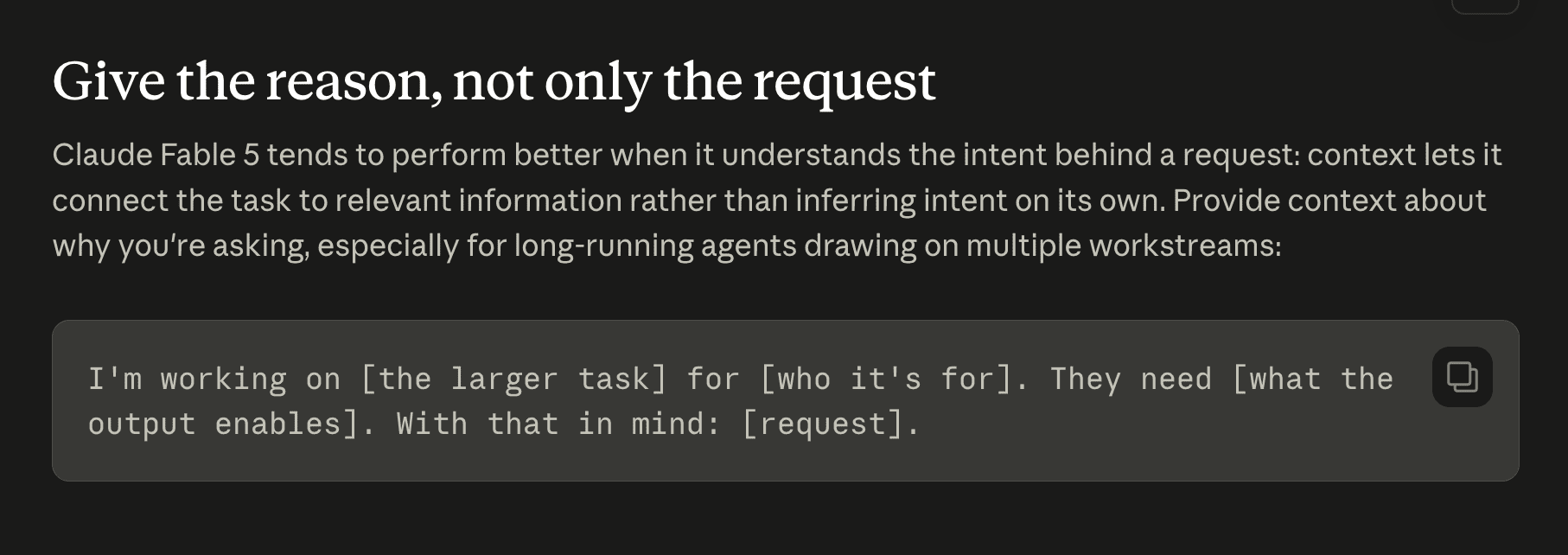
That third one is the most underrated line in prompting right now.
Compare these:
“Write a competitive analysis of email marketing tools”.
versus:
“I’m preparing a recommendation for a 5-person startup choosing their first email tool. They have no budget for anything above $50/month and no technical team. With that in mind: write a competitive analysis of email marketing tools”.
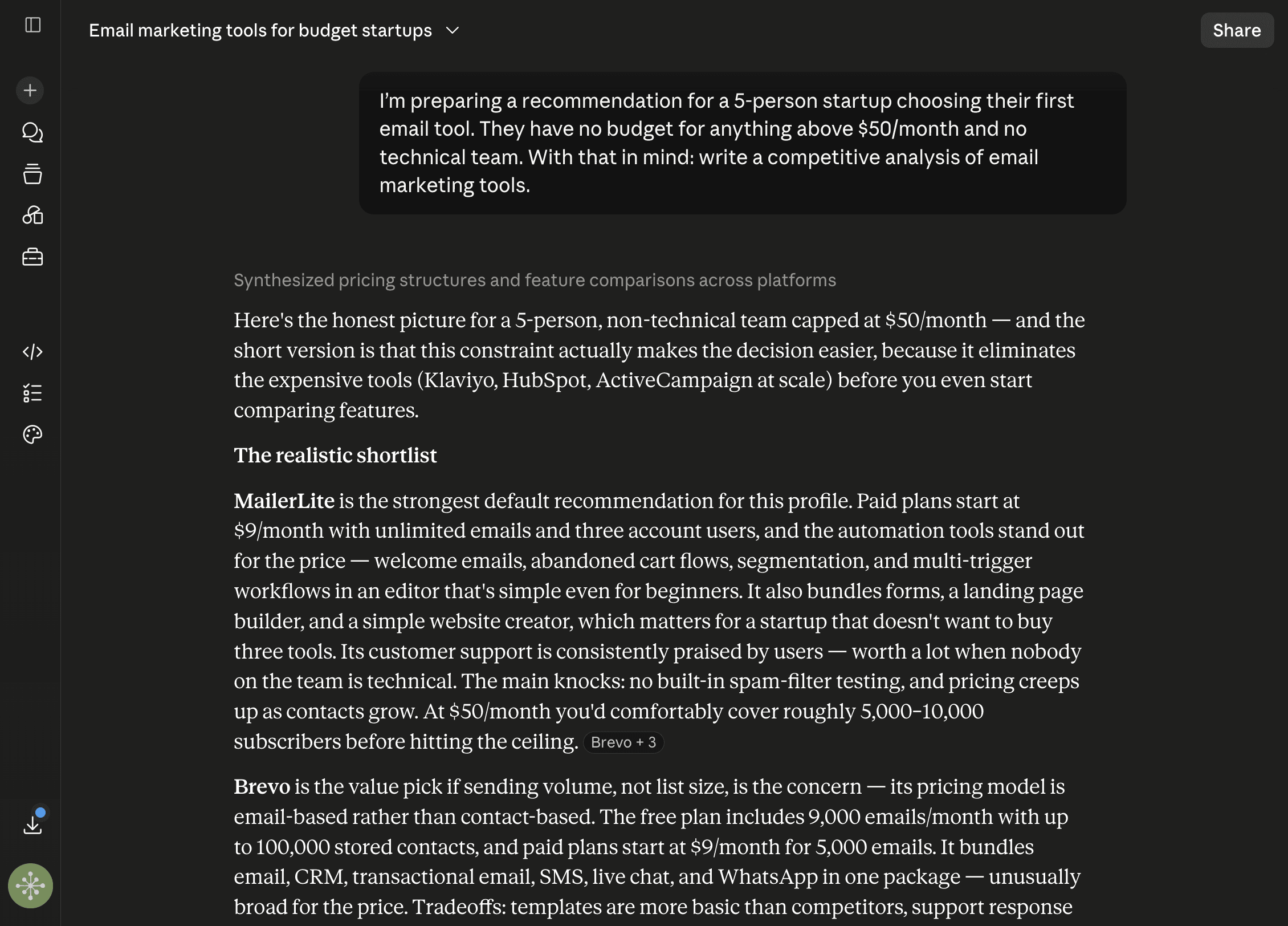
The second prompt reliably produces work you can actually use, because the model understands the stakes, not just the task. And context beats instructions on this model, every single time.
One caveat from Anthropic’s own docs: at higher effort settings, Fable can over-deliver by adding features nobody asked for, refactoring things that were fine, and building for hypothetical future requirements. If you notice this, add one constraint line: “Do the simplest thing that works. Don’t add anything beyond what this task requires”.
If you use Claude Code, you have a CLAUDE.md file.
It’s the standing memory the model reads at the start of every session in your project.
And if you’re like most people, that file has grown into a bloated rulebook of instructions you copied from Twitter threads in 2025.
Here’s the problem: most of what’s in that file is stuff Fable 5 can already figure out by scanning your project. Every unnecessary line becomes noise that competes with the lines that genuinely matter. On this model, a lean file beats a stuffed one.
You only need three things in there:
A two-line summary of what the project is and does.
The handful of commands you run constantly: build, test, deploy.
The recurring corrections, meaning the genuinely non-obvious stuff the model can’t figure out on its own: business decisions, team conventions, and the reasoning behind rules.
Open that file today and cut it down by half.
This is the rare optimization that takes five minutes and improves every session you run afterward.
This is the role change that separates casual users from the top 1%.
I can see that most people still treat Fable like an intern, feeding it one small task after another. But a model this intelligent creates far more value supervising work than typing keystrokes.
Yes, Fable 5 was explicitly built for this.
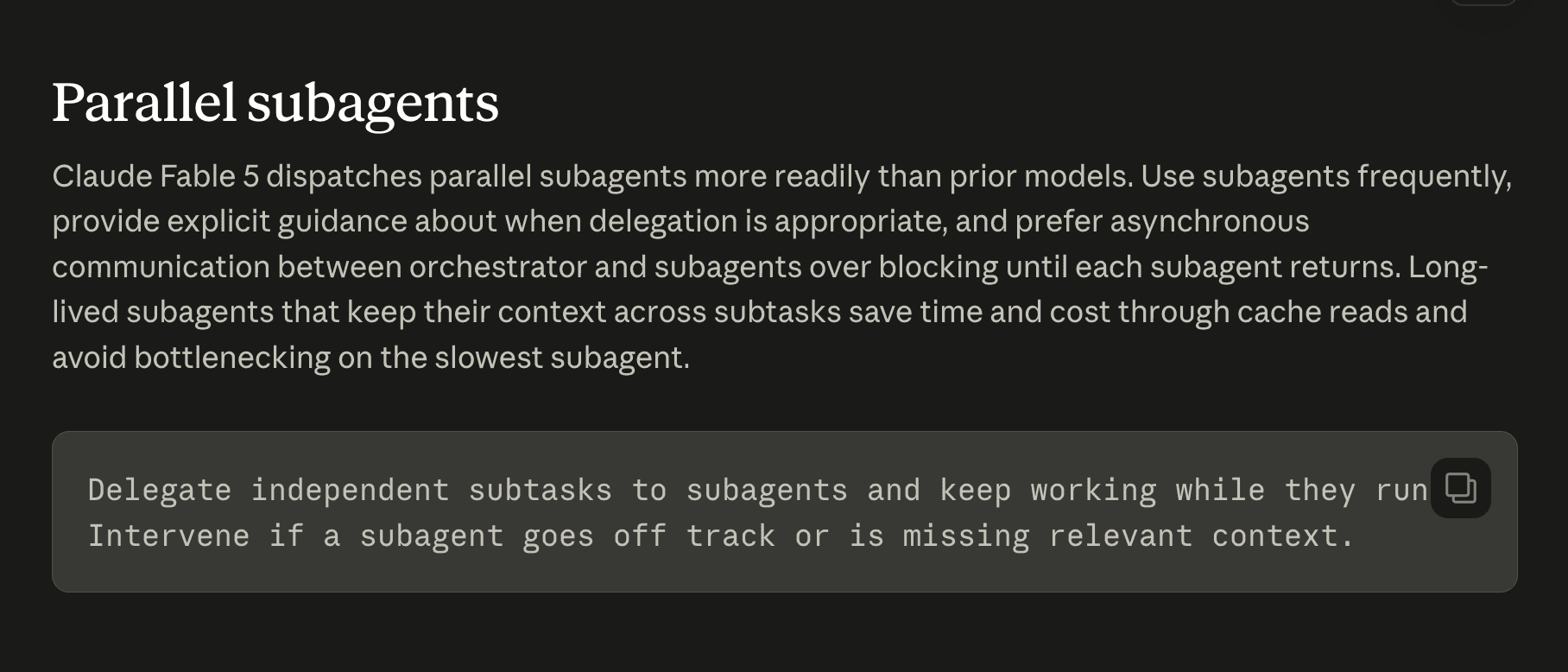
According to Anthropic, it delegates to parallel subagents more naturally than earlier models did, and it retains a multi-stage workflow in memory across hours or days without dropping a single constraint.
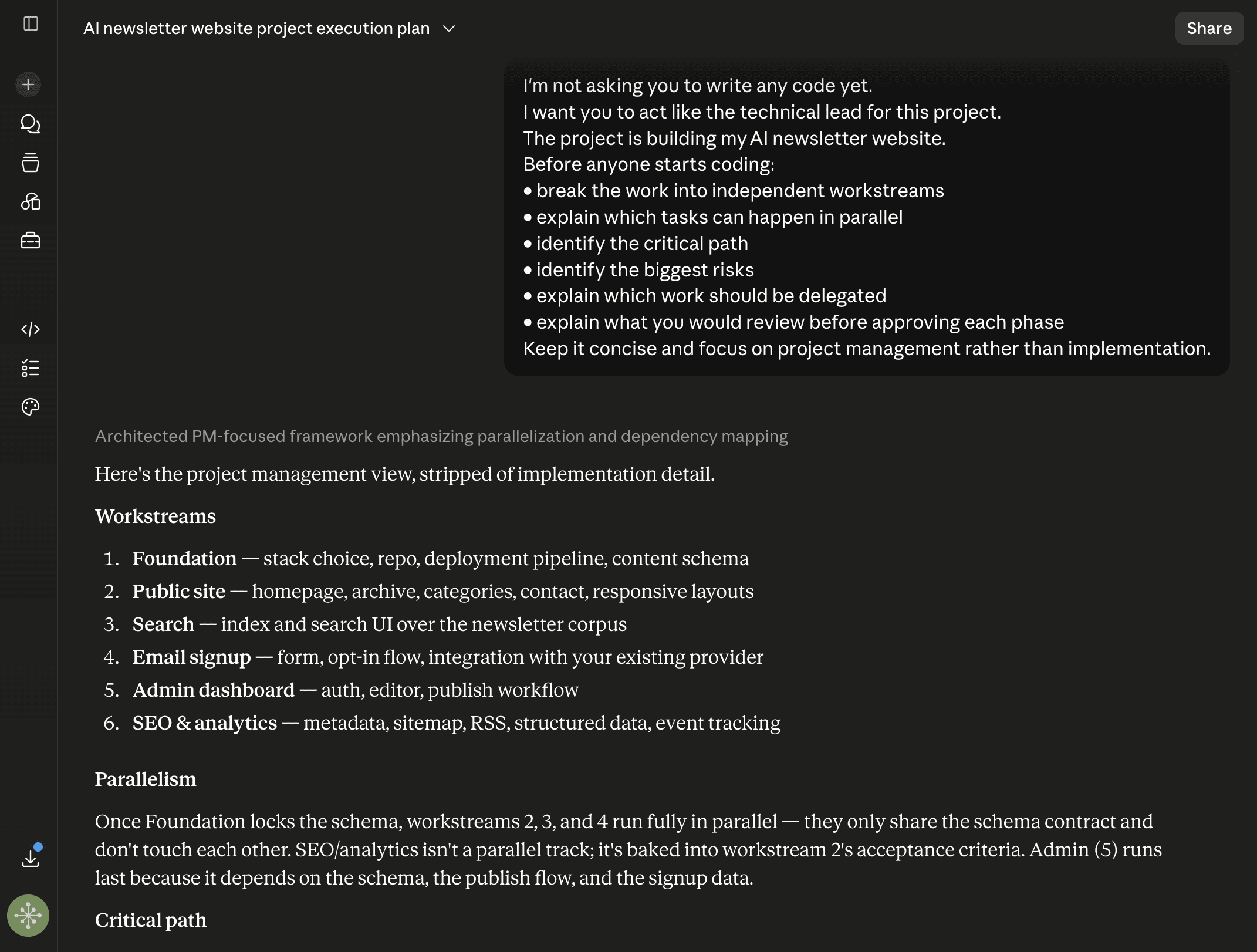
The setup looks like this:
Fable plans. Give it your project and let it break the work into staged, testable pieces before anything gets built.
Fable delegates. Execution goes to subagents running on cheaper models (Opus does the labor), with each subagent owning a single lane.
Fable reviews. Completed work returns to the leader, gets compared against the original plan, and gets sent back for another round whenever it falls short.
You steer. Drop in at intervals, adjust course where needed, and let the system keep running.
Also, in Claude Code, creating a subagent means creating one tiny config file inside .claude/agents/ in your project. That file contains three things: the agent’s name, which model powers it, and a brief description of its job.
Then the Claude Fable 5 scans that folder to see which specialists it has available.
Two rules keep this system honest:
Each subagent owns exactly one lane. Parallel execution is only safe when the lanes operate on completely separate files.
A dedicated verifier confirms everything. Create one agent whose entire job is reviewing completed work with fresh eyes. No self-graded homework allowed. This reviewer matters more than any builder on the team, because work that passes verification early won’t come back broken three stages down the line.
And here’s the part people miss: this setup actually reduces your token spend. Your premium model’s tokens go exclusively toward planning, reviewing, and decision-making, while the cheaper models absorb the heavy lifting. Premium intelligence at labor-tier costs.
This is where Fable 5 transforms from a chat window into an autonomous system that keeps producing while you sleep.
Claude Code has a /goal command. You define a single finishing condition, and the model keeps grinding away independently, turn after turn, until that condition is met. No approvals in between. People are running Fable sessions during meetings, overnight, even while traveling, and returning to completed work.
But the entire craft lies in defining a finishing condition the model can’t fake its way past.
Three rules:
Require visible evidence. “Run the full test suite and paste the results here, everything must pass” demands receipts. Compare that to simply writing “make the tests pass,” which invites a confident declaration of victory with nothing behind it.
Add a brake. There’s no built-in stopping point, so always append a limit like “or quit after 10 to 20 attempts.” An unattended goal without a brake is how people end up with horror stories about runaway usage.
Add one accountability sentence. Something like: “Back every claim of progress with actual output from this session”. This single line almost completely kills false completion reports.
Here’s a complete example you can adapt today:
/goalThe landing page runs locally and the signup form successfully saves a test email. Prove both by pasting the server logs plus a screenshot at mobile width. Quit after 25 attempts if incomplete.
Set it, walk away, and return to a session log where evidence sits next to every claim. That’s a working relationship with an AI that most people don’t even realize is possible yet.
This is the part that confuses people the most, and almost nobody is writing about it clearly.
Fable 5 ships with safety classifiers for cybersecurity and biology, which is the reason Anthropic could release a model this capable to the public at all. When a classifier flags your request, your session gets automatically rerouted to Opus 4.8, with a notification. You’re not charged Fable prices for rerouted requests.
Here’s the trap: in Claude Code, the reroute can trigger on your very first message, before you’ve typed anything unusual, because that first request carries your CLAUDE.md and your repo’s context along with it. A project containing security-related files or naming can trip the classifier on context alone. If that happens, /model fable switches you back, but if the trigger is still sitting in your context, the next request bounces you again.
Two fixes worth knowing: you can start with claude — safe-mode to test whether your customizations are the trigger, and there’s a setting under /config to turn off automatic model switching so you decide each time instead.
Knowing this saves you from the most frustrating experience with this model, which is thinking Fable is refusing you when it’s actually just handed you to a different model without you noticing.
Comments
Nothing yet. Say the first thing.
Sign in to join the conversation.