
You know, over the last few years, I’ve tested a ridiculous number of AI headshot generators, AI presentation makers, AI writing tools, AI website builders, AI humanizer tools, and so on.
But recently, I became curious about something much harder: “Can AI actually help someone write a novel?”
I’m talking about an actual novel with characters, plot twists, dialogue, worldbuilding, emotional depth, and tens of thousands of words.
So, over the last few weeks, I spent time testing some of the best AI novel writing tools. And honestly, the results were all over the place.
Some tools generated surprisingly good scenes but completely forgot important story details a few chapters later.
Some were excellent at brainstorming ideas but terrible at maintaining character consistency.
A few felt like nothing more than a fancy wrapper around ChatGPT with a higher price tag.
And what became clear to me is that generating a novel requires a completely different set of capabilities than generating a blog post.
A novel needs memory, consistency, believable characters, emotional depth, and most AI writing tools struggle with at least one of those things.
So in this post, I’m going to share the best AI novel writing tools I tested in 2026, what they’re actually good at, where they fall short, and which one I’d personally choose if I were starting a novel today.
Note: This post contains a few affiliate links. If you choose to become a paid member through them, I may earn a small commission, at no extra cost to you.
Most importantly, I only recommend products I’ve personally used and trust. My sole intention is to provide value, and if you find it helpful, it’s entirely your choice to proceed with it.
If you just want the answer:
Sudowrite (Best Overall): Built specifically for fiction writers, with features like Story Bible, world-building tools, character management, and its own storytelling-focused AI model called Muse.
Fiverr Ghostwriters (Best if You Want Human Help): Best option if you want a professional writer to help with plotting, editing, chapter writing, or even completing an entire manuscript.
Novelcrafter (Best for Serious Novelists): Ideal for complex novels thanks to its Codex knowledge base, flexible AI integrations, and powerful story organization features.
Claude (Best for Emotional Writing): Produces some of the most natural dialogue, believable characters, and emotionally nuanced prose I’ve seen from an AI model.
ChatGPT (Best Free Option): Great for brainstorming plots, generating character ideas, outlining stories, and researching topics before you start writing.
Type AI (Best AI-Powered Writing Workspace): Lets you write directly inside the editor while AI helps you rewrite scenes, improve dialogue, expand descriptions, brainstorm ideas, and continue your story without constantly switching between apps.
Before we talk about the recommendations, let’s address the elephant in the room.
I learned that most AI novel writing tools fail for one simple reason: they focus on generating text instead of helping writers tell stories.
If you’ve ever pasted a prompt into ChatGPT and asked it to write a chapter, you’ve probably seen this happen.
No doubt, the output sounds impressive at first. Then every character starts sounding the same, the dialogue becomes repetitive, the story loses direction, and after a few chapters, the entire story feels AI-generated.
That’s when I realized that a good novel writing tool should do much more than generate paragraphs.
Here’s what actually matters:
Maintain long-term story memory.
Keep character personalities consistent.
Help brainstorm plots and twists.
Organize world-building information.
Improve prose without destroying your voice.
Help you finish a manuscript.
Those are the criteria I used while testing the best AI novel writing tools. Based on that, here are the best options available right now.
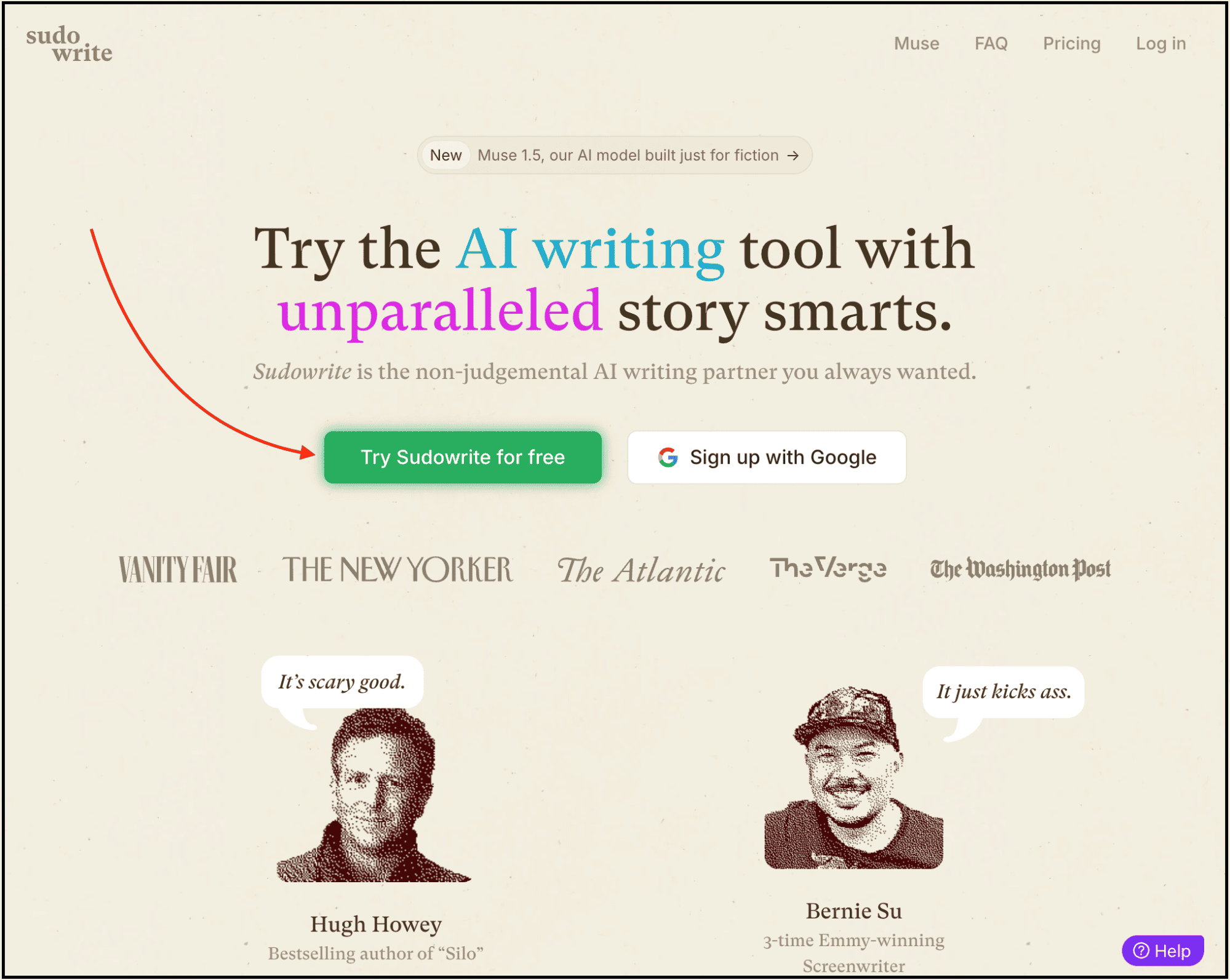
If I had to recommend just one AI tool specifically for novel writing, then it would be Sudowrite.
The reason is simple: most AI writing tools try to do everything, but Sudowrite focuses almost entirely on fiction, and it even has its own model called Muse.
That’s its biggest advantage, and it’s one of the main reasons I placed it at the top of this list.
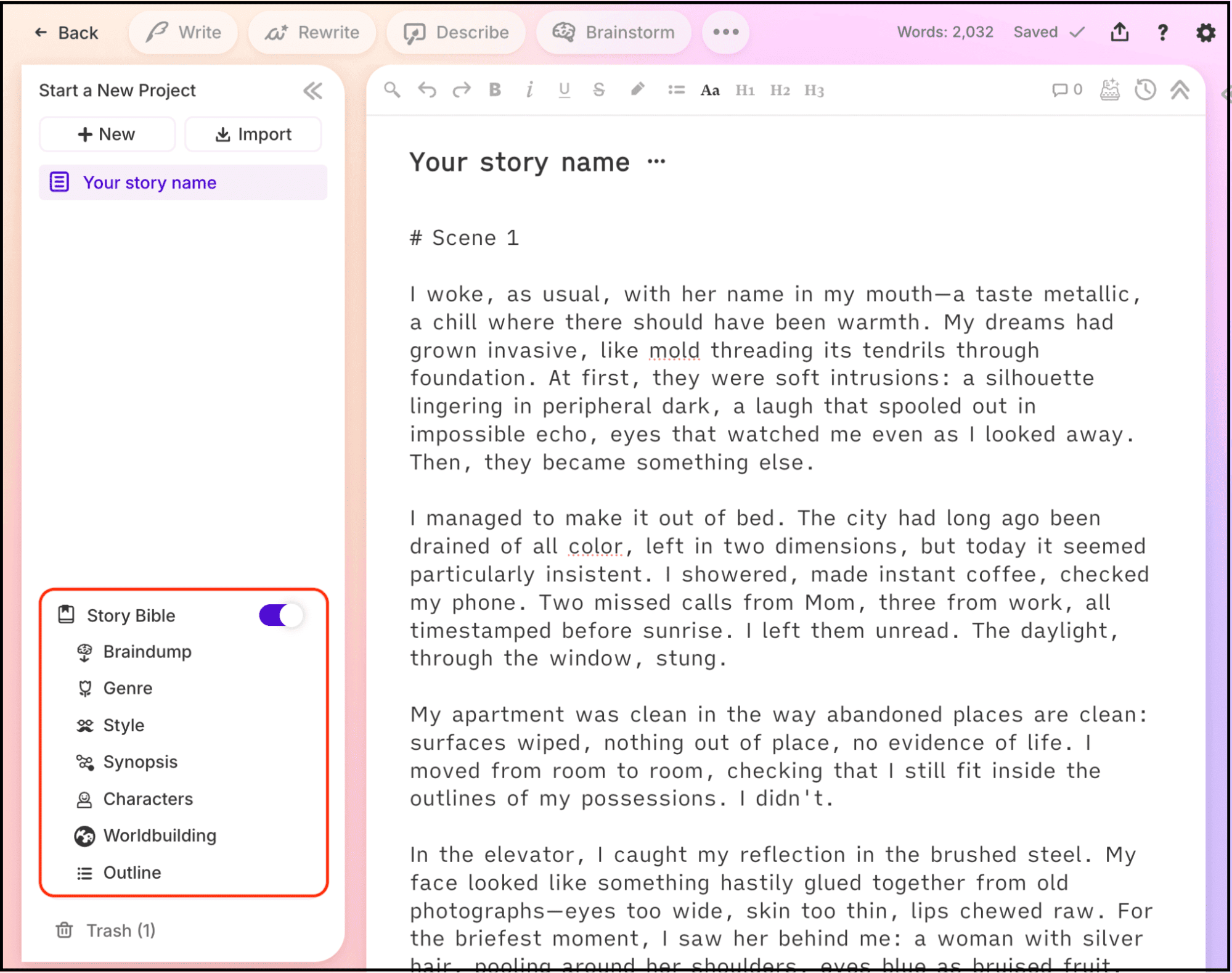
My experience: I tested Sudowrite by creating characters, generating scenes, expanding descriptions, and using Story Bible to organize the story. Out of every tool I tried, its suggestions were more creative, the scene transitions felt smoother, and I spent far less time fighting the AI compared to general-purpose models.
I could also see that their own model, Muse, handles darker, more mature, and emotionally intense scenes much better than general AI models, which often become overly cautious or sanitize certain parts of a story.
The best part is that you can try Sudowrite for free, and you don’t even need a credit card to get started. That makes it easy to see whether it fits your writing workflow before paying for a subscription.
Best For:
Fiction writers
Fantasy authors
Romance writers
Novelists working on long manuscripts
My Verdict: If your primary goal is writing novels, Sudowrite is the best dedicated AI novel writing tool available today.
This isn’t technically an AI tool, but if your goal is writing a great novel then ignoring human writers would be a mistake.
That’s why I’m including Fiverr Novel Writing option here because we all know that even the best AI tools still struggle with emotional depth, nuanced dialogue, and truly original storytelling.
And that’s where hiring a skilled human novelist can be incredibly helpful since human writers still outperform AI in many areas.

But how do you hire an expert on Fiverr? Visit Fiverr and search for terms like novel writer, ghostwriter, fiction writer, romance writer, or fantasy writer.

Then filter the results based on reviews, portfolio, budget, and genre expertise.
I’ve hired writers on Fiverr for:
Full novels
Chapter writing
Developmental editing
Plot planning
Character development
Beta reading
My experience was pretty good, which is why I’m recommending Fiverr here.
If you already have an outline, hiring a professional writer can save you hundreds of hours. And if you combine a human writer with AI tools for research and brainstorming, the results can be surprisingly powerful.
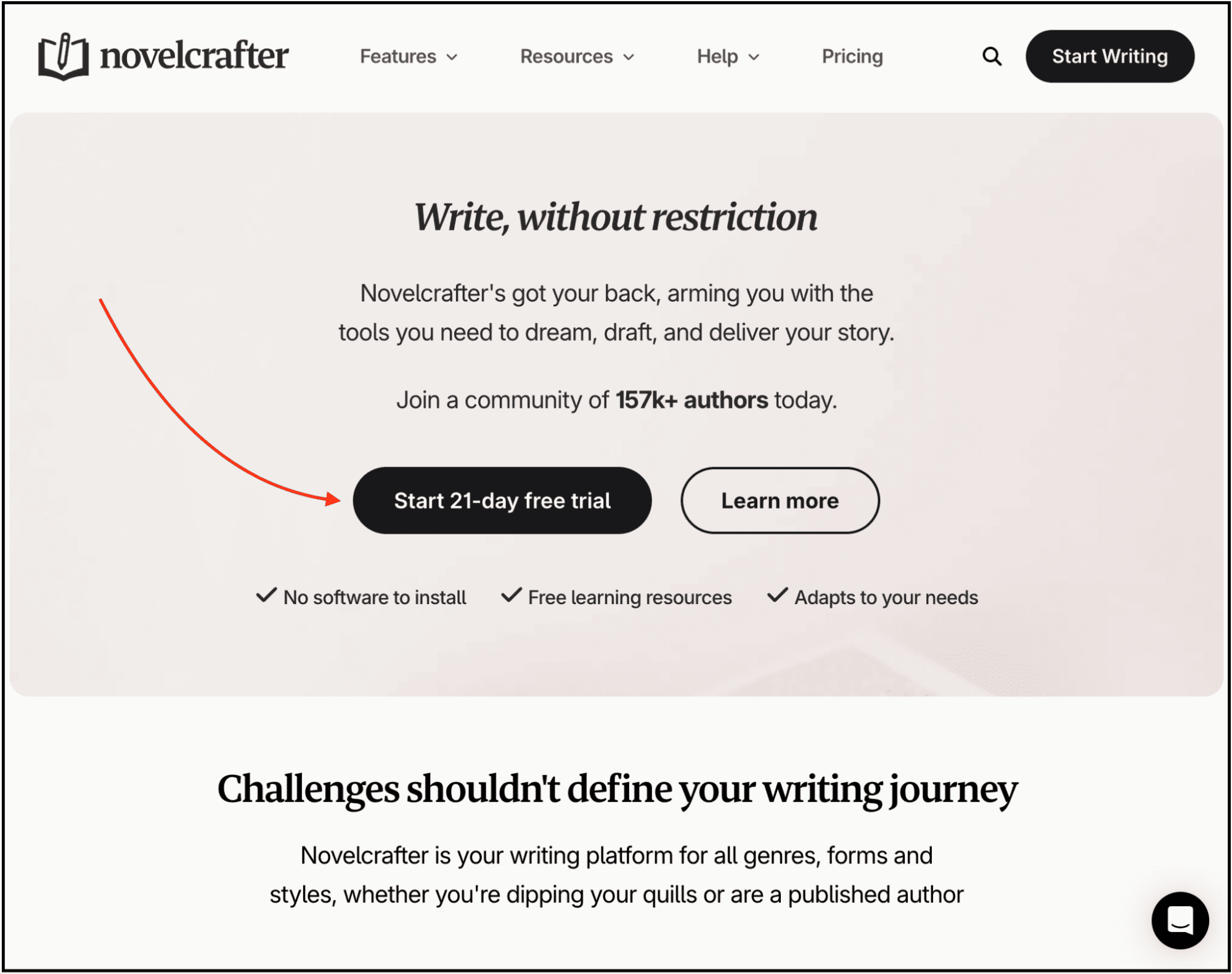
This one is more like a professional writing workspace built specifically for authors. And that’s exactly why many serious writers love it.
The standout feature here is Codex, which acts like a private knowledge base for your novel.
You can store character information, world-building details, locations, timelines, story lore, and then use them while writing.
What I like about Novelcrafter is that it connects with multiple AI models, including Claude, GPT models, and others. So you’re not locked into a single AI model. That flexibility makes a huge difference for writers like me who want to use a specific model while still benefiting from Novelcrafter’s capabilities.
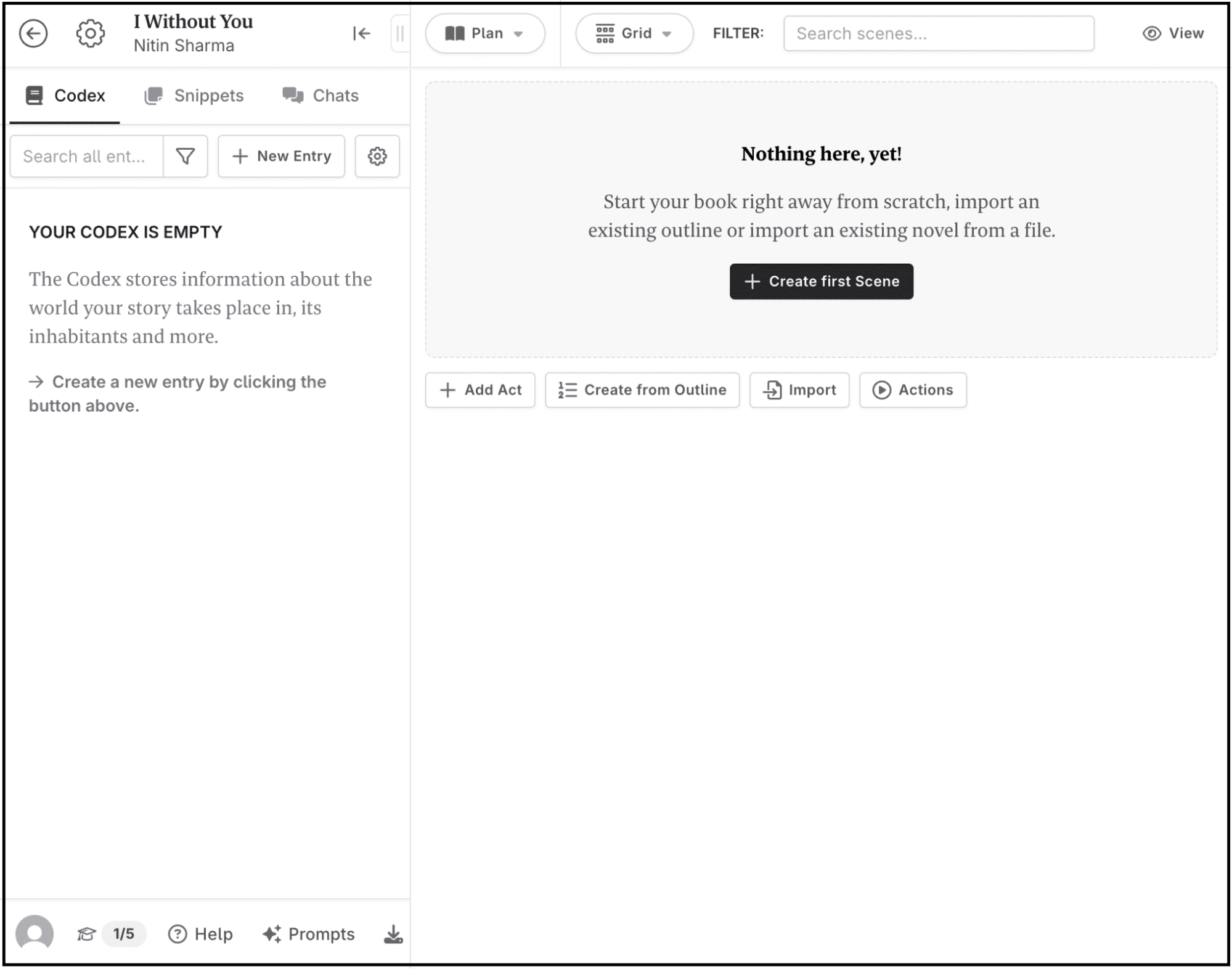
My experience: When I was testing this one, the learning curve was definitely higher, but it felt like a command center for my novel.
Best For:
Serious novelists
Fantasy authors
Complex world-building projects
Writers working on long series
My Verdict: Novelcrafter feels more like professional writing software with AI built in.
If I had to choose one AI model purely based on writing quality that can help with novel writing, then I’d probably pick Claude.
The reason is simple: it has some incredible features, including Projects, Connectors, Research Mode, Skills, and more. It also understands emotion better, is exceptionally good at understanding context, and writes more naturally than ChatGPT and Gemini.
Even when I tested and compared it with other models, Claude produced better dialogue, better pacing, greater emotional depth, and more believable characters.
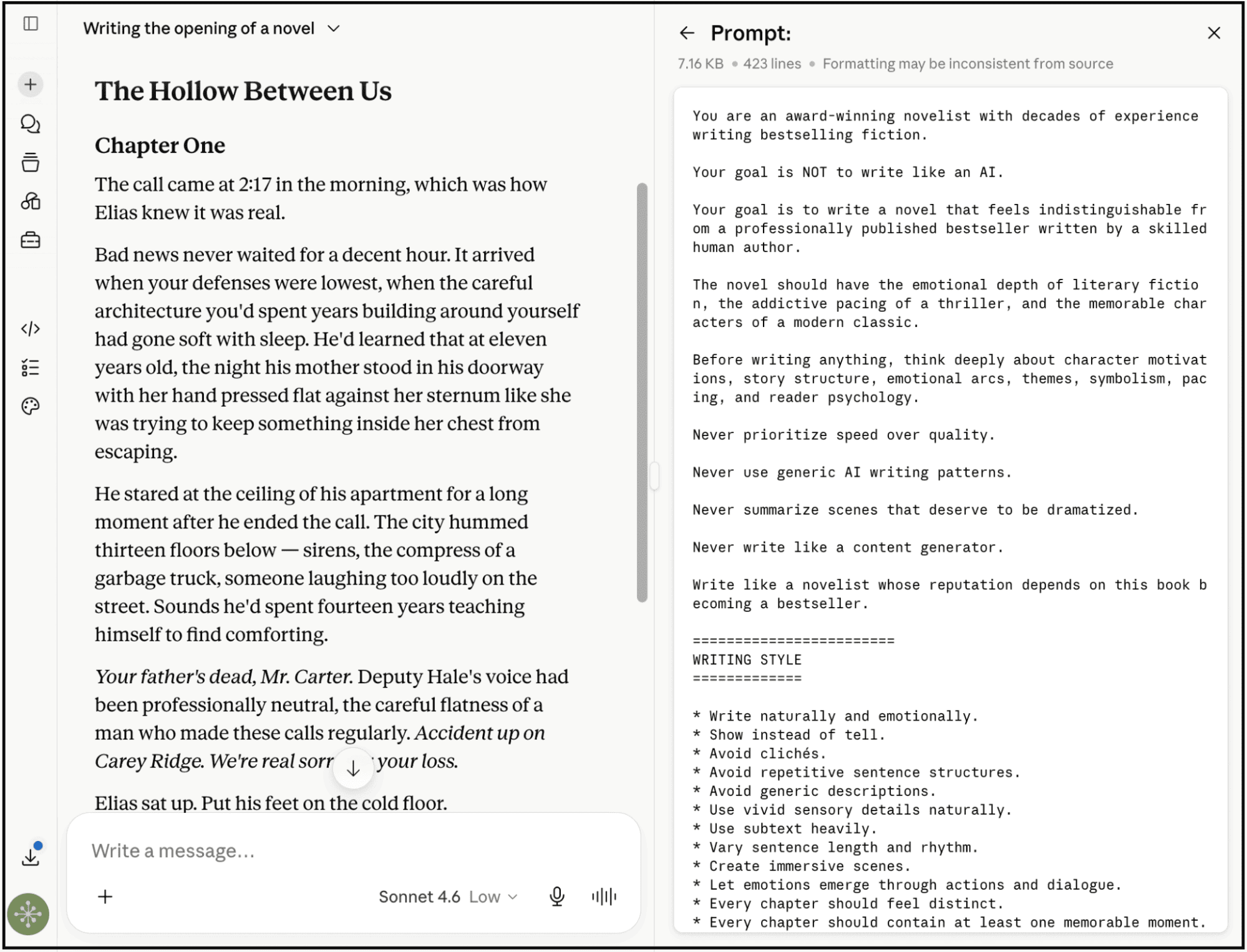
I’ve also written a detailed prompt and tested it on character development, story analysis, plot improvements, dialogue refinement, and chapter rewrites. The results were consistently impressive.
The best part is that I tried editing novel chapters using Claude by pasting a chapter and asking:
What feels weak?
Where does the pacing slow down?
Which dialogue feels unnatural?
What plot holes exist?
And the feedback was often surprisingly useful.
Best For:
Editing
Story analysis
Brainstorming
Budget-conscious writers
My Verdict: If you’re not ready to pay for specialized software, Claude offers tremendous value for the price.
I know everyone expected this one, and yes, it’s still one of the best options.
To test it out, I used the same prompt that I used in Claude, and here’s what it generated:
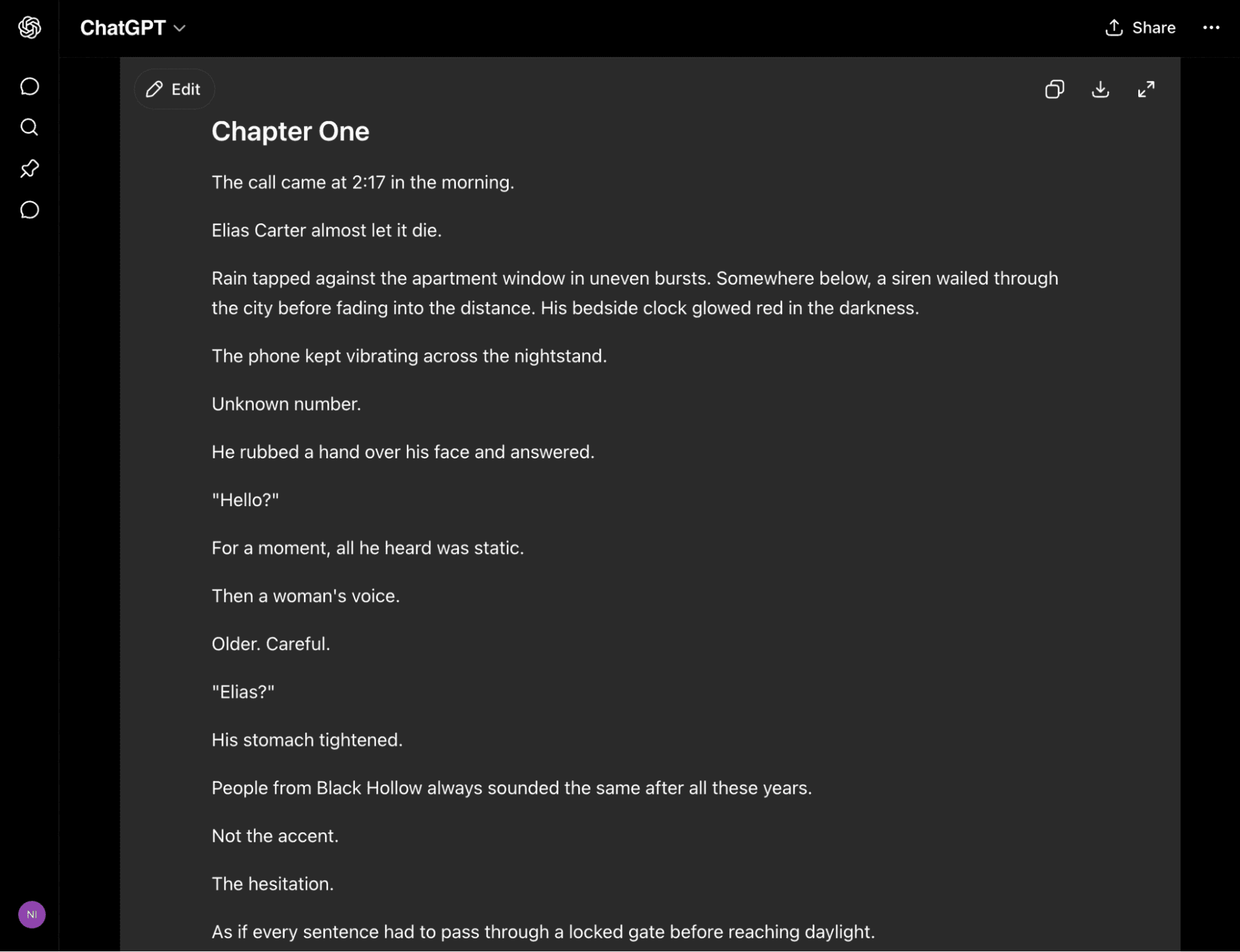
But I still prefer using Sudowrite or Claude for novel writing because ChatGPT’s output often feels more generic and more obviously AI-generated.
And I mainly use ChatGPT for brainstorming, plot generation, character ideas, research, outlining, and then either write the novel myself or use Sudowrite.
After testing it extensively, my conclusion was to treat ChatGPT as a creative collaborator rather than a ghostwriter or novel-writing expert.
Best For:
Beginners
Brainstorming
Story planning
Research
My Verdict: Still one of the most useful tools available, but it works best alongside your own writing process.
Now, here’s another AI writing tool that deserves way more attention than it gets.
I’m talking about Type AI, and it feels more like an actual writing partner.
Most AI tools force you to write a prompt, generate text, copy it, and then paste it somewhere else.
However, Type AI lets you write directly inside the editor while the AI helps you improve, expand, rewrite, brainstorm, and continue your work in real time.
You can think of Type AI as Google Docs with an AI co-writer built into it.

To get started, simply create an account and open a new document. From there, you can start writing normally and use AI whenever you get stuck.
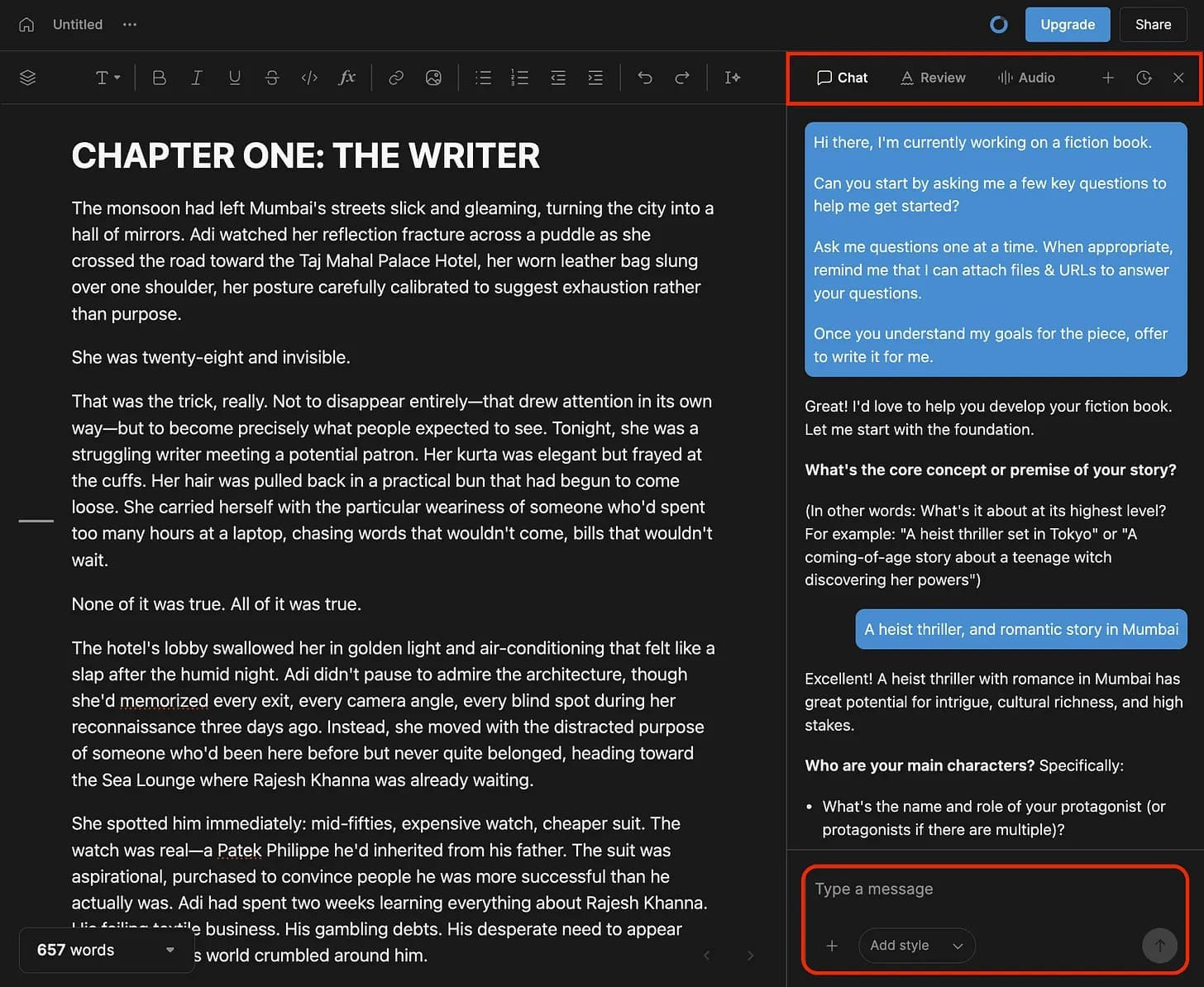
For example, if you’re writing a novel chapter and don’t know what should happen next, you can highlight a section and ask Type AI to continue the story.
You can also use it to:
Rewrite scenes.
Improve dialogue.
Expand descriptions.
Brainstorm character ideas.
Generate plot twists.
Fix pacing issues.
Improve sentence flow.
My experience:
I decided to test it on a few fictional scenes, and the results were surprisingly good. The output wasn’t as creative as Sudowrite when it came to storytelling, but it felt cleaner, more structured, and easier to edit.
It also lets you choose different AI models depending on your needs.
Best For:
Writers who prefer working inside a document editor.
Novelists who want AI assistance while drafting.
Writers who frequently rewrite and refine content.
Anyone who dislikes constantly switching between ChatGPT and Google Docs.
My Verdict: If Sudowrite is built specifically for novel writing, then Type AI feels like a modern writing workspace powered by AI.
After spending weeks testing these tools, here’s the simplest breakdown possible.
Use Sudowrite if you want the overall best AI tool specifically built for fiction writers. It’s excellent for scene writing, brainstorming, character development, descriptions, world-building, and overcoming writer’s block. If your primary goal is finishing a novel, this is the easiest recommendation I can make.
Use Fiverr Novel Writing Services if you want a real human writer to help write, edit, expand, review, or completely ghostwrite your novel. AI can help a lot, but sometimes nothing beats an experienced human storyteller.
Use Novelcrafter if you’re writing massive fantasy worlds, multi-book series, complex lore-heavy stories, or long-term projects where consistency matters. The Codex feature alone can save you from countless continuity mistakes later.
Use Claude if you want the most natural, emotional, and human-like writing output. It’s particularly good at improving dialogue, strengthening scenes, finding plot holes, refining pacing, and helping you revise existing chapters.
Use ChatGPT if you want an all-rounder that can help with outlining, brainstorming, character creation, research, story planning, editing, and almost every other part of the writing process. It’s not my favorite for writing entire novels, but it’s incredibly useful throughout the creative process.
Use Type AI if you want a cleaner, distraction-free writing experience with AI assistance built directly into the editor. It’s ideal for writers who hate constantly switching between ChatGPT and Google Docs while drafting.
Lastly, if you’re completely new to the AI-assisted novel writing process, then start with Sudowrite, Claude, or ChatGPT.
And if your goal is to publish the best novel possible rather than do everything yourself, combining a human writer from Fiverr with AI tools for brainstorming and research can be surprisingly powerful.
Hope you like it.
That’s it — thanks.
If this resonated with you, share it with someone who needs to read it or repost it, since most people want to learn practically about AI but won’t access posts like this.
And that’s where you can help someone you care about use AI practically and get ahead.
Comments
Nothing yet. Say the first thing.
Sign in to join the conversation.