
I usually don’t like listicles, but this list of 10 claims about AI looks quite good to me. Usually, with a list like this, we tend to quickly move from item to item without spending much time thinking about each item. But for this list, I would like you to pause after each item and think about the implications for you, your job, your daily routine, and how you’re using or not using AI. The quoted text is from Alex’s tweet; the rest is my commentary.
1) AI “not working” in your job is almost always a skill issue now
There is a possibility that for a small single-digit percentage of you, AI can’t really help you much with your job. But, for most of you, chances are high that you just haven’t figured out a way to use AI effectively and expertly yet. I estimate that I am only using AI at 20% effectiveness, and when I look around me, I think most other people are at 20% of me. In short, you need to spend more time trying different things with AI. And more money.
2) Transforming a shitty business with AI is like putting rocket boosters on a PT Cruiser
AI is a sycophant. So it will tell you what you want to hear, unless you get better at extracting good feedback from AI. Which means that if you know where you’re going, AI will help you get there faster, but if you don’t know where you’re going, then AI will just speed up a journey to nowhere. AI isn’t a magic replacement for judgment, expertise, and vision.
3) 90% of AI transformation has nothing to do with AI. It comes down to people, process, data.
For 40 years, we lived in a world where you could make a lot of money by telling computers what to do and get them to listen to you (aka software), and the reason it paid well was that getting computers to listen to you required a lot of skill. AI is making that skill obsolete, so the skill that remains, the one that will pay well in the future, is being able to tell people what to do and get them to listen to you. These skills will not be taught in the same classrooms or even the same colleges.
4) Strict AI governance for enterprises is important. It’s also going to lead to a brain drain of top performers quitting to be closer to the frontier.
Sensible companies must be very careful when adopting AI, because there is a high chance that AI use will cause all kinds of serious problems. And yet, that will be extremely stifling for the smartest people, who will long to be at the cutting edge to do exciting things with AI.
I don’t know what the answer to this dilemma is. But every person and every company should make a conscious choice of which path they want to take: be sensible and boring or go for adventure and bleed on the cutting edge1.
5) Job seniority & AI expertise are often inversely correlated now
Youngsters are much better at adopting and adapting to AI. So, the older people are in trouble unless they make extra extra efforts to be mentally flexible. I’ll probably write an entire post on this topic soon.
6) CEOs are lying to employees faces if they say that AI won’t cause job loss long term
I do regularly see industry leaders saying that there won’t be job losses. I don’t think they’re lying knowingly, but anyone saying anything with confidence about the impact of AI on jobs is either deluded or lying.
7) The least sexy AI initiative is likely the right one for most companies: get an enterprise LLM subscription and enable your entire org on the tools, starting with engineering
Every company that discourages the use of AI is making a mistake. Every company that doesn’t allow/encourage the use of the best models (i.e., at least Opus 4.6 or ChatGPT 5.3-codex/5.4 (and no, Microsoft Copilot doesn’t really count, as of today)) is probably making a mistake.
8) 90% of your time working with LLMs should be organizing and feeding the right context to a model
Context is that which is scarce.
9) Most execs do not have a compelling answer to “what is your moat?” in a post-AI world
This part scares me, and a lot of people I know. I think the smarter people are in the bargaining stage of the stages of AI grief (“it will affect some tasks, but not the core or what I do” or “I’ll figure it out”). At this point, I don’t see this item as an actionable insight because I don’t know what to do about it. But I think people who are in denial (“AI is just hype” or “AI is just stochastic parrots”) need to move to the other stages.
I think the best answer here is to explicitly acknowledge that you can’t predict the future, but you’ll aggressively OODA-loop your way through it. This is another topic on which I hope to write a more detailed article.
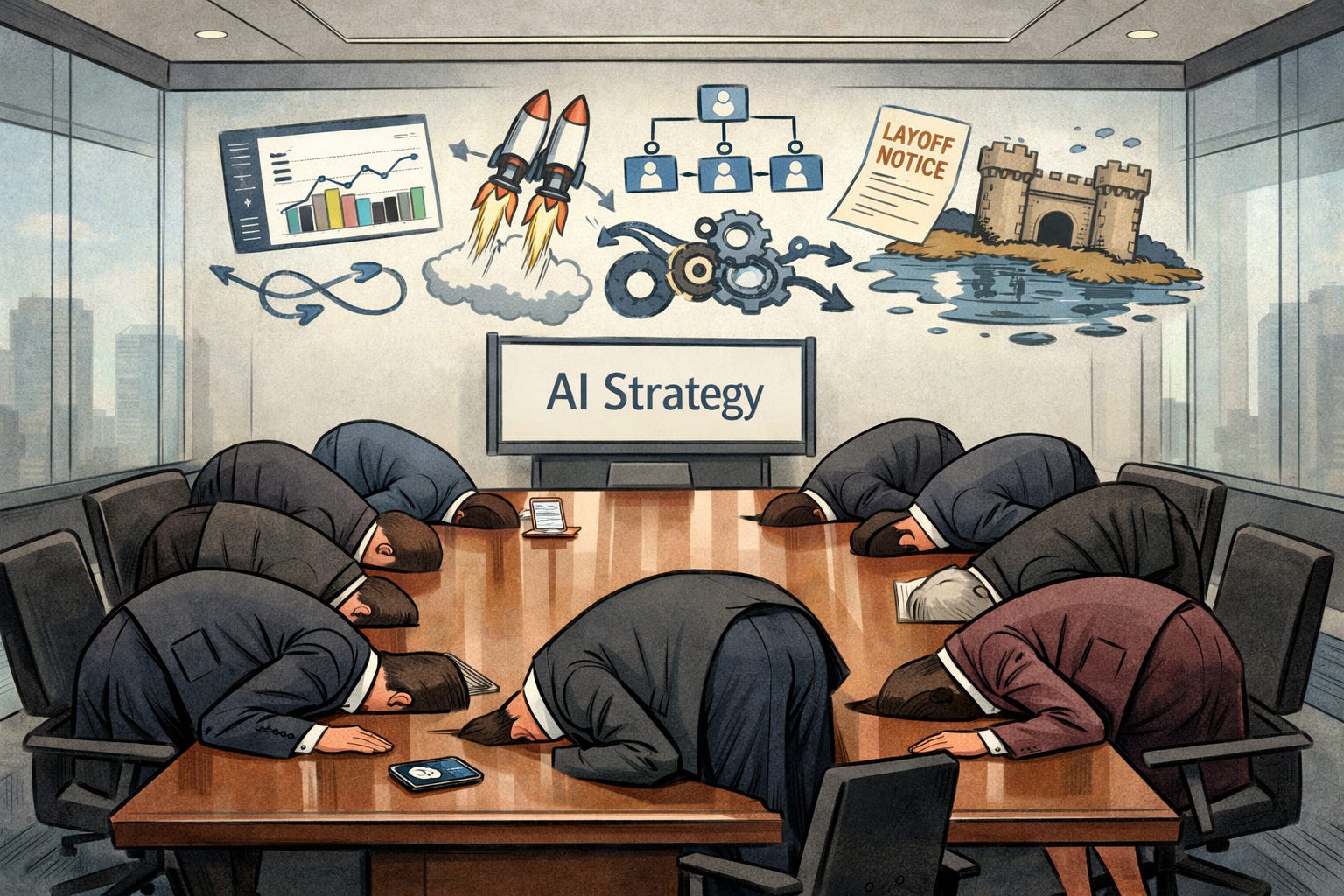
10) Most companies don’t have cohesive AI strategies. They have a hodgepodge of initiatives that don’t work together, have no measurable ROI, and don’t address the core issue
Another point that is true, but not actionable, in my opinion. If you don’t have an answer to #9, you can’t have a coherent strategy for #10. But a lot of companies don’t even have a hodgepodge of initiatives. They are just using the ostrich algorithm to tackle this problem. So, here I would give companies good marks for having a hodgepodge of initiatives. Sure, a coherent strategy would be great to have, but that’s unlikely for most companies, and in their absence, each initiative is giving some usable information to feed to the OODA-loop.
Reminds me of the young men who signed up for India service during the early days of the British East India Company. The average life expectancy of such men was around a few years (ending with death due to disease or in battle), but the few that survived, became rich beyond their wildest dreams.
No posts
Comments
Nothing yet. Say the first thing.
Sign in to join the conversation.