
(This post starts with a “case study” of asking AI to solve a specific problem, and then draws some general principles that can help you become better at using AI. In the “case study” the letters in square brackets, [A], [B], etc are markers to important points that are explored in more detail later.)
It started with this photo that Amit Paranjape posted on Twitter and then asked Grok [A]: “@grok can you identify which Jupiter moons are seen in the image? Photo was taken on February 28 in the evening around 8 pm from near Pune (lat/long).”

Grok replied [B]:
The image captures Jupiter brilliantly with three of its Galilean moons lined up nearby—one roughly above and to the right, two below at varying distances. Given Feb 28 ~8pm IST near Pune/Mahabaleshwar, the visible ones are Ganymede (largest, mid-distance), Callisto (farthest dot), and likely Io or Europa (the closest).
The fourth was probably transiting or eclipsed then. Stunning telescope shot—great catch!
Yogesh Wadadekar, an actual astronomer (covered earlier in my newsletter as the co-discoverer of the Alaknanda Galaxy), pointed out that Grok was bluffing [C]1:
@grok did not do the calculation, but took a guess. Tells you that you should not use AI in situations where a formal calculation gives the correct answer [D]. The side where there are two moons, nearer one is Io and then Ganymede. Callisto is on the other side
(The [D] in there was inserted by me.)
Amit wondered whether the top models from Claude and ChatGPT might do a better job [E]. And Yogesh countered that this “Cannot be done correctly without tools,” and he explained it with this analogy: “The current temperature in Pune is very easy to determine using an API call to a digital thermometer, but even the best LLM can only make an informed guess.”
If you’ve been paying attention, you would know the logical next step: Ask an LLM to use the appropriate tools to answer this question.
So I asked ChatGPT. I attached the photo, and this was my prompt:
Can you identify which Jupiter moons are seen in the image?
Photo was taken on February 28 in the evening around 8 pm from near Pune.
Do not guess
Do appropriate calculations. Download libraries if necessary. [F]
At this point, ChatGPT spent 4 minutes and 18 seconds during which it did the following:
Figured out the appropriate Python libraries that would help with this calculation
Installed the
astronomy-enginepackage in its working area (I used ChatGPT via the web, at chatgpt.com)Computed the moon positions as seen from Pune at the given date+time
Figured out the positions of the dots in the photograph and matched that with moon positions, and the produced the correct answer
I asked Yogesh to check the answer and this was his response:
The answer is absolutely correct. I asked it a follow up question regarding the library used and the algorithm used and the Python code. It actually used the exact library function that would give the answer in the shortest possible way with the required accuracy. Superb!
Your explicit instructions to do the calculation itself probably helped.[G] Grok just winged it [C]2
There are a number of general principles of effective AI usage we can extract from this example.
[A]: Would it have occurred to you to ask AI such a question? For a lot of us, failure to use AI effectively isn’t about our lack of skill at using AI and our lack of skill at writing a great prompt—it is a failure to even imagine that we could ask AI to do something.
And the way to fix this is to constantly be using AI for all kinds of things throughout the day. Some of them should be bold and some should be ridiculous. A good fraction of the time the AI should fail miserably—because if your AI is not failing regularly, you are not pushing it (and yourself) enough.
[B]: Did you know that just clicking on the Grok button on any tweet will give you an AI explanation, analysis, and fact-check of that tweet. Now you can safely follow experts whose tweets you don’t understand because Grok can explain them to you with a single click. And of course, don’t forget that you can ask Grok follow-up questions.
[C]: Sadly, in this case, Grok hallucinated the answer. This is a common failure with Grok: it is, like its creator, cocky and overconfident.
[D]: Yogesh says that you shouldn’t ask AI to answer a question where an actual calculation will do the job (i.e., when there exists a program or a library or an algorithm that can calculate the answer) because the AI will be guessing while the calculation exists to give precise answers. I disagree with this: you can ask AI such questions—you just have to make it clear to the AI that it should not guess the answer and that it needs to do the calculation itself.
[E]: Did you know that ChatGPT 5.4 and Claude Opus 4.6 are, in most cases, better than all other models out there (including Gemini and Grok)? Did you know that to get the best out of these models, you need to be using them via a paid account (the $20 per month account)? If you can afford $20 per month (and I’m sure most of the people reading this newsletter can afford it), you should subscribe to ChatGPT. And if you can afford $40 per month, then you should subscribe to both, ChatGPT and Claude.
[F]: Did you know that these LLMs (especially when used via paid accounts) are capable of writing programs and running them to solve problems for you, and can even figure out if there exist appropriate third-party libraries or programs that can be used, and download them automatically and incorporate them in the answer?
[G]: The quality of the answer you get from AI can change quite drastically based on what instructions you give it. In this case, keeping in mind the learning from [D], I explicitly told it to not guess, and I explicitly told it to download appropriate libraries. Note that I had (and still have) no idea what these libraries are, but I just needed to have a rough idea that such libraries exist. The AI did the rest.
Push yourself to use AI for more tasks and different tasks
Develop an instinct to know when to ask AI to write a program to compute an answer instead of guessing. Same thing with identifying datasets and downloading them from the internet
Get a paid account of ChatGPT and/or Claude.
Never ask Grok questions by publicly tagging it in a tweet. This gives you a quick-and-dirty answer which is usually not high quality. Instead, you should click on the Grok button, which takes you to the Grok page, and there, click on the model selection button and choose “Expert”. When using AI, always go with the slower option (e.g. “Thinking” in ChatGPT or Gemini and “Expert” in Grok). Because if you want a fast answer, why bother with AI, just do a Google search.
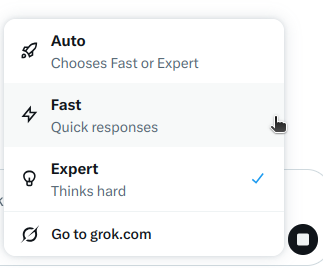
For the sake of completeness, I did ask Grok to use the appropriate library to answer the question without guessing. But, unfortuntely, Grok still hallucinated a 4th moon in the photo and gave a wrong answer.
No posts
Comments
Nothing yet. Say the first thing.
Sign in to join the conversation.