

Why this guide exists, who wrote it, and why that matters, and what being told a thing is “inevitable” is actually meant to do. Start here.
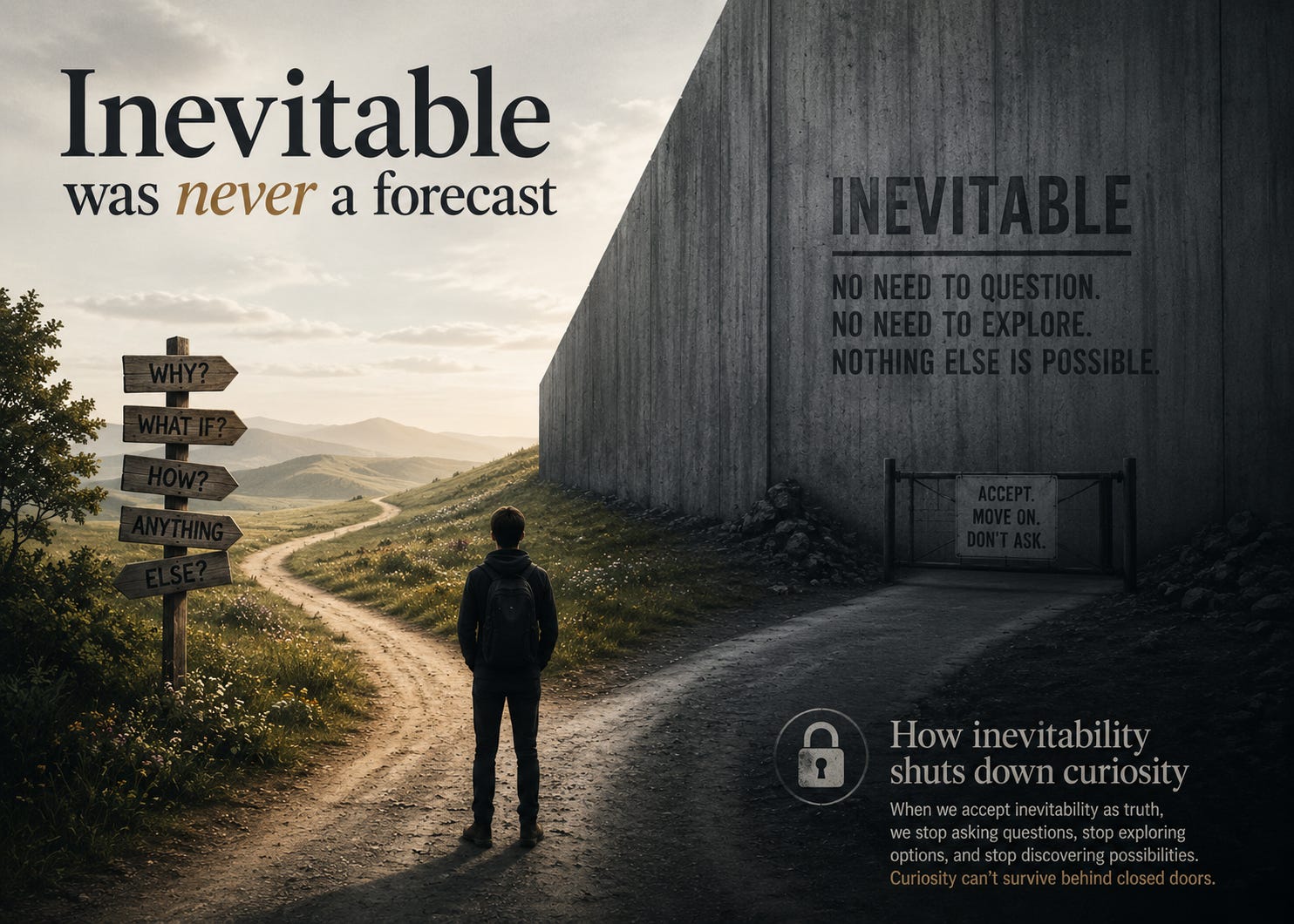
The personal essay at the heart of the guide. For the better part of a decade, I sold the coming wave of AI, and "inevitable" was the move I made for a living. Here it's named for what it is — a quiet form of bullying that reverses the burden of proof. If you read only one chapter, read this one.

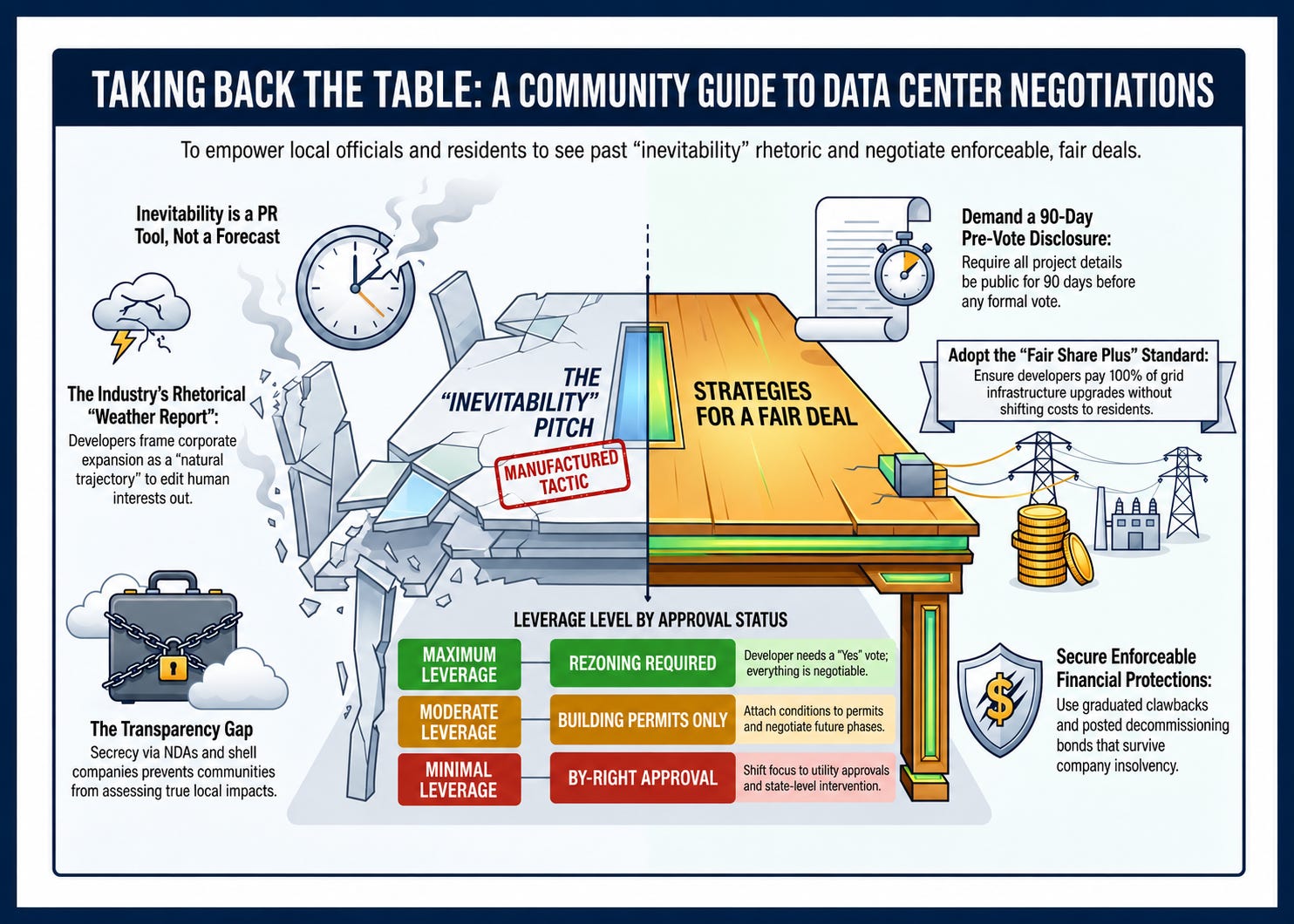
How the industry actually talks, the selling strategies that have worked on communities and those that have failed, where towns have won in real terms and where they have lost. If a project just landed in your county, keep this chapter open.

This chapter is a working reference section. What to ask before you say yes. What to put on the table. Hopefully this is a list far wider than most communities realize.
You will find information to handle the variation in leverage and deal structure that makes one-size-fits-all advice useless.
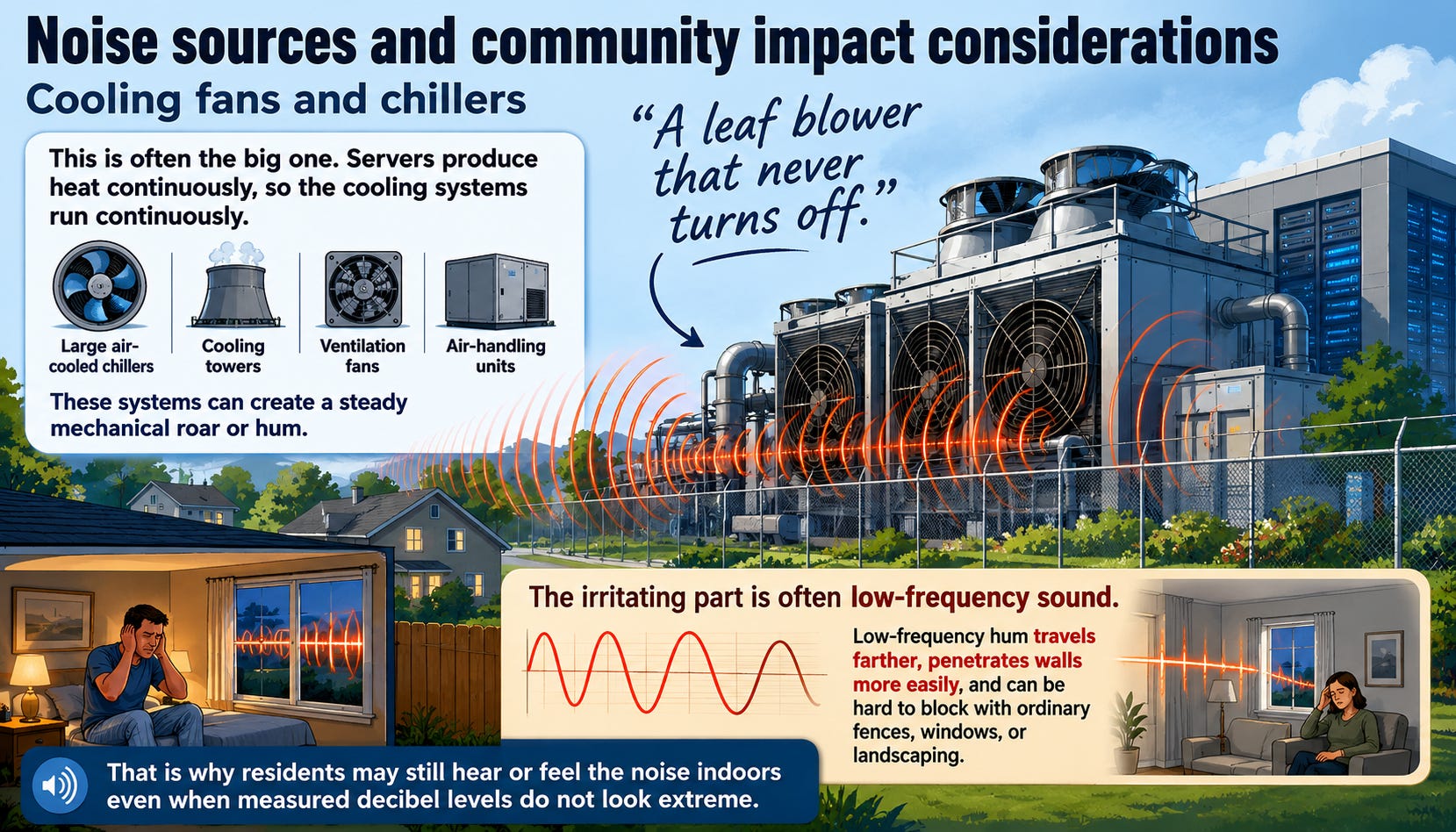
One impact, examined in full, as a model for interrogating any single claim a developer makes.
You do not have to read all of it, or read it in order. Pick what fits the situation in front of you.
Curious about the history, take Chapter 1.
Want the argument named and a tool to carry into a meeting, take Chapter 2.
Standing in an actual fight, go straight to Chapters 3 and 4.
One thread runs through every chapter. When someone calls a thing inevitable — destined, unstoppable, already decided — they are asking you to set down your own judgment. You have not lost the right to evaluate what is in front of you. That right is the first thing the word tries to take, and the first thing worth taking back.
This guide was assembled as a contributed effort, to the best of my ability, with the assistance of AI. You are welcome to reuse it, adapt it, and move it into any useful form to help your efforts. Consider it open, in the spirit of Creative Commons CC BY 4.0 Attribution. Check my work. If you find an error or something I’ve missed, I’d be glad to hear it, offered in the same spirit it was made: as a contribution to the effort.
Copy and paste all of these articles and use them to your advantage.
I sold the future once. In 1983 I joined Symbolics, the company that had just spun out of the MIT Artificial Intelligence Lab, and for the rest of the decade I sold and marketed the 1980s version of AI — expert systems, inference engines, machines that were going to think. I wrote the brochures. I stood in the room and told people it would change everything. I believed it. Funding from DARPA was flowing into research labs. AI was going to be in PCs and everyone would be using it.
Then the wave broke, the field went into what came to be called the AI winter, and the people who had rearranged budgets and departments and five-year bets around me got the winter instead of an apology.
I am telling you this first because it is the only reason to trust the pages that follow over the hundred other guides you could read. I know what the sales pitch sounds like, not because I studied it but because I built it for a living. And the thing I was selling, underneath the technology, was the feeling that none of it was up for debate — which is the one part that proved false even where the machines eventually delivered. I can hear that same note now, almost intact, in the way data centers are being sold to towns.
I’m sure you’ve heard that AI is the largest thing to happen to us since fire, since language, since the wheel. A change beyond anything in human history. A payoff for everyone. We are often left with an implied assumption that this is so large that the only sensible response is to step aside and let it happen. We’ll benefit in some undefined way in the future.
Then there are the receipts.
Across the country, the communities that agreed to a data center in their area are filing their reports, and many of them read like warnings. Paused and banned projects. Tax deals that handed over tens of millions for a handful of permanent jobs. Water strain a town cannot spare, and on a grid, the rest of the county still has to pay for. Decisions are locked into thirty-five-year contracts that cost more than a billion dollars to reopen. The promise arrives as a press release. The bill arrives later, and it arrives locally.
I want to be clear about where I stand, because it shapes what this guide is and is not.
I am not against data centers. I use cloud computing and AI apps every day. I used it to help compile the research in these pages and to assemble them into something you can actually use. I use some aspects of AI to help me think and learn.
The argument here is narrower and more practical than a for-or-against argument. This guide is meant to provide you would informed leverage. Use the guide freely to negotiate an arrangement that benefits the community at large and the agreements are transparent.
Here is the part the pitch never mentions. Confident, expensive, hugely popular promises have failed to arrive on their own terms before — and not in obscure corners, but on the front pages of their day.
In 1963, the United States committed federal money to a supersonic airliner meant to beat the Concorde: three hundred passengers, more than twice the speed of sound, the obvious next chapter of air travel. Boeing won the contract. The government pledged to cover most of the cost. Everyone knew it was coming. In 1971, Congress killed it before a single production plane ever flew, because the noise was unacceptable, the cost would not stop climbing, and the economics never closed. The future that could not be stopped was simply never built.
The sharper example is an energy story, which is what a data center finally is. In 1954, the chairman of the Atomic Energy Commission stood before a room of science writers and told them their children would have electrical power “too cheap to meter.” Civilian nuclear energy was a certainty, just over the horizon. The plants got built. The power was never close to free. Seventy years on, the phrase has outlived its promise, a fossil of a sales pitch that everyone believed.
The lesson is not that data centers are a fraud or that the future never comes. Sometimes it does. The lesson is narrower and more useful: being told a thing will surely pay off is not the same as it paying off. Inevitable is a mood, not a track record. The men and women selling AI silicon and software today are selling the next chapter of the same story, in the same voice, to the same room. You do not have to cheer that voice or boo it. You only have to ask for the terms.
Underneath all of it runs a single move, the one I knew best when it was mine to make. It is the inevitability argument — the claim that the decision is already settled and your only job is to get out of the way. The next chapter takes that argument apart and hands you a tool small enough to carry into any meeting.
After that, the guide gets practical, and its real subject is the work you do before the serious conversations start. Most of what decides how a deal turns out is settled long before anyone sits down at a table — in what you have read, what you have asked for, and what you already know to expect when the developer walks in. So these pages document the selling playbook from both sides: the strategies that have worked in communities and the ones that have failed, laid out in enough detail that you can recognize the move as it is being made on you. You will find what other towns have won and what they have lost, what a fair deal actually requires, and a list of things you can put on the table that runs much wider than most communities realize — water and power terms, decommissioning and land-reuse guarantees, enforceable noise limits, independent monitoring, local hiring, and more.
The other side of the table carries a burden too, and it belongs in the open. A developer who wants a community’s trust has to earn it, and the currency is transparency — the plans already drawn, the load already projected, the on-site generation already contemplated, said plainly and early rather than surfaced after the contract is signed. A project that will not say what it intends is telling you something. Part of what this guide does is help you ask the questions that make that silence visible.
Because a developer is going to knock. When they do, you will need to tell the rare good deal from the bad one. For a lot of rural places, the honest answer is no — the water, the power, the land, and the question of what stands on that land ten years from now do not add up.
For some communities, the answer is yes, on terms worth signing.
So I’ll mention again, I’m not against the addition of new data centers. With or without AI, the demand for more computing is increasing, though the ‘resource needs’ of computing for AI are significantly higher. And I completely agree with the community pushback on local water extraction issues, especially in Texas, where I live.
Either way, the one thing you cannot afford is to be the person who was told this new AI technology wave is inevitable and believed it, only to find out too late what that belief had cost.
This guide is not legal advice, and I am not an attorney. It is a civic research and discussion resource meant to help communities ask better questions and negotiate from a more informed position. Before relying on it in any actual decision, please verify local facts and consult qualified legal, engineering, financial, environmental, or policy professionals as appropriate.
This guide was assembled as a contributed effort, to the best of my ability, with the assistance of AI. You are welcome to reuse it, adapt it, and move it into any useful form to help your efforts. Consider it open, in the spirit of Creative Commons CC BY 4.0 Attribution. Check my work. If you find an error or something I’ve missed, I’d be glad to hear it, offered in the same spirit it was made: as a contribution to the effort.

Comments
Nothing yet. Say the first thing.
Sign in to join the conversation.