
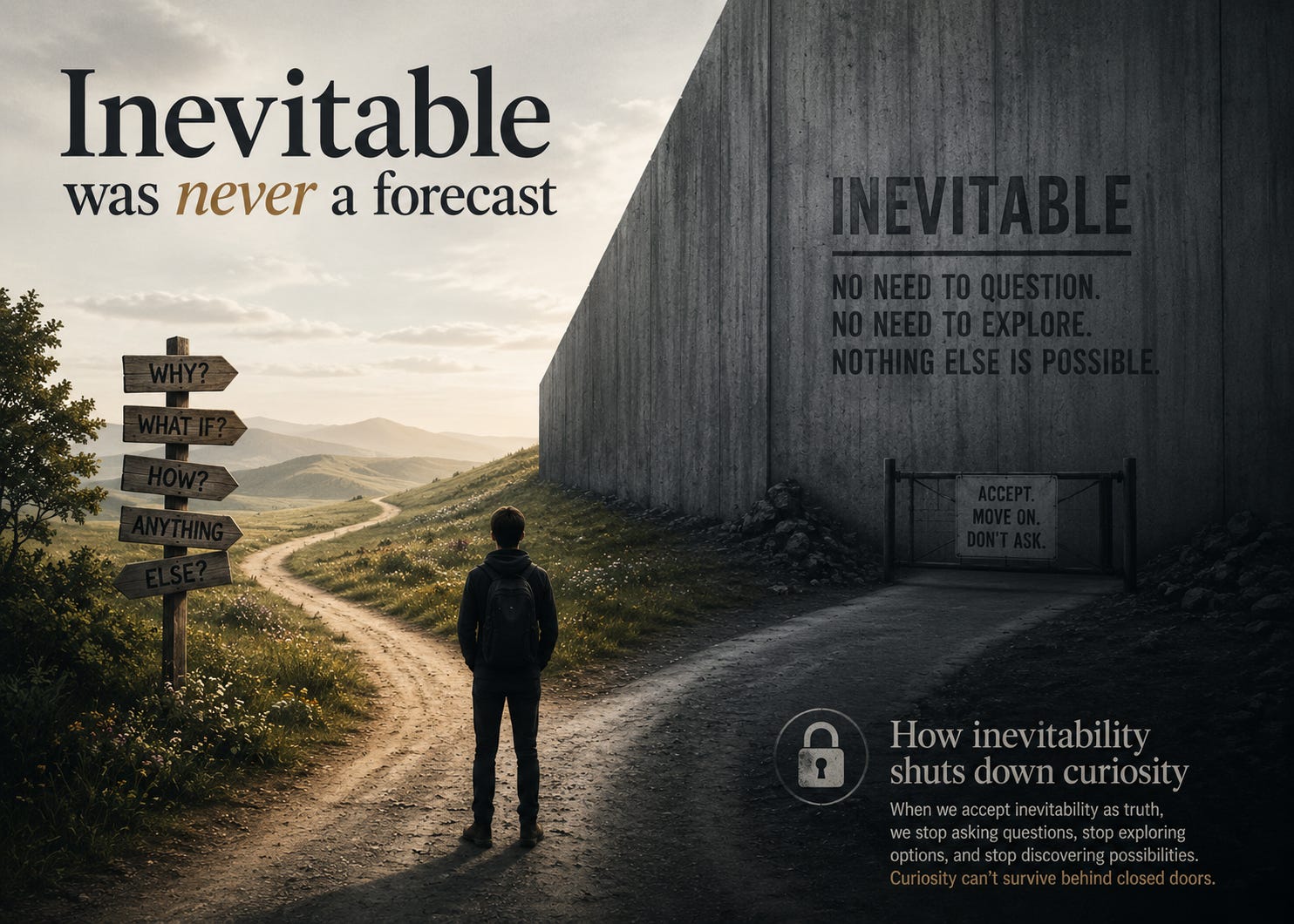
Someone asked me an honest question last week. He wanted to understand the fight over data centers, and he said so plainly: new to it, genuinely curious, not trying to win anything. He worked through the energy question, wondered whether a state with clean hydropower might be the smart place to build, and then, almost as an aside, he closed the door on his own curiosity.
“The centers are going to be built,” he wrote. “The money will find a way.”
I have been hearing variations of ‘inevitable’ my whole working life, and it’s often associated with new technology.
The man who wrote it is not the problem. He is the evidence. Somewhere along the way, he was taught that asking was pointless, and he had absorbed the lesson so completely that he reached for it to end a question he actually wanted answered. That is what the inevitability argument does. It is not a forecast. It is a way of getting you to stop asking, and it works best on people who never notice it when it arrives.
AI for Lifelong Learners is a reader-supported publication. To receive new posts and support my work, consider becoming a free or paid subscriber.
The quiet force of the argument
So let me call it what it is. The inevitability argument is a form of bullying. Not the shouting kind, but the quiet kind, the kind that dresses a sales pitch in the language of natural law and dares you to argue with the weather.
Here is the mechanism.
The moment you question the claim, you are the one who has to justify yourself, while the person who made it has justified nothing at all. The burden of proof is reversed. You are put on trial for asking, and the man selling the data center never takes the stand. That reversal is the whole social force of it. The argument wins not by being right but by making your evaluation feel naive. A forecast invites scrutiny. Bullying forecloses it.
What I learned about selling the ‘previous AI wave’
I know the move from the inside, because I used to make it. For the better part of a decade, I sold and marketed artificial intelligence for a living: expert systems, inference engines, as the coming wave. I told customers it would change everything, and I was not lying. I believed it. They believed it. Then the wave broke early, and the tide went out for a long time. They called it the AI winter of the 1980s, and by the time it ended, there was almost nobody left to call it anything. The companies folded. The researchers scattered. The certainty I had been selling turned out to be a mood, not a law.
What I do not say often enough is what the mood cost the people who trusted it. They had rearranged real things around my confidence: budgets, hiring, the direction of a department, in a few cases, a whole company’s bet on the next five years. When winter came, the certainty evaporated, leaving them holding the rearrangement. Nobody sent them an apology. The pitch moved on to the next room, the next buyer, the next sure thing.
The same certainty is back
That same certainty is back now, almost word for word, as if the winter taught us nothing. “It is coming whether we like it or not.” The technology did come, eventually. But it arrived late, it arrived changed, and it arrived only after a long detour none of us predicted. The certainty was wrong even when the prediction came true, because it never described the future. It was managing the room.
What happens when people decide
The receipts are arriving in real time. As of 2026, the supposedly unstoppable thing is being slowed, redirected, and refused all over the country.
More than seventy cities and counties have paused or banned new data centers. In the past year, at least twenty-five projects were canceled outright, and Bloomberg, citing the analytics firm Sightline Climate, reports that close to half of the capacity slated for 2026 may be delayed or canceled, with only about a third under construction so far. The Seattle City Council voted nine to nothing for a moratorium, with fifty-two residents speaking in favor and not one against. New York’s legislature sent the governor a statewide pause. None of that looks like a force of nature. It looks like people are deciding.
Why the word ‘inevitable’ still gets used
So why does the word still work? Because the deals it protects do not survive daylight.
In Orangeburg, New York, the Rockland County Industrial Development Agency approved roughly $77 million in sales-tax exemptions for a JPMorganChase data center expansion that promised to create a single permanent job, by watchdog estimates, the largest per-job subsidy ever recorded in the country. The public hearing tells you everything: nobody came, twenty minutes passed in silence, and the deal was approved two weeks later. That is not the talking point of someone who hates technology. It is what happened, and it is exactly the kind of fact “inevitable” is built to keep off the table. The argument is almost always deployed by someone with a stake in your silence.
Sometimes that stake is a number it would rather you not see. Other times, it is the clock — the deal gets done before the room fills up.
El Paso moved forward with its Meta deal with limited public scrutiny, and the fact that the developer named in the paperwork, Wurldwide LLC, was Meta did not appear to be the subject of any broad public deliberation before the vote. The formal process ran on the timing of special meetings and posted notices, not on a sustained public reckoning with Meta’s identity, its water demand, its power demand, or the leverage the city was signing away for decades.
In December 2023, El Paso’s City Council unanimously approved a thirty-five-year Chapter 380 incentive agreement for what the city now calls the Meta data center project, filed under Wurldwide LLC. When a council member tried to reopen the deal in 2026, the city was warned that unwinding it mid-construction could expose taxpayers to significant legal and financial risk, including lawsuits from one of the largest companies on earth. By the time anyone thought to ask again, asking had become expensive. The certainty did its work early — before the backlash, before the second thoughts.
A closing invitation
I sold the coming wave once, and the people who rearranged their lives around my certainty got the next wave instead of an apology — same pitch, same confident men explaining that resistance was beside the point.
So whatever this one turns out to be worth, ask two questions. Is this telling me something true about the world, or telling me to stop thinking? And who benefits if I do? “Inevitable” is the word that hopes you won’t ask either one. Don’t give it the satisfaction.
The next chapters (3,4,5) that follow are the practical half of that refusal — what to ask before a town says yes, what to put on the table, what other communities have won and lost. Use them to your advantage.
If you are in one of these fights, or have watched one up close, I would like to hear from you. A more equitable version of this is available to us — but it is the kind of thing people build together, by comparing notes, rather than waiting for permission.

This guide is not legal advice, and I am not an attorney. It is a civic research and discussion resource meant to help communities ask better questions and negotiate from a more informed position. Before relying on it in any actual decision, please verify local facts and consult qualified legal, engineering, financial, environmental, or policy professionals as appropriate.
This guide was assembled as a contributed effort, to the best of my ability, with the assistance of AI. You are welcome to reuse it, adapt it, and move it into any useful form to help your efforts. Consider it open, in the spirit of Creative Commons CC BY 4.0 Attribution. Check my work. If you find an error or something I’ve missed, I’d be glad to hear it, offered in the same spirit it was made: as a contribution to the effort.
If you missed Chapter 1 - Chapter 1: Introducing how to negotiate a better deal when a data center developer comes knocking
AI for Lifelong Learners is a reader-supported publication. To receive new posts and support my work, consider becoming a free or paid subscriber.
Comments
Nothing yet. Say the first thing.
Sign in to join the conversation.