
In the first part of this interview, we began discussing using WikiEducation as a means of engaging with students as writing as an alternative to traditional writing assignments. We continue this conservation with Dr. Jennifer Bernstein and LiAnna Davis.
About the Interview series
As part of my work in this space, I seek to highlight the folks I’ve been in conversation with or learning from over the last few years as we navigate teaching and learning in the age of AI.
If you have experiences around AI and education in higher education classrooms that you would like to share, consider being interviewed for this Substack.
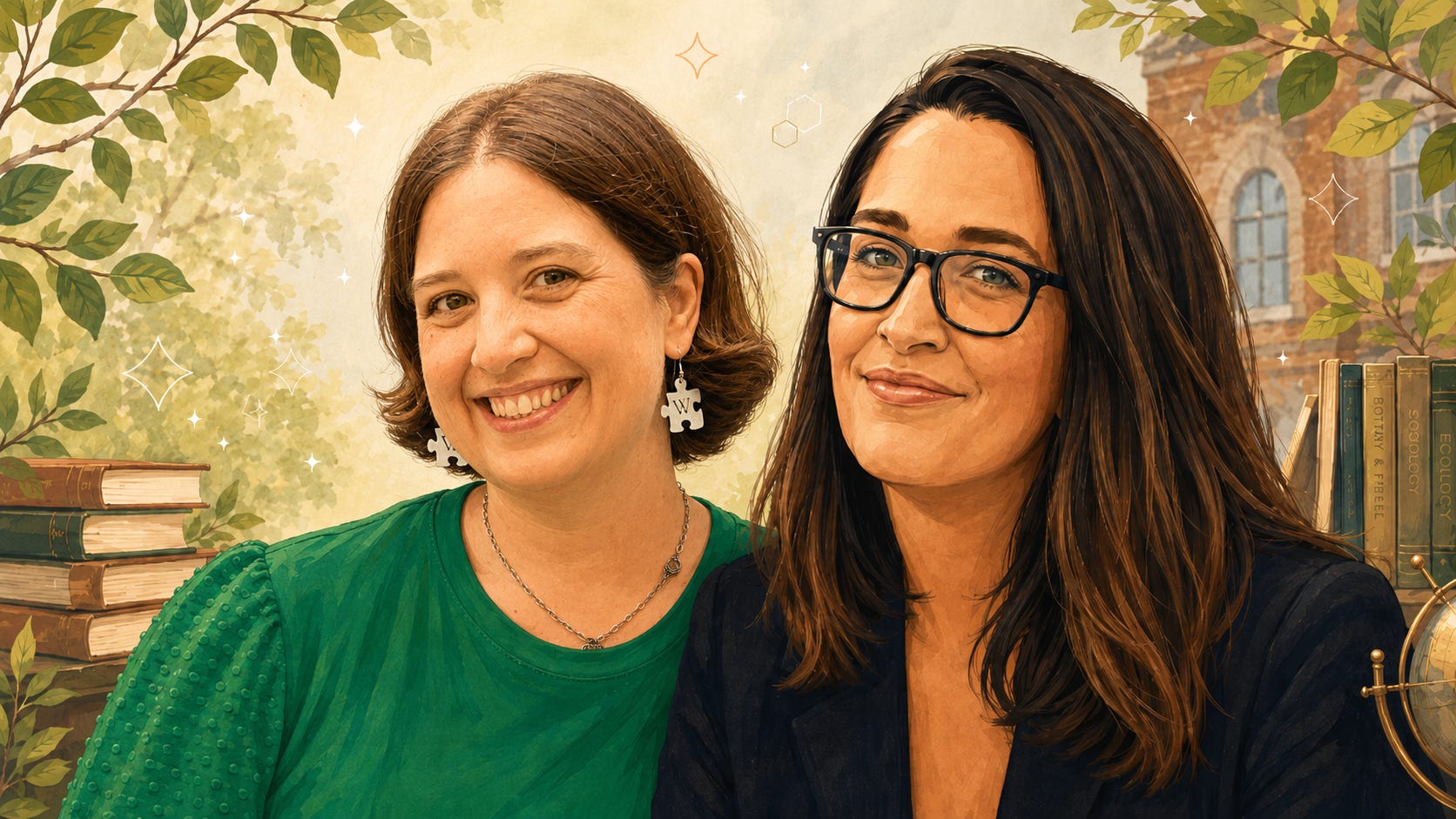
Jennifer: This is all excellent. One thing I wanted to mention: I love this idea of next-level citations. It’s one thing to have an appropriate citation, but to make sure the specific claim is actually in that specific citation, beyond a surface level. I edit an academic journal, and that happens all the time with authors who should know better. It’s a real service to students to know that’s the level of rigor we expect if they continue on. And I love that it’s not coming from mom, you know? It’s coming from someone else, in the spirit of collective improvement.
This intersects with my critique of the “AI is good or bad” discourse. When I see the “they used AI” framing in popular media, as if it’s immediately discrediting, it’s like saying “you’re on your phone.” What are we doing, and how are we doing it, is the more important question. I don’t like that bifurcation. And I get all this spam in my feed: because they think I’m a student, they tell me how to generate this stuff and get the right citation; then they figure out I’m a professor, so they sell me the software to detect my students. We just bounce around that loop.
There’s a huge profit motive in us out-gunning one another. What LiAnna spoke to is that this is a project of collective improvement. You’re not getting busted for using AI; we’re all here trying to make a quality resource together, and any critique that comes back is a real opportunity for learning.
We use Pangram, and I think it’s good. But a lot of students just don’t want to go to a different platform. If they’re in Canvas, they don’t want to click anywhere else, so they’ve got this platform anxiety, and when they get flagged for AI, they freak out and come to me.
I say, “Okay, let’s talk about why it got flagged,” and treat it as a learning opportunity. It breaks down the us-versus-them that dominates so much of the discourse. In my courses, I don’t ban it. I disclose use, and in my AI assignment I had students keep a journal of what they were using it for and which platform. I take the places where they get flagged and talk about it.
With undergraduates, I’ll read something that’s obviously LLM-generated and ask, “How did you use this?” and they’ll say, “You were asking us to connect the topics from the textbook to your lecture.” And I’ll say, that’s the thinking part. You can use it for either end, but the middle is what you’re supposed to do.
So many students come in feeling guilty, like they’re sneaking around. I teach environmental studies and sciences, and so many of them are freaked out by the water footprint (and that discourse has been pretty overblown) but my heart goes out to them saying, “I’m not touching this because it’s wrecking the very thing I’m researching.”
We need an open forum to break down this dichotomy because it’s not productive, and it’s not helping students use AI in ways that can be productive and step into the critical thinking that Wikipedia teaches.
As for deep research: I’m writing a book right now and playing with the deep-research tools, cross-referencing the nitty-gritty output with what’s available, running it in areas where I’m an expert. It can do a lot in 20 minutes and is directing me to amazing primary sources. It’s anecdotal, but at the end of the day, I ask, am I creating a better product for the readers with integrity? If I’m doing that, then like LiAnna says, we should use whatever method gets us there.
LiAnna: It’s really helpful to frame the detection question not around the use of these tools but on the outcomes of that use. In our case: are you creating information that’s reliable and verifiable for Wikipedia? Can I take the sentence you wrote and the citation you added and check that it exists?
AI tools are built into most of the software students write in now. They’re using Grammarly, and the AI modes will write stuff for them if they’re not careful, so students can be using these tools without even realizing it, accepting text suggestions without understanding it. It’s not like they copied a prompt into ChatGPT. So we ask them to turn off Grammarly, because one thing we’ve seen on Wikipedia is subtle distortions of meaning, which matter a lot. We’ve tried to reframe the debate away from “did you use this tool” to: our detection system identified that your content may have used generative AI, and because of that, we need to make sure everything is verifiable because we care about protecting the integrity of information on Wikipedia. For instructors who engage students on that information-integrity and verifiability angle, it’s been productive. It’s not policing AI usage so much as making sure what you’re doing meets Wikipedia’s requirements.
Lance: There’s something here, LiAnna. The “we don’t even know it’s there,” the students won’t know it’s there. If you grew up with autocomplete throughout your life, in your emails, it can feel hard to know where it ends and you begin. I so appreciate recognizing that. It sounds like you’re doing this practice of helping students build their AI literacy, figuring out, just like we had to figure out our social-media identity or how we’d use the internet, “where is my relationship to this?”
Jennifer: That’s almost a meta level I’d like to teach about, because more and more you have to navigate pushing against these tools. I feel like I’m starting to push upstream, and I don’t want that. Helping students identify where these things are sneaking into their work would be a whole new knowledge base and I’m not that far ahead of it. My daughter is 15 and in high school, and she just says “AI, no.” I wonder if that’s the default we’re giving. And there was that change with Grammarly that students didn’t know about: things that weren’t being flagged before are being flagged now. Can you imagine going through that as a student?
Lance: I have a lot of empathy for students navigating all of this right now.
LiAnna: One of the real challenges is the difference on college campuses between the administration’s direction and the individual instructor’s. So many campuses are giving students enterprise-level subscriptions to generative AI tools — you show up, here’s your campus email, here’s your campus GPT account — and that’s a tacit endorsement.
Then you get into an individual class where the instructor says don’t use it. Academia collectively hasn’t grappled with the right approach, and different campuses have different ones. Especially for early-career faculty moving between institutions, a policy that works at one place may not work at the next because of a different perspective from administration.
So at Wiki Education we’ve tried to create something universal enough to work across disciplines and across the pro-AI and anti-AI camp. So much of the discourse is either people who think it’s the best thing ever invented and every student must use it at all times as a critical job skill, or people who think it’s the worst thing ever created and you’d better not touch it. Neither is particularly helpful. We work with faculty interested in the AI-literacy angle: where are there opportunities to use these tools, where do they fall short of their stated goals, and how can we equip students to tell the difference? Writing for Wikipedia is one of the core areas. In the process of uncovering how Wikipedia works, students start to recognize how untransparent and black-box the knowledge from their AI systems is. Wikipedia can feel like a black box, but once you learn the slightest bit about it, you can see every edit ever made, who added it, the citation, where it came from. You can verify it. There are “citation needed” templates, warning banners that something may not be reliable or may be out of date. That radical transparency is a demonstrated way of being public about what we do and don’t know, in a way AI is not. Engaging with Wikipedia causes students to reflect more on the AI systems too: where they’re getting information, and whether it’s real.
Jennifer: One thing you provide in your Substack, Lance, is different AI policies. I was looking through it this morning, and it proves the breadth. I want to echo what LiAnna said about the breakdown between administration and faculty. At institutions I’ve worked for, you typically get some template text with different options for AI use in your classroom; but once you choose your option, that’s where the communication ends. I understand administration needing to provide that, but I don’t think the real work or the real discussions are happening there. And I want to echo the black-box point: implicitly challenging that black-box idea is really what I saw through these assignments. Getting that literacy skill is so fundamental.
Share AI + Education = Simplified
Lance: Those are both great points. There’s a real challenge about institutional policy. There’s a need for it, because it gives faculty some clarity and lets them know the institution has their back for alignment. But there’s still so much that has to happen at the disciplinary and classroom level. Jen, I’d love to hear from you: are there any poignant moments in this experience with students: moments where you saw the “aha!”, where their engagement with Wikipedia was clearly shifting something?
Jennifer: I’ll couch this by saying I teach this remotely, which is a testament that it can work across platforms. I don’t have one pull-quote student, but the most powerful thing over the semester is starting to see their level of ownership over a topic. I had a student doing a project on the Dallas Arboretum, which just had the shell of an article. She started visiting the garden more, talking to the people on site. She got more involved as a primary researcher. She knew personal communications wouldn’t be appropriate to include in the actual Wikipedia post, but she used them to direct her to primary research and to validate claims from people on the ground. By the end, it was powerful to see how her relationship changed to a place that was already near and dear to her. I imagine she’ll have a very different lifelong relationship with it.
Lance: I have no doubt LiAnna is like me, starting to check the Dallas Arboretum on Wikipedia.
Jennifer: Dallas is going to get a bunch of hits and wonder what happened.
Lance: Any final thoughts, or anything we didn’t get to that you wish had come up?
Jennifer: This has been a great conversation. One thing I’m really interested in is that learning process from knowledge receiver to knowledge producer, whether it happens across other mediums, because that shift is so important right now. So, putting my researcher hat on, I’d like to dive into that space and dork out a little more.
LiAnna: We have a whole community of faculty who started teaching with Wikipedia and then their research made an abrupt turn. They started researching student learning outcomes for Wikipedia assignments in their subject area, which may not be traditionally their pedagogy. You’re welcome to join.
I’d just say Wikipedia assignments are more relevant than ever. Wikipedia is facing real challenges from AI. But it’s also an opportunity for programs like ours, using Wikipedia to teach AI-literacy skills in a system students already know because everyone uses it, regardless of whether their teachers told them not to.
We give them a chance to grapple with: am I a consumer or a producer of knowledge? How can I make a contribution to the global community? What is a neutral point of view? Where are the secondary sources?
We haven’t even gotten into systemic bias; Wikipedia is a reflection of the published sources in academia, and where are those great and where are they not. Those questions about the gaps in your field are the cornerstone of a college education: teaching students to think not just about what’s already been discovered, but what hasn’t and whether that’s because no one’s thought about it yet or because of systemic challenges.
Wikipedia provides such an opportunity, both to become a real expert in one topic area and to reflect on what’s known about your subject. And it can do that because of the student-motivation angle. If you can get them over the hump!
Jen talked about undergraduates nibbling around the edges; they’re often terrified to click the edit button. And it’s not just students. Over 15 years of new-editor outreach, I’ve seen that even tenured professors who are the expert in their discipline find it terrifying to click edit and add to their subject area. Giving people the opportunity to step into the space where they can be an expert, produce knowledge, and help the world out has been powerful for students, and in the age of AI it’s only more important.
Jennifer: It gives them hope, that’s what I want to say. I see the larger anxiety and this gives them something they can do, and the belief that people just like them can contribute. It runs counter to so much of the misinformation overwhelming them elsewhere in their lives. They want something positive to do, and this is really a place where they can do it. It gives them hope in a challenging ecosystem, both pragmatically and, honestly, psychologically.
Upcoming Sightings & Shenanigans
Keynote speaker at the Reimagining the Liberal Arts in the Age of AI Conference, July 21-23 at the University of Mary Washington.
EDUCAUSE Online Program: Teaching with AI. Virtual. Facilitating sessions: ongoing
Recent Recordings, Resources, & Writings:
Davis, L., & Eaton, L. (May 2026). Expanding OER with GenAI. EDUCAUSE Review.
AI x Higher Ed Podcast with Anand Rao & Stefan Bauschard. Episode: Universities Must Adapt to AI—Here’s How They’re Doing It (May, 2026)
Damm, C., & Eaton, L. (2026, March). From prompt to practice: A framework for transparent GenAI use in higher education. EDUCAUSE Review.
Eaton, L., Nemeroff, A., & Sun, X. (2026). AI-assisted course design and development. In K. S. Ives, M. Cini, & R. Schroeder (Eds.), AI applications in online higher education administration: Strategies for maximizing returns and improving outcomes. Routledge.
Margin of Thought with Priten: Season 1, Episode 5: How Can We Center Pedagogy During the AI Tech Wave? (February 2026)
Online Learning in the Second Half with John Nash and Jason Johnston: EP 39 - The Higher Ed AI Solution: Good Pedagogy (January 2026)
The Peer Review Podcast with Sarah Bunin Benor and Mira Sucharov: Authentic Assessment: Co-Creating AI Policies with Students (December 2025)
David Bachman interviewed me on his Substack, Entropy Bonus (November 2025)
The AI Diatribe Podcast with Jason Low (November): Episode 17: Can Universities Keep Pace With AI?
The Opposite of Cheating Podcast with Dr. Tricia Bertram Gallant (October 2025): Season 2, Episode 31.
The Learning Stack Podcast with Thomas Thompson (August 2025). “(i)nnovations, AI, Pirates, and Access”.
Intentional Teaching Podcast with Derek Bruff (August 2025). Episode 73: Study Hall with Lance Eaton, Michelle D. Miller, and David Nelson.
Dissertation: Elbow Patches To Eye Patches: A Phenomenographic Study Of Scholarly Practices, Research Literature Access, And Academic Piracy
AI Syllabi Policy Repository: 200+ policies (always looking for more- submit your AI syllabus policy here)
Finally, if you are doing interesting things with AI in your higher ed classrooms, consider being interviewed for this Substack or even contributing. Complete this form, and I’ll get back to you soon!
We periodically host small-group workshops and leadership sessions for higher ed teams. You can learn more about our current offerings here.
AI+Edu=Simplified by Lance Eaton is licensed under Attribution-ShareAlike 4.0 International
Comments
Nothing yet. Say the first thing.
Sign in to join the conversation.