
About the Interview series
As part of my work in this space, I seek to highlight the folks I’ve been in conversation with or learning from over the last few years as we navigate teaching and learning in the age of AI.
If you have experiences around AI and education in higher education classrooms that you would like to share, consider being interviewed for this Substack.

Dr. Jennifer Bernstein is Editor-in-Chief of Case Studies in the Environment, published by the University of California Press, and teaching faculty in the Department of Geosciences at Texas Tech University. She holds a PhD from the University of Hawaiʻi at Mānoa and master’s degrees in Geography and Science Education.
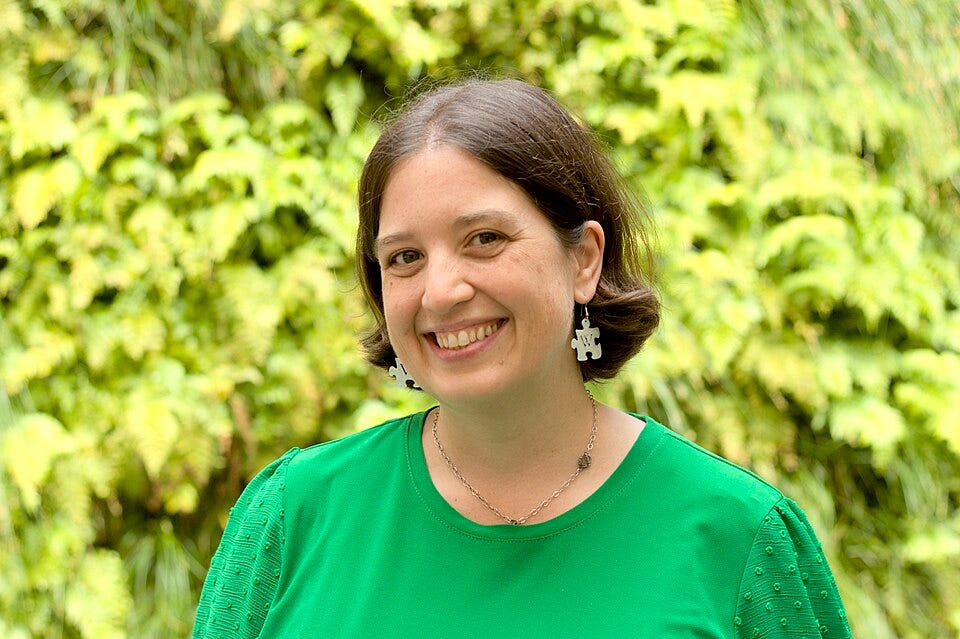
LiAnna Davis serves as the Chief Programs Officer and Deputy Director for Wiki Education, a nonprofit that works to make Wikipedia more accurate, representative, and complete. She joined the team that started the Wikipedia Student Program in 2010, helping grow it from a small pilot to a vibrant, scalable initiative in the United States and Canada that brings 19% of all new active editors to the English Wikipedia. Her work has enabled a small-but-mighty program to have global impact, diversifying the editor base and content on Wikipedia while adding high quality, fact-based information read by millions of people — all while teaching students critical digital media literacy skills needed to fight disinformation.
Lance Eaton: Can you tell us where the idea for the project came from, and what ideas you were grappling with?
Jennifer Bernstein: There are kind of two parts to it, and since LiAnna is here, I want to make sure we talk about Wikipedia in the context of AI. I’ve always taught students using Robert Harris’s CARS model for evaluating internet sources. I’ve been teaching from that for about 15 years: how do you establish credibility and authenticity, all the things students go through to navigate the big wide world of the internet. But over the last few years, like a lot of faculty, I started feeling like an AI cop, and that’s not why I got into teaching. I can put all the statements I want on my syllabus, but there’s chaos actually happening. So I asked, how do I change this feeling of resentment I’m developing toward grading?
On one hand, I revamped all my courses to make assignments that couldn’t just be pumped into an LLM. But the other thing I did was try to bypass myself as the instructor-arbiter. I got the Wikipedia assignment through one of the listservs I’m on, and I loved its outward-facing aspect. I thought it was an interesting contrast with the AI black box students were dealing with: stepping away, not demonizing anything, and asking, how does credible information get produced, and how does it get evaluated? I’ve had great success with my students and watched them grapple with going from being a receiver to a producer of knowledge. Doing those two projects in tandem was really helpful.
Lance: Can you tell us how that evolved into working with Wiki Education and Wikipedia?
Jennifer: One of the things that really appealed to me was that it was forward-facing. The students were responsible for the credibility of their content. Once, when I was in grad school, my office mate said, “Microsoft Word is where ideas go to die.” That hit me, and I’ve always wanted my work and my students’ work to be public-facing. It was my subtle workaround to give students a way to grapple, in a positive way, with their struggles around evaluating AI content. Wikipedia, in a kind of secret way, addressed all the concerns coming up in my teaching.
Lance: LiAnna, can you share your experience coming on to work with Jen and maybe a bit about Wiki Education in this context?
LiAnna Davis: We’re a nonprofit organization, a spin-off of the Wikimedia Foundation, the nonprofit that runs Wikipedia. Our role is to connect subject-matter experts to Wikipedia and encourage content gaps to be addressed. The English Wikipedia has more than 7 million articles: a much deeper and broader coverage of information than any encyclopedia ever in history. But just because it has a lot of content doesn’t mean it has every bit of content, and the quality of certain areas is higher than others, in part because of the nature of a volunteer community. People naturally write about what they’re most interested in, so you end up with content gaps. One of the big areas of gaps is academic subjects, broadly defined. People tend to write and read a lot about pop-culture topics: things in the news, on TV, in music and movies. Those tend to be well developed because people are excited about them. The more academic topics, where you see page-view spikes corresponding with the academic term, have varying levels of quality.
So our organization exists to empower subject-matter experts to contribute, particularly in those academic areas. Our flagship is the Wikipedia Student Program, the one Jen participated in. We’ve run it for a little more than 15 years, working with college and university faculty across the U.S. and Canada to assign their students to edit Wikipedia as a course assignment. We hear the same things Jen just talked about: whereas AI systems are a black box, Wikipedia is open and transparent. You can follow any discussion on the talk page of any article and see editors debating what to include. The producers-not-consumers framing is a key motivator for many faculty, along with the public-facing assignment.
I don’t want to be dismissive of the college writing experience, but there are a lot of throwaway assignments where students are writing for an audience of one (their professor) and as soon as they finish, they get a grade and neither of them ever thinks about it again. The Wikipedia assignment flips that: how can students use the fruits of their research to improve the world’s most referenced encyclopedia?
And this matters more than ever in the age of AI, because one of the most powerful sources of information for chatbots is Wikipedia. If AI chatbots don’t know something, they’ll just make something up, so it’s better to feed them reliable, real information. I’ve done this personally: I wrote a Wikipedia article, and beforehand I asked ChatGPT what it knew about the topic. The coverage wasn’t very good. Then I wrote the article, and suddenly, ten minutes after I published, ChatGPT had a great answer that included links to the article I’d just written.
That feedback loop where you add information to this resource, and it’s immediately dispersed across the ecosystem of knowledge, is really powerful for students, even though they’re collating and editing already-published sources into an encyclopedic form. We hear over and over, “This was the first time I shared something I did in college with my mom, or my grandpa.” That willingness to do public-facing work has been really powerful.
Lance: As a fellow educator, open pedagogy has been a core part of my practice for about a decade. I’m always thinking about the bigger life of the work students do. As a tangent, some of what I’ve done is having students create audio narrations for LibriVox, a site of public-domain audiobook recordings made by volunteers. I’m so here for this conversation!
Let’s go back to you, Jen. You started to answer this, but more tangibly: what did you want your students to notice or what did they start to notice about knowledge construction as they worked on Wikipedia, in contrast with AI?
Jennifer: First, LiAnna, that’s really powerful! It is a great exercise for students to see the real-world implications, because sometimes my students get frustrated about why they can’t just use AI to write their articles. And I’ll say quickly: I’ve done this project twice now, and Wiki Education gives incredible support. The interface for programming your course and getting all the resources is great, and for faculty with a 4–4 load, it’s wonderful to have that kind of built-in scaffolding.
One of my larger takeaways, both from assigning this and from talking with others who assign it, is that almost all students come in with this intuition that they shouldn’t cite Wikipedia. It’s been hammered into them for years, and it takes a while, especially with my nontraditional students, to get over it. And on reflection, even that intuition shows we’re not taking citations, and thus the production of knowledge, seriously. What does “citing Wikipedia” even mean? That’s not really a thing. Over the course of the project, they went from “don’t cite Wikipedia” to looking at the governance structures around information creation: neutrality, sourcing, edit histories. It went from “Wikipedia bad” to “how is this information developed, managed, and assessed for quality?”
I run their assignments through some rough content analysis to see what comes up. Reflecting on my last experience with undergraduates: they felt in over their heads, overwhelmed, and nervous about talking with others about it. A lot felt intimidated at the beginning, so they were editing around the edges, replacing images. That transition was easier for some than others. And the other thing I found was students were bringing the same critical skills they developed with the Wikipedia project to evaluating their AI output and citations. The interplay between the two was really obvious.
Lance: I love that transfer. And when you talk about “don’t cite Wikipedia,” I think about the Wikipedia wars of the late 2000s and early 2010s.
LiAnna: Part of what “don’t cite Wikipedia” is grounded in is that Wikipedia is fundamentally an encyclopedia, a tertiary source, which, like any encyclopedia or dictionary, you shouldn’t be citing at the college level. Unfortunately, how that’s been explained to students in their K–12 education is that there’s something uniquely bad about Wikipedia because it’s this open community that “anyone can edit.” But what we’ve seen over the last decade and this is true with AI systems, and with the rise of social media and YouTube videos that may or may not be real, is that determining whether something is real or not has become increasingly challenging.
We do students a disservice when we issue blanket statements like “don’t use Wikipedia” or “don’t use AI,” because we’re just blacklisting entire tools instead of giving them the critical-thinking skills to understand how knowledge is produced and the evaluation skills to understand where information is correct and where it leaves something to be desired. Those critical-thinking and media- and AI-literacy skills are the core of what we hope students learn through the Wikipedia assignment.
We’ve seen it in research. We did a study with students a few years ago with pre- and post-assignment surveys asking them for three adjectives to describe Wikipedia. The number-one adjective before was “unreliable,” and the number-one word after was “reliable.” That flip comes from understanding how knowledge is produced: while Wikipedia may not cover everything and not everything is perfect, you can trace the breadcrumbs back. You can see the citation, go to the original peer-reviewed journal, and verify it’s there. Wikipedia ends up being a great starting point for research — a broad overview, and a list of the primary and secondary sources students should actually be citing at the college level.
Share AI + Education = Simplified
Lance: I think an added challenge is that we have these supposedly distinct categories of primary, secondary, tertiary and there are times when Wikipedia is going to be a primary or secondary source because there hasn’t been enough produced yet. I think about breaking news: from what I’ve read about Wikipedia, that’s one of the first places trying to pull it all together. So there’s a categorization problem. Those categories come from a world of physical texts, and in digital there’s more nuance. That’s also where we get these blanket, all-or-nothing statements, whether it’s AI or Wikipedia. LiAnna, you’ve been doing this a long time, have you seen projects different kinds of projects grappling with the AI question?
LiAnna: Certainly, every college or university instructor worldwide is grappling with AI in their writing assignments. I speak to a lot of faculty across the U.S. and Canada in our programs, and a global community doing similar work. This is a universal challenge. Where we see the particular challenges is walking the fine line between being adaptive enough to work within each institution’s and each instructor’s AI policies, while ensuring we’re adding reliable, real information to Wikipedia.
We’ve looked through contributions students make using AI, asking AI to write a Wikipedia article. Part of the challenge is that because so much of the fact-based information that comes out of AI systems is derived from Wikipedia, AI systems are particularly bad at creating content that isn’t already on Wikipedia. So students produce information that sometimes sounds good, sometimes is actually accurate, with a citation that AI generated. A lot of the public discourse has been about fake citations or journal articles that don’t exist. We don’t find that to be a big challenge. The vast majority of citations these students add go to relevant, reasonable journal articles. But when you take the sentence cited to that source, open the source, and try to verify the claim, it fails verification. And verifiability is one of the core policies on Wikipedia: any information you cite to a source needs to be found in that source. The trust comes from that radical transparency: information plus a citation to where you found it. What we’ve found, at least as of 2026, is that when AI systems write content for Wikipedia, they generate information that may or may not be accurate but overwhelmingly fails verification. The citation ChatGPT or Claude or Gemini generates won’t contain the information it’s cited to.
Because of that, we have a full-on “do not use AI to draft your content” policy. But there are helpful places for students to engage with AI in the research process — such as having them think through content gaps, then asking the AI what other content gaps they haven’t thought of. One good thing about AI systems having ingested every Wikipedia article is that they have a good sense of the structure including what kinds of headers go into different types of articles and they can surface sources that are hard to find through a Google Scholar search, or a journal article that isn’t in JSTOR. So guiding students, if the instructor’s policy permits, to use AI as a tool in the research process without using it as the factual basis for drafting is something we’ve pushed organizationally, with a lot of success.
We’ve seen a steady increase in generative AI usage. In fall 2025 we put systems in place, including AI-detection software. We use one called Pangram that we’ve found highly reliable for Wikipedia content, and what it flags is overwhelmingly unverifiable. That’s enabled us to keep AI usage to a minimum.
And what we’re seeing comes back to motivation. You hear the horror stories: “95% of my students are using it, every paper is fully AI-created.” But there’s something special about this real assignment, where students are writing for a resource they use every day, that motivates them to take the extra step and actually do the reading and writing.
Fundamentally, the goal of those writing assignments isn’t to produce a paper for the instructor to read; it’s to have students do the research, the critical analysis, the thinking and writing. If you just put the prompt into AI, you bypass all of that learning. So if students use AI, they’re cheating themselves out of the learning. A Wikipedia assignment gives them an extra reason not to. It’s hard, especially for a 19- or 20-year-old, to understand the learning you’re getting and why it matters, but a Wikipedia assignment lets them say, “I’m doing this to contribute to the public understanding of this resource I’ve used my whole life, even though my teachers told me not to.” In the pre-AI world, that motivation got students to physically set foot in the library for the first time. We have many anecdotes of “this was the first time I went to the library in my whole college career.” In the age of AI, it gives them a reason not to use AI, because they’re trying to produce something factually accurate that matters.
Lance: At one point you said “actually accurate,” but what I heard was “actually facturate” and I’m like, that needs to be a term. Wikipedia-fact accurate: facturate.
Jennifer: I heard that too. I love it. I’m borrowing that.
Lance: One follow-up. A lot of this is about the typical chatbot interface. I’m curious what you’ve seen, or what the discussion is, about the deep-research tools.
LiAnna: This is such an interesting question and actually a better one for Jen than for me, because we don’t oversee the research part of the work; that’s between the student and their instructor.
What we evaluate is the output: does the writing meet Wikipedia’s quality standards? Wikipedia has a reliable-sources policy . This is what’s kept it as accurate as it is over the 25 years we just celebrated. It says information must be cited to something independent of the source. You can’t use a self-published blog or Substack; you can cite those for basic information about somebody, like where they live, which can be hard to find. But it prioritizes secondary sources such as newspaper articles, journal articles, books; something that’s gone through an editorial review process and is published by an entity with an independent editorial board making decisions about what to cover. So tools that surface reliable, relevant sources are great, whether AI-powered or not. Anything we can do to get students beyond the first page of Google results and into the scholarly literature is excellent. The specifics of how each professor does that depend on their learning objectives and how comfortable they are encouraging those tools.
Join us for the second part of the interview next week!
The Update Space
Upcoming Sightings & Shenanigans
Co-facilitator with Dr. Rhoan Garnett of this Myfest session: Structuring AI in Our Learning: What Are We Missing in the Conversation? on Wed, July 1 at 12pm (ET).
Keynote speaker at the Reimagining the Liberal Arts in the Age of AI Conference, July 21-23 at the University of Mary Washington.
EDUCAUSE Online Program: Teaching with AI. Virtual. Facilitating sessions: ongoing
Recent Recordings, Resources, & Writings:
Davis, L., & Eaton, L. (May 2026). Expanding OER with GenAI. EDUCAUSE Review.
AI x Higher Ed Podcast with Anand Rao & Stefan Bauschard. Episode: Universities Must Adapt to AI—Here’s How They’re Doing It (May, 2026)
Damm, C., & Eaton, L. (2026, March). From prompt to practice: A framework for transparent GenAI use in higher education. EDUCAUSE Review.
Eaton, L., Nemeroff, A., & Sun, X. (2026). AI-assisted course design and development. In K. S. Ives, M. Cini, & R. Schroeder (Eds.), AI applications in online higher education administration: Strategies for maximizing returns and improving outcomes. Routledge.
Margin of Thought with Priten: Season 1, Episode 5: How Can We Center Pedagogy During the AI Tech Wave? (February 2026)
Online Learning in the Second Half with John Nash and Jason Johnston: EP 39 - The Higher Ed AI Solution: Good Pedagogy (January 2026)
The Peer Review Podcast with Sarah Bunin Benor and Mira Sucharov: Authentic Assessment: Co-Creating AI Policies with Students (December 2025)
David Bachman interviewed me on his Substack, Entropy Bonus (November 2025)
The AI Diatribe Podcast with Jason Low (November): Episode 17: Can Universities Keep Pace With AI?
The Opposite of Cheating Podcast with Dr. Tricia Bertram Gallant (October 2025): Season 2, Episode 31.
The Learning Stack Podcast with Thomas Thompson (August 2025). “(i)nnovations, AI, Pirates, and Access”.
Intentional Teaching Podcast with Derek Bruff (August 2025). Episode 73: Study Hall with Lance Eaton, Michelle D. Miller, and David Nelson.
Dissertation: Elbow Patches To Eye Patches: A Phenomenographic Study Of Scholarly Practices, Research Literature Access, And Academic Piracy
AI Syllabi Policy Repository: 200+ policies (always looking for more- submit your AI syllabus policy here)
Finally, if you are doing interesting things with AI in your higher ed classrooms, consider being interviewed for this Substack or even contributing. Complete this form, and I’ll get back to you soon!
We periodically host small-group workshops and leadership sessions for higher ed teams. You can learn more about our current offerings here.
AI+Edu=Simplified by Lance Eaton is licensed under Attribution-ShareAlike 4.0 International
Comments
Nothing yet. Say the first thing.
Sign in to join the conversation.