
Greetings from the last week of 2025. I’ve got a series of posts in the pipeline, but wanted to share this one before we run out of the year. What did we understand of AI in 2025?
First, I’d like to summarize what I’ve tracked and analyzed about AI in education and the world at a top level, then will describe at a meta level what one LLM application had to offer as I created this post. I’ll conclude with some potential directions for 2026.
As always, I encourage you to share your thoughts in the comments box below.
One more note: my Substacks have gotten very long this year, so I’m experimenting with compressing this one. Let me know how it works for you.
I divide what follows into categories we’ve used throughout the year. The focus is the world in various domains; I’m saving higher education for a followup issue.
We didn’t see much in the way of breakthroughs in 2025, with the powerful exception of Deepseek’s stunning success last winter with relatively cheap and constrained hardware. Otherwise we saw many incremental improvements in terms of quality, hallucination control, multimodal input and output, code quality, context window size, and more.
The drive towards agentic AI continues. In addition to answering questions and generating content, the goal is for LLMs to manipulate software and other parts of the world on our behalf. We may be seeing agentic features appearing in the big platforms, albeit in limited ways.
The divide between closed and open source AI also continued. While proprietary titans win the lion’s share of attention and, as far as I can tell, use, open source applications keep impressing. The latter appear in use across the board, according to many stories, and China both makes and uses open source widely.
AI may also be eating the world wide web. Google deployed “AI mode” for search, offering a Gemini-generated response to a query before providing the traditional links list, and this has won some measure of adoption. This in turn means fewer clicks on and inbound links to web pages, which threatens to weaken conversations and business models alike.
One more theme: as training sets run out of human generated content, there’s the possibility of creating artificial worlds and replicas of this one for future training.
Perhaps the leading geopolitical dimension of AI has been increasing US-China rivalry on the technology. Each nation’s leadership has committed funding, political capital, and prestige to a kind of LLM race aimed in the direction of artificial general intelligence (AGI), albeit in different ways. We’re seeing this play out in various forms: China’s emphasis on smaller implementations (Deepseek) and also open source; academic politics; the possibility of divergent AI ecosystems. The Trump administration followed the Biden in trying to block Chinese access to key hardware, which seems to have backfired as Chinese technologists innovated new ways to make LLMs work on less than stellar infrastructure.
Other nations have mounted efforts to catch up, from British and Middle Eastern data centers to Switzerland’s public benefit AI Apertus. An interesting theme which emerges from this global competition is “AI sovereignty,” the attempt to run LLMs on a nation’s own infrastructure. (Perhaps “AI autarky” was too extreme a term?) We can find examples around the world, from Europe to South Korea and Taiwan.
Within each nation there are many political responses and uses of AI. Some nations and subnational units have sought to encourage AI development, or to take advantage of it. Israel used AI to aid in targeting during its Gaza war. In the United States the Trump administration and Republican party have generally doubled down on supporting the tech, while some progressive opponents critique it. America’s federal system also saw a struggle over the rights of states (as opposed to the federal government) to issue AI regulations.
The largest question looming over AI was probably the bubble one. Was the AI sector overvalued, overloaded with too much investment, and about to pop or collapse? Or were we witnessing the warts and all buildout of necessary infrastructure, along the lines of 19th century railroads, early 20th century phone lines, and 21st century broadband? As of this writing we see investment continue to flood into LLMs, especially for building out a vast data center ecosystem. Electricity and water demands have soared.
2025 saw the first impact of AI on the labor market as some firms laid off workers, citing their replacement by LLMs, and others stopped hiring young staff. Unemployment as a whole hasn’t taken off - 4.6% in the US, a mostly steady rate - but we’re seeing what might be employers taking the first step up a tall staircase.
On the business side we’ve seen OpenAI and Google continue to struggle for market dominance, matching each other’s offerings and pushing hard to take the lead on many metrics. Gemini 3 won impressed reviews while ChatGPT 5 underwhelmed.
Struggles over copyright continue, with lawsuits against AI companies proceeding through legal systems. One major finding against Anthropic hit that firm’s use of literally pirated materials, not the large general data scraping practice.
How have we acculturated and responded to the AI revolution? I’ve tracked this in some detail. One fascinating aspect has been the rising use of AI as companionbots, or our anthropomorphizing the tech more broadly. 2025 has seen story after story of people treating LLMs as companions, conversation partners, romantic objects, soul mates, therapists, religious advisors, government officials, and friends.
Another aspect is the rise of what I very awkwardly called the intermediary layer: when AI mediates between people, simply put. I use AI to prepare an email or web page, then you use AI to find, understand, and respond to it. This can happen at a relationship level, as well as in domains of economics, politics, culture, and more. I haven’t seen a lot of commentary on this point, but the practice certainly seems to exist in the world and to be growing.
AI artifacts continue to appear across the digital world, as people and bots use LLMs to produce all kinds of media objects. The derisive term “slop” seems to have become the word of art to describe such artifacts, and you can see a great deal of resistance and dismay in it. Given human ingenuity in the arts and storytelling, it should come as no surprise that people use AI to craft a range of items, like producing videos of deceased people to pop songs to science fiction shorts. Less obviously, AI use appears in mixed forms, as people employ the tech while making their own material, like this Japanese writer did.
The cultural divide over AI persisted through the year, with hype and proponents meeting critique and opponents.
Getting meta: I drafted an outline of this post in Substack and wrote some paragraphs, first from memory of the year, then by poking into the archive of 20+ posts.
Next, I turned to AI to see what it might add. Specifically, I created a new notebook in NotebookLM, feeding it URLs from all of the year’s Substacks. After it ingested them, I used the chat interface to ask it questions about what it saw of the year through my writing. The responses were pretty good, hitting themes I had in mind, which wasn’t redundant, as NotebookLM confirmed my intuitions. It also offered some interesting summaries, which led me back to some Substacks in new ways. It gave education a lot of attention, which I’m taking to the next post.
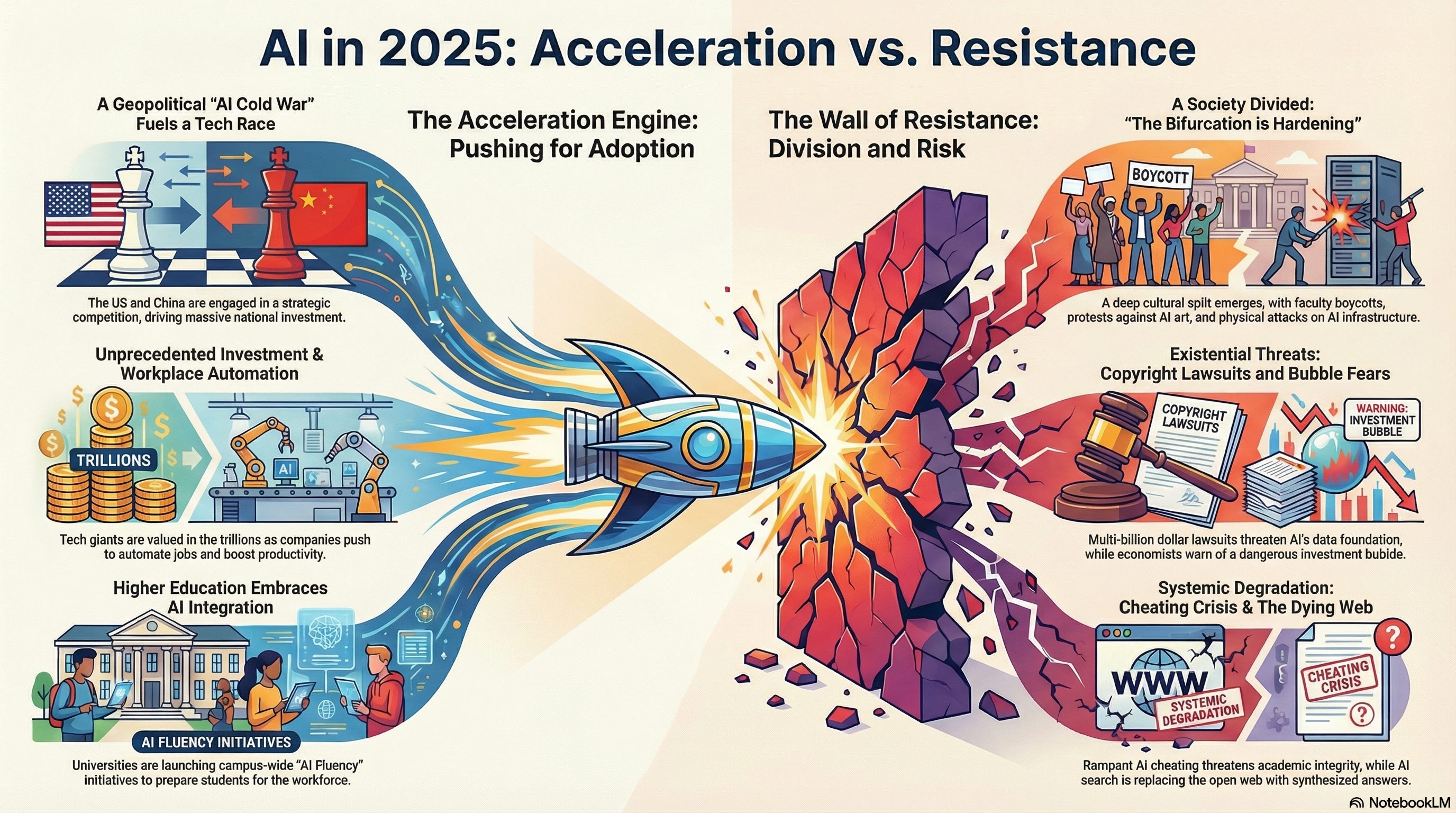
NotebookLM is a busy creature, providing a bunch of options in its Studio. It whipped up an infographic for the year:
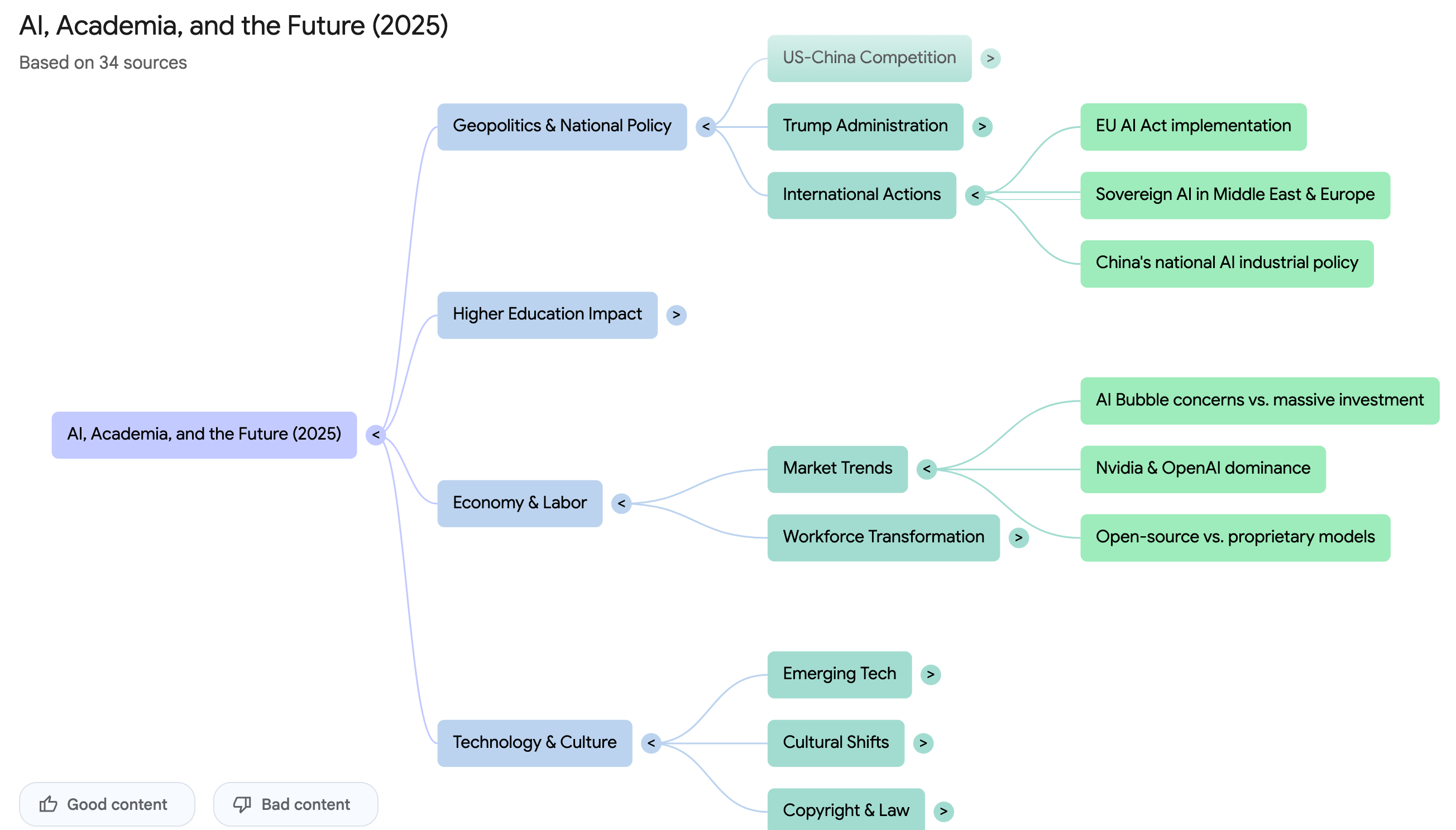
It created a mind map:
It also created a data table (of policy developments), an audio overview, some slides, and a video overview. I think of these as reflections or refractions on my writing, a version of readers responding to the posts. I found it useful.
I didn’t use NotebookLM to write these paragraphs, although I changed up some sentences in response to what the AI generated. Nor did I use it to make the images in the first part; those were Midjourney’s. (As I’ve said before, I’d prefer to use Creative Commons-licensed photos, but it’s hard to find the right ones for my purposes, and it is of course apt to use AI given the subject of this newsletter.)
So what does all of this suggest as we consider the next year?
At a first order of approximation we can extend these trends forward under the principle of “if those goes on…” In this way we should expect a continued US-China AI rivalry, pushes for AI sovereignty, Open AI vs Google, more AI-explained job freezes and cuts, more companionbots, more use of AI to create stuff, more opposition to LLMs, and so on.
The trick is to anticipate how those trends might change, how they could grow, shrink, or mutate beyond simply continuing as they did in 2025. There are a lot of factors to consider, from major political decisions to wild cards. At the tech level, will LLMs start to run into quality issues as they run out of data to scrape? Will open source advance further in quality and adoption? Might AI hit a market correction or bubble in the US? Would a disaster popularly attributed to AI cause public revulsion and pop the bubble? Would Trump drop the AI cause as a result, hating to be contaminated by losers? If not, will American politics break firmly on AI along partisan lines, with Democrats denouncing the stuff and the GOP doubling down on it?
I’m agnostic on many of these for the simple reason that generative AI is now so vast a thing, so embedded in so many human and technological systems, that it’s hard to get good data on much of it and difficult to solve the resulting foggy, many-body problem. My gut tells me anti-AI sentiment and critique will develop still further, that we could see a market correction, that the intermediary layer will expand as will agentic capacity, and that the Trump administration will be chaotic on AI. But that’s intuition, albeit informed by continuous horizon scanning, analysis, and reading the literature. I feel on firmer ground in forecasting more creative uses of AI will occur, from art to storytelling to technological development, based on what I know of the history of technology and human innovation. I also feel a bit more confident, and also sad, in projecting AI will continue to gnaw at the web. So many institutions, including academia, still struggle with using the web in its full or even basic form that we might hit peak web in 2026.
I’m also skeptical that we’ll see anything which most people would recognize as human-level intelligence from an LLM next year. The past year’s incremental improvements suggest more of the same, unless a staggering breakthrough appears.
Thinking through such questions, I’ve been reading and revisiting commentaries new and old. A recent one from Tim O’Reilly and Mike Loukides asks us to view forecasting AI in terms of a different question: is generative AI an ordinary or extraordinary tech? That is, either
AI faces the same barriers that every enterprise technology faces: integration costs, organizational resistance, regulatory friction, security concerns, training requirements, and the stubborn complexity of real-world workflows. Impressive demos don’t translate smoothly into deployed systems. The ROI is real but incremental. The hype cycle does what hype cycles do: Expectations crash before realistic adoption begins.
or:
we aren’t experiencing an ordinary technology cycle. We are experiencing the start of a civilization-level discontinuity. The nature of work changes fundamentally. The question is not which jobs AI will take but which jobs it won’t. Capital’s share of economic output rises dramatically; labor’s share falls. The companies and countries that master this technology first will gain advantages that compound rapidly.
AI is strange, in this sense, a weird mutation which blazes a new path.
I think it could go in either direction now. There’s a lot of pressure to domesticate LLMs, to see them through Gartner’s famous hype cycle and into legible enterprise and consumer slots. We are very busy people, after all, with a lot on our plates. It would simplify things very much if we could use AI like Excel or an XBox. Business owners would like to slot LLMs into the classic modes of either replacing labor with capital or adding tech to leaven productivity. Investors would like this to happen in a way which produces profit. Yet… the technology is strange, alien enough to break the mold. Human ingenuity can run with it in bizarre directions, as we’ve already seen.
I’m not sure this is entirely or even mostly a technical problem. I suspect it’s more a question of culture, economics, and politics - of perceptions - how we think about and use the tech en masse. That evolving collective shift will either lead us towards a singularity (in O’Reilly and Mike Loukides’ sense) or into another turn of the old tech wheel. If that’s right then 2026 is shaping up to be a struggle over where we take AI. There will be immense and broad-ranging competition to frame and reframe LLMs. We should watch pop culture, political arenas, business plans and marketing, boycotts, and workshops to see what we make of it. We should watch - and participate.
Now it’s over to you, dear reader. What do you make of these scans of 2025 and glances to 2026? What do you think of using NotebookLM? And was this issue too terse or compressed to a good level?
(Next up: education!)
No posts
Comments
Nothing yet. Say the first thing.
Sign in to join the conversation.