
Greetings from the road, friends. I’m traveling to give talks on AI and the future of education in Florida, California, and Florida once again. At one of those events my wife, Ceredwyn, introduced her AI project, a new theoretical and implementation framework; we’ll post about that here shortly.
Today we’ll examine what’s been happening in the world of AI research and development. New releases and iterations keep appearing, churning the environment and giving us more choices. Let’s scan the AI tech horizon.
(If you’re new to this newsletter, welcome! This is one of my scan reports, which are examples of what futurists call horizon scanning, research into the present which looks for signals of potential futures. We can use those signals to develop trend analysis, which we can then use to create glimpses of what might come next. On this Substack I scan various domains where I see AI having an impact. I focus on technology, of course, but also scan culture, government and politics, economics, and education, this newsletter’s ultimate focus.
It’s not all scanning here at AI and Academia! I also write other kinds of issues; check the archive for examples.)
Now, on with the scan. There’s a lot to explore here. I’ve divided the following by businesses or business-like entities, followed by some quick reflections as time and space allow.

…has been busy. They released ChatGPT 5.1. This has two versions, Instant for general use and Thinker to show its work, with an Auto function which picks a version based on a user’s prompt. The company describes this release as “warmer by default and more conversational,” improving or adding more personas or personalities: “Default, Friendly (formerly Listener), and Efficient (formerly Robot) remain (with updates), and we’re adding Professional, Candid, and Quirky.” OpenAI claims improved accuracy and speed.
OpenAI also provided a branching function. With this you can fork a discussion into two or more paths, returning along them as you like. Ars Technica offers a nice analogy: “Think of it almost like creating a new copy of a ‘document’ to edit while keeping the original version safe—except that ‘document’ is an ongoing AI conversation with all its accumulated context.”
The House of Altman also released ChatGPT Pulse, a kind of agentic summary which summarizes the past day of a user’s activity as seen through the app. Tom’s Guide offers this glimpse:
At the end of the day, Pulse takes a look at your chat history, memory, feedback and then does a round of asynchronous research, synthesizing all the information you’ve shared or asked during the day.
The next morning, it delivers a curated feed of updates in the form of visual cards you can scan quickly or expand for details. Think of it as a morning briefing, but one that reflects your personal goals, habits and even your calendar.
I think it’s only available for Plus users.
What received more attention that these offerings was the new version of Sora. Sora 2 (only available for iPhones now, irritatingly) is a video generator, much improved from 1.0. For example:
Users can also insert their own video content into a clip. Additionally, there is now a Tiktok-style Sora app where you can browse a stream of Sora 2 clips. Improved quality has given rise to a new wave of concern about the trustworthiness of all visual media, if Sora can convince many viewers of its reality.
The search+ giant has also been very busy, fighting to lead the AI revolution. It released a new version of its main AI service, Gemini 3, to a lot of respect and applause. Many reviewers gave it improved ratings from its predecessors, citing improved speed, output quality, better coding, various kinds of reasoning. It scores well on multiple ratings on LMArena’s leadeboard. It has more agentic abilities. It competes well with OpenAI’s ChatGPT 5.1. Salesforce’s CEO rhapsodized:
Marc Benioff @Benioff Holy shit. I’ve used ChatGPT every day for 3 years. Just spent 2 hours on Gemini 3. I’m not going back. The leap is insane — reasoning, speed, images, video… everything is sharper and faster. It feels like the world just changed, again. ❤️ 🤖
There’s much more. Google launched a new version of its image creator, Nano Banana Pro, which I think is embedded within Gemini. Reviews have claimed sharper images, faster results, more fine grained user control. They updated Veo to version 3.1, which is paid only, as far as I can determine. This promises better audio and video output.
Google Scholar now has a conversational AI feature. So far I’ve seen that it lets me ask questions in natural language, but the output is formatted as before, a list of citations. Google Earth now has AI features, using LLMs to connect multiple data streams for what it calls geospatial reasoning. The company updated Sima, an agent which can follow instructions in virtual worlds, following and describing a reasoning chain. Google posted about VaultGemma, an effort to reduce the amount of private data LLMs retain.1
Google also launched Mixboard, a whiteboard tool somewhere on a continuum between the company’s Jamboard (light) and Miro (advanced). You can prepopulate a Mixboard by prompting it, then add or edit the results. Here’s one example I quickly whipped up:
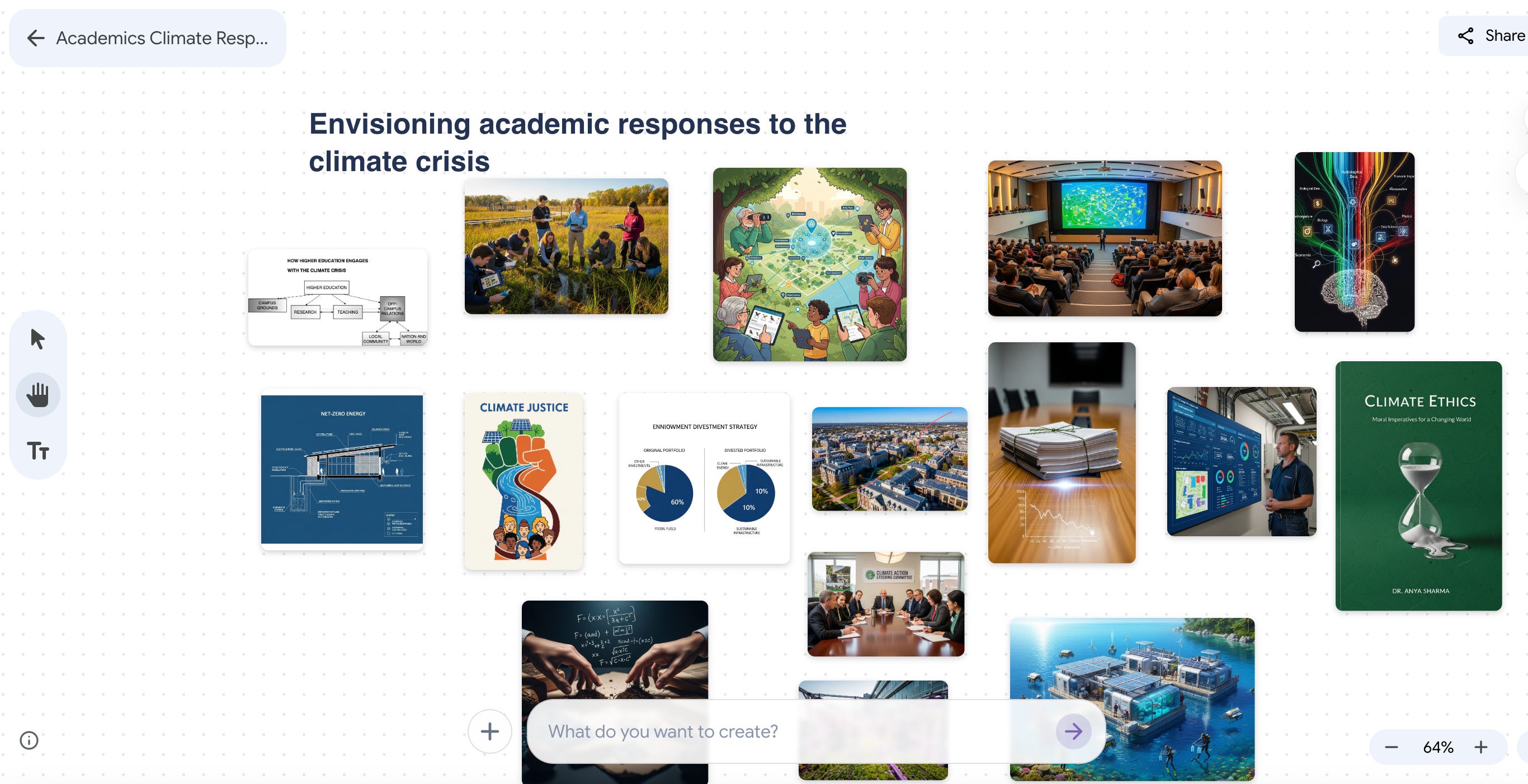
Google Cloud and Stanford University researchers published a framework for small language models to use multi-step reasoning for the first time. Supervised Reinforcement Learning (SRL) “reformulates problem solving as generating a sequence of logical ‘actions’.”
Also on the academic front, Google announced Learn Your Way, which looks like an AI tool for teaching a learner about a document in a personalized fashion. Users apparently upload a pdf of something they’d like to study, then the site asks some particular questions: grade level (K-12), other interests, media formats. It then generates questions, quizzes, videos, summaries, and assessments. I wrote “looks like” because I’m still on the waitlist, and am working from a video clip on the announcement page. At this distance I can imagines Learn Your Way becoming an out of the box tutor for challenging topics, then users (or teachers) daisy chaining a series for a curriculum.
On the hardware side, Google announced its latest customized silicon chip, Ironwood, the 7th generation of its Tensor Processing Unit (TPU), will be available for purchase. More ambitiously still, the company announced plans for putting AI in orbit. Project Suncatcher “envisions compact constellations of solar-powered satellites, carrying Google TPUs and connected by free-space optical links.”
As a result Google seems to have taken the lead in AI at present. To illustate, here’s what Gemini gave when I asked for an image of “an AI company taking the lead over other AI companies”:

Moonshot.ai launched open source Kimi K2 Thinking, which is getting fine reviews (for example) (for example). You can find more info here, code here, and API docs here.
Anthropic published Claude Opus 4.5, claiming improvements over previous versions, including a broader context window and ameliorated coding output. An Ars Technica report notes Opus 4.5 exceeds all comers in accuracy. Anthropic also continues to publish research, such as an analysis of user productivity on its tools. Claude can now end conversations the software deems to be harmful.
Elsewhere, Microsoft continues its AI work. The company is apparently developing its own AIs, independent of OpenAI’s. Two have been announced, MAI-Voice-1 and MAI-1-preview. Redmond launched Agent 365, a “control plane” for its agents. On the hardware side, Microsoft announced a “superfactory” in Georgia and Wisconsin with “hundreds of thousands of advanced Nvidia GPUs.”
Meta continues its AI work. The company is pushing to release a new version of its open weight tool Llama before January. Meta’s AI for Good is working to build bad weather detection tools for Florida. And some retraining is under way to keep bots from writing inappropriate content to minors. On the hardware side, they apparently reached out to Google to use its chips, which depressed Nvidia’s stock price.
Deepseek upgraded its China-facing app to work more effectively with chips produced in that nation. V3.1 also improved in quality.
A group of three Swiss public universities - ETH Zurich, the Swiss Federal Technology Institute of Lausanne (EPFL), and the Swiss National Supercomputing Centre (CSCS) - launched Apertus, an open source LLM intended for the public good, and which we noted this summer. According to one Swiss acount,
“We aim to provide a blueprint for how a trustworthy, sovereign and inclusive AI model can be developed,” said Martin Jaggi, professor of machine learning at the Swiss Federal Institute of Technology Lausanne EPFL.
The Verge notes that it followed European regulations. One interesting point about Apertus concerns language:
Trained on 15 trillion tokens across more than 1,000 languages – 40% of the data is non-English – Apertus includes many languages that have so far been underrepresented in LLMs, such as Swiss German, Romansh, and many others.
And here’s a kind of FAQ.
Amazon continued to work on AI. Leaked documents point to developing agentic software. Amazon also won a $50 billion contract with the American federal government to provide AI to multiple agencies.
Apple added AI to its Airpods, designed to translate languages for the user. Apple also started offering code to work with the MCP agentic protocol.
X.ai launched an AI-powered encyclopedia called, inevitably, Grokipedia. Business owner Elon Musk claimed it would be free of political bias. Reviewers have noted times when it espouses right wing views or draws on such sources (for example). One reviewer suggested that it shows how to use AI to improve the least-developed Wikipedia entries. X.ai also launched two sex-themed chatbots. Additionally, the company is apparently working on world models.
Friend launched its hardware pendant of the same name. It contains a microphone which picks up nearly sounds. It transmits text to its user’s smartphone. Friend elicited backlash, with people tearing down and mocking posters in New York City and criticism appearing online. Meanwhile, AI toys are a success in China.
What might we derive from these developments?
Overall, research and development continue along a series of domains we’ve been tracking. Many LLMs received incremental, versioning improvements, especially in chat, as well as image and video creation. There are pushes to expand the scale and capacity of LLMs, as well as some efforts to produce smaller ones.
Agentic work keeps coming, but often folded in with other tools. In our AI seminar we debated what precisely defined an AI agent. My sarcastic idea was “agents are what companies can charge more for,” but a more sober answer might note that agents are less separate from non-agentic AI and more blended in.
There’s rising interest in software fixes for conversations which turn abusive or dangerous.
Open source AI keeps improving, usually without much attention. Chinese developers are especially learning into open source. Once again I remind readers that generative AI is not a US-only thing.
Over to you, dear readers. Have you tried any of the new tools listed here?
(thanks to Steven Kaye, Garthster Lucerne, Ruben R. Puentedura)
Several friends have told me they can’t access Google Scholar’s AI mode and think they need invites. I didn’t hit this barrier and can’t find any invites. Has anyone run into this?
No posts
Comments
Nothing yet. Say the first thing.
Sign in to join the conversation.