
Last Friday I posted about what I’d seen of artificial intelligence in the world during 2025. That summed up what these newsletters have found through this year. I added some reflections on what 2026 might bring. Today I’d like to shift that annual reflection to focus on higher education and AI before we run out of 2025.
I’ll break up the below into the categories I’ve been using in these Substacks: actions coming from outside the academy but which bear on research, teaching, and campus operations, followed by actions academics have taken. I’ll add some reflections at the end, including observations on using several AIs to help craft this post. For reasons of time and space I’m leaving out K-12.
For those new to this newsletter, I’m basing today’s issue on what I’ve been seeing in the world, what futurists call an environmental or horizon scan. I’ve created this in several ways: traveling to a bunch of campuses and academic meetings; connecting with more academics online; reading what scholars in several fields are saying; hosting a series of Future Trends Forum sessions on and around AI; holding many, many conversations with people in and around this space. I’ve also been teaching classes on the subject at Georgetown University. I’ve then shared and tested my findings through these newsletters, social media, presentations, etc., hopefully improving their quality.
Also, as with the previous newsletter, I’m trying to compress the newsletter so that it’s not too huge. Let me know what you think. And in general, I’m always looking forward to your comments.
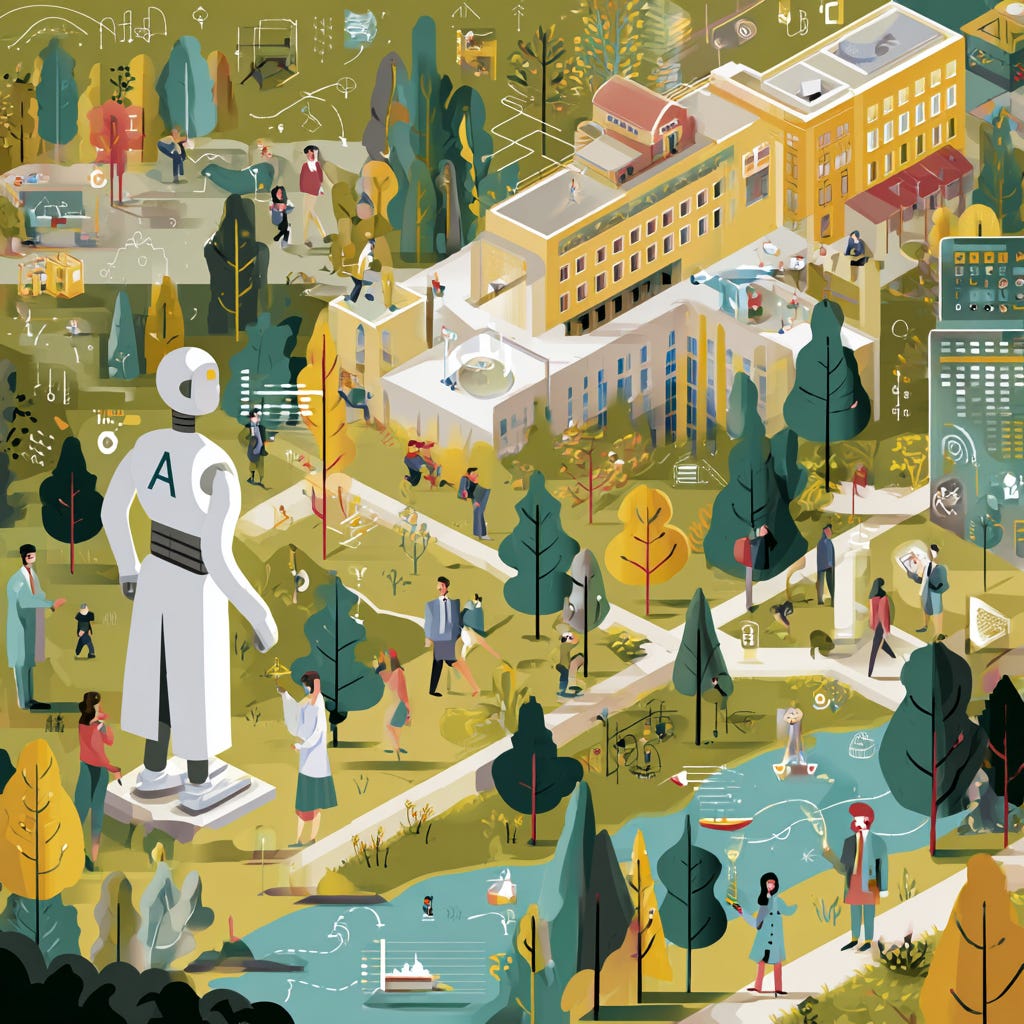
In addition to the vast churn of AI offerings covering a wide range of topics, more AI-backed teaching tools and functions came online in 2025. Google, OpenAI, and Anthropic each launched a study or learning mode for their services. Google in particular leaned into education, released an AI Co-scientist, an application aimed at helping people do scientific research, while launching Learn About. Google Scholar now presents an AI interface. Other AI-powered commercial offerings have appeared, like Socrait and Gradescope. Vendors who provide educational goods and services have added or expanded preexisting AI functionality to that, as we’ve seen in the LMS world (Phil Hill’s team is on point here) and Grammarly. The same is true for general-use tools we use in education, like Canva and Adobe’s Creative Cloud suite. And pre-2025 AI applications persist, like Elicit.
Beyond technology providers came other pushes for AI in higher education. For one example, the International Telecommunication Union (ITU) announced at Davos an AI skills coalition. Various governments, including American states, have expressed support for higher ed to pick up AI.
How have academics acted on, or reacted to AI?
Overall, it seems that colleges and universities are still scrambling to react to this technological revolution at a strategic level. Three years after ChatGPT 3.0 exploded only one quarter of campuses have institutional policies about AI, according to the new CHLOE report. Many of the policies I’ve seen have been tentative, or basically add “don’t cheat with AI” to academic integrity pages. There are a few exceptions, where institutions took up AI strategies from the top level, like the University of Michigan, Arizona State University, and The Ohio State University. Otherwise most campuses are still figuring things out. In some cases I suspect that the presidential and dean level has punted to colleges and schools, which deferred without resources to department, which ditto to individual faculty members. Given that adjuncts are the largest proportion of the professoriate, it seems that part-time temporary instructors are leading academia’s AI engagement.
How to structure institutional responses in terms not just of policies but also governance structures, enterprise adoption, support, and more is still an open question with plenty of campus variations. I’ve talked a university who had a single, unfunded committee in charge of AI, while another had a dozen groups, each budgeted to explore one aspect of the issue. In some institutions librarians are taking the lead in supporting students, faculty, and staff, while at others teaching and learning centers play that role. IT departments continue to wrestle with security, licensing, training their own staff, and overall support. Academic departments decide on their own approaches to AI.
Funding academic AI work is a challenge this year, especially in the United States (for more information on why things are challenging, see my blog or the Trump vs academia video series or new book or just look around US media). Some campuses have reached for external support. Perhaps the most dramatic is Bowdoin College which set up the Hastings Initiative for AI and Humanity. The “Hastings” in the name is from Reed, as in Netflix chair and co-founder, who donated $50 million to start it off. The California State University (CSU) system struck a deal with OpenAI to fund community access to ChatGPT. The National Science Foundation (NSF) now offers support for AI work, as does the Department of Education. At least one foundation has an AI program.
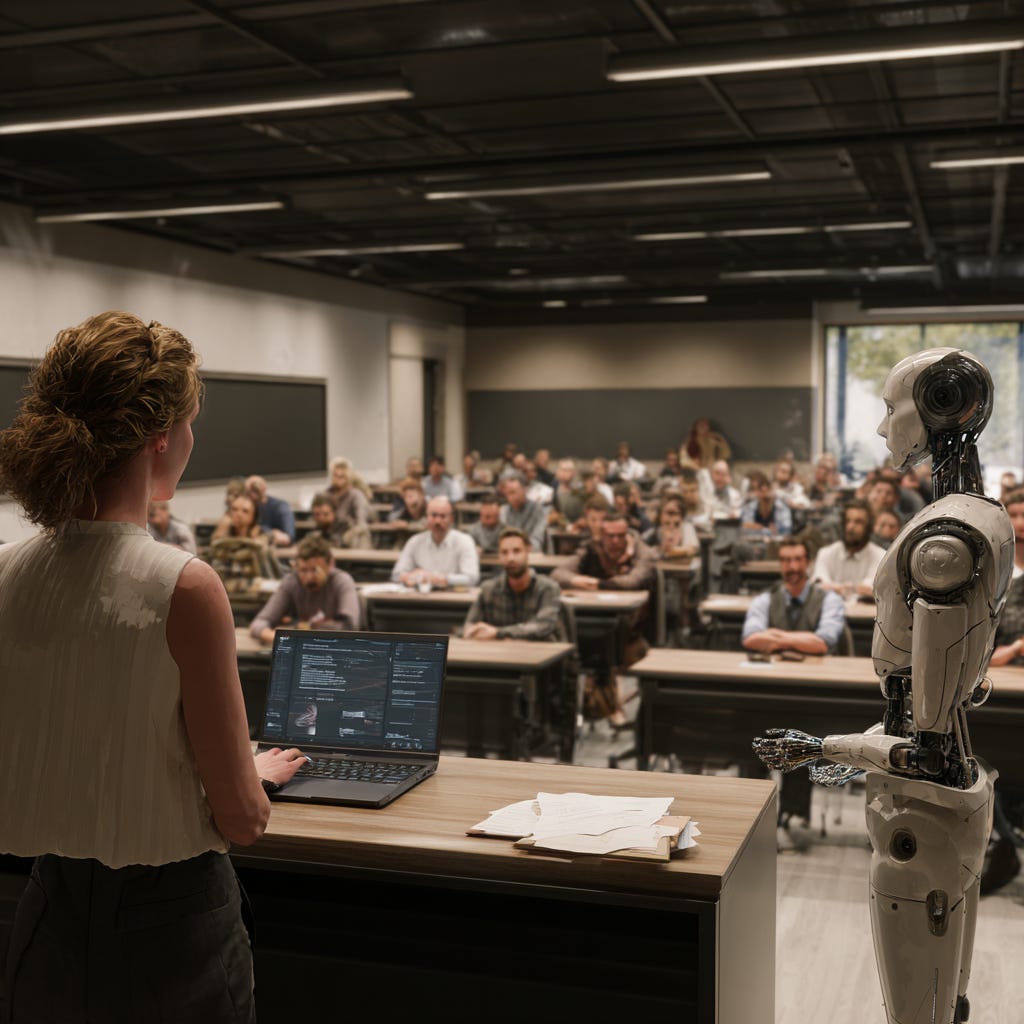
For many the largest AI issue is accelerating AI-enabled cheating and how to respond to it. There have been many examples of this - the University of Minnesota expelled a PhD student, charging him with cheating using AI on a preliminary exam. The (former) student fired back, criticizing the detection process, the disciplinary process, and also the professors involved. Elsewhere, a federal judge dismissed a researcher’s statement because AI generated some of it. Hilariously, the expert’s speciality was misinformation. France’s Sciences Po returned to entrance exams, in part to reduce AI cheating. There are technological responses with tools like ChatZero but the consensus (which I share) is that they are very unreliable at best. Meanwhile, some faculty and some schools have turned to basic, retro anti-cheating efforts, notably oral presentations, the nostalgia-drenched bluebook, and banning devices from classrooms. These don’t scale well and have other problems. In fact, we still don’t have good solutions. I keep coming back to the need to reformat our entire assessment system. (I mentioned this in a talk to the POD Network, and to my surprise the audience applauded thunderously.)
Beyond assessment problems there are plenty of pedagogical, research, and operational experiments, in addition to some curricular offerings. Emerson College is experimenting with AI offerings and projects through its Emerging Media Lab. A group of community colleges in the midwest, Rocky Mountains, and northeast joined forces to develop shared classes about AI. Some Chinese universities are expanding their AI course offerings. (archived) A Stanford University professor developed a generative AI tool, Evo 2, which can produce DNA sequences of more than one million nucleotides. Research into AI continues, as with this Columbia Graduate School of Journalism study on the technology’s citation quality. I’m curious to see if the bimodal cloister/starship model gets any traction. Elsewhere nearly every campus I visit virtually or in person has instructors trying out a range of pedagogies, from having students use AI to generate writing which they critique to teaching students hands-on skills.
Another open question is how to prepare students for the post-AI world, especially for the labor market. This is truly an open question, as there’s no consensus about what AI will do to the workplace, the choices being: creating lots of unemployment and underemployment; creating jobs which don’t exist now; infusing AI into job skills. There’s also no consensus about how colleges and universities should prepare students for that cloudy future. Some of us have argued that a liberal arts undergraduate experience is best, given how it teaches flexibility of mind.
Not discussed very much (as far as I’ve seen) is the possible impact of agentic AI on higher education. Ray Schroeder has some ideas. Yuhan Gao offers more. Melik Peter Khoury is skeptical.
Meanwhile, substantial academic opposition to AI continues. I’ve seen many instances of this over the past year and examples are ready to hand. John Warner has been consistently opposing AI in the writing classroom through his Inside Higher Ed columns and his Substack. There’s a “Refusing GenAI in Writing Studies: A Quickstart Guide.” Bluesky has a steady stream of criticism from faculty and staff members. One colleague told me about giving a talk about AI at a college this spring, following which a faculty member took the podium to read a prepared statement slamming my colleague, AI, and the college for arranging the session. I’ve gotten some static and even insults for my work. Most recently Eric Hayot and Matt Seybold published an essay in the Chronicle of Higher Ed calling on academics to organize against AI.
The substance of the critique is well known by this point, charging AI with: reproducing biases, conducting unfair labor practices, infringing on copyright at a massive scale, aggregating undemocratic power to a handful of gigantic companies, reproducing colonialism, and consuming dangerous amounts of electricity and water. Over the year I’ve seen more critique linking AI to the political right, especially in the United States where technologies leaders from Meta to Apple aligned with Trump and most (but not all) Republicans have boosted AI. Additionally, Ronald Purser slammed the CSU system for making the OpenAI deal which he saw as part of a strategy to attack the humanities. (Here’s my summary of AI opposition, which I really should update.)

As with all of my Substacks, I wrote all the text. Once the draft shaped up, I shared some paragraphs with ChatGPT and Gemini to see their reactions, much like asking friends for feedback. I also asked those bots some questions to get a sense of what we futurists call “the official narrative,” in order to make sure I hadn’t missed any major points. I didn’t ask for any writing.
For this post’s images I used Midjourney, as usual, as I tend to get the best results there. You can see prompts in the caption under each. In addition, or in contrast, this time I turned to Better Images of AI to look for more, on Alan Levine’s urging, and used one above (full credit at end of this post).
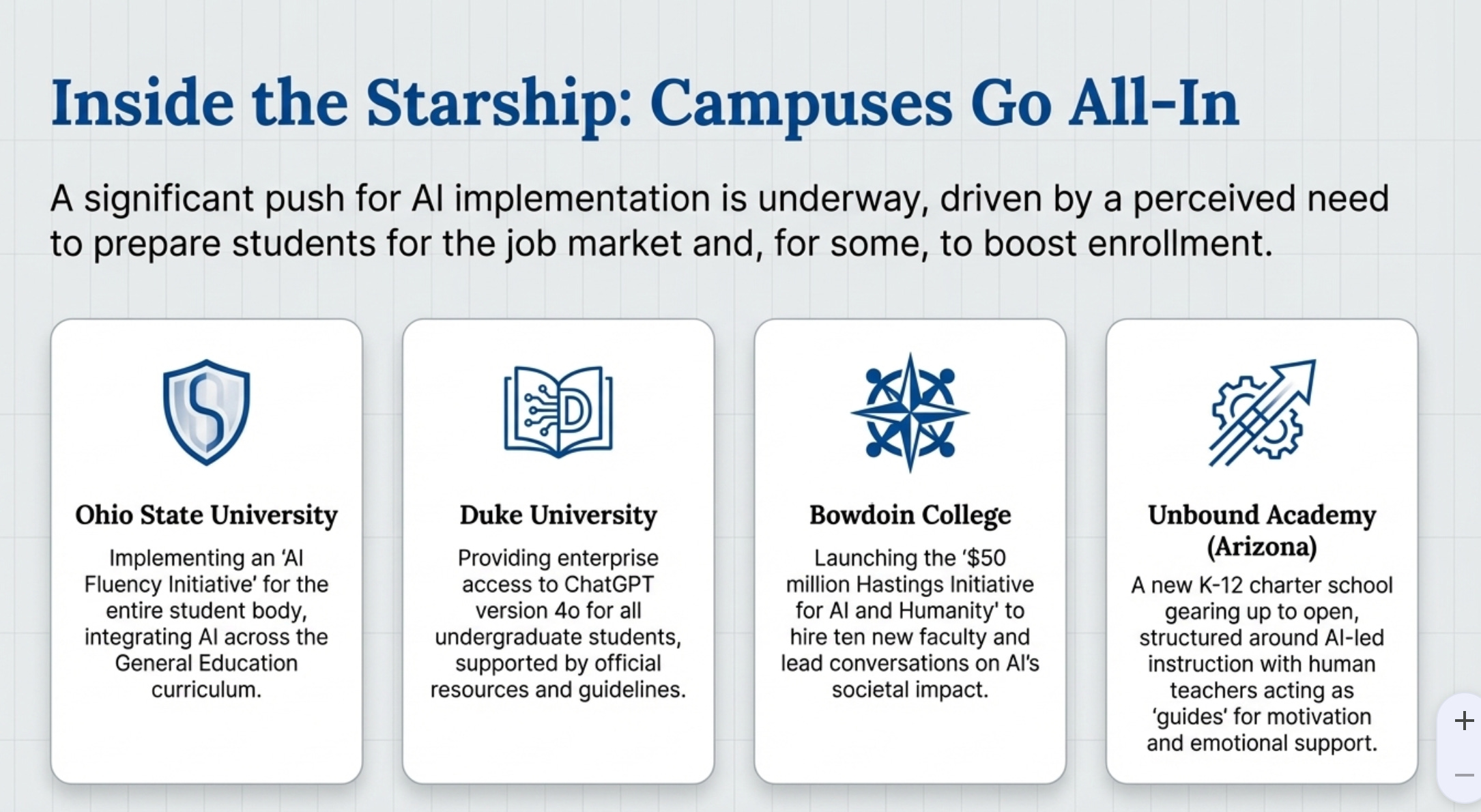
Now, as with my last post, I used NotebookLM for extra help. For that post I uploaded all of my Substacks from 2025 into a new notebook. For this one I asked it questions about not AI in general, but AI and academia in particular. What NotebookLM saw surprised me. It emphasized the split between AI users and opponents over all, which wasn’t the impression I had of my work, but made sense on review. It also really liked the starship/cloister model, and I’m not sure why. It didn’t generate any new Studio documents (slides, infographics, podcasts, videos) based on my queries; those seem based on the total corpus established, rather than individual queries on it. However, some of the slides did focus on education, like this one:
So much depends on what happens to AI in the world beyond academia. Technological developments independent of the academy can change the tools we already use and offer new opportunities and challenges. National and subnational policies can impact us. How popular attitudes shift also impact college and university use, such as if we see a bubble burst. The impact of technology-driven economic dislocation can have all kinds of academic impacts. Heightening geopolitical tensions over AI can play out in terms of international student recruitment and student, faculty, and staff resistance. If American Democrats pick up AI opposition as a major cause, which they might, academic opposition could become more politicized. I do wonder how academia will respond to AI search’s pressure on the web. Will this reduce incentives to produce web content, from open access journals to departmental and disciplinary web resources?
That said… I expect we will continue to engage with AI through 2026, even if there’s a bubble bursting or market correction. Unless the major tech companies completely give up on AI, which seems unlikely, the technology should be present and elicit our attention. In which case we can expect many of the above trends to continue: concerns about cheating, conducting research into AI, trying out institutional and pedagogical experiments, grappling with big tech firms, etc. But that’s only a first level approximation. Trends can always shift and mutate.
I haven’t seen much academic use of open source LLMs. Perhaps I’m missing some of that which is happening under the radar. Maybe we’ll see academics follow some technologists and use open LLMs for reasons of expense and flexibility.
It is difficult to get a handle on how many academics use AI at all, much less who uses what tools for which purposes. From what I’ve been able to see AI use is widespread among students. It seems used to some degree among staff and faculty, based on the accumulation of individual stories, but this is still difficult to determine with any precision. We should expect this foggy picture to persist in 2026. In addition, we may see operational uses start to clarify. (Note to reader: this is an excellent research project for campuses to conduct on their own population, especially with student participation!)
More institutions might take up strategic responses to AI. I suspect governmental, funder, corporate, and student (and traditional-age students’ parents) concern about the changing labor market will drive some changes, such as creating new majors or expanding old ones, setting up AI centers, encouraging AI literacy, and revising career services’ practices. Community colleges may have the edge here, being so plugged into local labor needs. Unless a fix for cheating appears that we broadly adopt, that problem will persist. I expect more commercial and open source responses, along with more nostalgia for bluebooks.
I am very concerned about higher ed’s reputation in the AI revolution’s wake. I don’t mean higher education’s objective reality but how people perceive it. As I’ve said elsewhere, it’s possible that public opinion of colleges and universities, already souring in the United States, could worsen. We might appear to be out of touch with the modern age, especially if acts of resistance get popular attention. Our rising published prices (as opposed to what people actually pay) could make AI appealing for education. Our inability to conduct assessment without cheating could sap the value of our degrees. If people perceive graduates to struggle with getting jobs, including positions suited to their education, opinion can decline even further.
Conversely, we might see popular anxiety about AI make the academy look better in contrast. While AI hallucinates, needs irksome data centers, is generally offensive and chaotic, colleges and universities could appear more reliable and trustworthy. This will depend to an extent on how people see us respond to the technology. Public intellectuals speaking from their professional expertise might help that come about.
Within post-secondary education I expect opposition to AI to continue. There are many faculty, staff, and students who strongly oppose the technology and the tech seems unlikely to transform in a deep way to meet their concerns (although cf open source again). As noted above, academic opposition to AI may become politicized. I’m not sure what forms that could take, but can speculate. It’s easy to imagine scholarly research, teaching, and public statements against AI. We may see some movements to block or reduce AI on campus. Perhaps the intensity will rise to the level of the Gaza protests, and I make this comparison to highlight the possibility of institutional tumult. And the Purser argument - that a campus leadership took funds from certain fields to support AI work - might gain currency. For years I’ve asked audiences to imagine a “Butlerian jihad”1 against AI, which often mystified people; recently this prospect seems to be swimming into view.
I wonder how the academy will respond to AI’s companionbot uses. (Here’s my sketch of those.) For example, how many institutions - or units, like student life - will support AI for mental health purposes, either explicitly or tacitly? Will other institutions create official, branded AI bots which they hope students will spend a good deal of time with?
…and I did vow to compress this newsletter and have clearly not succeeded, so I’ll stop here. Over to you, dear readers. What did you see of AI in higher ed this year? What do you anticipate for the next?
(“Pas(t)imes in the Computer Lab” image by Hanna Barakat & Cambridge Diversity Fund / https://betterimagesofai.org / https://creativecommons.org/licenses/by/4.0/)
The term is from Frank Herbert’s classic 1965 novel Dune, which imagines a future historical war against “thinking machines.” “Butler” refers to the Victorian author of that name, whose 1872 novel Erewhon envisioned a society which criminalized technology. That in turn was presaged by Butler’s 1863 letter arguing for evolution to appear in technology.
No posts
Comments
Nothing yet. Say the first thing.
Sign in to join the conversation.