
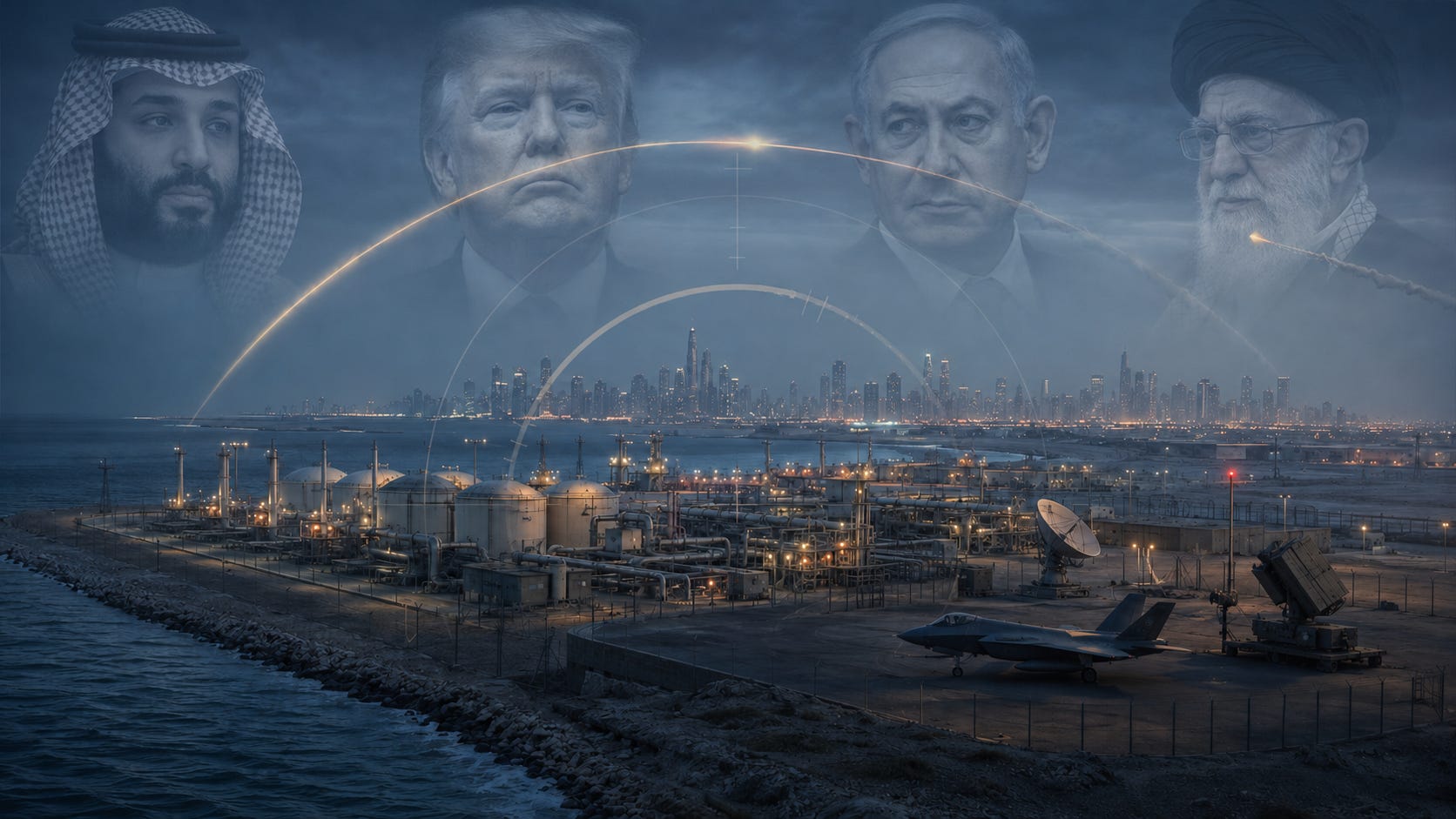
In the same week, two pieces of news arrived from the Gulf.
In Kuwait, an Iranian attack struck a power and water desalination station. It was the second attack on Kuwaiti desalination infrastructure in two days, and flights at Kuwait International Airport were suspended amid repeated missile and drone threats.
In a desert country where desalination supplies more than 90 percent of drinking water, these attacks are designed to make ordinary life possible.
Then Washington announced that the State Department had approved a possible $1.96 billion weapons sale to Saudi Arabia: up to 20,000 Advanced Precision Kill Weapon System guidance units, split between air-to-air and air-to-ground configurations. These weapons are designed, in part, to help Saudi forces bring down relatively cheap drones without burning through far more expensive Patriot interceptors.
Read together, they raise a question that has hovered over this region for years and now feels impossible to avoid:
Is the United States still protecting the Gulf from war or is it selling Gulf states the means to survive wars that American policy helps bring to their shores?
The Insurance Policy
For decades, Gulf governments treated the American military presence as an insurance policy, providing land, airspace, ports, basing access and strategic alignment. Washington supplies weapons, training, intelligence, diplomatic support and the implied promise that overwhelming American power would deter any state from attacking them.
That arrangement delivered real benefits, that must be acknowledged. Kuwait remembers who led the coalition that ended Iraq’s occupation in 1991. For most of the three decades that followed, conventional attacks on the Gulf monarchies were rare. American early-warning systems and air defenses have intercepted missiles and drones that might otherwise have killed many more people. Perhaps the region would be more exposed without them.
Yet an insurance policy is judged most severely when catastrophe arrives. And the catastrophe now unfolding has exposed a gap between American power and Gulf security. The United States has extraordinary capacity to strike, and it has demonstrated its ability to destroy targets inside Iran. There is no doubt about that. The unanswered question is whether the exercise of that power is making the people of Kuwait, Bahrain, Qatar, Saudi Arabia, the United Arab Emirates, Oman and Jordan safer.
Gulf governments warned Washington against launching the war on Iran. Officials later complained that they received no advance notice of the February 28 U.S.-Israeli attacks, even though their countries were certain to absorb part of Iran’s response. Several had even refused to let their territory be used to launch offensive strikes. Iran attacked them anyway. Iran bears responsibility for those attacks. Its decision to strike airports, energy facilities and water infrastructure cannot be excused by only pointing toward Washington because Tehran chooses where it aims. Still, the strategic question still stands:
What is an alliance worth when one partner can initiate a war, while the others, who neither chose it nor control its objectives, become the retaliation zone?
When The Map Of Protection Becomes A Target List
The American military footprint stretches across the Gulf. Bahrain hosts the U.S. Fifth Fleet. Qatar hosts Al Udeid Air Base and the forward headquarters of U.S. Central Command. The UAE hosts American forces at Al Dhafra. Kuwait hosts Camp Arifjan, Ali Al Salem Air Base and Camp Buehring. American forces also operate from facilities in Saudi Arabia, Oman and Jordan. In peacetime, that map is described as deterrence. In wartime, the same coordinates can become a target list.
Iran claimed this week that it struck American military facilities in Kuwait, Bahrain and Jordan. While Reuters could not independently verify those specific battlefield claim, the broader vulnerability, however, is no longer in dispute.
A Washington Post analysis of satellite imagery found that Iranian attacks during the first phase of the war damaged or destroyed at least 228 structures or pieces of equipment across 15 U.S. military sites.
Seven American service members were killed and more than 400 were injured through late April, according to the U.S. military. Some facilities became too dangerous to staff at normal levels. This does not mean Iran defeated the United States since U.S. forces retained the ability to wage their bombing campaign. It actually means something more relevant to the people who live around those bases: American force protection and host-country protection are not always the same mission.
A base can remain militarily useful to Washington while making the surrounding country more vulnerable to retaliation. A missile intercepted above a capital may count as a defensive success. Falling debris, shuttered airports, depleted interceptor stocks, damaged power stations and families waiting for the next siren tell another version of that success. So which measure matters?
Is a base protecting a country if its presence helps attract the attack that its weapons then intercept? Would Iran target Gulf infrastructure anyway because these states sit at the center of the global energy economy and remain deeply embedded in the American alliance system? Does the danger argue for removing U.S. forces, imposing much tighter limits on their use, or integrating American and Gulf defenses even more deeply?
There is also a deeper distinction. For decades, Washington used its military presence largely to defend a regional status quo. In this war, Washington became a direct belligerent seeking to transform it. A system built to deter war behaves very differently when its guarantor starts one.
A Tactical Answer To A Strategic Problem
Drone warfare has exposed a brutal economic imbalance: A relatively cheap one-way drone can force a defender to launch an interceptor costing many times more. Precision-guided rockets give Saudi forces another layer of defense and preserve scarce Patriot missiles for larger threats. Yet the sale remains a proposal, not a signed contract or an immediate shield. It answers the question of how Saudi Arabia might shoot down the next drone but leaves untouched the question of why the next drone is coming.
Can more weapons repair a misalignment of political interests? How many billions must Gulf states spend to gain protection from the consequences of military decisions they do not control? Does every escalation deepen the dependency … American bases draw fire, American systems intercept it, American suppliers replenish the systems, and Gulf treasuries finance the cycle?
Perhaps the sale is evidence that the alliance is working: A partner faces a new threat, and Washington helps it adapt. Perhaps it reveals an arrangement that has learned to monetize its own failures. Perhaps, both these things are true at once, as is so often the case.
The official language surrounding the deal is revealing. Washington says the sale will advance U.S. national security by improving the security of a major ally and strengthening interoperability with American forces.
But whose security takes priority when those interests diverge? The safety of a Saudi city? The survival of American aircraft on Saudi soil? Freedom of navigation through the Strait of Hormuz? Israel’s freedom of military action? The commercial interests of U.S. defense companies?
Alliances can serve several interests at once. They begin to fracture when one member absorbs the danger while another retains the power to define the mission.
The Saudi Experiment
Saudi Arabia has been moving toward this conclusion for years. The 2019 attack on Abqaiq and Khurais temporarily knocked out roughly half of Saudi oil production.
Washington blamed Iran but did not launch a military response. For Riyadh, the lesson was difficult to miss: Even an attack on infrastructure central to the global economy would not necessarily activate the protection it thought it had purchased. In 2023, Saudi Arabia restored diplomatic relations with Iran in an agreement brokered by China. That détente was an acknowledgment of geography.
Iran is a permanent neighbor with missiles, drones, proxy networks and the ability to impose enormous costs. It can be deterred, constrained, sanctioned and negotiated with. But it cannot be wished away. Saudi Arabia itself did not escape this war. Iranian attacks struck Prince Sultan Air Base earlier in the conflict, damaging American aircraft and wounding U.S. troops.
Yet Riyadh has also tried to limit the use of its territory for American offensive operations. In May, Saudi Arabia and Kuwait restricted U.S. access to bases and airspace for a proposed mission in the Strait of Hormuz, forcing Washington to pause the operation. Those restrictions were later reportedly eased.
The episode was messy, temporary and still instructive, showing that basing rights can be leverage rather than a blank check. Could denying offensive use become a form of national defense? If an American aircraft is safest when parked on the soil of an ally that refuses to let it join the war, what does that say about the purpose of the base? How much control do Gulf states actually possess over the wars conducted from, through or around their territory? Would Washington still consider them reliable partners if they exercised that control publicly and consistently?
Riyadh’s answer so far appears to be diversification without rupture: American weapons alongside regional diplomacy, domestic military production, new defense partnerships and continued engagement with Tehran. Washington is still indispensable, it is exclusivity that Saudi Arabia seems less willing to accept.
Who Gets To Define ‘Security’?
The word itself may now conceal more than it explains. For Washington, regional security can mean protecting American forces, preserving military reach, defending Israel and keeping oil and shipping lanes open. For Gulf governments, it increasingly means keeping airports operating, water flowing, investment arriving, cities building and ambitious economic plans from collapsing under the price of permanent war.
While these priorities overlap, they are no longer identical. This contradiction is seen in Washington’s own warnings:
The State Department ordered non-emergency personnel and their families to leave several Gulf states earlier in the war. In Qatar, the U.S. government strongly encouraged Americans to depart and told those who remained to make contingency plans that did not rely on an American evacuation.
In Saudi Arabia, it warned that its ability to provide emergency assistance was limited.
A superpower can evacuate some of its people from the risk it helped create. The people who live there do not have that luxury. Kuwaitis cannot evacuate their need for water. Bahrainis cannot move their island. Millions of migrant workers across the Gulf cannot summon a second passport, a private aircraft or a diplomatic convoy.
What would security policy look like if their lives—not only bases, oil terminals and shipping routes—were placed in the center? Would Gulf governments demand binding limits on how foreign forces use their territory? Would they build a regional air-defense system that serves the GCC rather than one external patron? Could they negotiate a pact with Iran that makes desalination plants, power grids, airports and energy corridors inviolable?
Would Iran honor such a pact after demonstrating its willingness to strike civilian lifelines? Can Israel be integrated into any regional order while its genocidal wars and occupations repeatedly spill across borders? Would the United States accept a partnership in which its allies can say no? And where are Gulf citizens in this discussion?
The security bargain has largely been negotiated in the royal courts, generals and foreign governments. The public receives its consequences as sirens, canceled flights, military censorship, higher prices and instructions to remain indoors. Should citizens know which operations foreign bases on their soil support? Who decides what level of retaliation is an acceptable cost?
These are no longer academic questions.
They are being asked quietly in ministries, palaces, diwaniyas and family WhatsApp groups, even in places with restrictions on discussing them. That is a reality.
Perhaps the most consequential image is not of a missile, an airbase or an interceptor. It is this one: Saudi and Iranian officials meeting in Beijing, attempting to reduce through diplomacy a danger that decades of military architecture had failed to eliminate.
Was this merely tactical hedging, or recognition that Gulf security cannot be built indefinitely around the containment of a country that will remain across the water?
Perhaps the question is no longer whether the Gulf can live without America. It is whether the Gulf can retain the benefits of American power without allowing American decisions to determine the price of regional security.
A shield should make the people beneath it less likely to be hit. When the shield also gives an enemy their address, sells them the interceptors and retains the power to begin the next escalation, what should they call it?
Who, in the end, is protecting whom, from what?
Ahmed Eldin | Out Loud is a reader-supported publication, to support my work, please upgrade to paid subscriber.
Comments
Nothing yet. Say the first thing.
Sign in to join the conversation.