
Spain lifted the World Cup trophy high on Sunday. Somewhere in that result is a small mercy nobody asked for: the tournament didn’t end with Javier Milei holding a trophy that Benjamin Netanyahu had already tried to claim two days earlier.
On Saturday, less than 24 hours before kickoff, Netanyahu sat down with Argentina’s ambassador to Israel, Rabbi Shimon Axel Wahnish. Wahnish brought an audio message from Milei, calling Netanyahu his friend and thanking him for rooting for Argentina “because of me.” Netanyahu sent one back. “Javier, you are a friend. A true friend,” he said. “We support you, we support Argentina in so many ways, including tomorrow. Good luck.” Then he chanted “Vamos Argentina” and held up an Argentina jersey for the cameras.
The exchange was the public face of a relationship two years in the making, not a one-off gesture before a big game. Milei visited Israel in June 2025, days before Israeli strikes on Iran, and has defended the war ever since. He signed an AI cooperation agreement with Israel in April. He directed the $1 million monetary component of the Genesis Prize, awarded to him in Jerusalem, toward the so-called “Isaac Accords,” a push to deepen ties between Israel and Latin American governments. Netanyahu has called Milei “a great friend of Israel” and credited him with revolutionizing the relationship between their two countries. On the eve of the final, he made sure everyone knew why he was cheering for Argentina.
It’s not the first time this tournament that Argentina caught a break it didn’t earn. And the team it beat to get here already carried its own story about what football owes the world. After Egypt won its first-ever World Cup knockout match, on penalties against Australia, head coach Hossam Hassan carried a Palestinian flag and dedicated the win to “the Egyptian people, the Palestinian people, and the Arab people,” and said his heart was with Palestinians, asking God to have mercy on Gaza’s martyrs.
Days later, before facing Argentina, he went further: anyone who doesn’t feel for the Palestinian people, he said, is “not human.” A tournament built to keep things safe with flags, sponsors, nationalist pageantry was suddenly cracked open for a moment because one coach refused to let a win be an alibi for silence.
Then Egypt lost to Argentina anyway. 3–2, after leading 2–0 with barely a quarter of the match left. The collapse came with a disallowed Egyptian goal and an unreviewed penalty shout on Mohamed Salah. Egypt’s federation filed a formal complaint over the officiating. FIFA’s Pierluigi Collina dismissed the allegations of bias outright. Then a second story landed that made the first one look a lot less like sour grapes. Argentine and international outlets reported that FBI agents and federal prosecutors had begun taking testimony over the Argentine Football Association’s financial operations in the U.S., examining roughly $300 million that moved through American banks via a Florida-based commercial agent, and whether any of it amounted to fraud or money laundering.
That sat alongside a separate case back home, where a judge had already barred AFA president Claudio Tapia from leaving the country over allegations the federation failed to pay some 19 billion pesos in social security contributions, and a December raid on AFA and more than a dozen clubs tied to a different laundering investigation. No charges have been filed in the U.S. probe. Egypt’s complaint was never upheld. But the pattern repeats: a losing team asks for accountability and gets called bitter, while the federation that beat them turns out to have its own finances under quiet federal scrutiny the whole time.
The pattern held all the way to the semifinal. Three minutes into Argentina’s 2–1 win over England, Enzo Fernández caught Elliot Anderson with an elbow to the back of the head. Referee Ismail Elfath gave nothing. Not even a foul. England’s players surrounded him to protest. Keith Hackett, a former head of English refereeing, said afterward that Elfath let Fernández off too easily and never grabbed control of the match. The broader disciplinary numbers had already drawn scrutiny before the semifinal. Through five matches, Argentina had committed 59 fouls while receiving only three yellow cards, that is roughly one booking per twenty fouls. England’s rate was closer to one every seven or eight. Argentina had also been awarded three penalties, though Messi missed two. None of it proves a fixed game outright, but I guess this is what leniency looks like when nobody has to admit it’s there: a longer whistle, match after match, for the team carrying the sport’s biggest name into one more final.
None of that is a secret or a conspiracy. The relationship has played out almost entirely in public, timed this week to a match watched by half the planet, and that timing is the tell. A World Cup final is one of the only stages left where a government can borrow the emotion of an entire country and spend it on something else. In this case: laundering a foreign-policy alignment with a state whose conduct in Gaza is the subject of genocide proceedings at the International Court of Justice, which found the Palestinians’ asserted rights under the Genocide Convention plausible enough to order provisional measures intended to protect them.
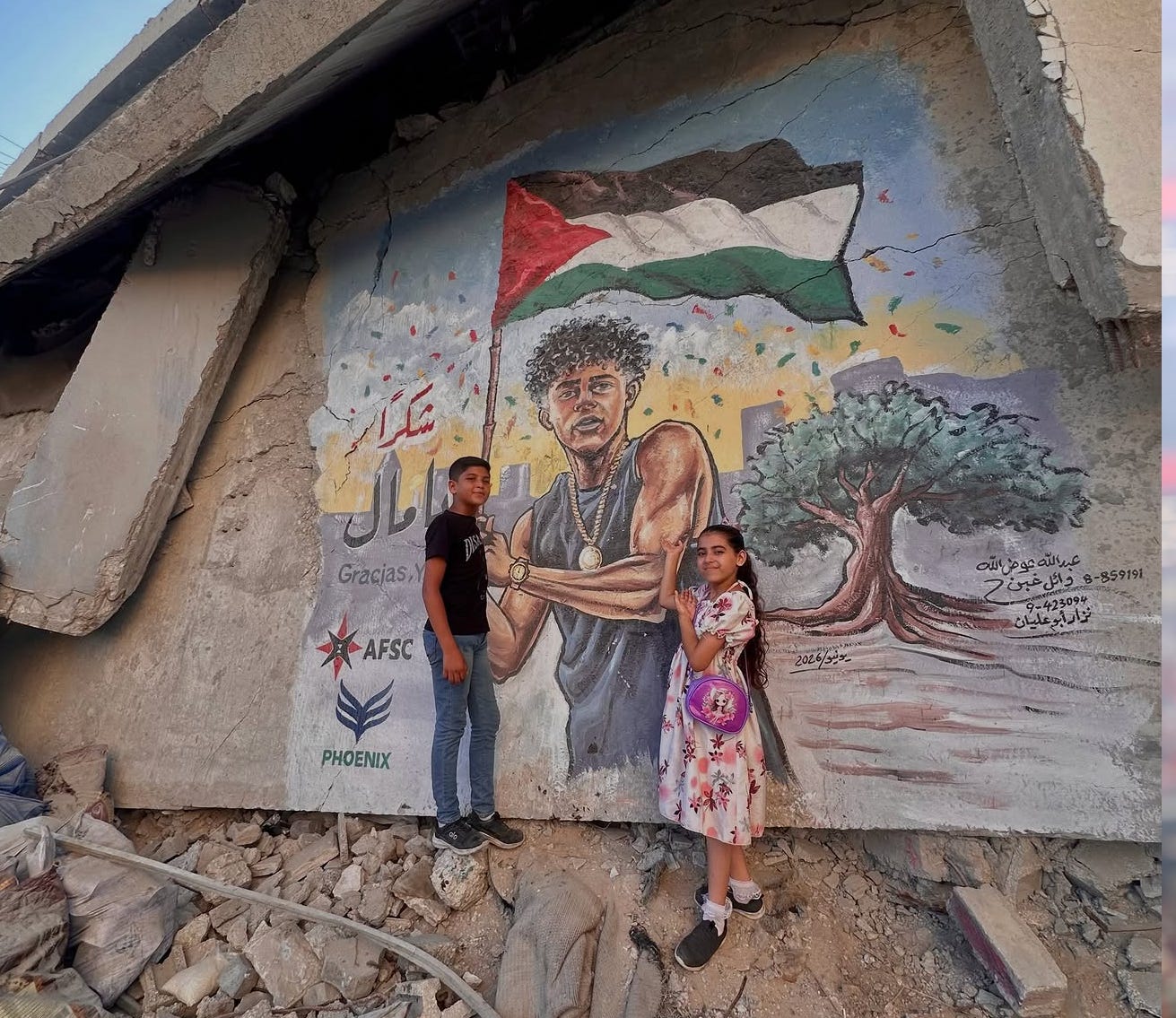
In May 2024, Spain became one of the first major European governments to formally recognize a Palestinian state. It permanently withdrew its ambassador to Israel this past March, over the war in Gaza. Prime Minister Pedro Sánchez has said so plainly, at party conferences and in public statements. It hasn’t just been the government. Lamine Yamal waved a Palestinian flag from the top of a bus during Barcelona’s La Liga title parade in May. Israel’s defense minister accused him of inciting hatred.
Sánchez defended him publicly. Javier Bardem took a Palestinian flag handed to him by a fan in the stands during Spain’s match against France and held it up on camera. Existence is resistance, he said. Spain stands with Palestine. None of that is incidental to who Spain is right now, as a team and a country. It’s the most visible thing about them to a lot of the world watching.
That’s why, by the time the final kicked off, people in Gaza City were already picking a side, and it had nothing to do with who had the better midfield. They said so directly, to reporters, over the sound of a war still going on around them. They were with Spain because Spain had stood with them. A government can’t buy that kind of allegiance with a phone call to an ambassador. A team earns it by making a choice in public, when it costs something to make it.
Strip it down and the real matchup was Milei, Messi, and Netanyahu against Sánchez, Yamal, and Palestine. On one side stood Milei and Netanyahu, publicly attaching themselves to Messi and Argentina through friendship calls, diplomatic loyalty, and a tournament in which Argentina repeatedly benefited from a generous whistle. On the other stood Sánchez, Yamal, and the Palestinian cause, which was represented not through private messages between leaders, but through a flag raised openly, despite the backlash.
Spain’s win doesn’t free a single person in Gaza. It doesn’t reverse a single policy in Buenos Aires. But it matters, this time, that the side Netanyahu spent the week publicly attaching himself to lost, and lost to the one country that spent this tournament being claimed, gratefully and specifically, by the people its opponent’s closest ally is bombing. Symbols don’t substitute for substance. This one, at least, was earned.
Comments
Nothing yet. Say the first thing.
Sign in to join the conversation.